Local SEO Checklist: What to Fix First, in Order
A good local SEO checklist comes down to five things, in this order: your Google Business Profile, consistent business details, one page per service, reviews, and tracking. Get those right and you've done most of the work. The rest is polish.
This checklist is built for local service businesses: trades, clinics, home services and professional firms that need the phone to ring. It also answers the questions people ask before they start. Which checklist can you trust? What does the 80/20 rule mean here? Can ChatGPT audit your site? Is SEO still worth the effort in 2026?
Key Takeaways
- Start with your Google Business Profile, because it drives the map results that bring local calls.
- Build one page for each service you want to be hired for, and one for each area you serve.
- Put your effort into the few tasks that move rankings and calls, and skip checklist items that only look busy.
- Use ChatGPT to review and draft, but check its findings against your own data.
- Read how the Google local pack works before you decide where to spend time.
Table of Contents
What Are Some Good SEO Checklists to Use?
The best local SEO checklist is short, ordered by impact, and tied to calls and booked jobs, not to a score. Generic audit tools list hundreds of items and weight them all the same. That buries the handful that matter for a business serving one area.
Google's own Business Profile help pages say local results are based mainly on relevance, distance and prominence. Use those three words to sort every item you add. Does it make you more relevant to the search? Does it confirm where you are? Does it show you're well known and trusted?
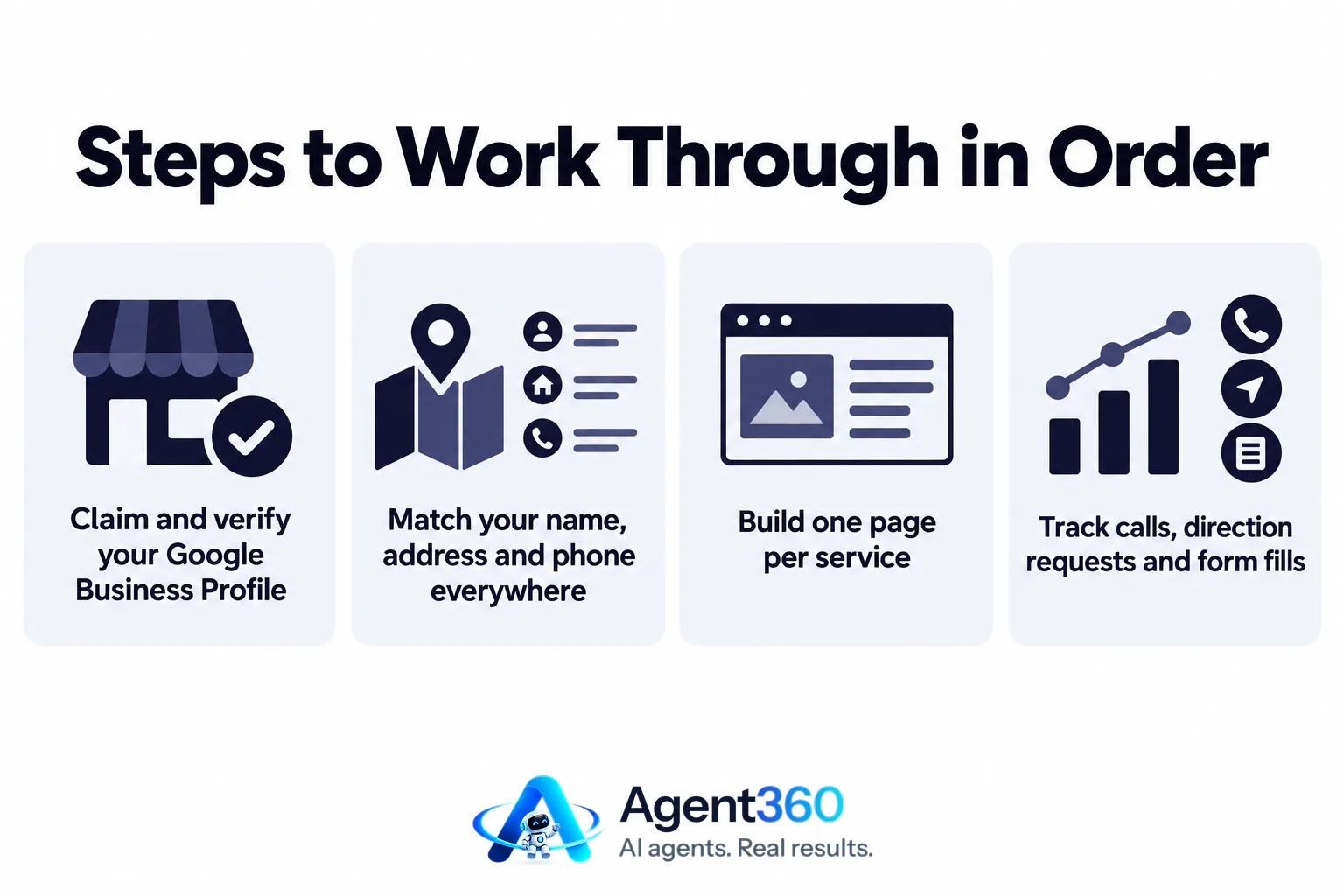
Work through these steps in order:
- Claim and verify your Google Business Profile. Without verification you can't control what shows up when people search for you.
- Choose the right primary category. Pick the one that describes your main job, then add secondary categories only for services you truly offer.
- Match your name, address and phone everywhere. Check your website, social profiles and directory listings. Fix any mismatch.
- Build one page per service. Each page should say what you do, who it is for, what it involves and how to book.
- Add area pages where you really work. Name the suburbs or towns you serve and write something useful for each, not a copied page with the place name swapped.
- Ask every happy customer for a review, and reply to all of them. Google's review policies don't allow reviews in exchange for incentives, so ask plainly and leave it there.
- Add real photos. Show your team, your vehicles, your work and your premises.
- Track calls, direction requests and form fills. Rankings mean little if you don't know which actions turn into jobs.
What should you do first if you only have an afternoon?
Verify and complete your Google Business Profile: categories, services, hours, phone number, website link and photos. Then check that the phone number on your website is tappable on mobile. Both fixes are free, and both sit close to the call.
How often should you revisit the checklist?
Review the profile and new reviews every month, and the service pages every quarter. Update hours the moment they change, holidays included. Results take time to move, so read how long SEO takes to show results before you judge any single change.
What Is the 80/20 Rule in SEO?
The 80/20 rule in SEO is the idea that a small share of your actions produces most of your results. It's the Pareto principle applied to search. The ratio is a rule of thumb, not a measured law for your business.
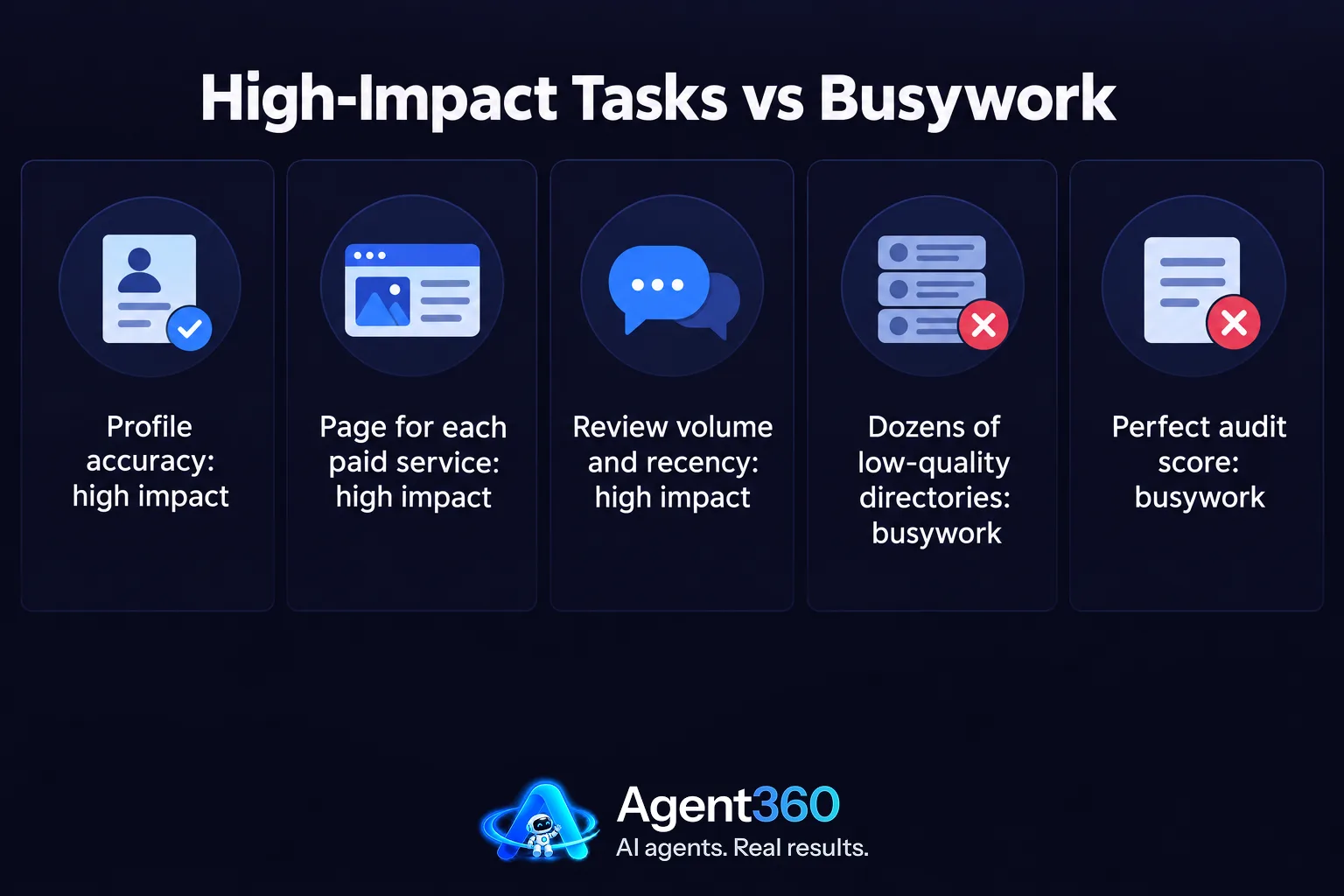
For a local business, the few actions that carry weight are usually your profile, your service pages and your reviews. A site with a complete profile, clear pages and steady reviews will often beat a site with perfect technical scores and nothing for a customer to act on.
Which local tasks are in the high-impact group?
Profile accuracy, a page for each paid service, review volume and recency, and a fast, readable mobile site. These match what Google says it weighs: relevance, distance and prominence.
Which tasks are busywork for most local firms?
Submitting to dozens of low-quality directories. Chasing a perfect audit score. Publishing blog posts that don't point to anything you sell. Do these only after the core is solid. If you want to find real content gaps, a keyword gap analysis shows what competitors rank for that you don't.
Can ChatGPT Do an SEO Audit?
ChatGPT can review what you paste into it and suggest fixes, but it can't run a full SEO audit on its own. It doesn't see your Search Console data, your map rankings or a live crawl of your site unless you connect tools that supply that data.

It's good at the reading and writing parts of the job. It's weak wherever the answer depends on data it hasn't been given. Treat its output as a list of things to check, not a verdict.
What can you hand to ChatGPT?
Paste in a service page and ask what a customer would still want to know. Ask it to flag vague headings, draft a page title and meta description, or suggest questions to add to an FAQ. You can also ask for a plain-language review of your Google Business Profile description.
What should you not rely on it for?
Rankings, traffic numbers, technical errors and competitor positions. Get those from Google Search Console, your Business Profile insights and your own call records. If it gives you a figure, ask where it came from, and verify before you act.
Is SEO Dead or Evolving in 2026?
SEO is evolving, not dead: people still search for local help, and the places they search now include AI answers. Google AI Overviews, ChatGPT and Claude all pull from pages and profiles they can understand and trust.
That makes the basics matter more. Clear service pages, consistent business details and real reviews give both a search engine and an AI tool something solid to quote. Nobody can promise you'll be named in an AI answer, but vague or thin pages make it less likely.
What changes on the checklist for AI search?
Write pages that answer questions plainly. State what you do, where you do it and who it's for in the first lines. Keep your business details identical across the web. Add an FAQ to each key service page. For the detail, see how to get in Google AI Overviews.
Does local SEO still bring calls?
It can, because local searches often come from people ready to book. But a call only turns into a job if someone answers. A tool that texts back missed calls helps, as covered in how missed call text back works.
Take the Next Step With Your Local SEO Checklist
Run through the list this week and write down what's missing. That list is your plan.
If you'd rather not do it yourself, we can. Agent360 offers SearchAgent, which works to rank you on Google and get you named in AI answers like ChatGPT, Claude and Google AI Overviews, and it writes and publishes articles for you. Our all-in-one growth plan, from $297/mo, adds your website, ads, funnels, CRM and automation, built and run by our team on one monthly plan. AI does the bulk of the work, and our people stay in the loop.
Not sure where your gaps are? Book a demo and we will walk through your local SEO checklist with you.
Frequently Asked Questions
What are some good SEO checklists to use?
Use a short checklist ordered by impact: Google Business Profile, consistent name, address and phone, one page per service, reviews, and call tracking. Long audit-tool reports can help later, but they give every item equal weight. Sort anything you add by Google's three local factors: relevance, distance and prominence.
Is SEO dead or evolving in 2026?
It's evolving. People still search for local services, and AI answers now sit alongside search results. Clear pages, accurate business details and genuine reviews help in both places, though no one can guarantee a mention in an AI answer.
What is the 80/20 rule in SEO?
It's the idea that a small group of actions drives most of your results. For local businesses that's usually the Business Profile, service pages and reviews. The 80/20 split is a rule of thumb, so judge it by your own calls and booked jobs.
Can ChatGPT do an SEO audit?
Only in part. It can critique page copy, suggest titles and spot missing information when you paste content in. It can't see your rankings, traffic or crawl errors without connected data, so check its findings against Google Search Console and your Business Profile insights.
How long does a local SEO checklist take to work?
Profile fixes can be done in an afternoon, but rankings move over weeks and months, not days. Track calls and direction requests monthly instead of checking positions daily.
Do I need a separate page for every suburb?
Only for areas you serve and can write something real about. Copied pages with the place name swapped add little for customers. Start with your main service pages, then add a suburb page when you've got genuine detail to put on it.
More articles
- Clay vs LeadSwift: Which Fits Your Outbound Job?
- Agent360 vs Belkins: a fair, side-by-side comparison
- Best done-for-you marketing package for local service businesses?
- How to Get Your Business Mentioned in Google AI Answers
- Who Should You Use for Done-For-You Auto Shop Marketing?
- What's a White Label GEO Agency and Who Offers It?
- The Best Marketing Strategy for an Auto Repair Shop
- What Contract Terms Are Typical for Outsourced SDR Agencies?
