How Long Does SEO Take to Show Results?
Three to six months for the first real movement. Six to twelve for a steady flow of visitors you can count on from Google and AI answer tools. That's the honest range for SEO, and where you land inside it depends on how competitive your market is, how much authority your site already carries, and whether new content keeps showing up on schedule. No setting compresses this into a few weeks, whatever a pitch deck tells you.
Founders and agency owners usually ask this question for one reason: they need to know whether to wait on SEO or run something else alongside it while rankings build. That second question matters more than the exact month count.
This piece covers what actually happens during an SEO timeline, whether SEO still works the same way now that AI search tools answer questions directly, and what to do with the months before rankings arrive.
Key Takeaways
- Expect three to six months before you see early ranking movement, and six to twelve months for it to compound into reliable traffic.
- A new site or a site with thin content history takes longer than one with existing pages and backlinks to build on.
- AI answer engines like ChatGPT, Claude and Google AI Overviews now pull from the same signals as organic search, so the work is not separate, it is one project; see what that work actually includes at Done For You SEO: What's Actually Included?
- A small set of pages and keywords usually drives most early results, so find those first instead of publishing broadly.
- Paid ads or outbound can fill the pipeline gap while SEO compounds in the background.
Table of Contents
If SEO Is Done Correctly, How Long Does It Take to Rank?
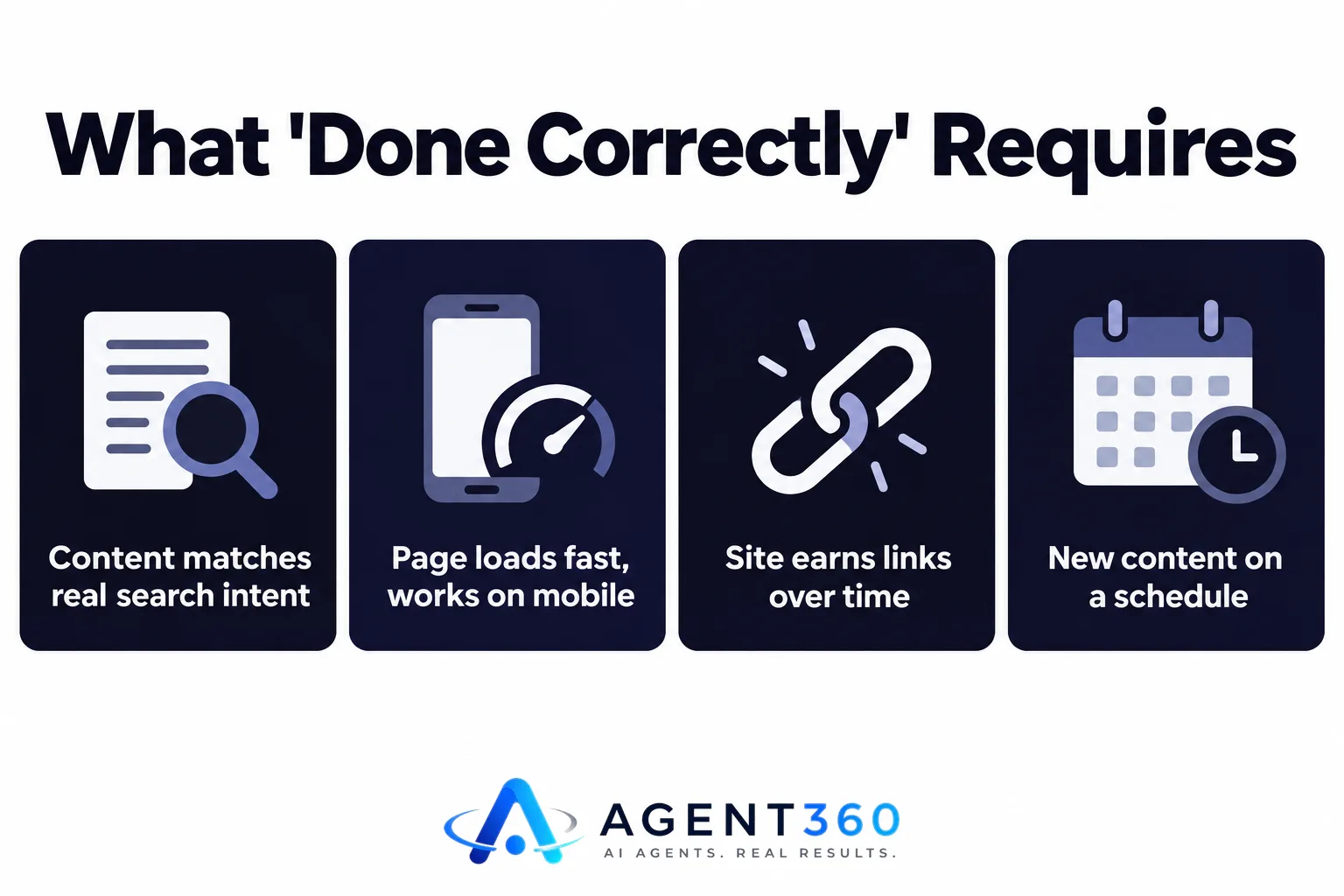
Correct execution still takes months, not weeks, because search engines need repeated signals of relevance and trust before they move a page up. “Done correctly” means the page answers a real search intent, the site is technically sound, and new content keeps arriving on a schedule. None of that changes how long indexing, crawling and ranking recalculation actually take. What it changes is whether the months you spend produce anything at all.
What Counts as “Done Correctly”?
It means the content matches what someone actually searches for, the page loads fast and works on mobile, and the site earns links or mentions from other credible pages over time. Skip any of these and the timeline doesn't shrink. The months just pass without the ranking movement you were expecting.
Is SEO Dead or Evolving in 2026?
SEO is not dead, but the destination has split in two: the Google results page and the answer an AI tool gives directly. Search engines still crawl, index and rank pages the way they always have. What's new is that large language models now summarize the web into direct answers, and getting named inside those answers runs on many of the same signals, clear structure, factual accuracy, topical depth, as ranking well organically.
Does AI Search Change the Timeline?
It adds a second outcome to track, not a second timeline. A page built for clarity and accuracy can earn a Google ranking and a citation in an AI answer around the same stretch of months. The checklist for showing up in AI Overviews overlaps heavily with standard SEO groundwork, covered in How to Get in Google AI Overviews: A Practical Checklist.
What Is the 80/20 Rule for SEO?
The 80/20 rule for SEO means a small share of your pages and keywords will account for most of your early traffic and leads, so find and prioritize those first. Publishing broadly and hoping something ranks is the slow way. The faster path is finding the handful of search terms your buyers actually type, and the pages already closest to ranking for them, then putting the effort there.
Which 20% Usually Moves the Needle First?
Pages already sitting on page two or three of Google tend to move faster than brand-new pages, because the signal groundwork already exists. Comparing your existing content against what competitors already rank for is one way to find that short list; see Keyword Gap Analysis: Find What Competitors Rank For for how that comparison works.
What Can You Do to Speed Up an SEO Timeline?
You cannot force Google to rank a page sooner, but you can clear out the delays that are actually within your control. Most “slow SEO” complaints trace back to a handful of fixable issues, not the search engine itself.
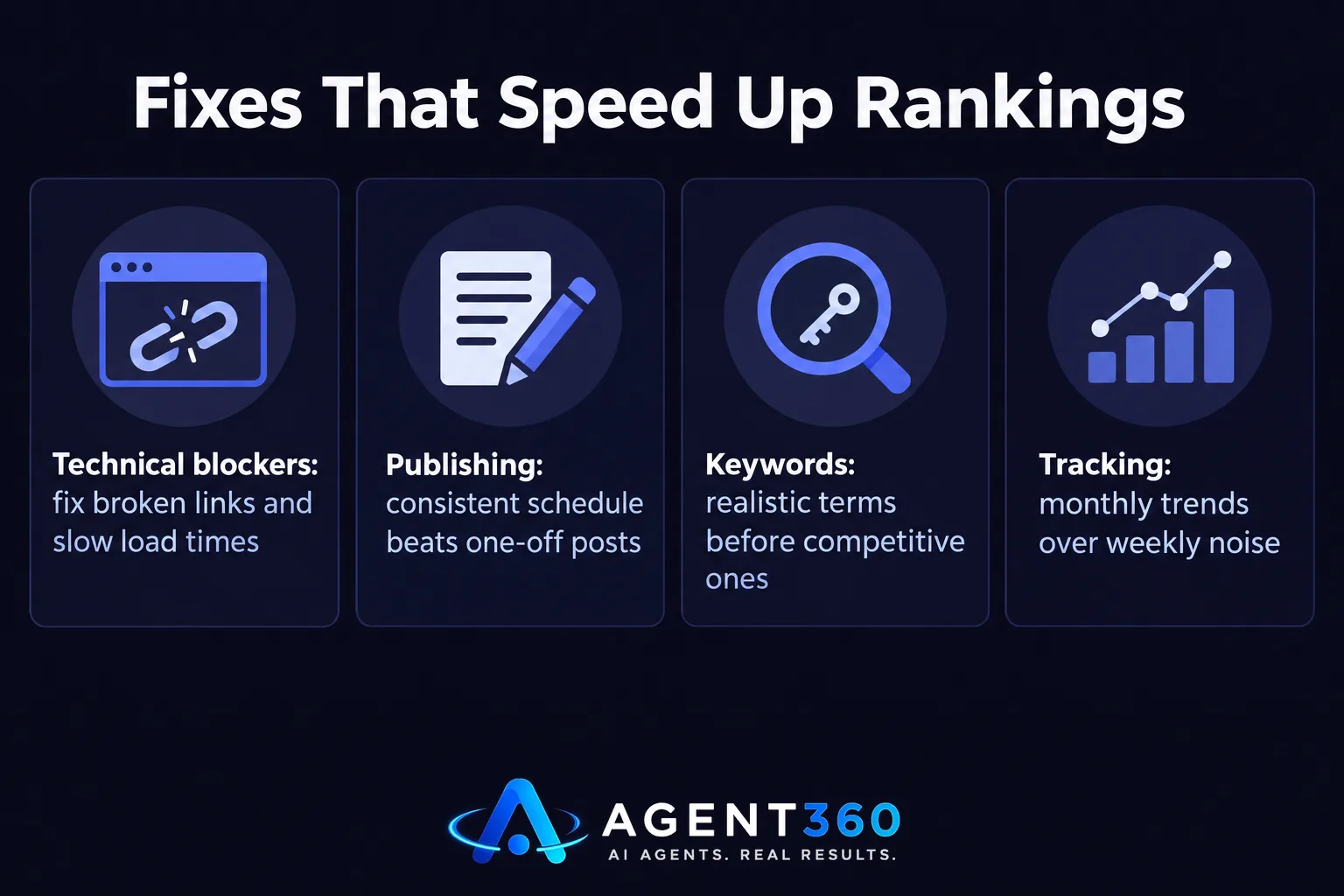
- Fix technical blockers first. Broken links, slow load times and missing mobile formatting hold pages back regardless of how good the content is.
- Publish on a consistent schedule. Search engines reward sites that show ongoing activity over sites that publish once and go quiet.
- Target realistic keywords first. Chasing highly competitive terms before the site has authority wastes the early months; narrower terms rank faster and build the base.
- Track rankings and traffic monthly, not weekly. Week-to-week swings are normal noise; the trend over two or three months is the real signal.
Can Ads Fill the Gap While SEO Ramps Up?
Yes. Paid campaigns can generate calls and leads right away while organic rankings build underneath them, which is why most growth plans run both at once instead of waiting on one before starting the other.
Take the Next Step With Your SEO Timeline
Waiting on SEO alone leaves months of empty pipeline on the table. Agent360's SearchAgent builds and publishes the articles your SEO plan needs, works to rank you on Google, and works to get you named in AI answers from tools like ChatGPT, Claude and Google AI Overviews, all on one plan alongside your website, ads and follow-up, run by one team instead of five vendors.

If you want SEO running alongside ads and outbound so the pipeline doesn't sit empty for six months, see the full plan at pricing.
Frequently Asked Questions
Is SEO difficult to learn?
The fundamentals, keyword research, on-page structure, basic technical checks, are learnable in weeks. What takes longer is the judgment about which pages and terms are worth the effort, and that usually comes from doing it repeatedly or handing it to a team that already has.
Is SEO a stressful job?
It can be, mainly because results lag the work by months and algorithm changes can shift rankings without warning. That lag is exactly why many business owners outsource the day-to-day execution rather than managing it themselves on top of running the business.
How long before SEO traffic shows up in Google Analytics?
Early movement in impressions and clicks inside Google Search Console often appears within the first two to three months. A visible lift in Google Analytics traffic usually takes longer, closer to the four-to-six-month mark, as rankings climb into positions people actually click.
Does switching providers reset the SEO timeline?
It can slow things down if the new provider changes the site's URL structure, content strategy or technical setup significantly, since search engines re-evaluate those signals. Switching without major structural changes usually preserves most of the progress already made.
Can paid ads work while SEO ramps up?
Yes. Ads produce calls and leads on their own timeline, independent of organic rankings, which is why running both together is common rather than treating them as sequential steps.
More articles
- Do Outsourced SDR Firms Require Long-Term Contracts?
- Done For You SEO: What's Actually Included?
- How to Get in Google AI Overviews: A Practical Checklist
- Outsourced SDR vs Hiring an SDR in Australia: True Costs
- AI Phone Screening: What It Actually Does for Hiring Teams
- Done-For-You Marketing: What It Actually Means
- Keyword Gap Analysis: Find What Competitors Rank For
- SDR Outsourcing: What to Check Before You Sign a Contract
