How to Get in Google AI Overviews: A Practical Checklist
Google pulls your page into an AI Overview when it already ranks well and gives a clear, quotable answer to one specific question. No submission form, no paid placement, no secret setting to flip. Google's AI systems lift from pages that already rank, then favor the ones structured so an answer can be pulled out cleanly, without rewriting.
So the work underneath is the SEO you should already be doing — just done with more discipline. The format changes: AI Overviews want the answer near the top of the page, not a story leading up to it.
That matters for local service businesses and small B2B companies because an AI Overview sits above every organic result, including yours. Let a competitor's page get quoted there, and you lose visibility you'd otherwise have earned fair and square by ranking.
Key Takeaways
- Answer one question per page in the first two sentences, then back it up with specifics.
- AI Overviews pull mostly from pages that already rank on page one, so basic SEO still comes first.
- Use plain headings written as questions, since Google's systems match questions to answers.
- Structured data and clean HTML make it easier for Google to lift an answer cleanly; see how an all-in-one growth plan handles this alongside the rest of your site.
- Keep publishing on a schedule, since AI Overviews refresh and reward pages that stay current.
Table of Contents
What Counts as Getting Into Google's AI Overviews?
Getting into an AI Overview means your page — or one sentence from it — gets quoted or linked inside that summary box sitting above the normal results. Google isn't picking these sources at random. It draws from pages already ranking well for the query, then looks for a passage shaped closely enough to a direct answer that it can lift it out with barely any rewriting.
Does ranking well in regular search guarantee an AI Overview spot?
No. Ranking on page one is close to a requirement, but it's not enough by itself. Among the pages that already rank, Google favors whichever one gives the cleanest, most self-contained answer to the exact question asked — which is why two competitors can rank almost identically and only one gets quoted.
How to Get AI Information on Google?
You get AI information on Google by publishing content that answers a real question in the first sentence, then backs it up with specific, checkable detail. AI Overviews are built from the same crawled, indexed content as normal search results. So the page still has to exist, get indexed, and earn enough trust before Google will ever consider pulling it into a summary.
What signals make a page easier to pull into a summary?
Short, declarative sentences near the top, question-style headings that match how people actually search, and clear structure — lists, numbered steps, defined terms — all make extraction easier. A page that buries its point under three paragraphs of throat-clearing rarely gets quoted, even when the information further down is accurate.
How Do I Get a Google AI Overview on Me?
You get your business named in an AI Overview the same way you'd earn a featured snippet: by owning a specific question your buyers actually type into Google. Chasing a broad term is a fight you'll mostly lose. Winning a narrow one tied to your service and location, or your niche, is realistic.
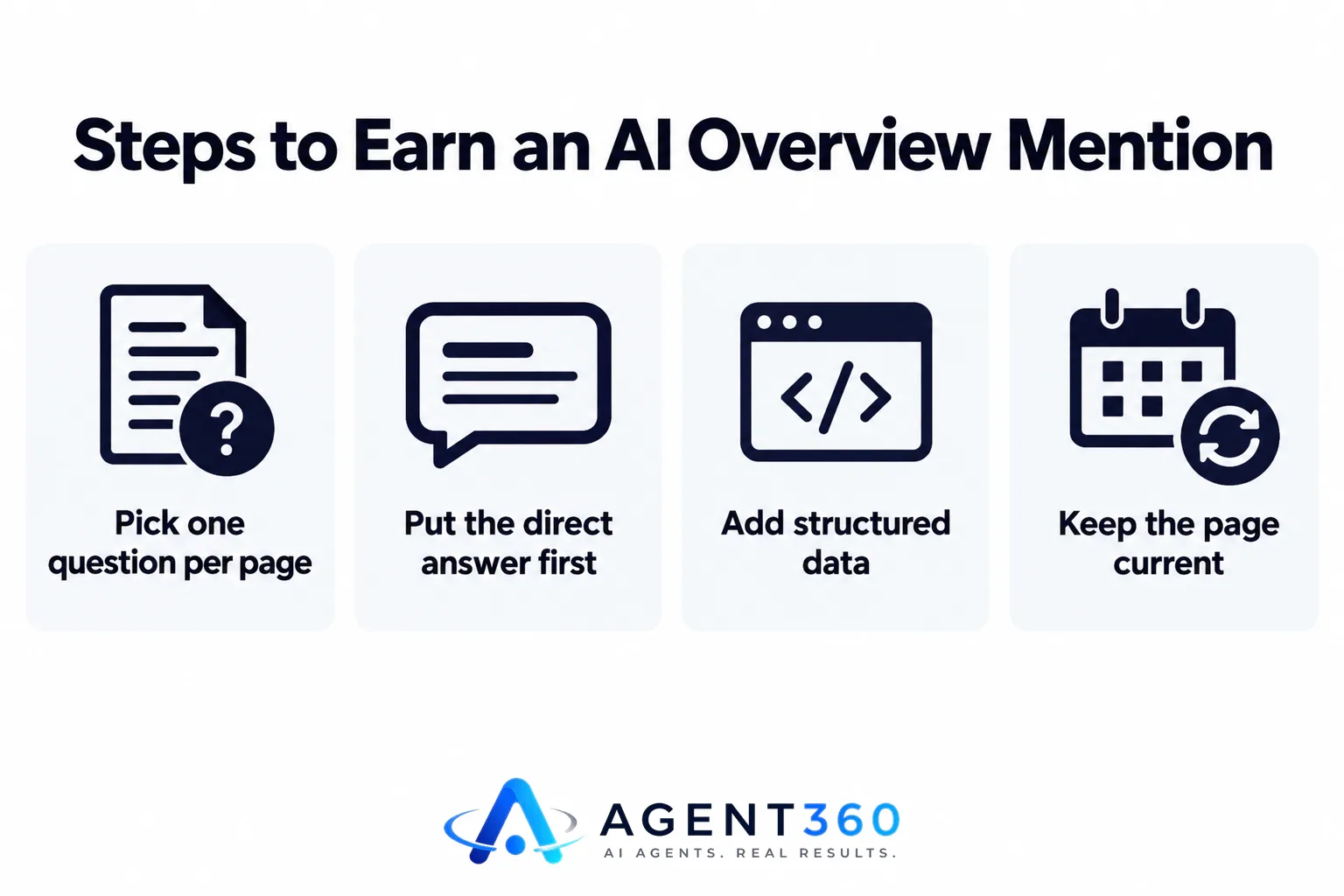
- Pick one question per page. A page trying to answer five related questions dilutes the clean, single-answer format AI Overviews favor.
- Put the direct answer first. Lead with the answer in the opening sentence, then explain the reasoning and exceptions below it.
- Add structured data. FAQ and HowTo schema help search systems identify which text block is the answer versus supporting narrative.
- Keep the page current. Revisit pages that touch pricing, rules, or steps that change, since stale answers get replaced by fresher competitors.
- Check what already ranks for that question. A quick look at which competitors rank for which terms shows you where a cleaner answer could outrank them.
What Should You Publish First to Show Up in AI Overviews?
Start with the questions your prospects already ask you on sales calls, not the broad keywords your competitors are chasing. Those questions have a real, specific audience behind them, and they're usually easier to own, since fewer competitors have bothered to write a clean, direct answer.
How often do you need to publish to stay visible?
Google doesn't publish a fixed cadence for this, and there isn't one to chase. What matters more than frequency is whether your existing pages stay accurate. A page giving the wrong pricing or process answer after something changes will lose its spot faster than an old page ever would from simple inactivity.
Take the Next Step Toward Showing Up in AI Search Results
Writing one strong answer page is manageable on your own. Doing it for every question your buyers ask, month after month, while also running your site, ads, and follow-up — that's where most small teams fall behind.

Agent360's SearchAgent writes and publishes the articles built to rank on Google and get named in AI answers across ChatGPT, Claude, and Google AI Overviews — as part of the same plan that also covers your website, ads, funnels, and CRM. See what's covered on a related topic in this guide to appearing in AI Overviews before deciding how much of it you want handled for you.
If you'd rather skip doing this page by page yourself, book a demo and find out how it fits your plan.
Frequently Asked Questions
Can I turn off AI on Google?
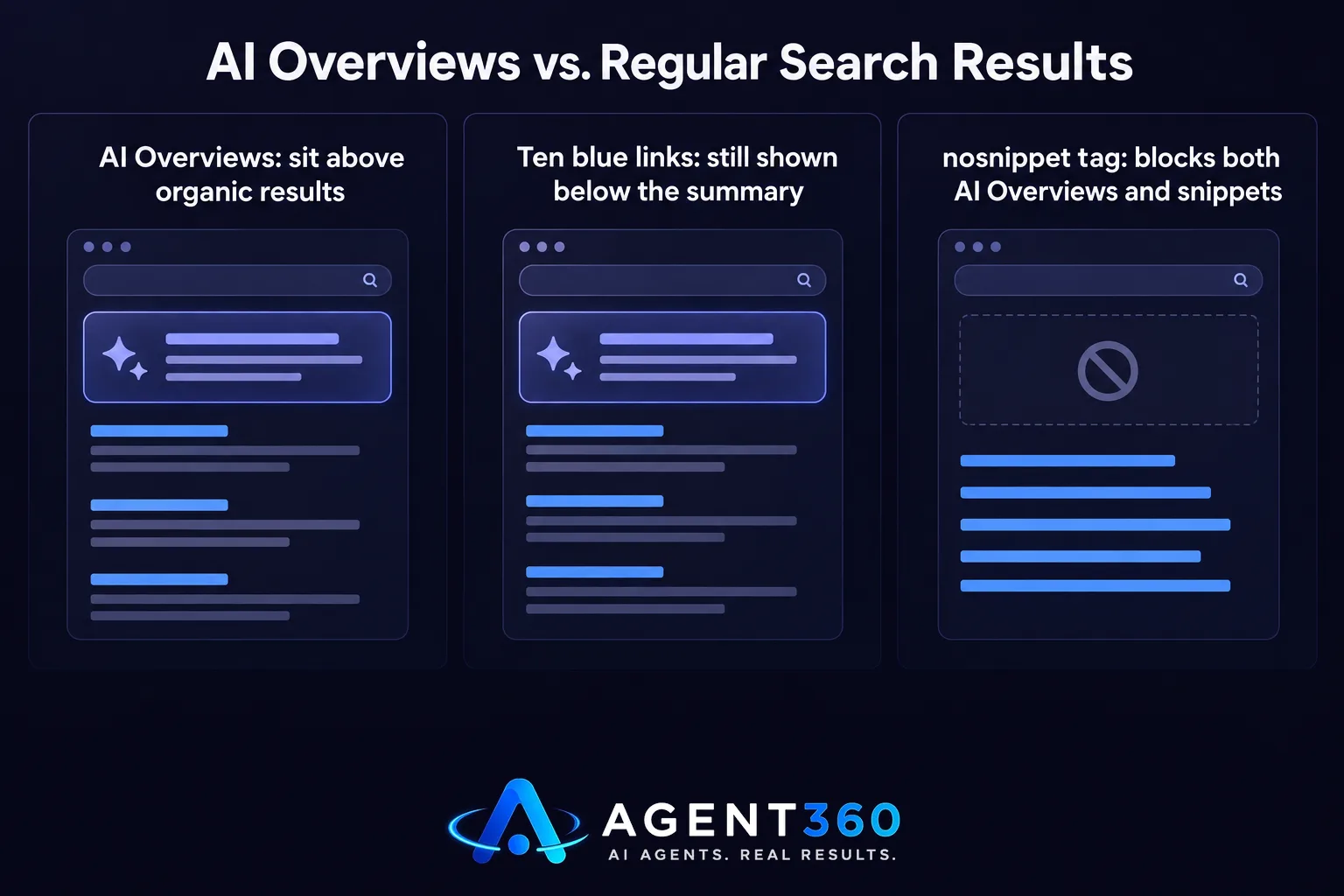
There's no public setting that lets a business opt its own pages out of AI Overviews specifically. The closest thing is the nosnippet tag, which Google's own Search Central documentation says blocks any snippet, including the kind used in AI Overviews — but it also knocks you out of regular featured snippets.
Do AI Overviews replace the ten blue links?
No. AI Overviews sit above the normal organic results, not in place of them. The regular list of ranked pages still shows up right below the summary.
How long does it take to show up in an AI Overview?
There's no published timeline. It depends on how fast a page gets crawled, indexed, and judged trustworthy enough to rank for the underlying query in the first place. A brand-new page usually has to earn a normal search ranking before it stands any chance of being pulled into a summary.
Does structured data help you get into AI Overviews?
It helps Google spot which part of a page is the direct answer, which makes extraction easier — but schema alone won't get a weak or thin answer picked. The content underneath still has to actually answer the question.
Can a small local business show up in AI Overviews, or only big brands?
Small and local businesses can appear in AI Overviews for narrow, specific questions tied to their service area or niche, where fewer large competitors have bothered to publish a direct answer. Broad national terms stay hard for a small site to win, AI Overviews or not.
More articles
- Outsourced SDR vs Hiring an SDR in Australia: True Costs
- AI Phone Screening: What It Actually Does for Hiring Teams
- Done-For-You Marketing: What It Actually Means
- Keyword Gap Analysis: Find What Competitors Rank For
- SDR Outsourcing: What to Check Before You Sign a Contract
- Real Estate Agent Marketing: What Actually Books Showings
- AI Sourcing: What It Actually Does for Recruiters
- Marketing for Mechanics: What Actually Books Jobs
