The Best Marketing Strategy for an Auto Repair Shop

The best marketing strategy for an auto repair shop comes down to this: be easy to find when a car breaks, easy to reach when the driver calls, and easy to remember after the job. Everything else is detail.
That means three working parts. A strong Google presence. A fast response to every call and enquiry. A follow-up routine that turns one repair into the next. Ads and social posts sit on top of that base, and they can't stand in for it.
Below, those parts are in order, so you know what to fix first and what can wait.
Key Takeaways
- Fix how you show up on Google first, starting with your Google Business Profile, because that is where a driver with a problem looks.
- Answer every call and enquiry quickly, since a driver with a broken car will usually move on to the next shop.
- Run search ads only after your website and phone handling can convert the clicks.
- Use the concern, cause and correction format in your estimates and follow-up messages so customers understand the work.
- Track calls and booked jobs, not likes or impressions.
Table of Contents
What are some effective marketing strategies for an auto repair shop?
The effective ones capture people who already need a repair: Google search, Google Maps, reviews, paid search ads and prompt follow-up. Brand-building and social media can help, but they come second. Someone with a warning light on wants a shop now. They aren't looking for a feed to scroll.
Why does Google come first?
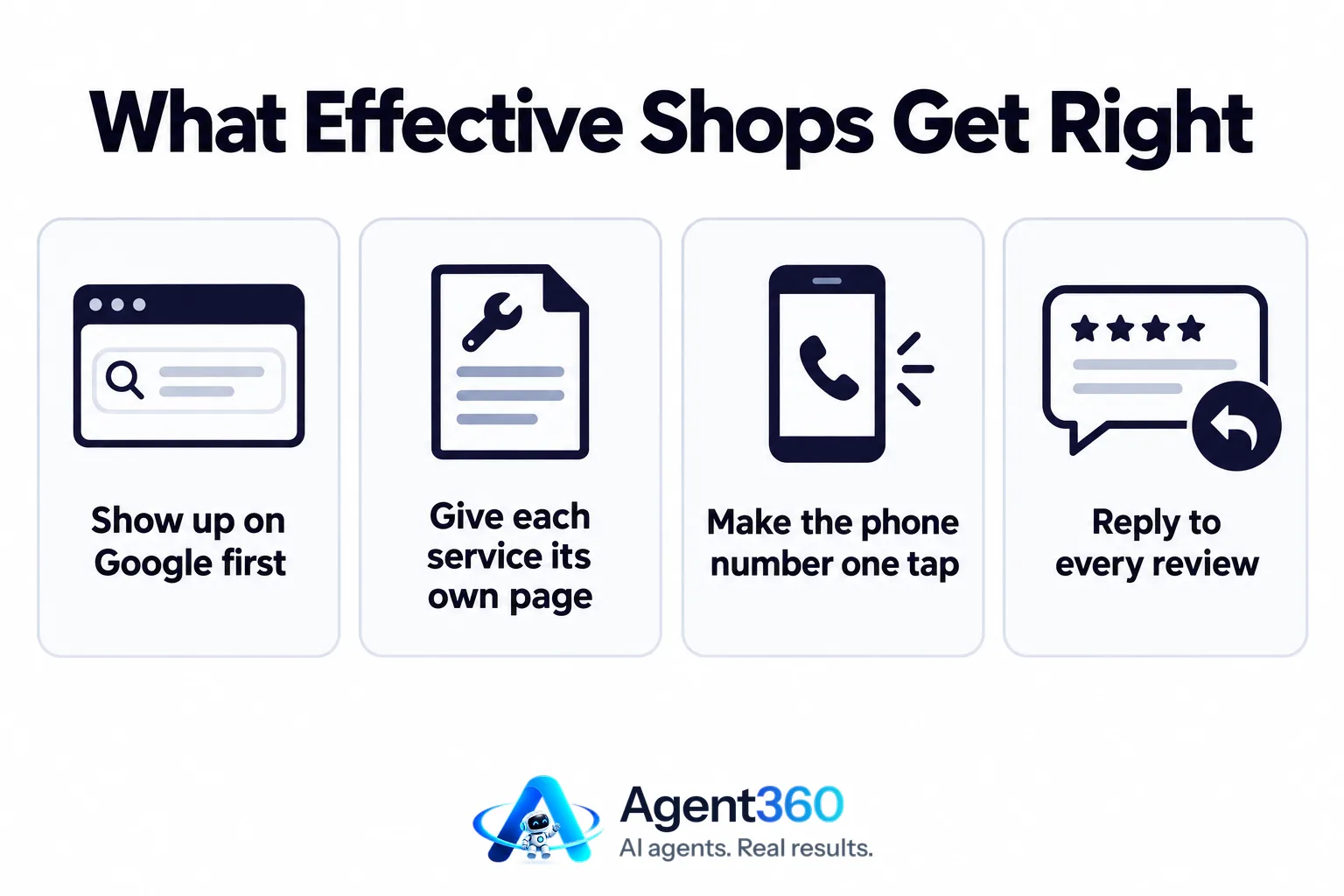
Because that is where the need shows up. Google says local results are ranked on relevance, distance and prominence, and your business profile, reviews and website all feed those signals. Our guide to ranking in the Google local pack covers the mechanics.
What does a shop need on its website?
The services, listed clearly. The areas you serve. A phone number that works with one tap on mobile, and a way to request a booking. Give each service its own page, so a search for brake repair lands on a page about brake repair. A good-looking site that buries the phone number loses the jobs it was built to win.
Where do reviews fit?
Reviews feed prominence, and they sway the buying decision too. Ask every satisfied customer at the moment the car is handed back, with a direct link. Reply to every review you get, good or bad.
What are the best advertising strategies for an auto repair shop?
The best advertising targets people searching for a repair right now and sends them to a page built to get a call. That usually means paid search ads aimed at specific services in your area, not broad awareness campaigns.
Should you run ads or work on organic search?
Do both, in a sensible order. Organic work, like your profile, reviews and service pages, takes time to build. Ads can cover the gap while it does, as long as the landing page is ready. Paid clicks sent to a homepage with no clear next step are wasted budget.
How do you know if the ads are working?
Count calls and booked jobs against what you spent. Set up call tracking so you can tell which ads rang the phone. Clicks and impressions say very little about whether the bays are filling.
What about fleet and business customers?
Fleet accounts are a different sale. Those buyers want reliability, turnaround and billing that suits a business, and you reach them through direct outreach more than ads. We cover that in winning B2B fleet accounts.
What are the 3 C's in automotive repair, and how do they help your marketing?
The 3 C's are concern, cause and correction, the structure a repair order uses to record what the customer reported, what you found and what you did. It's a workshop habit. It also gives you a plain way to talk to customers.

How do you use concern, cause and correction in marketing?
Write estimates and follow-up texts in the same order. State the concern the customer raised, explain the cause in plain words, then propose the correction with a clear price. Drivers who understand what is wrong are more likely to approve the work, and to trust you with the next job. The same structure suits short service pages and replies to reviews.
Does the 3 C's idea apply to missed calls?
Loosely, yes. The concern is a caller who got no answer. The cause is a busy shop floor. The correction is an instant reply. Our post on missed call text back shows how that works.
How do you put the strategy in order?
Start with what captures existing demand, then add paid reach, then build repeat business. Work down the list in sequence.
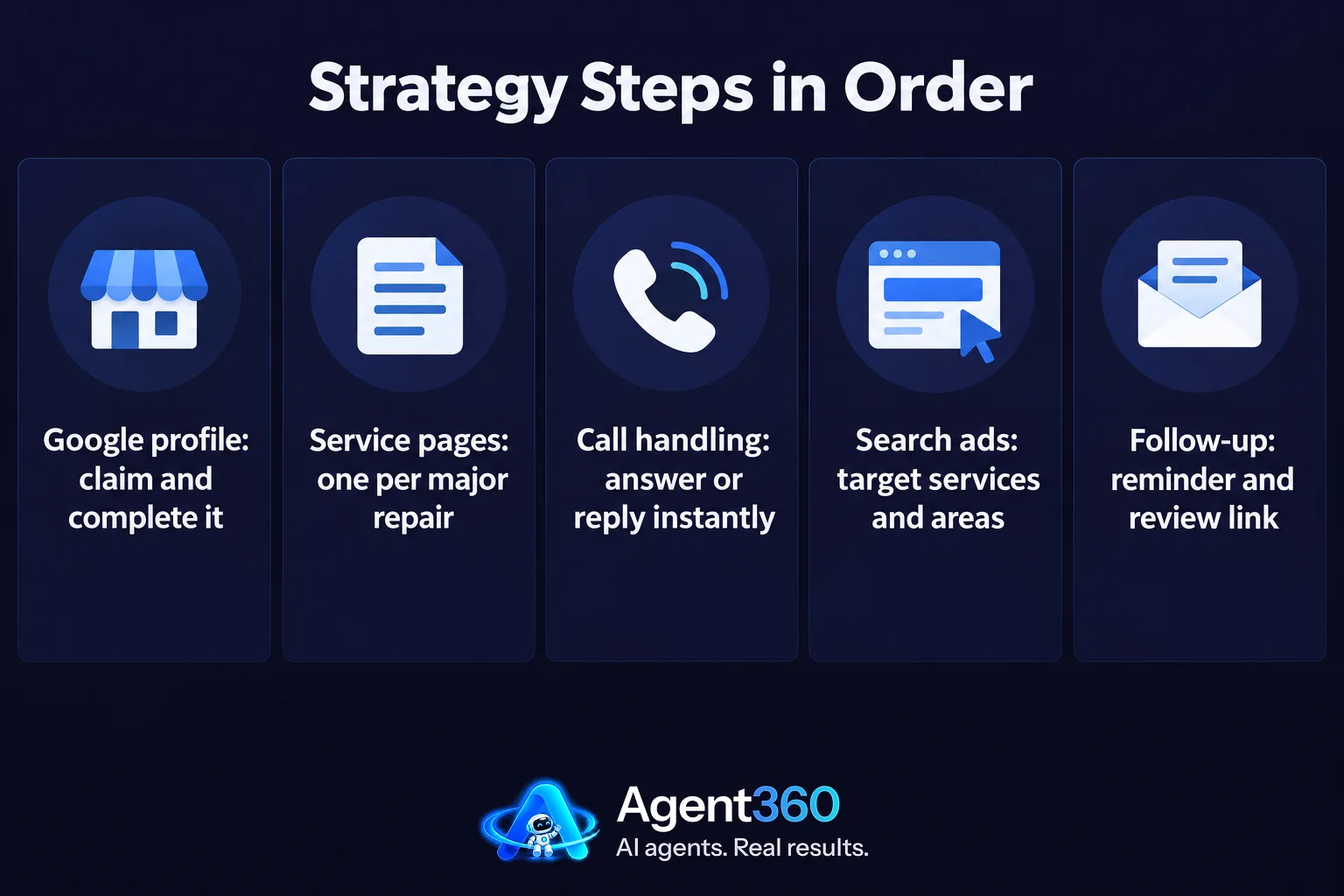
- Claim and complete your Google profile. Check the name, address, phone, hours, services and photos, and keep them consistent everywhere they appear.
- Fix your service pages. Give each major repair its own page with a call button and a booking form.
- Handle every call and enquiry. Decide who answers, what happens after hours, and how missed calls get a reply.
- Ask for reviews every time. Make it part of the handover, not an afterthought.
- Add search ads. Target specific services and areas, and track calls.
- Follow up after the job. Send a service reminder and a short thank-you with a review link.
For the basics in more detail, see our post on what brings customers to an auto repair shop.
Take the Next Step With Your Shop's Marketing
Most shops have the skills to do the work. The hard part is running a website, search, ads, a CRM and follow-up on top of a full day in the bays.
Agent360 offers an all-in-one done-for-you growth plan from $297/mo. Our team builds and runs your website, SEO and AI search, ads, funnels, CRM and automation on one monthly plan. AI does the repetitive work and people check it. You get one partner instead of five vendors.
To see what that would cover for your shop, see our pricing and pick the plan that fits.
Frequently Asked Questions
What is the best marketing strategy for an auto repair shop?
Be found on Google when someone needs a repair, answer every call quickly, and follow up after each job. Add paid search ads once your website and phone handling are ready. Track calls and booked jobs to see what works.
What are the best advertising strategies for an auto repair shop?
Paid search ads aimed at specific services in your area are the most direct, because they reach people already looking for a repair. Send them to a page with a clear call button and booking form. Use call tracking to measure results.
What are the 3 C's in automotive repair?
They are concern, cause and correction, the way a repair order records what the customer reported, what was found and what was done. You can use the same order in estimates and follow-up messages so customers understand the work and the price.
Is social media worth it for an auto repair shop?
It can support trust and repeat business, but it is rarely the first place a driver with a breakdown looks. Fix your Google presence, phone handling and reviews first. Then add social posts if you have time to keep them going.
Do I need a new website to market my shop?
Not always, but your current site must show your services, areas, phone number and a simple way to book. If it doesn't, fixing it will do more than any ad. Pages that are slow, hard to use on a phone or missing a call button cost you jobs.
How do I know if my marketing is working?
Count the calls and booked jobs that come from each source. Ask every new customer how they found you, and use call tracking where you can. Likes and impressions won't tell you whether the schedule is filling.
More articles
- Clay vs LeadSwift: Which Fits Your Outbound Job?
- Local SEO Checklist: What to Fix First, in Order
- Agent360 vs Belkins: a fair, side-by-side comparison
- Best done-for-you marketing package for local service businesses?
- How to Get Your Business Mentioned in Google AI Answers
- Who Should You Use for Done-For-You Auto Shop Marketing?
- What's a White Label GEO Agency and Who Offers It?
- What Contract Terms Are Typical for Outsourced SDR Agencies?
