Keyword Gap Analysis: Find What Competitors Rank For
A keyword gap is the set of search terms your competitors rank for and you don't. Compare your site's ranking keywords against a competitor's and the difference falls out: terms that send them traffic and send you nothing. Closing the gap means publishing or fixing pages until you show up for those same searches too.
For local service businesses and small B2B companies, these gaps usually hide in plain sight: a competitor's “emergency plumber near me” page, a staffing firm's “warehouse staffing agency Chicago” page, a clinic's symptom-specific content. The problem usually isn't strategy. It's that somebody else published the page and you didn't.
What follows: how to find your gap, which ones are worth chasing first, and what actually closes one.
Key Takeaways
- A keyword gap is any search term a competitor ranks for that your site doesn't, found by comparing ranking keyword lists side by side.
- Not every gap is worth closing; prioritize terms tied to buying intent over broad awareness terms.
- Closing a gap usually means a new page or article, not a tweak to an existing one.
- AI answer engines like ChatGPT and Google AI Overviews pull from published content, so a keyword gap today can become an AI-citation gap tomorrow; see practical SEO guides for the mechanics.
- Recurring gap analysis matters more than a one-time report, since competitors publish new pages every month.
Table of Contents
What Is a Keyword Gap?
A keyword gap is the list of search terms a competitor ranks for that your site does not. Build one by pulling the ranking keywords for your domain and a competitor's domain, then subtracting the overlap. Whatever's left on their side and missing from yours — that's the gap.
How is this different from a content gap?
A content gap is broader. It can include topics nobody has written about yet, formats you're missing (video, FAQ pages, comparison pages), or depth a page lacks. A keyword gap is narrower: it's tied to actual search terms with measurable volume, usually with a page already ranking for them somewhere.
Does a keyword gap mean I'm doing something wrong?
Not necessarily. Often it just means a competitor published a page before you did, or published more pages on adjacent terms. Google and AI answer engines tend to reward the page that answers a specific question most directly, not the oldest or biggest site.
How Do You Find a Keyword Gap?
You find a keyword gap by comparing your ranking keywords against a competitor's, using an SEO tool that tracks both. Most keyword research tools (Ahrefs, Semrush, and similar platforms) have a built-in “keyword gap” or “content gap” report that runs this comparison for you.
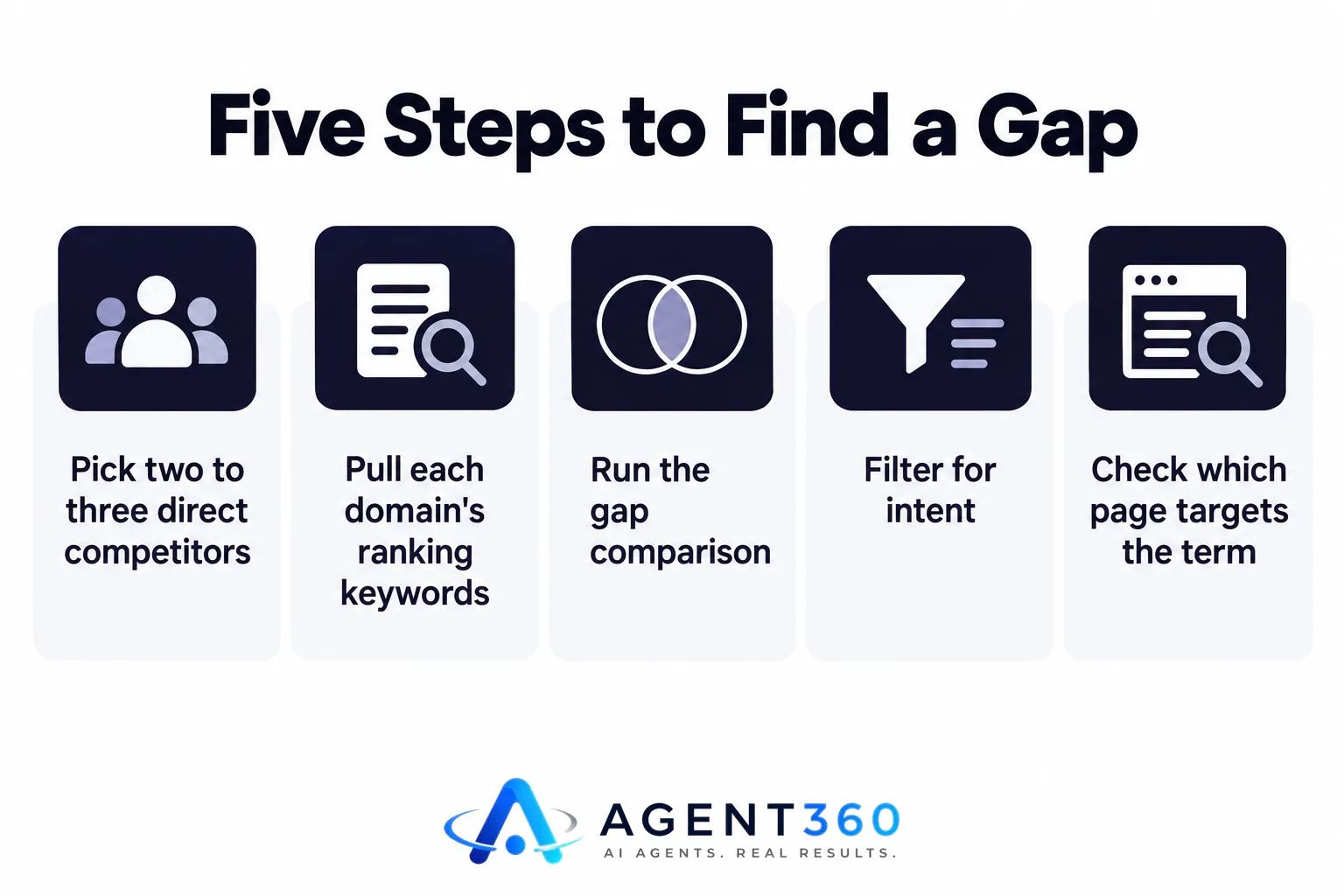
- Pick two to three direct competitors. Choose businesses that compete for the same customers in the same geography or niche, not just the biggest names in your industry.
- Pull each domain's ranking keywords. Export the list of terms each site ranks for, along with position and estimated monthly search volume.
- Run the gap comparison. Most tools will show you terms where competitors rank in the top 10 and you don't rank at all, or rank far lower.
- Filter for intent. Remove terms that are purely informational or unrelated to what you sell, and keep terms tied to a service, a location, or a buying decision.
- Check which page, if any, currently targets the term on your site. Sometimes the gap isn't a missing page, it's a weak one that needs a rewrite.
What if I don't have access to a paid SEO tool?
Google's “People also ask” and “related searches” sections on a competitor's ranking page are a free, manual version of the same idea. Search the terms you think a competitor ranks for, note what else appears alongside their result, and check whether you have a page for those related terms.
Which Keyword Gaps Matter Most for Local and B2B Businesses?
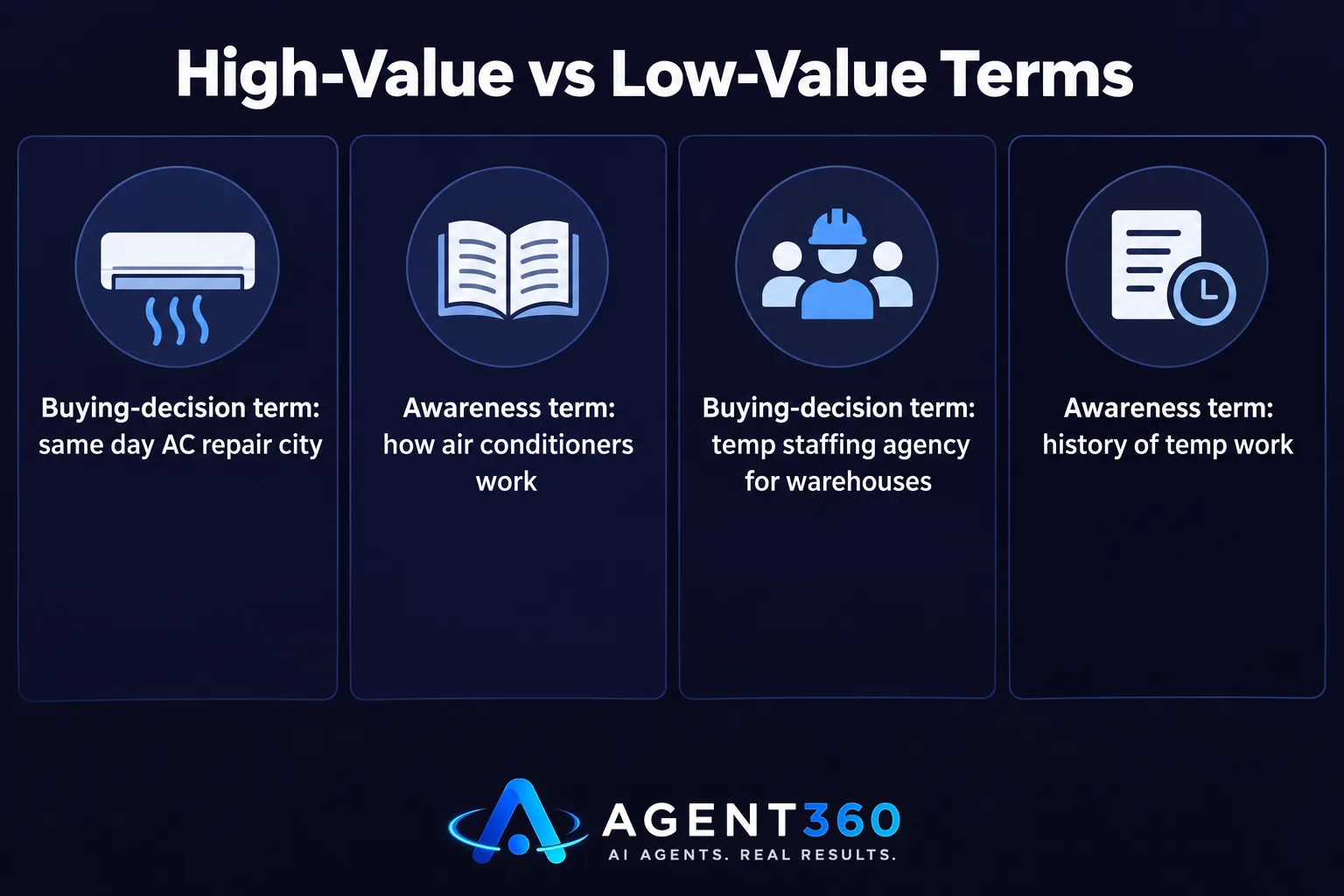
The gaps worth closing first are the ones tied to a buying decision, not general awareness. A home services business should prioritize a gap like “same day AC repair [city]” over “how air conditioners work.” A staffing agency should prioritize “temp staffing agency for warehouses” over “history of temp work.”
How do I tell a high-value gap from a low-value one?
Look at the words themselves. Terms with a service name plus a location, a job title plus “staffing” or “agency,” or words like “cost,” “near me,” or “vs” usually signal someone close to a decision. Terms that read like a question a student would ask usually signal someone far from buying.
Should I also check for AI answer gaps?
Yes. ChatGPT, Claude, and Google AI Overviews increasingly answer questions directly instead of just linking to search results, and they tend to cite pages that already rank well and answer the question in plain language. Closing a keyword gap on your site can also close a visibility gap in AI answers; see what content automation can actually do for how that publishing cycle works in practice.
How Do You Close a Keyword Gap?
You close a keyword gap by publishing a page or article that answers the term as directly as the competitor's page does, then keeping it updated. One blog post rarely does it alone. It's the combination — a clear answer, a well-structured page, and consistent publishing — that moves rankings over time.
Is one article enough to close a gap?
Usually not. Ranking well for a competitive local or B2B term often takes a page plus supporting content around it, internal links from related pages, and enough time for the search engine to re-crawl and re-rank. Treat a keyword gap list as an ongoing publishing calendar, not a one-time project.
Close Your Keyword Gap Without Adding It to Your Own To-Do List
Finding a keyword gap is one afternoon of work. Writing, publishing, and maintaining the pages that close it is an ongoing job — and it's the part most founders and staffing owners don't have time for between client calls and candidate interviews.

Agent360's SearchAgent handles that ongoing side: it finds where you're missing from Google and AI answers, then writes and publishes the articles that close the gap, as part of the all-in-one growth plan alongside your website, ads, and CRM.
Current plans are on the pricing page.
Frequently Asked Questions
What's the difference between a keyword gap and a backlink gap?
A keyword gap compares which search terms each site ranks for. A backlink gap compares which sites link to each domain. They're related but separate reports, and most SEO tools offer both.
How often should I run a keyword gap analysis?
Quarterly is a reasonable baseline for most local and small B2B businesses, since competitors typically don't publish new pages fast enough to shift the picture weekly. Faster-moving industries or active competitors may warrant a monthly check.
Can a small business realistically close gaps against larger competitors?
Yes, especially on local and niche terms where a larger competitor's page is generic and yours can be specific to a city, service, or industry. Specificity often beats size for the exact terms a ready buyer searches.
Do I need a tool to find keyword gaps, or can I do it manually?
You can do it manually by searching your target terms and noting which competitors appear, but a dedicated SEO tool makes the comparison faster and shows search volume you can't see manually. For most businesses, a free trial of one tool is enough to run an initial analysis.
Does closing a keyword gap help with AI search visibility too?
It can, since AI answer engines tend to pull from pages that already rank well and answer a question clearly. No AI provider guarantees it, but a direct, well-structured answer to a gap term improves your odds in both traditional search and AI answers.
More articles
- SDR Outsourcing: What to Check Before You Sign a Contract
- Real Estate Agent Marketing: What Actually Books Showings
- AI Sourcing: What It Actually Does for Recruiters
- Marketing for Mechanics: What Actually Books Jobs
- Content Repurposing: Turn One Asset Into Outbound Fuel
- ATS Tracking Cost: What You'll Actually Pay in 2025
- AI Content Calendar: What It Is and How to Build One
- Automotive Repair Marketing: Winning B2B Fleet Accounts
