Content Automation SEO: What It Can Actually Do
Content automation SEO is software that drafts, optimizes, and publishes search content at scale — with a human still checking the work before it goes live. The software handles the heavy lifting: drafting, keyword mapping, some technical formatting. But someone still has to verify facts, fix the tone, and decide what's actually worth publishing.
For a founder running outbound alone, or a staffing firm owner selling to hiring managers, this is a second channel — not a replacement for one. It builds organic traffic over months. It won't book you a meeting next week.
Here's what it actually includes, what it costs, where AI tools help, and how to prioritize the work so none of it goes to waste.
Key Takeaways
- Content automation speeds up drafting and keyword mapping, but accuracy and brand voice still need a human editor.
- Cost scales with how much editing and technical cleanup the output needs, not just the software subscription.
- Apply the 80/20 rule: a small set of pages and keywords usually drives most of the organic traffic, so audit those first.
- SEO content compounds slowly; if you need meetings on the calendar this quarter, run it alongside an outbound channel with a faster timeline.
- Check any AI SEO tool for factual accuracy and editability before you publish its output under your company name.
Table of Contents
What Is Content Marketing and SEO?
Content marketing is the material you publish; SEO is the set of practices that get that material found. Content marketing is the writing — articles, guides, pages built to answer what your buyers are already typing into Google. SEO is the plumbing underneath: page titles, internal links, site speed, crawlability. It's what lets search engines actually find that content and hand it to the right person.
How does content marketing differ from SEO?
Content marketing is the “what” — the words and ideas on the page. SEO is the “how it gets seen” — structure, keyword targeting, technical signals. Write a great page and skip the SEO side, and it never ranks. Nail the technical SEO on a page with nothing worth saying, and it still goes nowhere. You need both.
How Much Does Auto SEO Cost?
There's no fixed market price for “auto SEO,” because the real cost sits in the human work around the software, not the subscription itself. A tool can draft a page in minutes. Getting that draft to something you'd actually put your company's name on takes editing time, fact-checking, and technical fixes the tool never made.
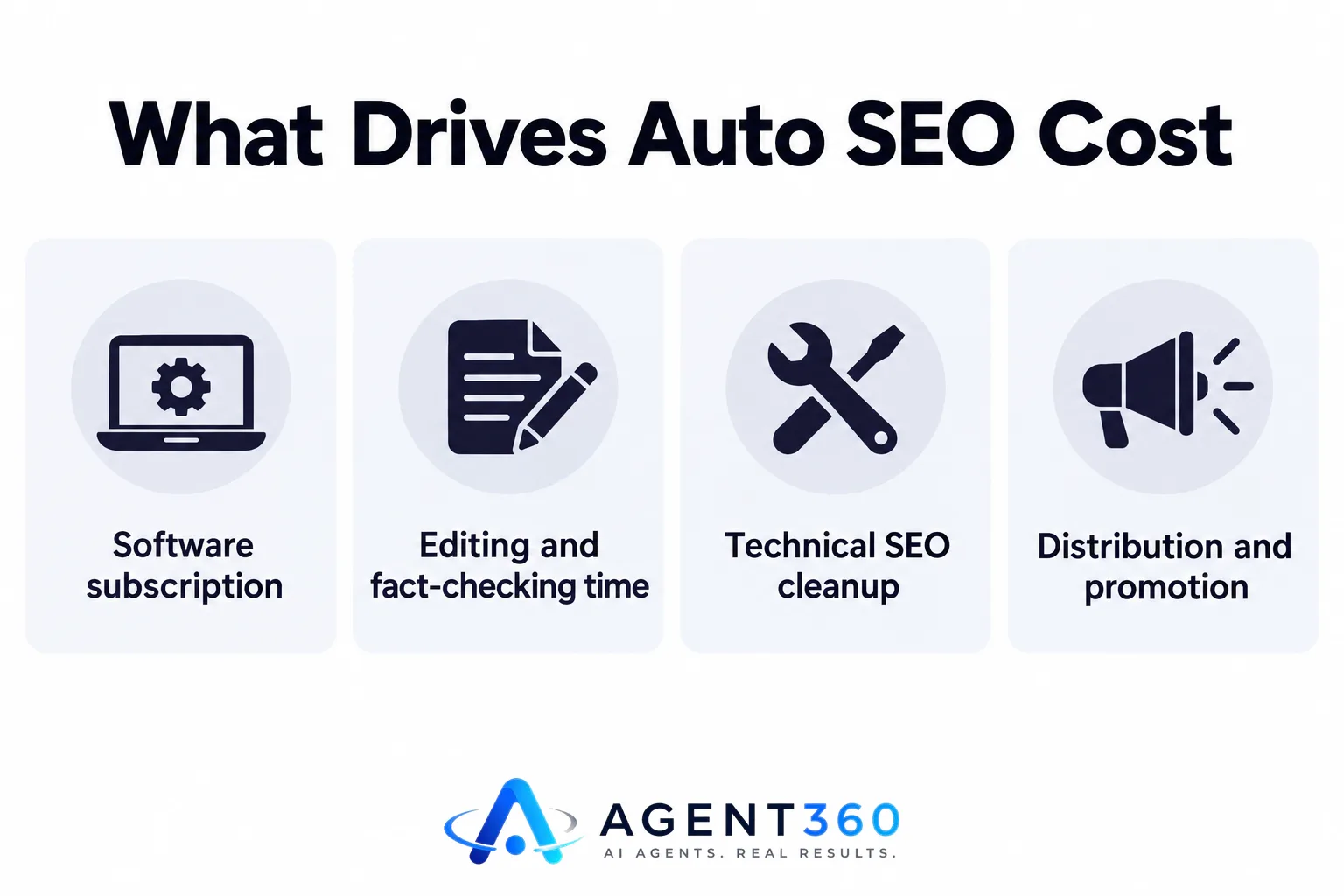
- Software subscription. This is the visible cost and usually the smallest piece of the total.
- Editing and fact-checking time. Someone has to verify claims, fix tone, and remove anything generic or wrong.
- Technical SEO cleanup. Internal linking, page speed, and indexing issues still need attention regardless of who drafted the content.
- Distribution and promotion. Publishing alone rarely drives traffic; it needs internal links, outreach, or paid amplification to get initial visibility.
What drives the price up?
Volume and accuracy requirements drive the cost up most. A recruiting firm writing about labor law or compliance needs more editorial scrutiny than a general blog post — more editing hours per article, no matter how fast the tool drafts.
Is There Any AI Tool for SEO?
Yes — AI tools exist for keyword research, content drafting, technical audits, and internal linking, but none of them remove the need for a human to check the work before it publishes. They fall into a few buckets: research tools that surface what people are searching, drafting tools that write the first pass, and audit tools that flag technical problems like broken links or slow pages.

Search engines and AI answer engines reward the same thing: content that's accurate and directly useful. That's a big part of why pages built entirely on unedited automated output tend to underperform. The same logic holds for showing up in AI-generated answers, not just traditional search results.
What should founders check before buying one?
Check three things before you pay for one: can the output be fully edited and republished in your own words, does it flag sources so you can verify claims, and does it work with the CMS you already have. A tool that locks you into its own publishing system just adds friction down the road.
What Is the 80/20 Rule in SEO?
In SEO, the 80/20 rule means a small share of your pages, keywords, or technical fixes usually account for most of your organic traffic. It's the Pareto principle applied to search. Instead of writing fifty thin pages, you're often better off improving the handful already pulling in impressions — or fixing the one technical issue blocking indexing across the whole site.
How do I find the 20% that matters?
Start with pages already ranking on page two or three for a relevant term. They need less work to move up than a page starting from zero. Then look for technical issues hitting many pages at once — slow load times, broken internal links — because fixing one of those can lift traffic site-wide instead of one article at a time.
Build Pipeline While Your Content Compounds
SEO content is worth doing. It just runs on its own clock. A new page can take months to rank well enough for consistent traffic, and longer still before that traffic turns into booked meetings. Founders running their own outbound, and staffing firm owners selling to hiring managers, usually don't have that kind of runway.
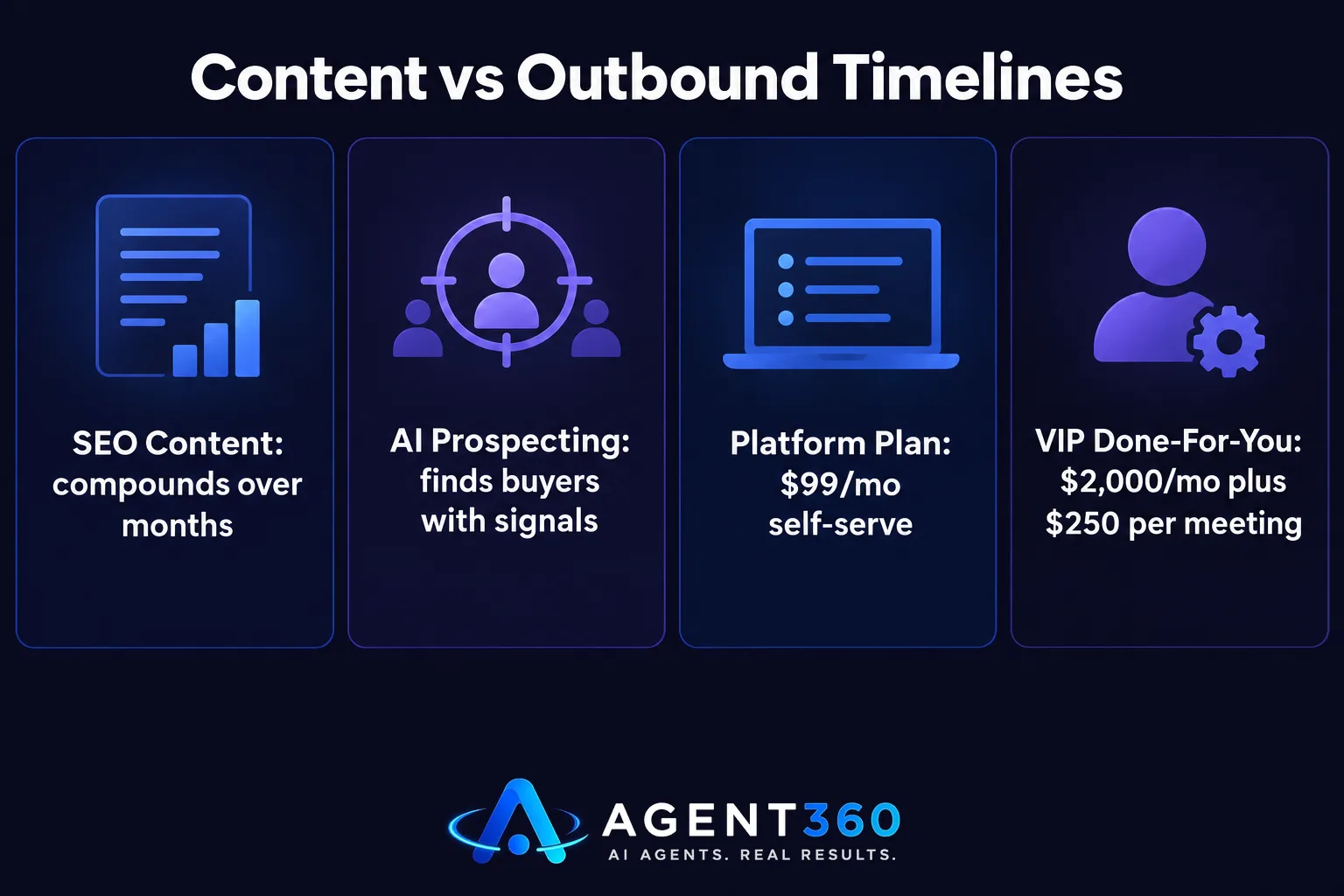
That's where outbound fills the gap. Agent360's AI Prospecting finds buyers matching your target market and flags buying signals; multi-channel outreach reaches them on LinkedIn, email, and phone; meeting booking puts qualified conversations straight on your calendar. The Agent360 Platform starts at $99/mo with leads included, an email and LinkedIn sequencer, a parallel dialer, and CRM — unlimited seats, no per-user fees. Want to hand the whole thing off? The VIP Done-For-You option runs outbound end to end for $2,000/mo plus $250 per booked meeting, with a dedicated GTM engineer and strategist. You just show up to the meetings.
Content and outbound run on different clocks, but they don't have to fight for your attention. Check pricing for both options and pick whichever one matches where you are right now.
Frequently Asked Questions
Does content automation replace outbound sales?
No. Content automation builds organic traffic over time; outbound reaches specific buyers directly and can book meetings within weeks. Most B2B teams run both, with outbound covering the gap while the content compounds.
How long does SEO content take to generate leads?
It depends on domain age, competition, and how fast technical issues get fixed, but new content commonly takes several months to rank meaningfully. There's no fixed timeline — search engines weigh too many site-specific factors for one.
Can staffing agencies use content automation for client leads?
Yes. Staffing firms can publish content answering hiring manager questions to build organic visibility. But it works alongside, not instead of, direct outreach to the hiring managers who need roles filled now.
What is the risk of publishing AI-drafted content without edits?
Unedited AI content risks factual errors, flat phrasing that doesn't rank well, and language that doesn't sound like your brand. Search engines and readers both tend to tune out content that reads generic or gets facts wrong.
Should I prioritize new content or fixing existing pages?
Check existing pages first, especially ones already ranking on page two or three — improving them usually moves faster than starting from zero. It's the same 80/20 logic: a handful of existing assets hold most of the upside.
More articles
- How to Show Up in AI Overviews When Prospects Google You
- How to Appear in Google's AI Overviews
- White Label GEO: What It Means and How to Buy It
- Auto Repair Shop Marketing: What Actually Brings In Customers
- How Many Connection Requests Can You Send on LinkedIn?
- Google Business Profile Optimization: A Practical Guide
- Agent360 vs Expandi: A Fair, Side-by-Side Comparison
- Apollo vs Smartlead: Built-In Data Versus Your Own Lists
