AI Sourcing: What It Actually Does for Recruiters
AI sourcing means software does the hunting: it finds, filters and ranks candidates (or prospects) faster than someone scrolling through resumes by hand. For recruiters, that usually means tools that parse resumes, run Boolean-style searches across job boards and LinkedIn, score matches against a job description, and draft the first outreach message. It shortens the search phase. It doesn't replace the judgment, relationship-building or client acquisition work that still sits with a human recruiter.
Staffing and recruiting firms adopt AI sourcing to fill more roles with the same headcount. The harder problem for most agency owners isn't finding candidates faster — it's keeping a pipeline of new client companies that need those candidates in the first place. Sourcing tools don't touch that side of the business.
This piece covers what AI sourcing actually automates, what it costs to run, and where recruiters still have to do the work themselves — including the business development side that candidate tools never touch.
Key Takeaways
- AI sourcing speeds up resume parsing, candidate matching and first-draft outreach — it doesn't replace vetting or relationship work.
- There's no single authoritative figure for what an “AI recruiter” earns; pay still comes down to placement fees, commission structure and market.
- AI can help you find both candidate sources and client prospects, but the two problems call for different tools.
- Picking “the best” AI sourcing tool means matching it to your workflow, not chasing the one with the most features — the same logic applies to staffing agency lead generation tools.
- Candidate sourcing and new-business sourcing are separate problems. Solving one doesn't solve the other.
Table of Contents
How Can AI Help With Sourcing?
AI speeds up the repetitive parts of finding and ranking candidates. It reads resumes and profiles, pulls out skills and experience, and scores how closely each one matches a job description. It can also draft the first outreach message based on a candidate's background — a recruiter edits it before sending.
What tasks does it take off a recruiter's plate?
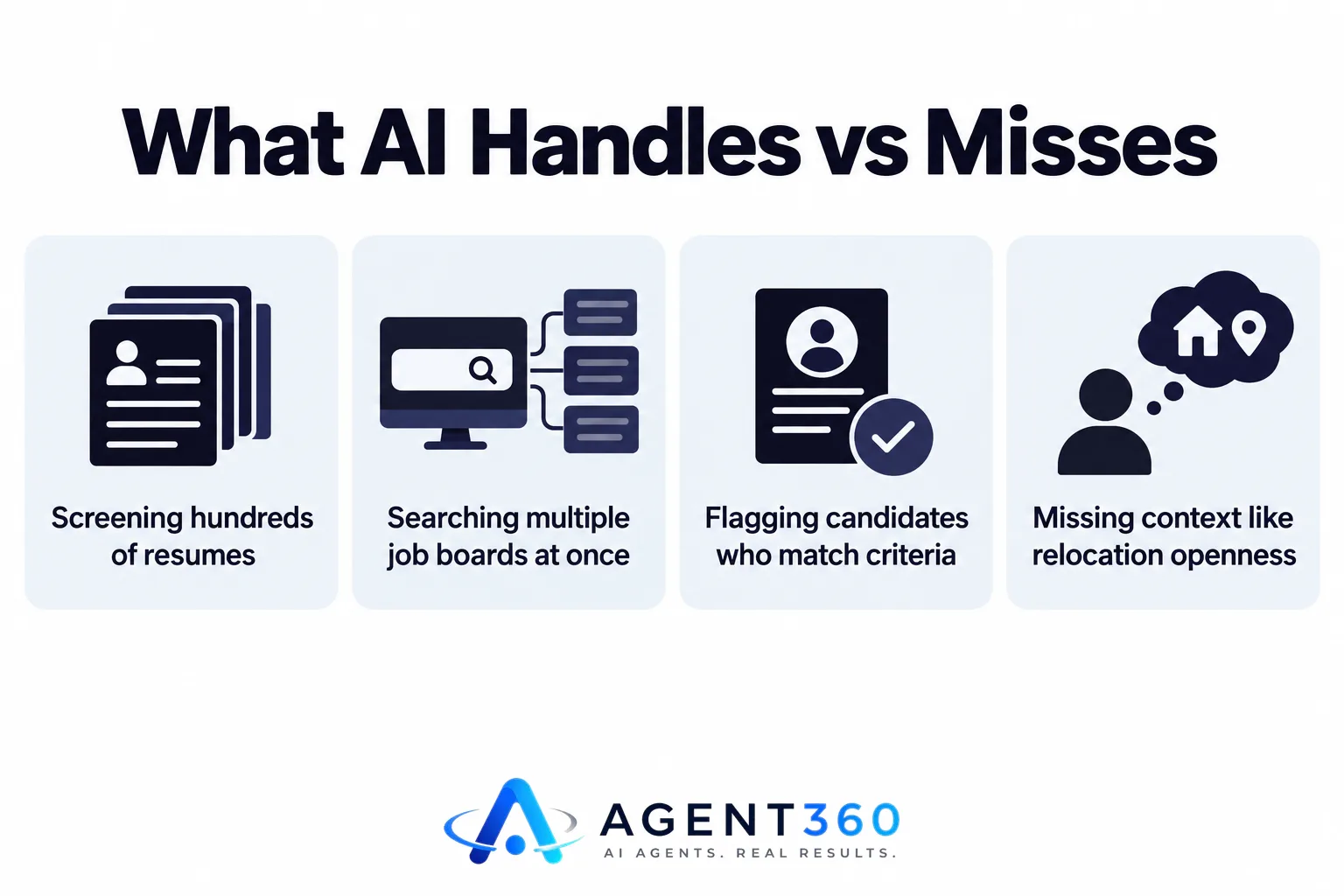
The tasks it handles well are high-volume and pattern-based: screening hundreds of resumes against a requirement list, searching multiple job boards and professional networks at once, flagging candidates who match criteria set up front. These are jobs where speed beats judgment.
What does it still get wrong?
AI sourcing tools miss context that never made it onto paper — whether a candidate is actually open to relocating, how they interviewed last time, whether their stated skills hold up under questioning. A recruiter still has to call the candidate, confirm fit, and manage the relationship through an offer. Sourcing software finds names faster. It doesn't close placements.
How Much Does an AI Recruiter Make?
There's no single published figure, because “AI recruiter” can mean a human recruiter who uses AI tools, or the AI tool itself, and pay structures differ widely. Recruiter income in staffing usually comes from a base salary plus commission or a fee per placement — not a flat rate tied to any particular software.
Does using AI change recruiter pay?
Using AI sourcing tools can change how many roles a recruiter closes in a given stretch, since less time goes into manual searching. But the pay structure itself — commission on placement fees, a split desk, a draw against future commission — is set by the agency, not the sourcing tool. If you're trying to estimate earnings, look at your own placement fee structure and close rate rather than a general industry number. Public salary data for recruiters varies by specialty, region and agency type, and isn't something this article can state as a fixed figure.
What about the cost of the tools themselves?
AI sourcing platforms are usually priced as a monthly subscription per seat, like most recruiting software. That cost is a separate line item from recruiter compensation, and it's worth weighing against how much search time it actually saves your team.
Can AI Help You Find Sources?
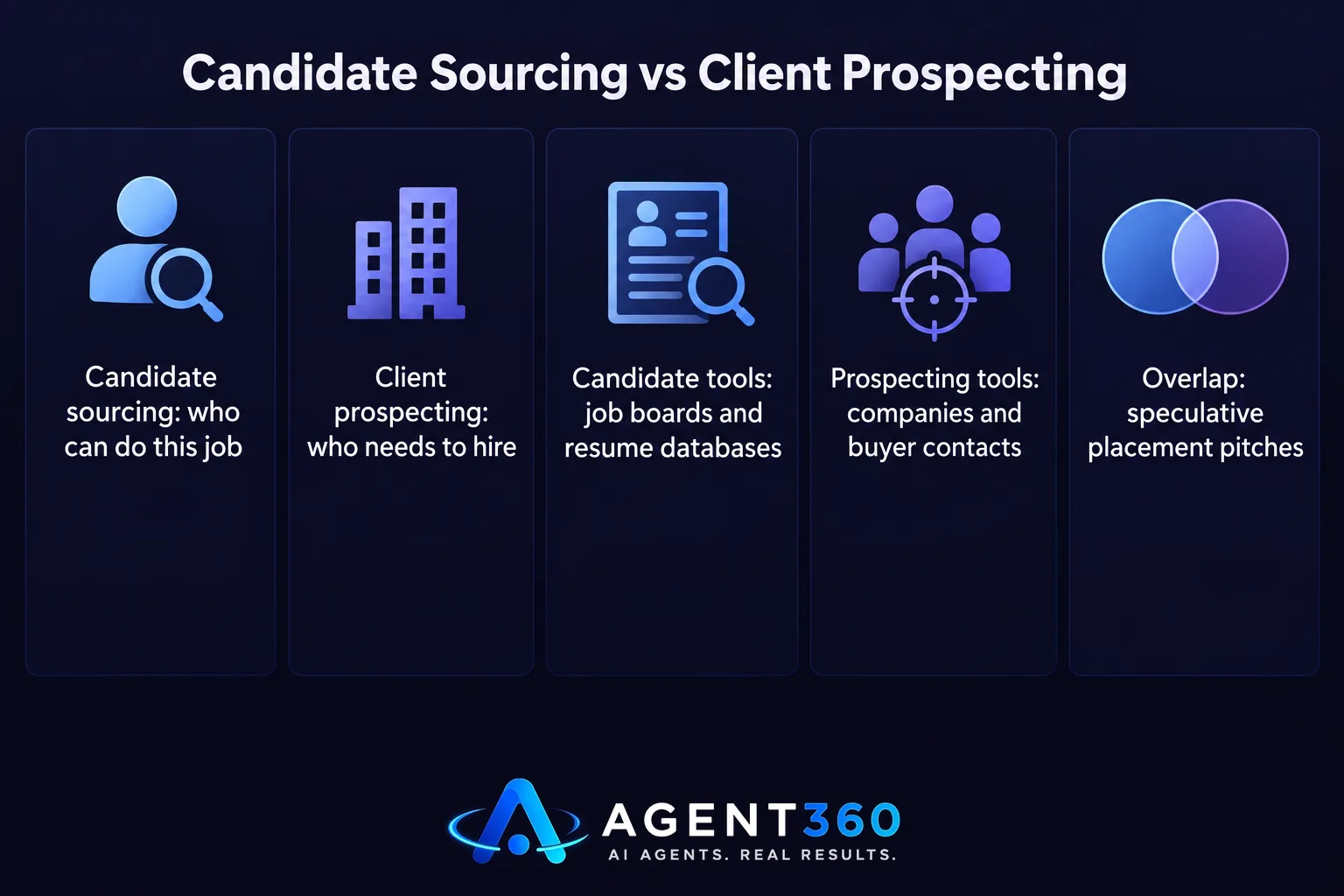
Yes — for both candidates and client companies — but the two call for different tools and different follow-up. On the candidate side, AI sourcing tools search job boards, resume databases and professional networks for people who match a role. On the business development side, prospecting tools search for companies and contacts who match a buyer profile — a different database and a different sales motion entirely.
Is finding candidates the same problem as finding clients?
No. Candidate sourcing answers “who can do this job.” Client prospecting answers “who needs to hire for this job and is willing to pay a fee for it.” An agency that only invests in candidate sourcing tools can end up with a strong bench and no open roles to fill it with. Firms that want a steady stream of new client meetings generally need a separate system for that, built around outreach to hiring managers rather than candidate databases. The approach for that side of the business is covered in cold email for recruiters.
Where do the two overlap?
In one place: a well-sourced candidate can sometimes justify reaching out to a company that isn't actively posting a role — a “speculative placement” pitch. Even there, the outreach to the company still has to run like business development, not candidate search.
What's the Best AI Source?
There isn't one best tool across the board — the right one depends on whether you're sourcing candidates or sourcing new client business. Evaluating “best” without naming the use case first is how agencies end up buying a tool that's strong at one job and expecting it to do the other.
- Define what you're sourcing. Candidates for open roles and new client companies for business development are different searches with different success metrics.
- Check where the data comes from. Ask whether contact or candidate information is verified and how often it's refreshed — stale data wastes outreach time either way.
- Test the outreach step, not just the search step. A tool that finds good matches but ships a weak or clunky follow-up sequence still leaves you doing manual work.
- Price it against time saved, not features listed. A longer feature list doesn't help if your team only ever touches three of the ten capabilities.
What should an agency owner prioritize first?
If your bench is full but your pipeline of client companies is thin, fix the business development side first. A recruiter can't place candidates into roles that don't exist, and that search is answered by prospecting and outreach tools like prospecting software, not candidate sourcing tools.
Build the Pipeline AI Sourcing Doesn't Cover
AI sourcing tools speed up how fast recruiters find and rank candidates. They won't bring in the next client company that needs those candidates placed. That's a business development problem, and it's the one most staffing and recruiting owners end up solving by hand, on top of running a desk.

Agent360's outreach platform is built for exactly that gap: leads included, email and LinkedIn sequencing, a dialer and CRM, with unlimited seats on every plan and no per-user fees. One triple-verified lead comes with every email sent, so the pipeline side of the business runs alongside candidate sourcing instead of competing with it for your time. Staffing and recruiting owners can see how the fit works at solutions for agencies.
If the goal is a steadier flow of new client meetings without adding a dedicated business development hire, start with pricing and see which plan matches the size of your desk right now.
Frequently Asked Questions
Does AI sourcing replace recruiters?
No. It automates the search and first-draft outreach stages, but a recruiter still has to vet candidates, manage relationships and close placements. The judgment calls that decide whether a candidate is actually a fit stay with the person running the desk.
Is AI sourcing only for large agencies?
No. Subscription-based sourcing tools come at a range of price points, and solo recruiters or small desks can use them the same way bigger firms do. The real factor is whether the agency has enough open roles to justify setting the tool up in the first place.
How is AI sourcing different from AI outreach?
AI sourcing finds and ranks people who match a set of criteria, whether candidates or companies. AI outreach handles what comes after: sending sequences, tracking replies, moving a contact through a pipeline. Agencies often need both, but each solves a different part of the process.
Can AI sourcing tools find client companies, not just candidates?
Some prospecting tools are built specifically to find companies and decision-makers rather than job candidates. These work off business-development data — company size, hiring activity — rather than resumes, and sit in a separate category from candidate sourcing software.
What should I check before buying an AI sourcing tool?
Confirm where the underlying data comes from and how often it refreshes, test the outreach or messaging step instead of just the search function, and price it against the hours it actually saves your team rather than its feature count.
More articles
- Marketing for Mechanics: What Actually Books Jobs
- Content Repurposing: Turn One Asset Into Outbound Fuel
- ATS Tracking Cost: What You'll Actually Pay in 2025
- AI Content Calendar: What It Is and How to Build One
- Automotive Repair Marketing: Winning B2B Fleet Accounts
- Content Automation SEO: What It Can Actually Do
- How to Show Up in AI Overviews When Prospects Google You
- How to Appear in Google's AI Overviews
