Real Estate Agent Marketing: What Actually Books Showings
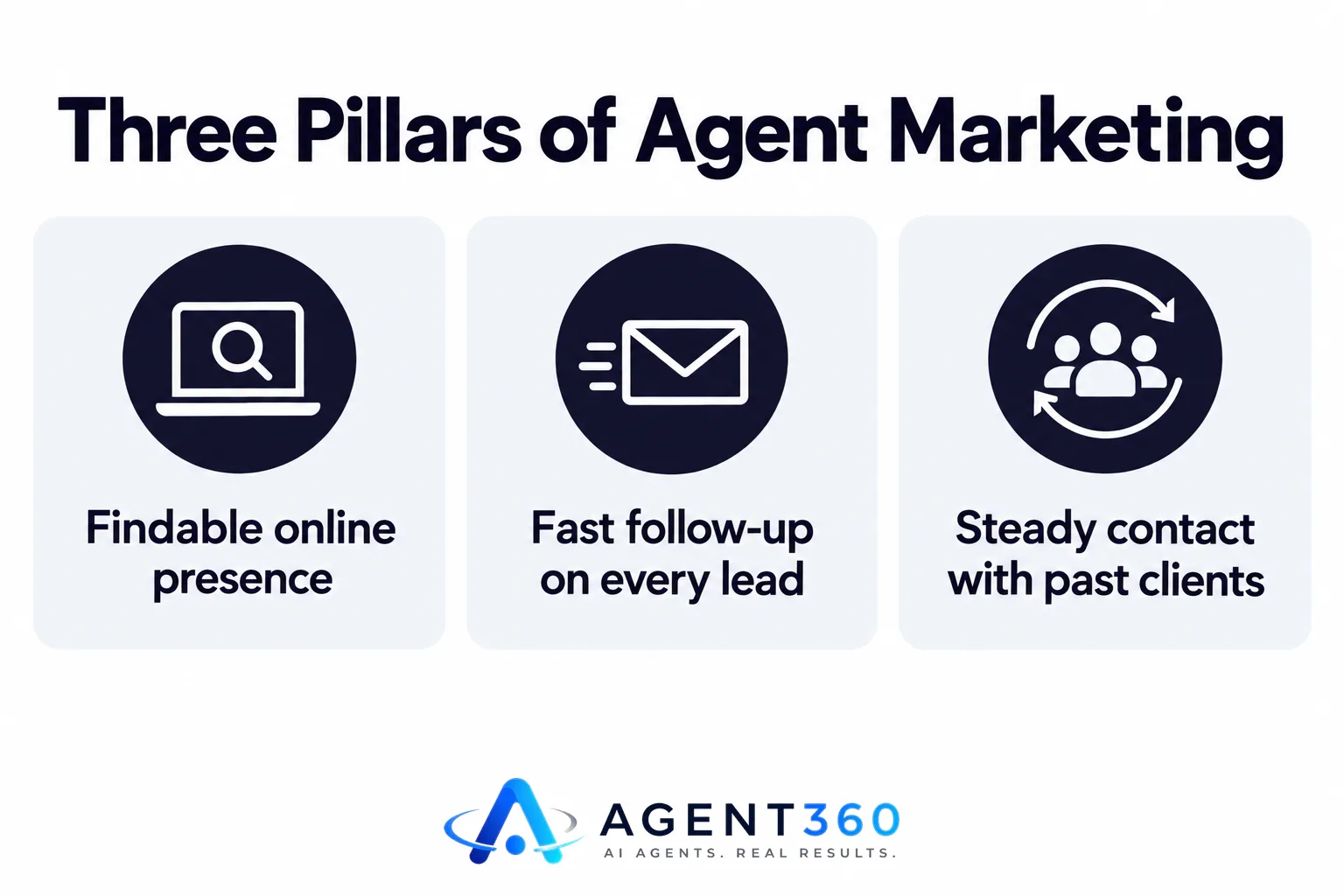
Real estate agent marketing works when three things run at once: a findable online presence, fast follow-up on every lead, and steady contact with past clients and referral sources. It's not one tactic. Post listing photos on Instagram all day, or buy a stack of Zillow leads every month, and you're still technically “doing marketing” — just not enough of it to build a pipeline that survives a slow season.
Agents who stay busy through a market slowdown tend to have the same three things running quietly in the background: a website and Google presence that gets found when someone searches for an agent nearby, a system that captures and follows up with every lead without being asked twice, and a referral engine that keeps bringing business without new ad spend.
Below: what actually moves the needle, what the commission math really looks like on a typical sale, and how to think about the volume it takes to hit a real income number.
Key Takeaways
- Treat real estate agent marketing as a system — findability, lead capture, and follow-up — not a single tactic.
- Commission on any sale is negotiable and gets split more than once, so income tracks volume as much as price point.
- The 80/20 rule means most of your production comes from a small slice of relationships and listings; find that slice and guard it.
- A complete Google Business Profile is one of the fastest ways to show up when someone searches for an agent near them.
- Automated follow-up beats ad spend most of the time, because the first contact rarely converts a lead on its own.
Table of Contents
What is the best marketing for real estate agents?
The best marketing combines local search visibility, a fast-responding lead system, and consistent contact with your sphere of past clients and referral partners. None of the three substitutes for the others. A strong Google presence brings in strangers searching for an agent; a lead system keeps those strangers from going cold; a referral engine brings back the people who already trust you.
Which channels bring in the most listings?
Listings tend to come from two directions: inbound search (someone types your city plus “real estate agent” or scans the Google Maps results) and your existing network — past clients, friends, local business referrals. Paid ads can add volume on top of both. They rarely replace the groundwork of a website that converts and a Google Business Profile that's filled out and current.
How do AI search results change what buyers see?
Buyers increasingly ask tools like ChatGPT or Google's AI Overviews something like “who's a good realtor in [city]” before they ever land on an agent's website. Showing up in that answer depends on having content and reviews these systems can actually read and cite — not just a polished homepage sitting there unread.
How much would a real estate agent make on a $300,000 house?
It depends on the commission rate negotiated for that transaction and how many ways it gets split, so there's no fixed dollar figure. Commission is a percentage of the sale price, agreed between the seller and their agent. Following the National Association of Realtors' 2024 practice changes, commission rates are explicitly negotiable and no longer uniformly published on the MLS, so the agreed rate varies by agent, market, and transaction.
Whatever percentage gets agreed, the payout is typically split at least twice: once between the listing side and the buyer's side if there's a separate buyer's agent, and again between the agent and their brokerage under that agent's individual split agreement. Two agents can work the exact same $300,000 sale and walk away with very different numbers, purely because of their brokerage split and how the commission was negotiated.
What is the 80/20 rule for realtors?
The 80/20 rule for realtors is the observation that a small share of your activities, clients, or referral sources tends to produce most of your closed business. Same Pareto principle used across sales everywhere: most agents find that a minority of their contacts, farming areas, or lead sources account for the bulk of their deals in a given year.
How do I find my top 20%?
Pull your closed transactions from the last 12 to 24 months and trace each one back to its source — a past client referral, a specific neighborhood farm, an online lead, an open house. Whatever source shows up repeatedly earns more of your time and budget next year. Whatever shows up rarely, or never, is a candidate to cut.
Can you make $1,000,000 a year in real estate?
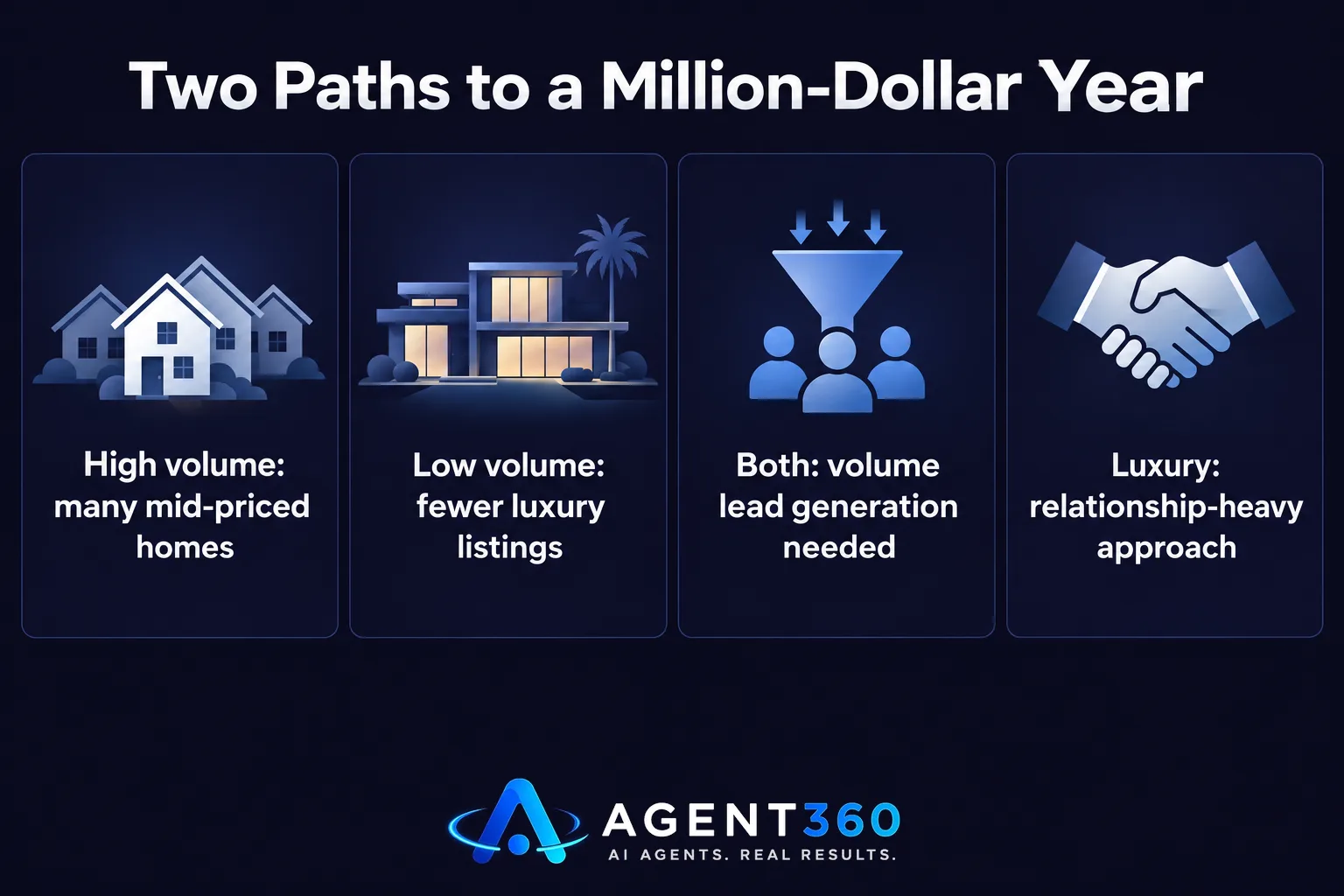
A million-dollar year is a function of volume and average commission per deal, not something that comes automatically with the license. It takes a high number of transactions at a modest average commission, a smaller number of transactions at a high price point, or some mix of both — sustained, year over year, not just once.
What does the math behind a million-dollar year look like?
Think in terms of deals closed times average commission per deal. An agent closing a high volume of mid-priced homes and one closing a handful of luxury listings can land on a similar total, but they get there with very different marketing systems: the first needs volume lead generation and fast follow-up, the second needs a narrower, relationship-heavy approach in one price tier.
- Audit your current lead sources. List every channel bringing you business today and how many closed deals each produced last year.
- Fix your local findability first. Claim and fully complete your Google Business Profile, add recent reviews, and make sure your website loads fast and shows your listings clearly.
- Put every lead into one follow-up system. Leads that don't get a fast, repeated response go cold; a CRM with automated follow-up catches the ones a manual process misses.
- Protect your top 20%. Once you know which sources and clients drive most of your production, build a regular touchpoint cadence around them instead of letting it happen by accident.
- Add paid volume only after the system works. Ads bring in more leads, but they only pay off if your follow-up and conversion process can actually absorb them.
Build the System Behind Your Next Listing
Most agents don't lose business because they're not working hard enough. They lose it because a lead sat unanswered for two days, or their website doesn't show up when a buyer searches their city, or a past client simply forgot they're still in the business.

Agent360's all-in-one growth plan, starting from $297 a month, is built for exactly this kind of local service marketing: a website and SEO that get you found on Google and named in AI answers like ChatGPT and Google AI Overviews, ads that bring in calls, and a CRM with automatic follow-up so no lead sits untouched. One team runs it on one plan, instead of you juggling a web developer, an SEO freelancer, and an ads agency separately.
See what's included at the pricing page and book a demo to walk through what it would look like for your market.
Frequently Asked Questions
Do I need a website if I already have an MLS profile?
Yes. An MLS profile or brokerage bio page is usually generic and shared with every other agent at your firm, so it does little to help a buyer or seller find and remember you specifically. A dedicated website lets you control what shows up in search and gives you a place to send paid traffic and referrals.
How often should I post on social media as a realtor?
Consistency matters more than frequency. A steady cadence of listing updates, local market notes, and client success moments keeps you visible without requiring daily posting, and tools that draft and schedule on-brand content can keep that cadence going without eating up your selling time.
Is paid advertising worth it for real estate agents?
Paid ads can work well once your website converts visitors and your follow-up system responds quickly, because ads simply bring more volume to whatever process you already have. Run ads before fixing conversion and follow-up, and you're usually just paying more for leads that go cold the same way the organic ones did.
How long does real estate SEO take to show results?
Local SEO for a specific agent and city typically takes a few months of consistent work: a complete Google Business Profile, accurate listing data, reviews, and locally relevant content. Results build gradually rather than appearing overnight, which is why it works best paired with other lead sources in the meantime.
Should I hire a marketing agency or do it myself?
It depends on how much of your week you want to spend on marketing versus selling. Agents who'd rather spend their time on showings and client calls often do better handing the website, SEO, ads, and follow-up to a team that runs it as one coordinated system rather than piecing it together themselves.
More articles
- AI Sourcing: What It Actually Does for Recruiters
- Marketing for Mechanics: What Actually Books Jobs
- Content Repurposing: Turn One Asset Into Outbound Fuel
- ATS Tracking Cost: What You'll Actually Pay in 2025
- AI Content Calendar: What It Is and How to Build One
- Automotive Repair Marketing: Winning B2B Fleet Accounts
- Content Automation SEO: What It Can Actually Do
- How to Show Up in AI Overviews When Prospects Google You
