ATS Tracking Cost: What You'll Actually Pay in 2025
ATS tracking cost can mean nothing a month or several hundred dollars per recruiter seat, and the sticker price alone won't tell you which one you're looking at. It depends on how the vendor prices candidate volume, job postings, and whatever add-ons they bolt on top. Most paid systems sit somewhere between a flat small-team plan and a custom enterprise contract, so the headline number is close to meaningless until you know the pricing model underneath it.
For staffing and recruiting agency owners, this cost sits alongside every other line in the tech stack: sourcing tools, job board spend, payroll software, whatever you use to drum up new client business. Getting the ATS line right matters. It's just one piece of the budget, not the whole thing.
Key Takeaways
- Price per recruiter seat, not the headline plan name, is the number that determines your real monthly cost.
- Free and open-source ATS options exist but usually cap candidate volume, job postings, or user seats.
- Implementation, data migration, and job board integrations are common hidden charges outside the base subscription.
- An ATS tracks candidates well but does not generate new client meetings, which is a separate problem covered in staffing agency lead generation.
- Compare systems by cost per hire or cost per placement, not by the subscription price alone.
Table of Contents
How much does an applicant tracking system cost?
Most ATS platforms charge a monthly or annual fee that scales with the number of recruiter seats and active job requisitions, not a single flat number. A small agency running a handful of open roles at a time pays far less than a staffing firm juggling fifty requisitions across several teams. Vendors price it this way because the system's cost to support — and its value to you — scales with how much data and how many users run through it.
What drives the price up or down?
Seat count is the biggest lever. Systems built for staffing agencies often price per active recruiter rather than per total employee, so adding a sourcer or coordinator can raise the bill even if they never run a search. Candidate volume and job posting limits come next — some vendors throttle how many open requisitions or resumes you can hold before forcing an upgrade. Integrations with job boards, background check vendors, or payroll systems are usually billed as add-ons, not bundled into the base price.
What are ATS charges?
Beyond the core subscription, expect separate charges for implementation, data migration, premium integrations, and sometimes per-job-posting fees. The subscription covers the software itself. Everything that touches your existing data or connects to an outside system tends to carry its own fee schedule.
Are there hidden costs beyond the subscription?
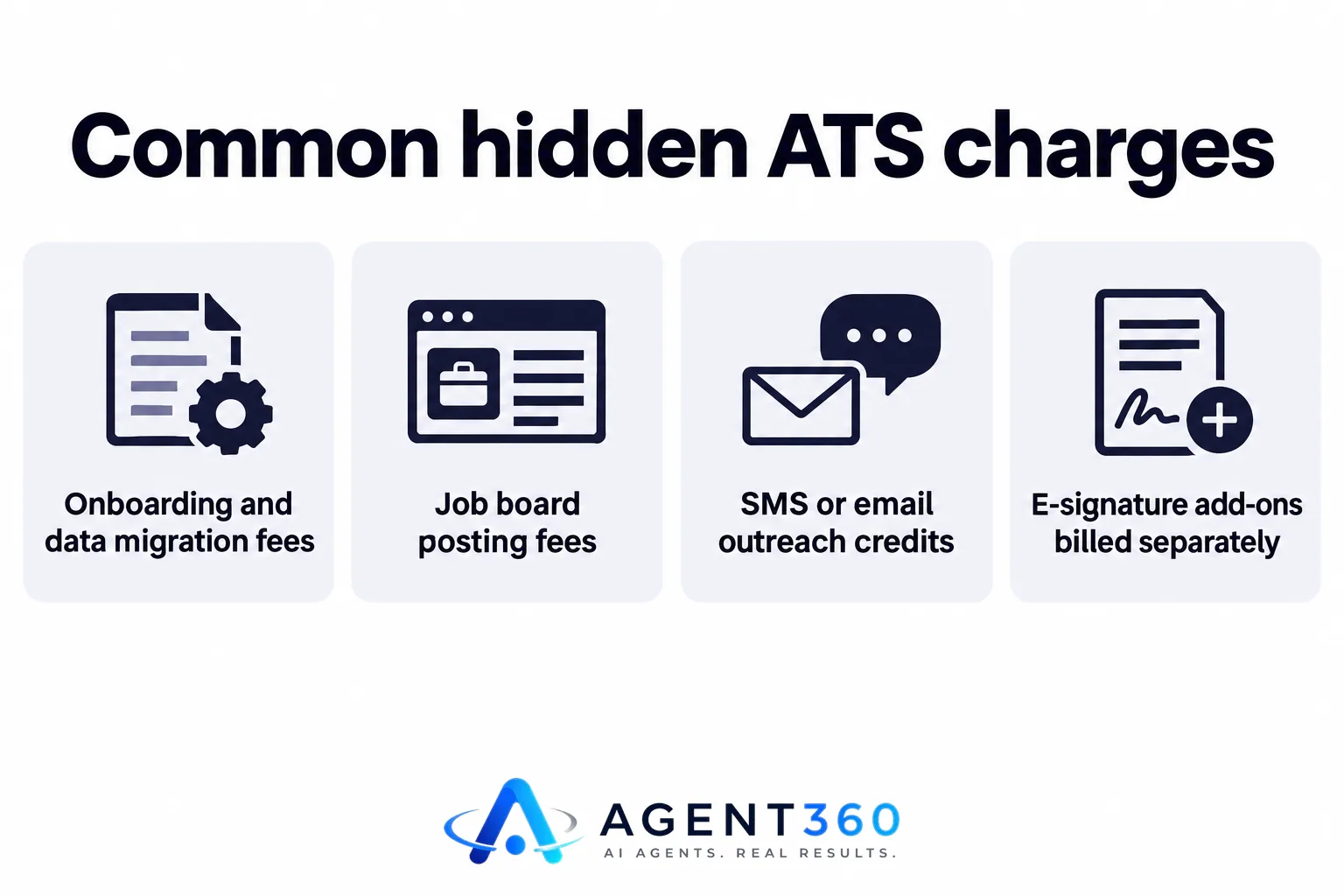
Onboarding and data migration from a previous system is the most common hidden cost — moving years of candidate records and job history is rarely free. Job board posting fees, SMS or email credits for candidate outreach, and e-signature add-ons get billed separately more often than not. Contract length matters too: many vendors knock down the per-seat price for annual commitments, which lowers the monthly number but locks you in before you really know if the system fits.
Is the ATS free?
Some ATS platforms are free, but almost always with limits on job postings, candidate records, or user seats that force an upgrade once you grow. Open-source options exist and carry no license fee, though you pay in setup time and ongoing maintenance instead of a subscription. Free tiers from commercial vendors are usually built as a funnel toward a paid plan — fine for a solo recruiter or a thin pipeline, impractical once requisition volume picks up.
Can you give me some examples of applicant tracking systems (ATS)?
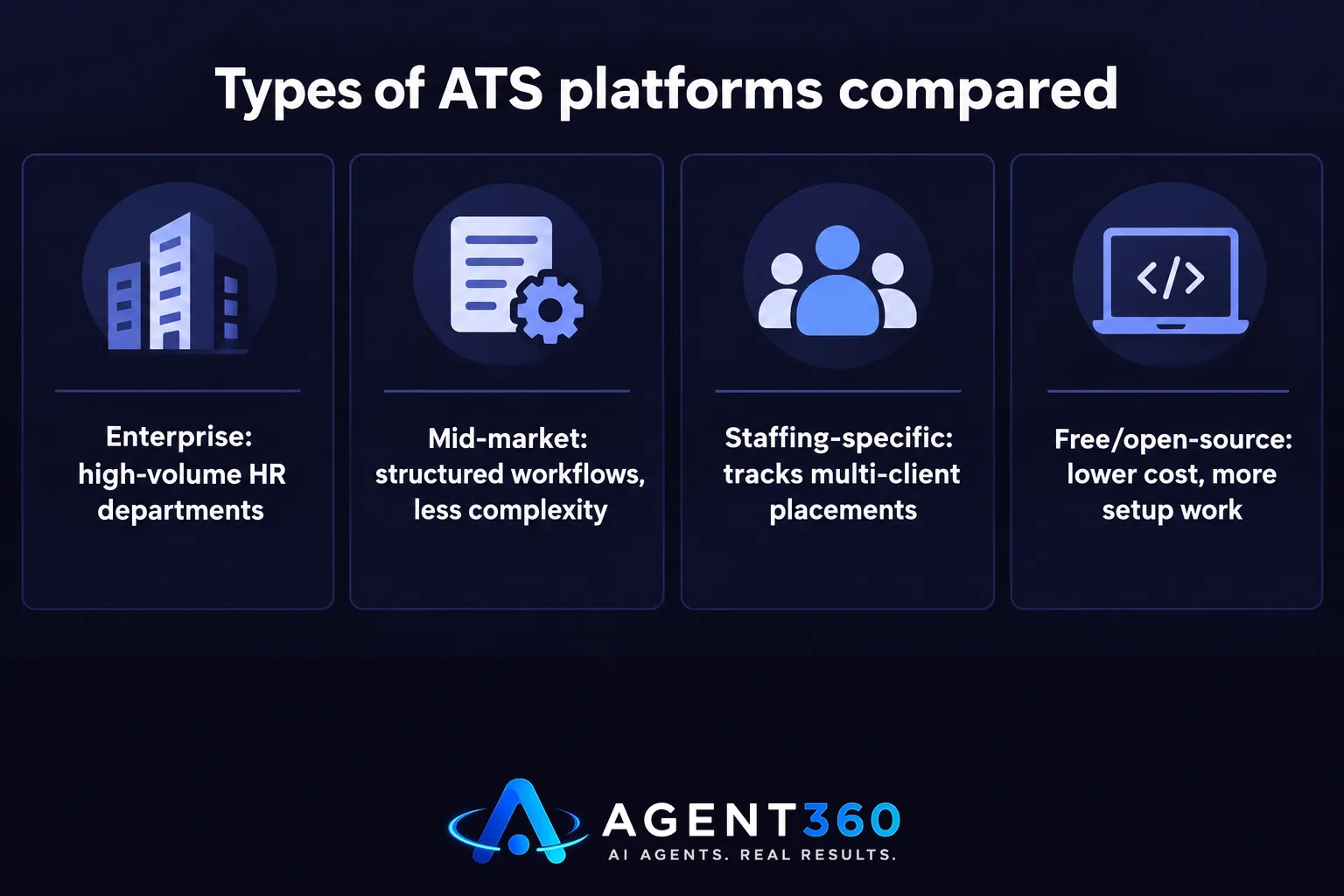
ATS platforms generally split into enterprise systems, mid-market tools, staffing-specific platforms, and free or open-source options. Enterprise-grade systems are built for large HR departments managing high applicant volume across many departments. Mid-market tools target growing companies that need structured hiring workflows without enterprise complexity. Staffing-specific platforms are built around the agency model — tracking candidates across multiple client placements rather than a single internal headcount plan. Open-source and free options exist for teams willing to trade a lower cost for more setup and maintenance work.
None of these systems are built to find new client business. They track candidates once a search is open. A separate CRM built for sales pipeline, not hiring pipeline, is what staffing firms use to manage the client relationships that bring those searches in the first place.
Spend Your Outbound Budget Where It Finds New Clients
An ATS keeps candidates organized once a client hands you a search. It does not find the next client. For staffing and recruiting agency owners, the budget question that matters most usually isn't the ATS line — it's whether anyone is consistently booking meetings with new hiring managers.

Agent360 runs that side of the business. The platform starts at $99/mo with unlimited seats and no per-user fees, and includes one triple-verified lead for every email sent, so agencies can run outbound in-house without adding headcount. For firms that want it handled end to end, the VIP done-for-you option runs outbound for $2,000/mo plus $250 per booked meeting, with a dedicated strategist managing the campaign while your team takes the meetings.
See the plan details on the pricing page.
Frequently Asked Questions
Do staffing agencies need an ATS and a CRM?
Yes, and they solve different problems. An ATS tracks candidates through a hiring process once a search is open. A CRM tracks the client relationships and new business pipeline that open those searches in the first place.
What's a reasonable ATS budget for a small agency?
It depends on seat count and candidate volume, not headcount alone. A two-person recruiting team with low requisition volume should expect a much smaller bill than a ten-recruiter firm running dozens of open searches at once, since most vendors price per active seat.
Does a free ATS tier work long-term?
It can, for a very small or early-stage operation. But most free tiers cap job postings, candidate records, or seats, and once an agency grows past those limits, the free tier usually forces an upgrade to a paid plan.
Why do ATS vendors charge separately for job board integrations?
Posting to external job boards involves licensing and data-sharing agreements the ATS vendor pays for on your behalf, so that cost is usually passed through as an add-on rather than bundled into the base subscription.
Can an ATS help book new client meetings for a staffing agency?
No. An ATS is built to manage candidates once a search is active, not to find and book meetings with new hiring managers. That function typically runs through separate outbound tools or services, such as those described on the agencies solutions page.
More articles
- AI Content Calendar: What It Is and How to Build One
- Automotive Repair Marketing: Winning B2B Fleet Accounts
- Content Automation SEO: What It Can Actually Do
- How to Show Up in AI Overviews When Prospects Google You
- How to Appear in Google's AI Overviews
- White Label GEO: What It Means and How to Buy It
- Auto Repair Shop Marketing: What Actually Brings In Customers
- How Many Connection Requests Can You Send on LinkedIn?
