How to Appear in Google's AI Overviews
You appear in Google's AI Overview by answering one specific question in a single, direct sentence Google can lift cleanly, then backing it with enough detail to prove it's right. Forget ranking first in the old ten blue links. Being the clearest, most directly responsive source for the exact phrase someone typed matters more.
Google's own Search Central documentation describes AI Overviews as a feature that pulls together an answer from several sources and displays it above the regular results. The pages it draws from state the answer plainly, right near the top. Pages that bury the point three paragraphs into a long introduction rarely make the cut.
For founders writing their own content, and for staffing or recruiting firm owners publishing to reach hiring managers, this matters because an AI Overview can reach a buyer before they ever click a link. It's a visibility channel. Not a replacement for outbound.
Key Takeaways
- Answer the exact question in the first sentence after your heading, in plain language, with no throat-clearing.
- Structure pages around the real questions buyers ask, using question-style headings that match their wording.
- Support the direct answer with specifics: steps, named sources, and concrete detail, not vague claims.
- Keep pages easy to crawl and indexed; an AI Overview can only quote what Google has already found and understood, which is the same groundwork covered in these practical guides.
- Treat this as one input into a content plan, not a guarantee, since Google controls which pages it chooses to quote.
Table of Contents
What Is Google's AI Overview, and Why Does It Matter for B2B Content?
Google's AI Overview is a generated summary shown above standard search results, built from a handful of pages Google judges most directly responsive to the query. For B2B founders and staffing firm owners, it matters because plenty of hiring managers and buyers see this summary before they scroll to any website at all. Getting quoted there gets attention even when the reader never clicks through — and that shapes how your brand looks before a cold email or LinkedIn message ever lands.
Where does the AI Overview pull its answers from?
It pulls from pages that already rank reasonably well and state an answer in clear, extractable language near a relevant heading. Pages written like a story, with the direct answer missing or scattered across several paragraphs, are harder for the system to lift cleanly.
How Do You Optimize for Google's AI Overview?
You optimize by matching the structure of the question people actually type, answering it in one sentence immediately, then proving that sentence with specifics. This reads more like a reference entry than a pitch.
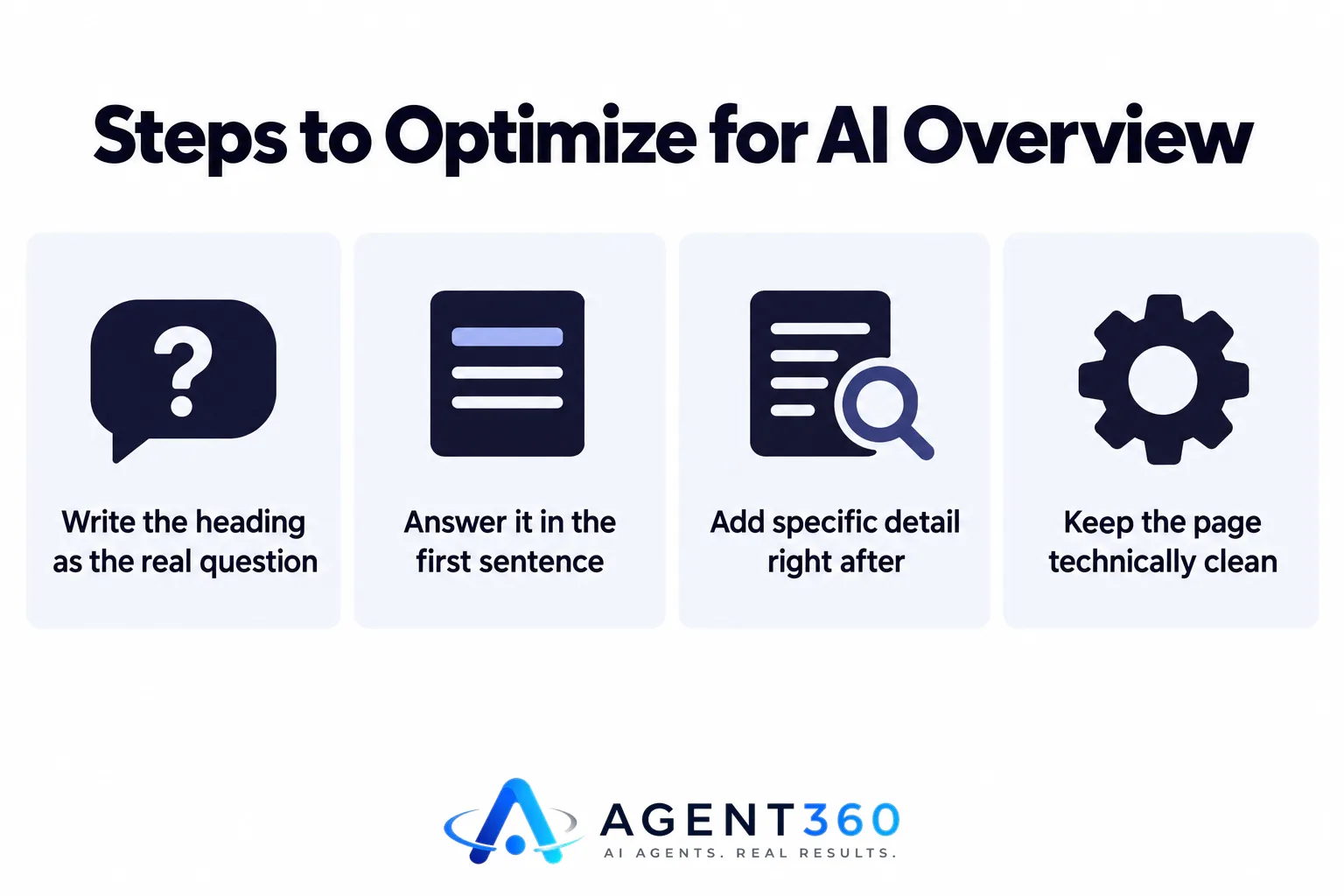
- Write the heading as the real question. Use the exact phrasing a buyer or hiring manager would type, not a clever rewording.
- Answer it in the first sentence. No setup, no story, just the direct answer in plain words.
- Add the specific detail right after. Name a step, a source, or a mechanism; avoid vague claims that could apply to any company.
- Keep the page technically clean. Make sure the page is indexed, loads fast, and is not blocked from crawling, since none of the writing matters if Google cannot read the page.
- Check back periodically. AI Overview results change as Google reruns its synthesis, so a page that is not quoted today can be quoted later if it stays accurate and well-structured.
What format works best inside the page?
Short, question-style headings followed by a one- or two-sentence direct answer, then supporting detail in a list or short paragraph. That's the pattern this article follows, and it's also the pattern Google's own guidance on writing helpful content recommends.
How Can You Make Your Company Show Up in Google's AI Overview?
You show up by publishing content on your own domain that answers the specific questions your buyers search, not by gaming a single page or keyword. For a staffing firm, that might mean a page answering what a client should expect from a contingency search fee. For a B2B founder, it might mean a page that answers how long outbound actually takes to produce a first meeting.
Does my site need to rank number one first?
No. AI Overview sourcing doesn't require the top organic spot, though pages that already rank reasonably well are more likely to get picked. What matters more is whether the page states a clear, correct, specific answer Google can lift without editing it first.
What Content Format Gets Picked Up by AI Overviews?
Content built around direct question-and-answer pairs, with supporting lists and named specifics, gets picked up more consistently than long narrative posts. An FAQ section near the end, where each question gets two to four standalone sentences, gives Google a second, self-contained shot at pulling a correct quote.

Should I add structured data for FAQs?
Structured data such as FAQ schema can help search engines parse the question-and-answer pairs on a page, though Google has said it doesn't guarantee any particular display. It's worth adding once the underlying writing already answers questions directly — schema won't fix writing that's vague to begin with.
Put Your Content and Your Outbound to Work Together
Getting quoted in an AI Overview builds awareness. It doesn't book a meeting on your calendar. That still takes direct outreach to the buyers who matter, which is where Agent360 fits. The Agent360 platform, starting from $99 a month, gives founders running their own outbound unlimited seats, included leads, and an email plus LinkedIn sequencer with a parallel dialer and CRM — so content and outbound run from the same place.
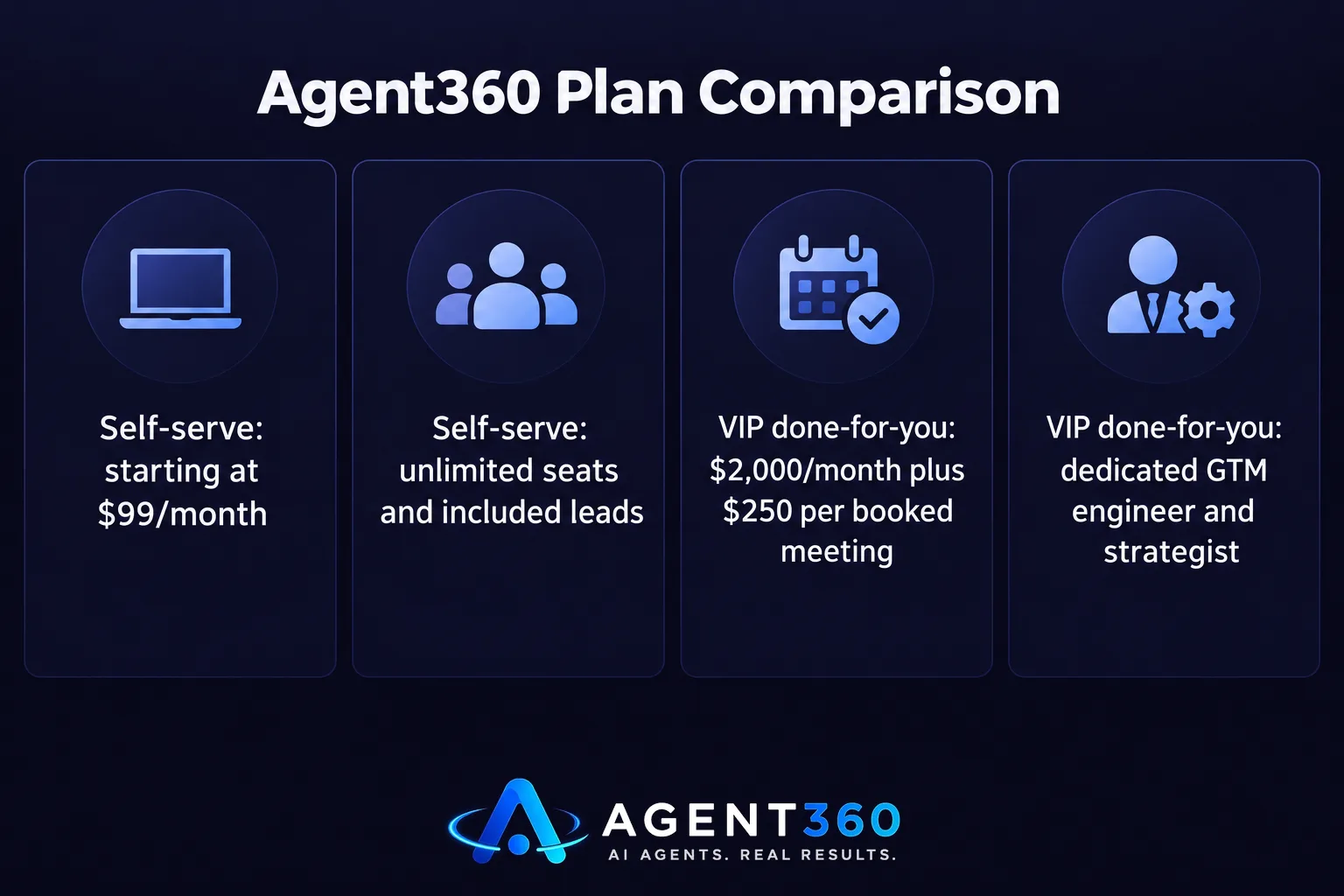
For staffing and recruiting firm owners who'd rather not run outbound themselves, the VIP done-for-you option — $2,000 a month plus $250 per booked meeting — puts a dedicated GTM engineer and strategist on the account. You just take the meetings. Every plan includes one triple-verified lead for every email sent, so the content you publish and the outreach you send both work from the same reliable foundation.
Check the how it works page to see how it fits together, or go straight to pricing if you already know which side you need.
Frequently Asked Questions
How do I get my site ranking in Google's AI Overview?
Write pages that answer one specific question directly in the first sentence after a matching heading, then support that answer with named, checkable detail. Keep the page crawlable and indexed, since the AI Overview can only quote pages Google has already found and understood.
How can I appear in an AI Overview feature on my website?
Structure the page itself, not just your overall site, around the exact question searchers type. A single well-structured page focused on one question is more likely to be quoted than a broad page that touches many topics loosely.
Does AI Overview use different ranking signals than regular search?
It draws from pages already present in Google's index and search results, so standard search fundamentals still apply. What differs is the extraction step: Google favors pages where an answer is stated plainly and can be lifted without rewriting.
How long does it take to show up in AI Overviews?
There is no fixed timeline, since it depends on when Google recrawls and resynthesizes results for a given query. Publishing a clear, direct answer is necessary but does not guarantee a specific date of appearance.
Do I need schema markup to appear?
No, schema markup is not required, but FAQ-style structured data can help search systems parse question-and-answer content more reliably. It supports well-written pages; it does not replace the need for a direct, specific answer in the text itself.
Will appearing in an AI Overview replace the need for outbound?
No. An AI Overview can build awareness and trust before a buyer ever hears from you, but it does not schedule a call or send a follow-up. Booking meetings still requires direct outreach, whether run in-house or handled end to end.
More articles
- White Label GEO: What It Means and How to Buy It
- Auto Repair Shop Marketing: What Actually Brings In Customers
- How Many Connection Requests Can You Send on LinkedIn?
- Google Business Profile Optimization: A Practical Guide
- Agent360 vs Expandi: A Fair, Side-by-Side Comparison
- Apollo vs Smartlead: Built-In Data Versus Your Own Lists
- MSP Sales Leads & Appointments: A Practical Playbook
- AI Competitor Gap Analysis Agent: What It Actually Does
