Done-For-You Marketing: What It Actually Means

Done-for-you marketing means a provider builds and runs your marketing for you — not a login screen and a tutorial you have to figure out alone. A done-for-you team handles the website, the SEO, the ads, the content, and the follow-up. You run the business. They run the marketing.
It sits opposite “do-it-yourself” marketing, where you buy a platform and build the campaigns yourself. It also sits opposite hiring in-house, where you add salaries, benefits, and someone to manage. Done-for-you lands in the middle: a monthly fee, a team on the other end, and finished work landing in your inbox instead of a dashboard you have to learn.
The model suits owners who know their business cold but don't have time to also become a web developer, an SEO writer, and an ads manager on top of it. It falls apart when the provider can't explain what they're actually doing, or won't show you the work before it goes live.
Key Takeaways
- Done-for-you marketing means a team builds and runs the work for you, not software you self-serve.
- Legitimate providers show you the deliverables — pages, posts, reports — not just a login screen.
- Ask what's included before you sign; see what done-for-you typically includes so you can compare offers apples to apples.
- Check for a month-to-month option, a named point of contact, and a clear list of channels covered.
- A real agency will tell you what it can't do as readily as what it can.
Table of Contents
What does “done-for-you” mean?
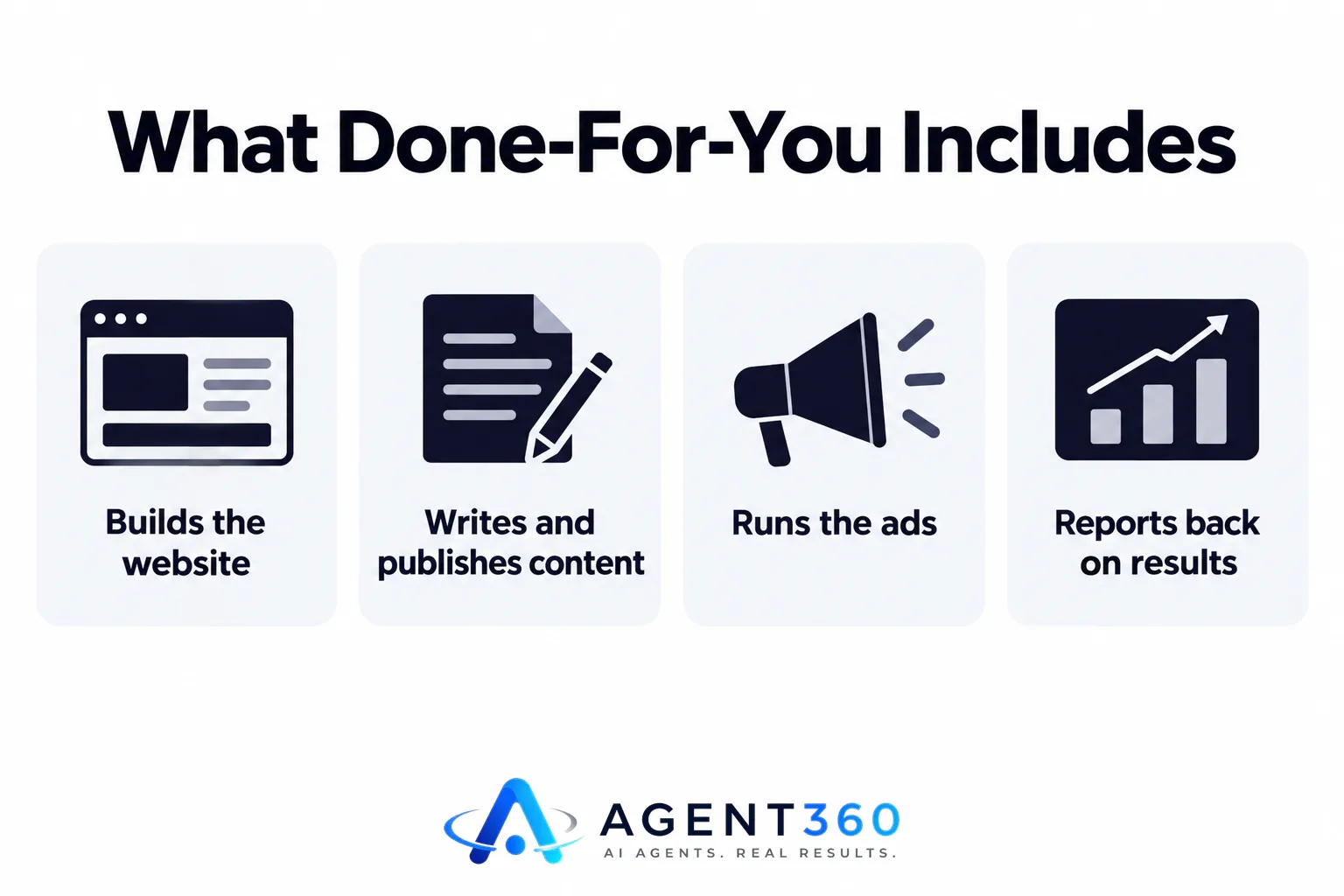
It means someone else does the marketing work on your behalf, using your brand and your approval, not just your login. You're not handed a tool and a tutorial. You get a team that builds the website, writes and publishes the content, runs the ads, and reports back on results, while you stay the decision-maker on anything that represents your brand.
What's the difference between done-for-you and a software subscription?
A software subscription gives you a tool and expects you to run it. Done-for-you gives you the outcome of that tool being run well, because people and automation are behind it handling the setup, the writing, and the ongoing adjustments. You're paying for the work, not just the access.
Does done-for-you mean I lose control?
No — not if the provider is set up right. Anything public-facing, like posts, articles, or ad copy, should still route through you for approval before it goes live. You're outsourcing the labor, not the decisions.
Are done-for-you brands legitimate?
Most are, but the category is also where resellers and overseas freelancer shops hide behind a polished landing page. “Done-for-you” describes a business model, not a certification. So legitimacy comes down to the specific provider, not the phrase itself. The model is common and used by real agencies across web design, SEO, ads, and content.
What makes a done-for-you offer suspicious?
Vague talk of “guaranteed results,” no named point of contact, pricing that only appears after a sales call, and reluctance to show sample work — those are the red flags. A legitimate provider can tell you exactly what gets delivered in a given month and point to examples.
How do I know if a marketing agency is legit?
Check what they'll show you before you pay, not just what they promise after you do. A legitimate agency walks you through a sample deliverable, names the person or team handling your account, and explains pricing without forcing a sales call just to see a number.

- Ask for a real example of the deliverable. A website mockup, a sample article, a sample ad — something concrete tied to a business like yours, not a generic portfolio page.
- Ask who owns the work. Confirm you keep the website, the content, and the ad accounts if you leave, rather than the agency holding them hostage.
- Ask about approval steps. Find out whether you see content before it publishes, or whether it goes live automatically.
- Ask about contract length. Month-to-month terms signal a provider confident the work will hold up on its own merits.
- Ask what's not included. A provider who lists the limits of the plan up front is more trustworthy than one who implies everything is covered for one flat fee.
What is the 3 3 3 rule in sales?
There's no single official definition, but the version most people use describes spreading outreach across three channels, with three touches, over roughly three weeks, instead of firing off one email and giving up. It's a heuristic some sales teams lean on to remind themselves that one message rarely books a meeting by itself.
How does the 3-3-3 rule relate to done-for-you marketing?
It's a reminder that marketing and outbound both need repetition across more than one channel to work. A done-for-you provider covering only ads, or only social posts, is running one channel. A provider covering website, search visibility, and follow-up together is closer to the multi-touch idea behind the rule. If outbound specifically is the gap, a founder-led sales setup built around multiple touches tends to outperform a single channel run alone.
Take the Next Step With Done-For-You Growth
Agent360's all-in-one growth plan is built on this model: a website, SEO and AI search visibility, ads, funnels, a CRM, and automation, run by one team on one monthly plan starting at $297/mo. You approve the posts and the pages; the team does the building, writing, and reporting.
For businesses that also need outbound sales meetings rather than inbound leads, the same done-for-you logic applies through VIP Done-For-You Outbound, where a dedicated GTM engineer and strategist run the outreach and you take the meetings. Either way, it's less time learning tools and more time running the business.
See what a plan includes on the pricing page.
Frequently Asked Questions
What's included in a done-for-you marketing plan?
It typically includes a managed website, SEO content, ads built and run on your behalf, and a CRM with automated follow-up, though exact scope varies by provider. Always confirm the specific channels and deliverables before signing, since “done-for-you” isn't a standardized package across agencies.
How fast can a done-for-you team start?
Timelines vary by provider and by how much setup your business needs, such as brand assets or existing content to migrate. Ask for a specific start date and first-deliverable date before signing rather than accepting a general estimate.
Do I keep ownership of my website and content after I sign?
With a legitimate provider, yes — you should own the domain, the website, and the published content even if the agency built it. Confirm this in writing before you start, since ownership terms are one of the most common gaps in lower-quality done-for-you contracts.
Can I combine done-for-you marketing with my own outbound?
Yes. Many businesses run done-for-you marketing for the website, SEO, and ads while handling outbound sales themselves, or the reverse. Compare in-house outbound options against managed outreach on the compare page before deciding where to put your own time.
What's the difference between done-for-you marketing and hiring an in-house marketer?
An in-house hire costs a salary and benefits and covers one person's skillset, while a done-for-you provider gives you a team covering several disciplines — web, SEO, ads, content — for one monthly fee. The tradeoff is less day-to-day control in exchange for broader coverage without adding headcount.
How do I avoid signing with a low-quality done-for-you agency?
Ask to see sample deliverables, confirm who owns the work, and check for a month-to-month contract before committing to anything longer. Reviewing how a provider explains its process on a how it works page is a reasonable first filter before a sales call.
More articles
- Keyword Gap Analysis: Find What Competitors Rank For
- SDR Outsourcing: What to Check Before You Sign a Contract
- Real Estate Agent Marketing: What Actually Books Showings
- AI Sourcing: What It Actually Does for Recruiters
- Marketing for Mechanics: What Actually Books Jobs
- Content Repurposing: Turn One Asset Into Outbound Fuel
- ATS Tracking Cost: What You'll Actually Pay in 2025
- AI Content Calendar: What It Is and How to Build One
