How to Appear in AI Search Results Across Platforms
Your business shows up in AI search results when its content is clear, structured, and recent enough for answer engines to lift and attribute — on top of the same signals that earn organic rankings in the first place. AI answers pull from pages that already rank well and read cleanly. So the work splits into two halves: being findable, and being quotable.
Fewer searchers click through ten blue links anymore. Google's AI Overviews, ChatGPT's search mode, and the newer AI Mode in Google Search all try to answer the question on the spot — naming a small number of sources as they go. Miss that short list, and a prospect who typed your category into a search bar never sees your name.
The mechanics differ a bit by platform. The habits underneath them don't. Here's what to check first, platform by platform, plus the content habits that apply everywhere.
Key Takeaways
- Write direct, one-sentence answers near the top of each page; AI systems extract and quote these first.
- Keep pages updated on a visible schedule; stale content gets passed over for sources that show a recent date.
- Structure matters as much as prose: headings as questions, short paragraphs, and lists all improve extraction.
- Google AI Overviews and AI Mode both draw from pages that already rank organically, so basic SEO is still the foundation, as covered in how to get in Google AI Overviews.
- ChatGPT search draws on a mix of its own index and live web results, so visibility there is a separate, ongoing effort, not a one-time fix.
Table of Contents
How do I get into AI search?
You get into AI search by publishing content that answers a specific question clearly, backing it with signals that prove it's accurate and current, and making sure the page is technically easy for a crawler to read. AI answer engines aren't inventing new ranking rules from scratch — they're layering extraction on top of existing search and crawl systems. A page that was never indexed, loads slowly, or buries its answer under a wall of marketing copy won't get picked, no matter how good the business behind it is.
What does an answer engine actually look for?
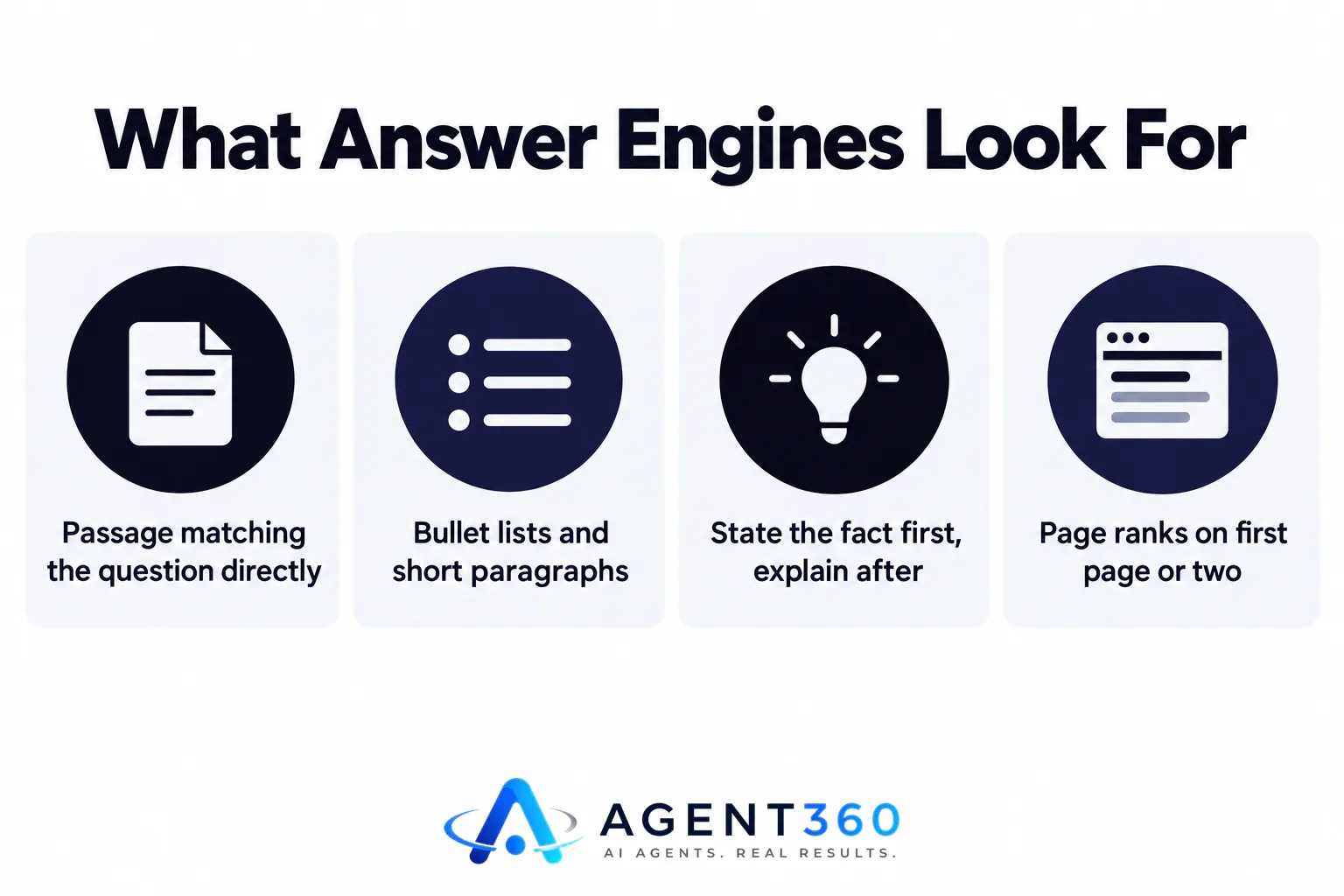
It looks for a passage that directly matches the question — usually within the first screen of content, written in plain sentences instead of vague claims. Bullet lists, defined terms, and short paragraphs extract more cleanly than long narrative blocks. State the fact first, then explain it; that order quotes easier than one that builds up to the point.
Does my site need to rank first to be cited?
No. But it needs to land somewhere on the first page or two for the query. AI Overviews and AI Mode pull from organic results, so a page buried on page three of Google rarely surfaces in the AI answer either. Fix the ranking problem and the AI-visibility problem usually fixes itself; a keyword gap analysis is a reasonable way to find where competitors are taking that first-page spot from you.
How to show up in Google AI search results?
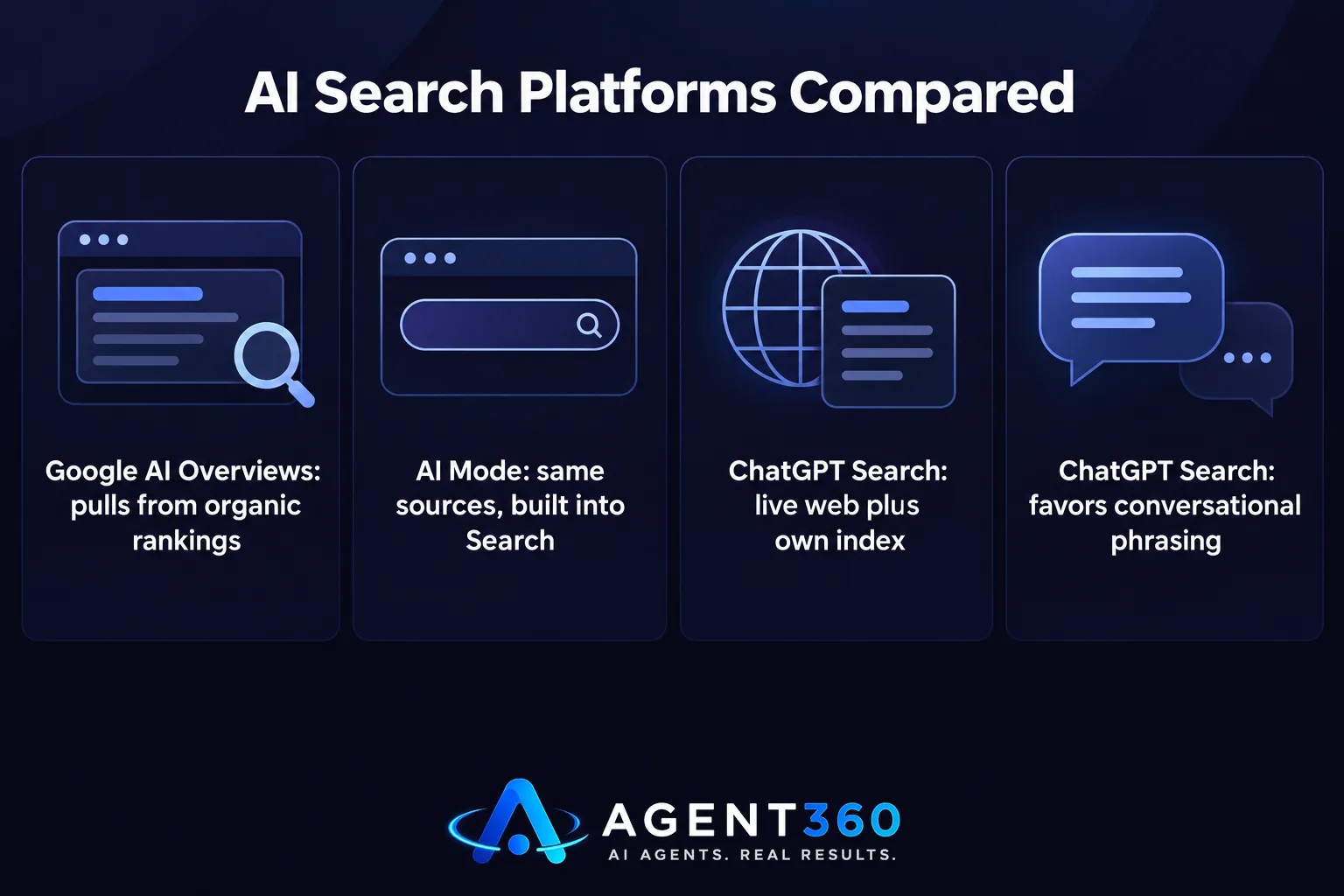
Showing up in Google AI Overviews and AI Mode starts with solid organic rankings, then layers on structured, directly worded content that Google's summarization system can lift cleanly. Google has said its AI features draw mainly from the regular search index, so there's no separate submission process to file. It's the same SEO path — just walked with more attention to how answerable each page actually is.
What should I check on my own pages first?
Open your three or four highest-intent pages and read only the first 150 words. If that passage doesn't answer the main question a visitor would type into Google, rewrite it — one sentence, answer first, brand language after. Pages that bury the answer under a mission statement or a hero-image caption rarely get picked up by AI Overviews.
How to appear in ChatGPT search results?
Appearing in ChatGPT search results depends on being indexed in the sources ChatGPT pulls from when it browses the live web, which overlaps with standard search visibility but is not identical to it. ChatGPT's search mode fetches current pages instead of relying only on older training data, so recency and crawlability both matter. A page that blocks common crawlers, loads behind heavy JavaScript, or sits several clicks deep in your site structure is harder for it to find — and harder to cite.
Is this the same work as ranking on Google?
Mostly, yes. One difference worth noting: ChatGPT tends to favor pages that read like a direct answer to a conversational question — closer to how people type into a chat box than how they type into a search bar. A few pages written in the exact phrasing of common customer questions, not just keyword-style headings, tend to help here.
How to activate AI Mode in search?
AI Mode is a feature inside Google Search itself, not something a business activates; it turns on for a searcher, and your job is to be one of the sources it draws from when it does. There's no setting on a website owner's side that flips AI Mode “on” for their content. The real question for a business isn't how to activate it — it's how to be included in what it shows, which comes back to the same organic and structural work covered above.
- Audit your top pages for a direct answer. Rewrite the opening of each key page so the main question is answered in the first sentence.
- Add or refresh a publish date. Visible recency signals matter more for AI summarization than for traditional ranking.
- Check crawlability. Confirm your robots.txt and JavaScript rendering are not hiding key content from crawlers.
- Build out question-shaped pages. Match the exact phrasing customers use, not just the keyword version of it.
- Track citations, not just rankings. Search your brand and category terms periodically inside ChatGPT and Google to see whether you are being named.
Get Help Showing Up Where Buyers Are Already Asking
This kind of visibility work never really stops. New questions come up, competitors publish, and answer engines keep changing how they summarize. Agent360's SearchAgent is built for that cycle — writing and publishing articles aimed at both Google rankings and AI answer inclusion, and tracking whether you're being named in tools like ChatGPT, Claude, and Google AI Overviews.

It runs alongside the rest of the all-in-one growth plan, so the SEO work ties back to the same site, funnels, and follow-up system instead of living with a separate vendor.
See exactly what's included at how it works.
Frequently Asked Questions
How to show up in Google AI search results?
Rank organically for the question first. Then make sure the page answers it directly in the opening sentences instead of burying it under general marketing copy. Google's AI features draw from the same index as regular search, so there's no separate submission step.
How to appear in ChatGPT search results?
Keep pages crawlable, current, and phrased close to how a person would actually ask the question in a chat box. ChatGPT's search mode fetches live pages, so recency and clean indexing matter more here than they do for a static knowledge source.
How to activate AI Mode in search?
AI Mode is a Google Search feature a searcher turns on — not something a business activates. The real task for a business is being one of the sources it cites, which depends on the same ranking and content-structure work used for AI Overviews.
How do I get into AI search?
Publish content that directly answers a specific question near the top of the page, back it with current rankings, and keep the page technically easy for a crawler to read. AI answer engines extract from pages that already perform well in standard search.
Does structured content really change whether I get cited?
Yes — short paragraphs, headings phrased as questions, and an answer placed early all make a page easier for any summarization system to lift cleanly. A page that reads like a direct answer gets pulled before one that reads like a brochure.
How long does it take to see results from this work?
There's no fixed timeline. It depends on how competitive the query is and how quickly search engines recrawl your pages. The ranking side of this follows the same pattern described in how long does SEO take to show results.
More articles
- Whitelabel GEO: What to Check Before You Resell It
- Applicant Tracking System for Small Business: A Buyer's Guide
- MSP Appointment Setting: What It Actually Costs
- How Long Does SEO Take to Show Results?
- Do Outsourced SDR Firms Require Long-Term Contracts?
- Done For You SEO: What's Actually Included?
- How to Get in Google AI Overviews: A Practical Checklist
- Outsourced SDR vs Hiring an SDR in Australia: True Costs
