Done For You SEO: What's Actually Included?

Done for you SEO means an outside team handles the technical fixes, the content, and the link-building needed to rank your site, while you approve direction and read the reports. You don't touch keyword spreadsheets, write meta descriptions, or chase backlinks. Someone else does the work. You watch the rankings move.
The term carries more weight now because search has split in two. You still need to rank on Google, but you also need to show up when someone asks ChatGPT or Google's AI Overviews a question about your business. A done for you setup should handle both — not just the old ten blue links.
This matters most to owners who don't have the hours to learn SEO and don't want to babysit a freelancer's to-do list. The question isn't whether to outsource it; most small and mid-size businesses already do. The real question is what “done for you” should cover before you sign anything.
Key Takeaways
- Done for you SEO should include technical fixes, ongoing content, and visibility in AI answer engines, not just a monthly report.
- You should never lose the ability to review or approve what gets published under your name.
- Results from SEO work take months to show, regardless of who does the work, so judge a provider on process, not promises.
- Compare what's included against a clear checklist before you sign, and see what done-for-you should include before committing.
- Price per month tells you little on its own; ask what's covered at that price and what costs extra.
Table of Contents
What Does Done For You SEO Actually Include?
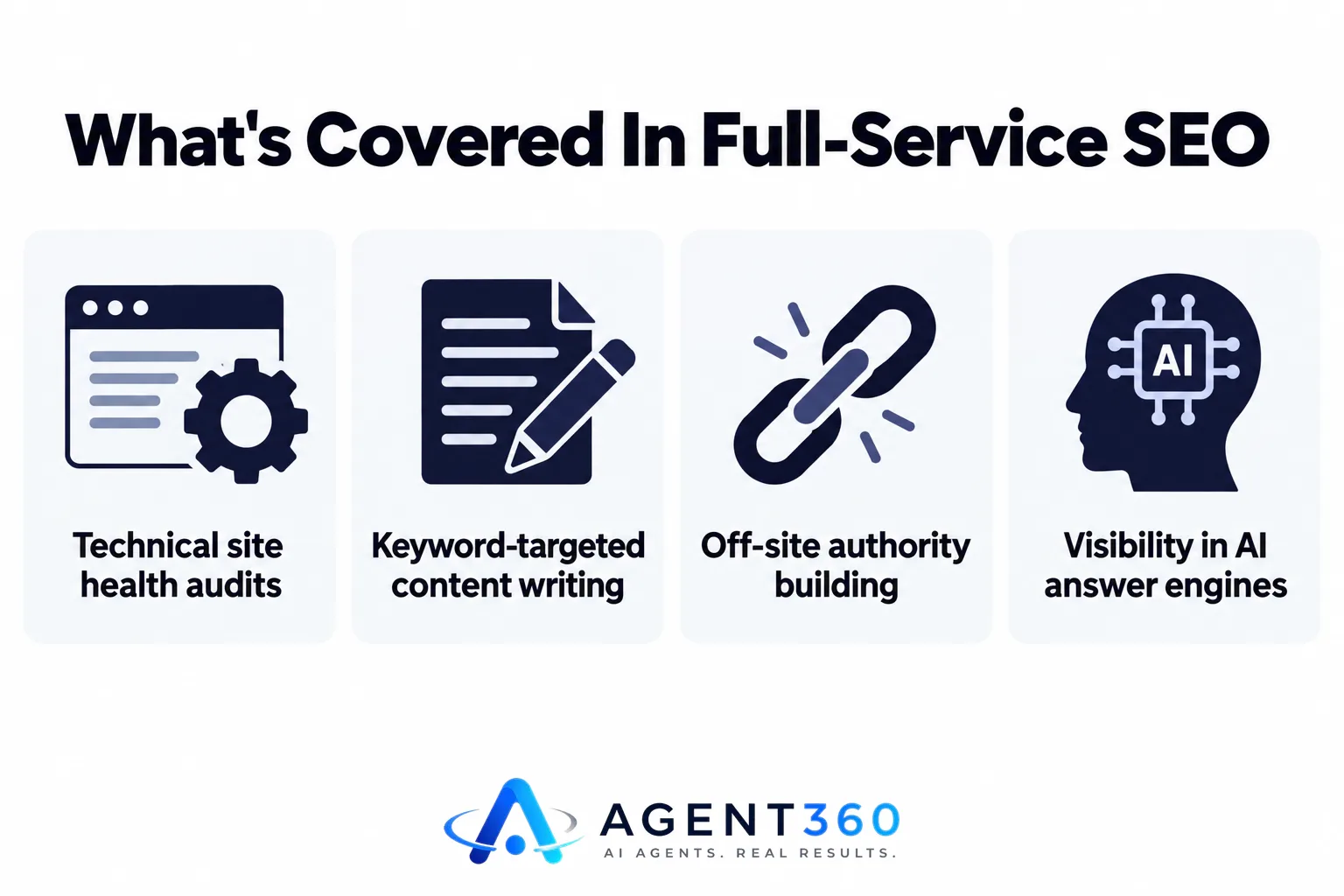
A full done for you SEO service covers technical site health, keyword-targeted content, and off-site authority building, managed on an ongoing basis. Someone audits your site for crawl errors and slow pages, writes and publishes articles aimed at searches your buyers actually type, and builds the signals that tell Google and AI tools your site is worth citing. It's not a one-time audit with a PDF at the end.
Does It Cover AI Search Results Too?
It should. Getting named inside an AI Overview or a ChatGPT answer rests on a lot of the same signals as ranking on Google — clear structure, authoritative content, consistent publishing — plus a few newer ones, like how directly your pages answer one specific question. A provider that only talks about “page one rankings” and never mentions AI answers is still working from the old playbook.
How Is Done For You SEO Different From Hiring a Freelancer or Agency?
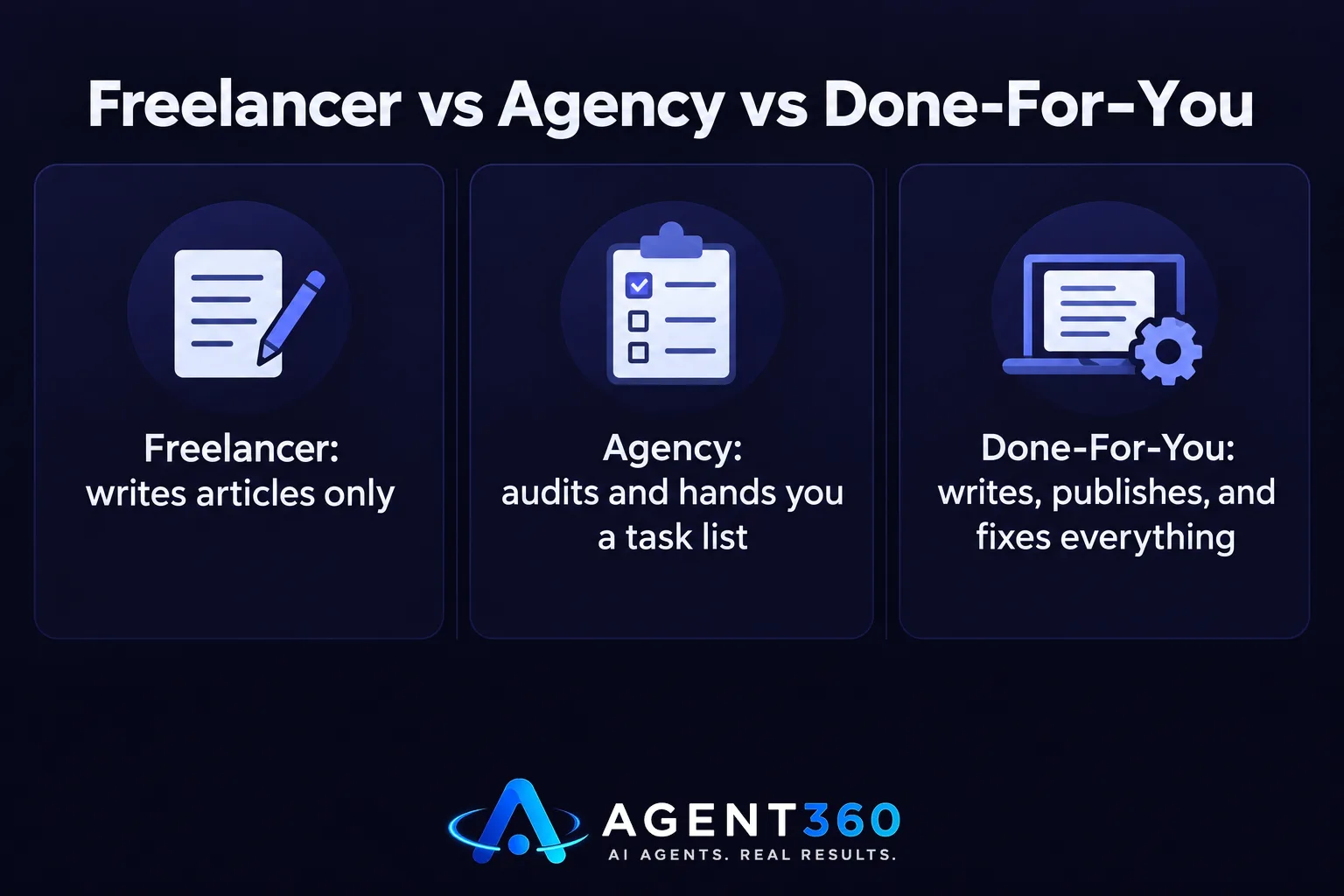
The difference is who owns the whole process, not just one piece of it. A freelancer might write articles but leave technical fixes to you. A traditional agency might run an audit and hand you a list of tasks for your developer. Done for you SEO is meant to remove that handoff — the team writes, publishes, and fixes, and you're not the project manager stitching vendors together.
What Should You Still Review Yourself?
You should still see and approve anything published under your business name before it goes live, and you should get reports you can actually read — rankings, traffic, and which pages are driving calls or form fills. If a provider can't show you that, you're paying for activity, not results you can check.
How Long Before Done For You SEO Shows Results?
Most sites need two to four months before rankings move in a way you can measure, and longer for competitive keywords. That holds true no matter who does the work, because Google and AI crawlers need time to re-index pages, build trust in new content, and weigh it against everything else already ranking. Anyone promising first-page rankings in weeks is describing paid ads, not organic SEO.

What Slows Results Down?
A site with deep technical problems — broken links, duplicate pages, slow load times — takes longer, because those have to get fixed before new content can help. A thin publishing schedule slows things down too. One article a month moves much slower than a steady, planned cadence.
How Do You Choose a Done For You SEO Provider?
Pick a provider by checking what they actually do each month, not just the price on the invoice. Walk through these steps before you sign a contract:
- Ask for a sample content calendar. You want to see how often they publish and whether topics tie back to real search terms your buyers use.
- Ask how they handle technical fixes. Find out whether site speed, broken links, and mobile issues are included or billed separately.
- Ask about AI search visibility specifically. If they can't explain how their work affects AI Overviews or chatbot answers, that gap will show up later.
- Check the reporting format. You want rankings, traffic, and lead activity in one place, not a spreadsheet you have to interpret yourself.
- Compare against at least one alternative. A quick look at how providers stack up makes it easier to spot what's missing from any single pitch.
What Does Done For You SEO Cost?
Done for you SEO is usually sold as a flat monthly fee that bundles content, technical work, and reporting into one plan rather than billing each task separately. That structure matters more than the exact number, because a low monthly fee that leaves out content writing or technical fixes can end up costing more once you add those back in piecemeal. Ask what's included at the quoted price before you compare it to anything else.
Take the Next Step With Done-For-You SEO
Agent360's SearchAgent service is built to cover both sides of search: it works to rank you on Google and get you named in AI answers from tools like ChatGPT, Claude, and Google AI Overviews, and it writes and publishes the articles that back that up. It's part of the All-in-one growth plan, which also covers your website, ads, funnels, CRM, and automation on one monthly plan starting at $297/mo, so you're not stitching together five vendors to get one result.
If you're trying to decide whether to handle SEO in-house, hire a freelancer, or hand the whole thing to a team, start by looking at what's included at each pricing level so you can compare it against what you're doing now.
Frequently Asked Questions
Is done for you SEO worth it for small businesses?
It's worth it when the alternative is not doing SEO at all, or doing it inconsistently between other tasks. Small businesses often lack the hours to publish content and fix technical issues on a regular schedule, which is exactly where a consistent, managed process pays off over time.
Does done for you SEO include content writing?
A full-service provider should include content writing as part of the package, since ranking depends on a steady flow of pages targeted at real searches. If content is billed as an add-on, ask how many articles are included before you compare the price to anything else.
How much should done for you SEO cost per month?
Costs vary based on how much is bundled in — technical work, content volume, and reporting all affect the price. Rather than comparing a single number across providers, compare what's included at that number.
Can done for you SEO guarantee rankings?
No legitimate provider can guarantee a specific ranking, because Google's algorithm and AI answer systems weigh too many factors outside any single team's control. What a provider can control is consistent technical fixes, content, and reporting that give your site a fair shot.
Do I still need to approve what gets published?
Yes. Even with a fully managed service, you should see and approve content before it goes live under your business name, and you should get clear reports on what was published and how it performed.
More articles
- How to Get in Google AI Overviews: A Practical Checklist
- Outsourced SDR vs Hiring an SDR in Australia: True Costs
- AI Phone Screening: What It Actually Does for Hiring Teams
- Done-For-You Marketing: What It Actually Means
- Keyword Gap Analysis: Find What Competitors Rank For
- SDR Outsourcing: What to Check Before You Sign a Contract
- Real Estate Agent Marketing: What Actually Books Showings
- AI Sourcing: What It Actually Does for Recruiters
