Cold Email for Founders: A Practical Way to Start

Cold email for founders means writing and sending outbound emails yourself to book sales meetings, before you have budget for a hire. You are the writer, the sender, and the one who shows up to the call. That changes what “good” cold email looks like compared to a trained SDR running a script.
Founders who do this well treat cold email as a small, repeatable system: one list, one message, one inbox to check twice a day. Founders who struggle usually try to do too much at once — five variants, three tools, no clear next step for the prospect.
This guide covers what to write, how much volume you actually need, and when the manual version stops being worth your time.
Key Takeaways
- Start with one tight offer and one list of 50-100 real prospects before you touch copy.
- Write like a founder, not a marketer — short, specific, and signed by a real name.
- Protect your sending domain from day one so a few weeks of mistakes don't cost you the inbox.
- Track replies in three buckets so you know what's actually working, as covered in Your CRM Should Have Four Stages, Not Fourteen.
- Decide early whether you're building a skill or buying back time — the answer changes your next move.
Table of Contents
What does cold email for founders actually involve?
It means owning the full loop: list, message, send, reply, and follow-up, with no one else to hand it off to. That is different from running a sales team, where each piece can be someone else's job. As a founder, you are deciding who to email, what to say, and what happens the moment someone writes back — often from the same inbox you use for customer support.

What does a founder need before sending the first email?
A list of real people who match your buyer, one clear sentence about the problem you solve, and a calendar link. Skip the templates and tools until those three exist. A polished sequence sent to the wrong 50 people will not book meetings; a plain message sent to the right 50 might.
How much time should cold email take each week?
Plan for a few focused hours: building or refreshing the list, writing or adjusting the message, and clearing replies. The time cost is front-loaded in the first week and drops once the list and message are steady — until it's time to find a new list.
How do you write a cold email that gets replies as a founder?
Write it the way you'd write to a peer, not the way a marketing team writes an announcement. Founders have one advantage a hired SDR doesn't: the email can honestly say “I built this” or “I run this company,” and that carries weight a templated signature doesn't.
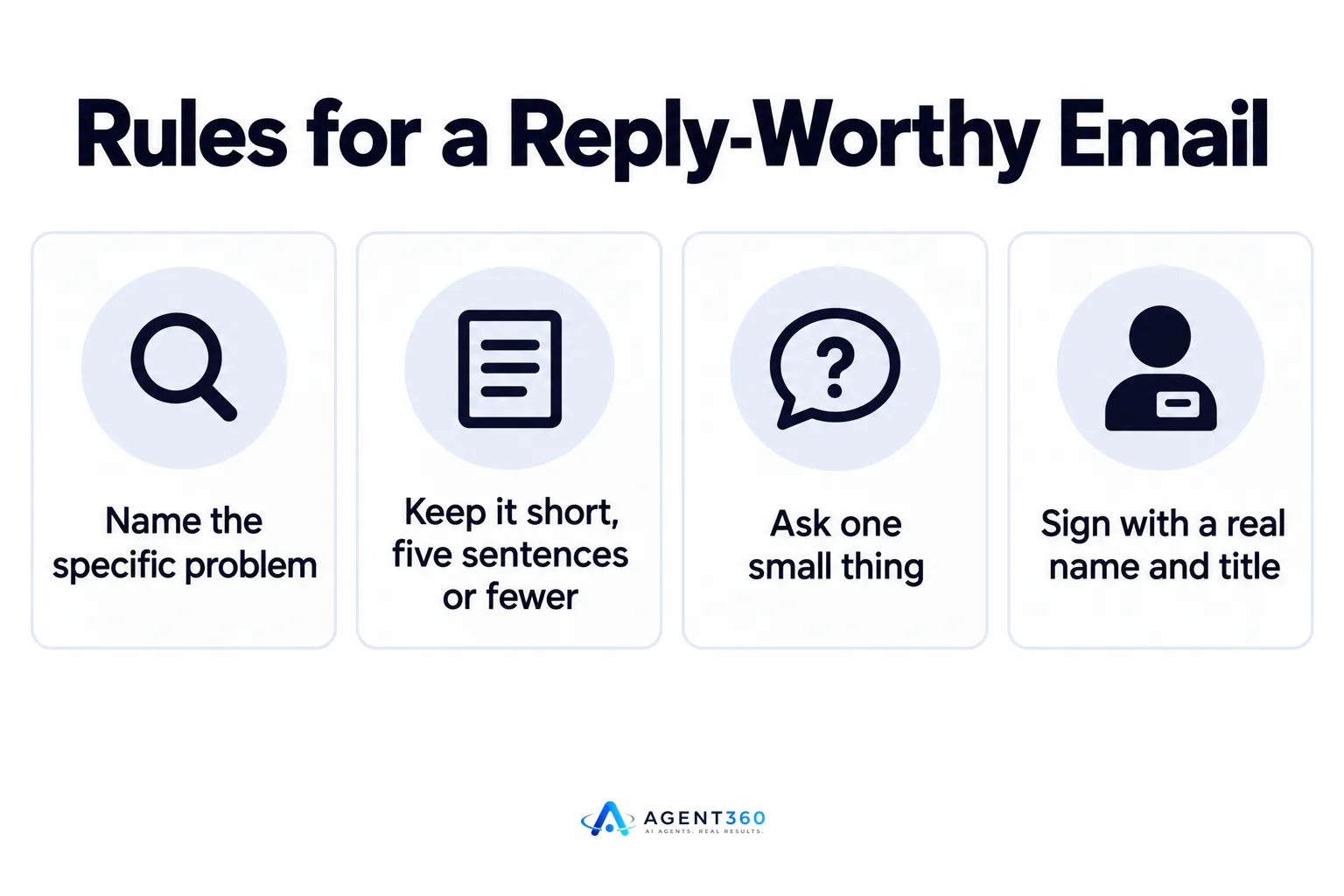
- Name the specific problem. One sentence that shows you understand their situation, not your product's feature list.
- Keep it short. Five sentences or fewer. Long emails from an unknown sender read as effort spent on everyone, which reads as spam.
- Ask one small thing. A yes/no question or a single time suggestion, not “let me know if you're interested.”
- Sign with a real name and title. No logo, no banner, no “Sent from my sales platform.”
- Send a short follow-up, not a repeat. A one-line bump after four or five days outperforms resending the same pitch.
Should founders personalize every email by hand?
Some personalization matters — one line that shows you looked at their company or role. Writing every email from scratch does not scale past a handful a day, which is usually the real ceiling on manual cold email for a founder running it solo.
How many prospects and emails do you need to get meetings?
There's no fixed number that works for every founder, because reply rates depend on list quality and offer fit more than volume. What matters is having enough prospects that a realistic reply rate still produces a few conversations a week, and enough discipline to track what's working instead of guessing.
What happens if the list is too small?
A list of 20 people gives you almost no signal. If none reply, you can't tell if the message is wrong or you just got unlucky. A starting list in the 100-200 range gives enough data to see a pattern after one send.
How long before cold email starts producing meetings?
Expect the first week or two to be about testing the message, not booking calls. Replies — including “not now” ones — tell you more than silence does. If nothing changes after a few sends, the problem is usually the list or the offer, not the subject line. For the mechanics of staying under sending limits while you find your rhythm, see cold email volume guidance.
Should a founder do cold email alone or use a tool?
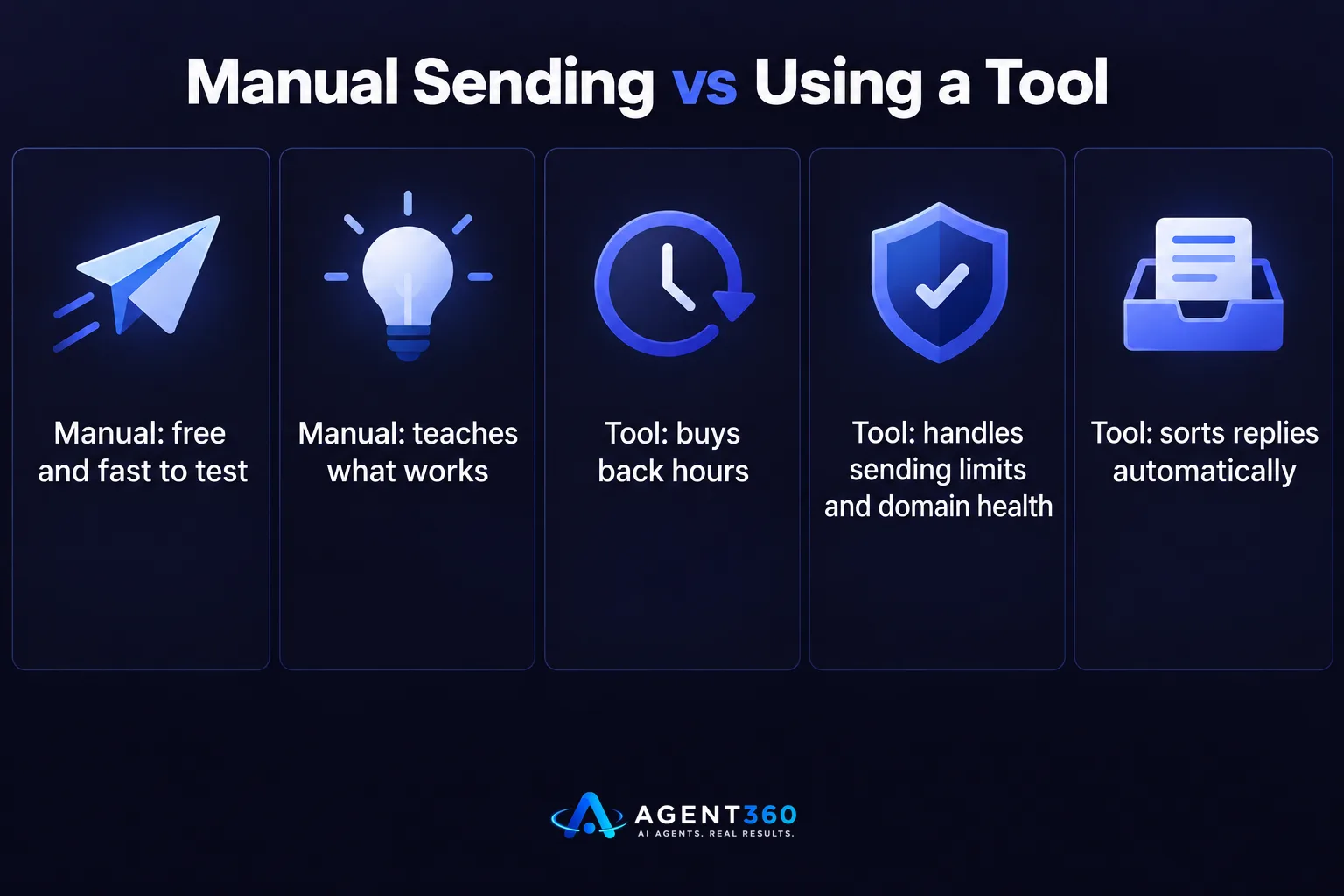
Doing it alone teaches you what works; using a tool buys back the hours once you know what works. Most founders start manually because it's free and fast to test. The point where that stops making sense is when you're spending more hours sending and tracking than it would take to set up software that does the sending and reply-sorting for you.
What should a founder look for in cold email software?
Look for something that handles sending limits and domain health automatically, sorts replies so you're not digging through a crowded inbox, and doesn't charge per seat if you plan to add a cofounder or first hire later. A side-by-side on sending behavior is in Cold Email Software Comparison: What Actually Matters.
When does it make sense to add other channels besides email?
Once email alone isn't producing enough replies, adding LinkedIn or a phone touch to the same prospect list usually lifts response, because not every buyer checks email first. That's a multi-channel decision, not a copywriting one.
Take the Next Step With Your Outbound
Running cold email by hand teaches you a lot fast, but it has a ceiling: your own hours. Agent360 handles AI prospecting, multi-channel outreach across LinkedIn, email, and phone, and books meetings directly on your calendar, so the system keeps running after the list and message you've tested manually start to work. CRM tools are included, so replies land in a pipeline you can actually see instead of a cluttered inbox.
If you're deciding whether to keep doing this yourself or hand off the sending and tracking, see outreach for how the channels work together.
Frequently Asked Questions
Is cold email still effective for founders in 2025?
Yes, when the list is accurate and the message is short and specific. It fails most often not because email as a channel is dead, but because the list is wrong or the message reads like a mass announcement.
What's the biggest mistake founders make with cold email?
Sending to too broad a list and writing a pitch instead of a question. Both make it easy for a prospect to ignore the email rather than reply, even with “no.”
Can a founder run cold email from their main business inbox?
It's possible at low volume, but it carries risk to deliverability if volume grows or mistakes happen early. Many founders use a separate, warmed-up sending domain to protect the main inbox.
How do I know if my cold email message is working?
Track replies in three categories — interested, not now, and no — rather than just counting opens. A steady trickle of “not now” replies with context is often a sign the message is landing, even before meetings get booked.
Do I need a CRM if I'm a solo founder doing cold email?
You need somewhere to see who you emailed, when, and what they said back, even if it's simple. As volume grows past what a spreadsheet can track cleanly, a basic CRM saves you from losing replies.
More articles
- How to Book Sales Meetings Without Hiring an SDR
- Outbound Sales for Founders: How to Book Meetings Yourself
- Cold Email Sending Limits: What They Actually Are
- How Many Inboxes Do You Need for Cold Email?
- How Many Emails Per Inbox Per Day Is Safe to Send?
- LinkedIn Weekly Invitation Limit: What It Really Is
- How Many LinkedIn Messages Can You Send Per Day?
- LinkedIn Connection Request Limit: What It Is and How to Stay Safe
