Cold Email Sending Limits: What They Actually Are
Cold email sending limits are the ceilings on how many messages one inbox or domain can send before mailbox providers start routing that mail to spam or blocking it outright. There isn't a single published number that applies to every sender. The real limit for your domain is a combination of what mailbox providers like Gmail and Outlook tolerate, what your sending tool enforces, and how much trust your domain has built up so far.
Treating sending limits as one fixed rule is how domains get burned. Treating them as a system with three moving parts is how you keep deliverability steady while volume grows.
Key Takeaways
- Cold email sending limits come from three sources at once: mailbox providers, your sending tool, and your domain's own reputation.
- Google's bulk sender guidelines set a spam-rate threshold, not a volume cap, which means reputation matters more than raw numbers.
- New domains need a slow ramp before they can carry full volume, regardless of what your tool allows technically.
- Spreading volume across more inboxes and domains lowers the load on each one, see cold email volume planning for how that math works.
- A rising bounce rate or falling reply rate is an earlier warning sign than any limit you'll find published.
Table of Contents
What counts as a cold email sending limit?
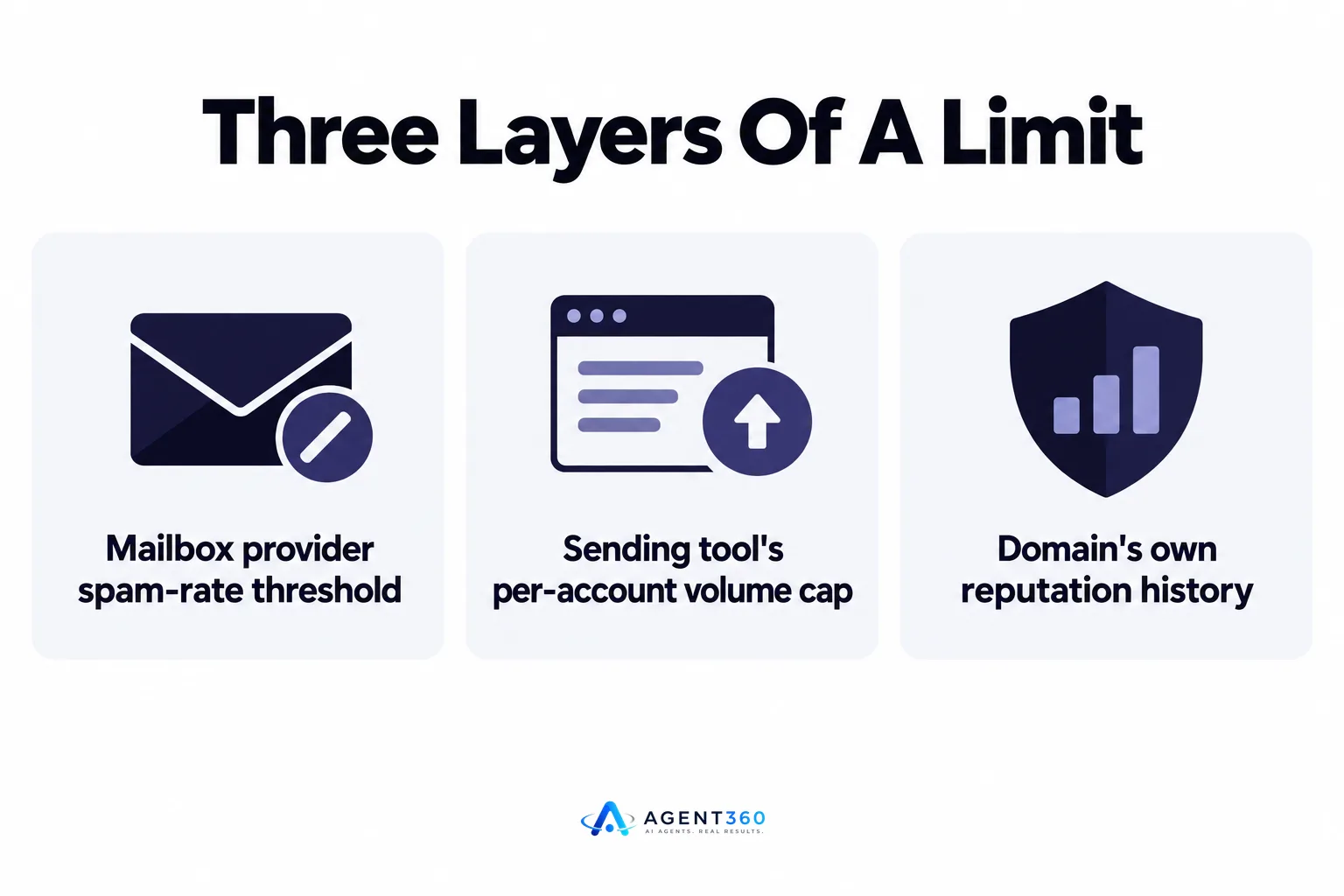
A sending limit is the point past which more volume starts hurting deliverability instead of just adding reach. It shows up in three layers, and each one can cap you independently of the others.
Is it the same as a mailbox provider's rule?
No. Mailbox providers like Gmail and Outlook don't publish a single daily number for cold senders. What they do publish, through Google's bulk sender guidelines, is a spam-rate threshold — senders are expected to keep spam complaints under 0.3% as measured in Google Postmaster Tools. Cross that threshold and your mail gets filtered regardless of how many you sent.
Is it set by the tool I send from?
Partly. Cold email platforms and inbox providers often cap outgoing volume per connected account to protect their own sending reputation, since one bad sender can affect deliverability for everyone on the same infrastructure. Those caps are set by each platform and aren't always published, so check your tool's own documentation rather than assuming a number.
Why do these limits exist in the first place?
They exist because mailbox providers are grading your domain, not counting your messages. Every email you send affects a reputation score tied to your sending domain and IP. High volume from a domain with no history looks like spam behavior even if every message is relevant and personalized.
That reputation score is built from open rates, reply rates, bounce rates, and spam complaints over time. A domain that's been sending modest, well-targeted volume for months can usually handle more per day than one that started last week. This is why “safe limit” is really shorthand for “safe limit given where your domain's reputation sits right now.”
How do you find a safe sending limit for your domain?
You find it by ramping slowly and watching the signals, not by picking a number off a blog post. The process looks the same whether you're on a brand-new domain or an established one adding volume.
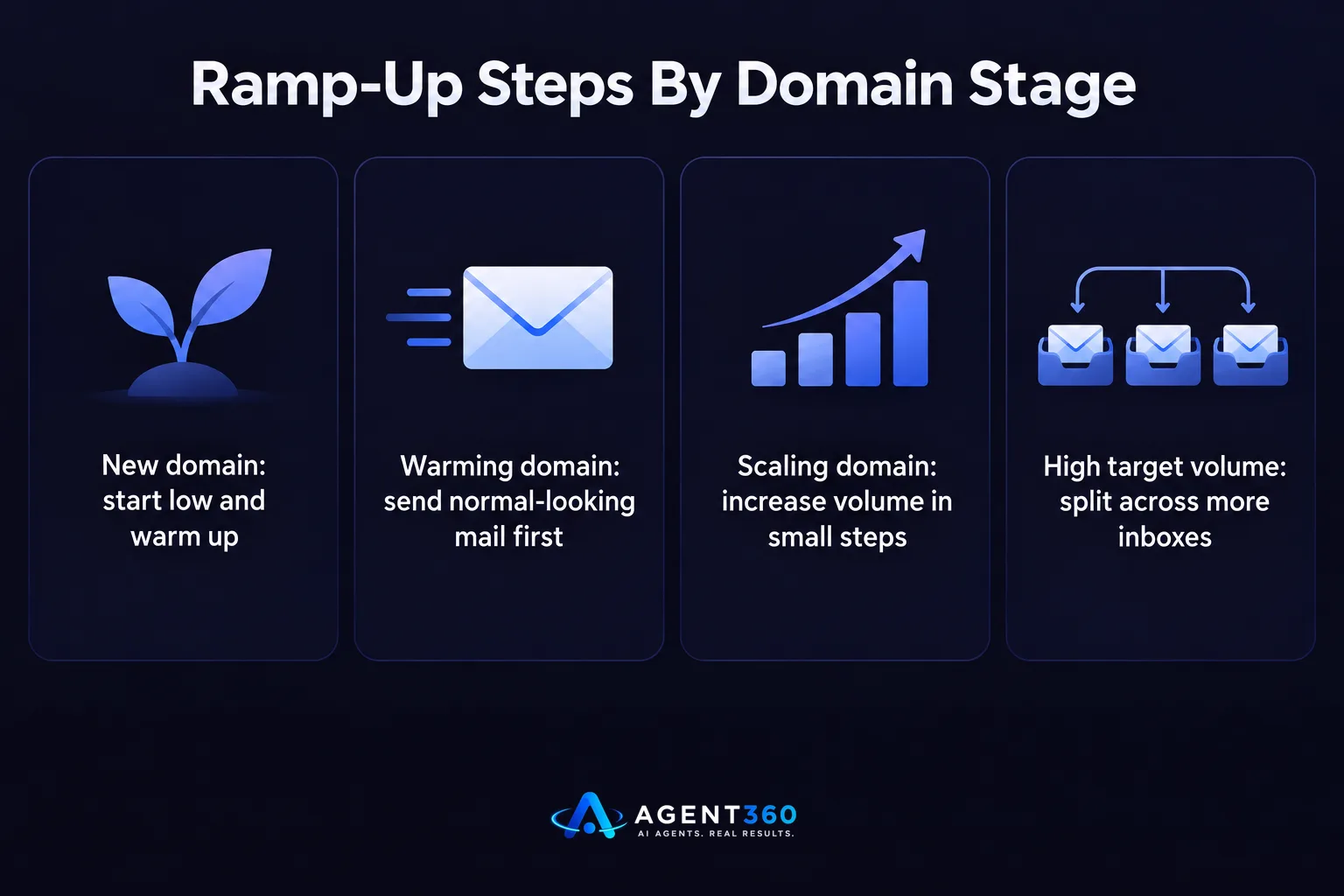
- Start low on a new domain. New domains have no history, so mailbox providers watch them closely in the first weeks. Begin with a small daily volume and increase gradually.
- Warm the domain before full campaigns. Let the domain send and receive normal-looking mail for a stretch before you point real outbound volume at it.
- Increase volume in small steps. Raise daily sends gradually rather than jumping straight to your target number, giving mailbox providers time to build trust in the pattern.
- Watch bounce and spam-complaint rates daily. A rising bounce rate or spam complaint count is the clearest early signal that you've gone past the domain's current limit.
- Split volume across more inboxes or domains. If your target volume is higher than one domain can safely carry, add inboxes rather than pushing one domain harder.
What happens if you ignore sending limits?
You risk the mail landing in spam, or the domain getting blocklisted, which is harder to fix than slowing down would have been. Once a domain's reputation drops, recovery usually means a forced pause and a slower re-warm, costing more time than a cautious ramp would have.
Can a damaged domain recover?
Often, yes, but it takes sending clean, low-volume mail for a sustained period while bounce and complaint rates come back down. There's no fixed timeline mailbox providers publish for this, which is another reason to avoid testing the ceiling in the first place.
Keep Every Inbox Under Its Limit
Planning sending limits by hand across multiple inboxes and domains is manageable at small volume and harder to keep straight as a team scales outbound. Agent360's multi-channel outreach spreads messages across email, LinkedIn, and phone, so no single inbox is carrying all the weight of your pipeline target.

Pairing that with AI prospecting means the volume going out is aimed at buyers already showing signals, which keeps reply rates up and spam complaints down — the two metrics mailbox providers actually watch.
See how the channels and volume planning fit together on the outreach product page.
Frequently Asked Questions
What is a safe cold email sending limit per day?
There's no single safe number that applies to every domain. The safe figure depends on your domain's age, reputation, and recent bounce and complaint rates, which is why ramping up gradually and watching those signals matters more than following a fixed count.
Do Gmail and Outlook publish exact sending limits?
Google publishes bulk sender guidelines with a spam-rate threshold rather than a volume cap, expecting senders to keep complaints under 0.3% as measured in Google Postmaster Tools. Outlook and other providers don't publish an equivalent fixed daily number for cold senders.
Does warming up a domain increase its sending limit?
Yes. A domain that has sent consistent, low-complaint mail over time builds reputation that lets it carry more volume safely, which is the entire point of a warm-up period before launching full campaigns.
Should I use one inbox or several for cold email?
Several inboxes spread volume so no single one approaches its limit, which protects your overall sending capacity if one account runs into a problem. How many you need depends on your target send volume, covered in more detail in cold email volume planning.
What's the first sign I've exceeded a sending limit?
A rising bounce rate or spam complaint rate is the earliest and clearest signal, usually appearing before mailbox providers take any visible action like blocking the domain. Reply rate dropping sharply is a secondary signal worth checking alongside it.
More articles
- Outbound Sales for Founders: How to Book Meetings Yourself
- How Many Inboxes Do You Need for Cold Email?
- How Many Emails Per Inbox Per Day Is Safe to Send?
- LinkedIn Weekly Invitation Limit: What It Really Is
- How Many LinkedIn Messages Can You Send Per Day?
- LinkedIn Connection Request Limit: What It Is and How to Stay Safe
- The Best Cold Email Tool Depends on Your Outbound Stack
- Smartlead vs Lemlist: Which Cold Email Tool Fits You?
