Cold Email for Recruiters: What Actually Works
Cold email for recruiters splits into two completely different jobs: landing new client companies and filling the roles you already have open. A staffing or recruiting firm emailing a hiring manager is selling a service. A recruiter emailing a passive candidate is selling an opportunity. Use the same subject lines, the same offer, and the same follow-up cadence for both, and neither one lands well.
Most of the confusion around cold email for recruiters comes from treating it as one skill instead of two. Below: what to write, how often to send, and whether any of it still works — or is even legal — heading into next year.
Key Takeaways
- Write separate cold email templates for client business development and candidate sourcing — the offer and proof points differ.
- Keep subject lines short and specific to the role or the hiring problem, not generic sales language.
- Follow CAN-SPAM and include an opt-out on every email sent to a business contact — recruiting outreach is still commercial email.
- Staffing firms that need a steady flow of client meetings without adding recruiters to business development can see how a dedicated lead flow works at /solutions/agencies.
- Expect weeks, not days, before reply rates stabilize — a new domain and a new list both need time to prove themselves.
Table of Contents
What to Say in a Cold Email as a Recruiter?
Say what problem you solve for that specific reader, in the first two lines, with no preamble. A hiring manager wants to know you can fill a role faster or cheaper than their current process. A candidate wants to know why this opportunity is worth fifteen minutes of their time. Mix those two pitches into one template, and that's the most common mistake in recruiting cold email.
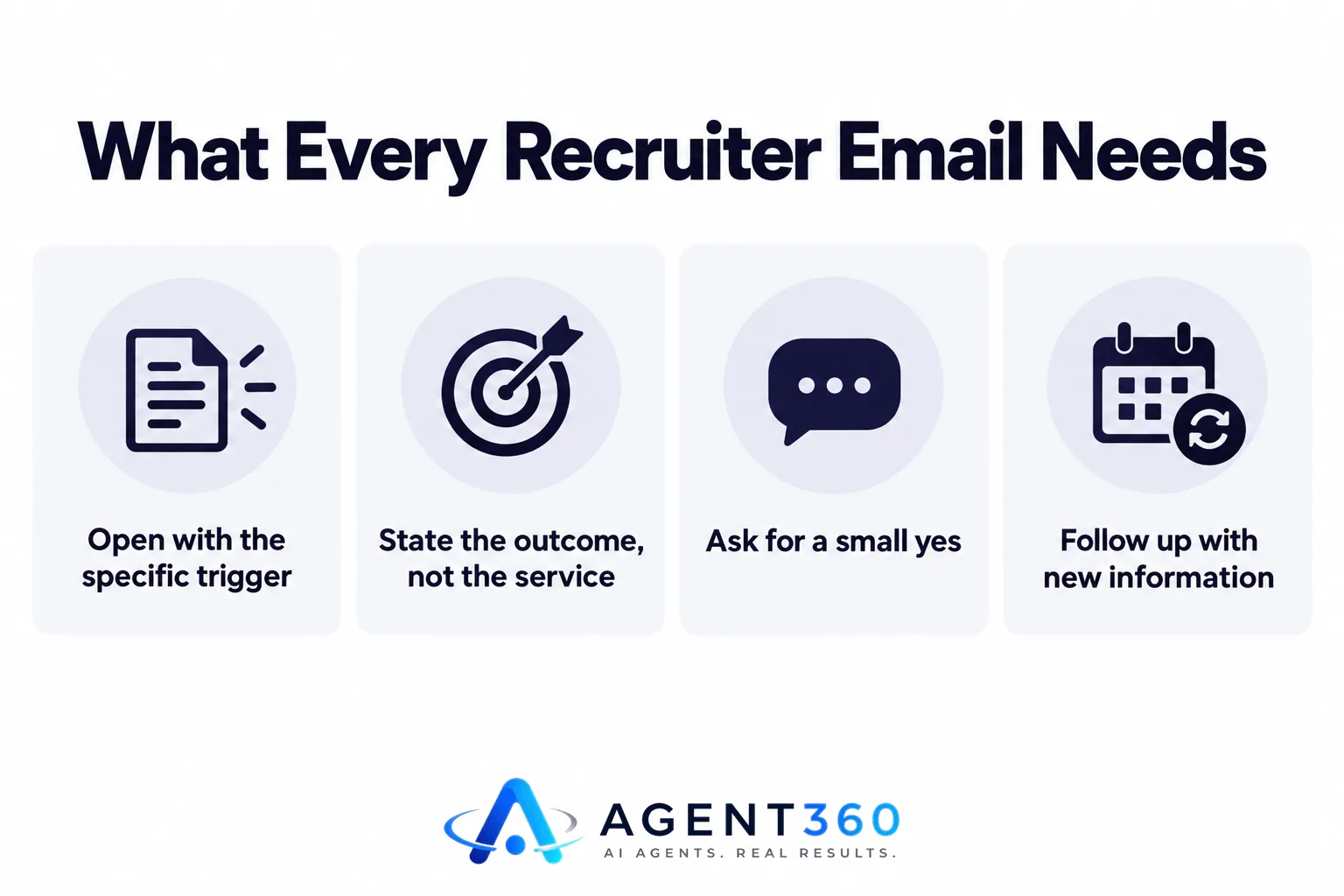
- Open with the specific trigger. Reference a job posting still open after 30+ days, a recent funding round, or a hiring pattern you noticed — not “I hope this finds you well.”
- State the outcome, not the service. “Fill your open SRE role in under three weeks” lands better than “We provide staffing solutions.”
- Ask for a small yes. One question, one meeting length, one calendar link. Don't ask the reader to describe their whole hiring process in a reply.
- Follow up with new information, not a nudge. A second email that adds a relevant candidate profile or a market rate data point beats “just following up” every time.
What Should the Subject Line Do?
Name the role, the company, or the specific hiring problem — nothing vague. “Your Senior DevOps req” beats “Quick question” almost every time, because it tells the reader why you're in their inbox before they even open it.
What Is the 30/30/50 Rule for Cold Emails?
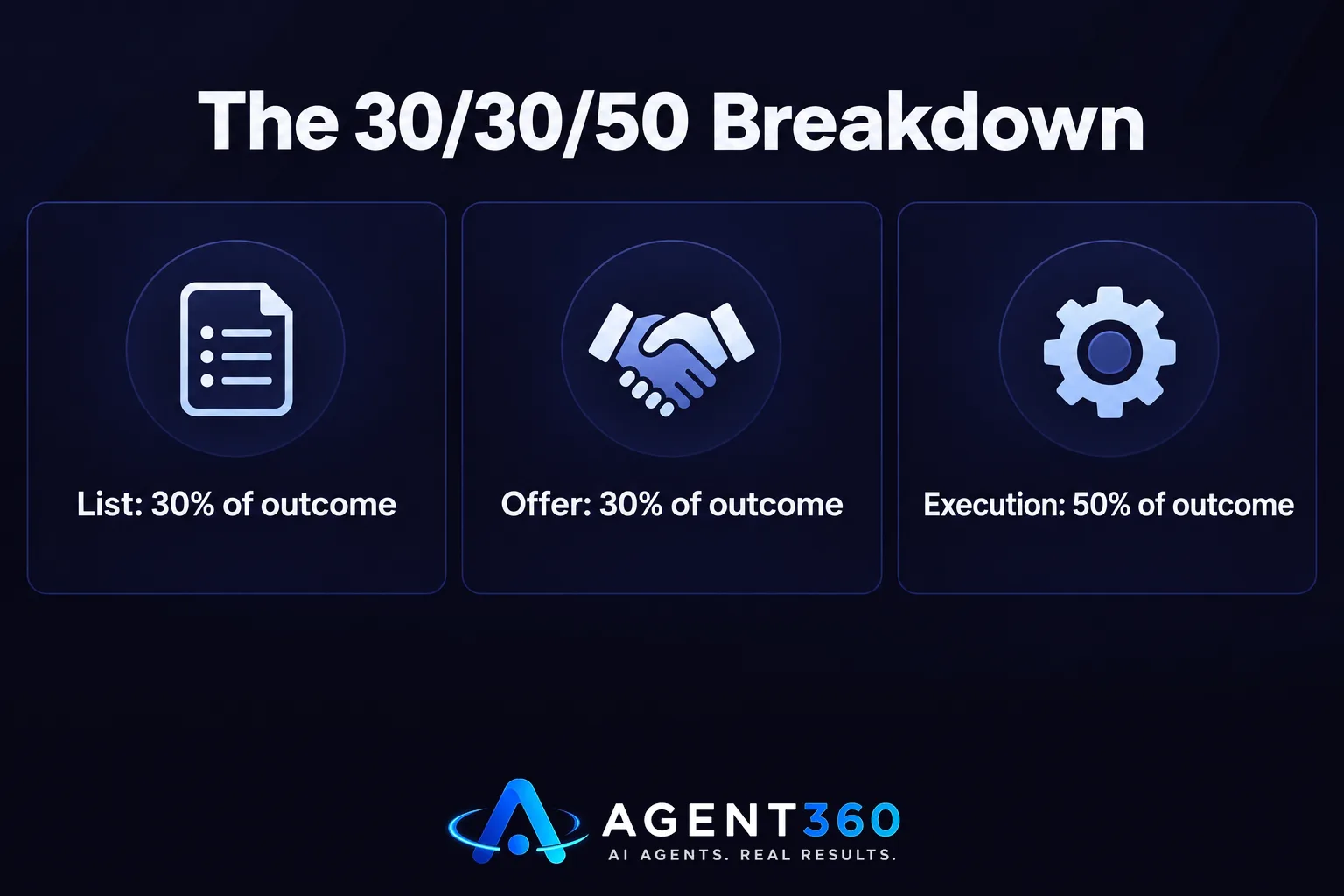
It's a rule of thumb, not a verified statistic, that splits cold email results into three levers: the list, the offer, and everything else. Roughly 30% of outcome comes from who you email (list and targeting accuracy), 30% from the offer itself (the role, the fee structure, the pitch), and the remaining 50% from execution — subject lines, timing, follow-up, copy. No official body tracks these numbers. The value of the rule is the order it puts things in, not the precision of the split.
Which Part Should Recruiters Fix First?
Fix the list before the copy. A perfectly written email to the wrong hiring manager, at a company that isn't hiring, still fails. Confirming the role is open, the contact is the actual decision-maker, and the timing is right does more for reply rates than another round of subject-line testing. Tools built for this stage focus on detecting live buying signals rather than static contact lists — see /product/buying-signals for how that detection works.
Is Cold Email Still Effective in 2026?
Yes, for recruiters who target accurately and send at a sustainable volume — less so for anyone blasting the same message to a wide, unverified list. Inbox providers have gotten better at filtering generic, high-volume sends, which punishes spray-and-pray harder than it punishes cold email as a channel. A hiring manager still reads a well-timed, specific email about a role they're struggling to fill.

What Changed About Inbox Filters?
Major providers now weigh sender reputation, reply rates, and spam complaints more heavily than they did a few years ago. That makes domain warm-up, list accuracy, and send volume per inbox matter more than clever copy alone. How many domains and inboxes a recruiting team needs depends on target volume — that math is laid out at /resources/cold-email-volume.
Is Cold Emailing Illegal?
No, cold emailing a business contact is legal in the United States under the CAN-SPAM Act, but it comes with rules recruiters have to follow. CAN-SPAM requires accurate sender information, a clear subject line, a physical mailing address, and a working opt-out link honored within 10 business days. It does not require opt-in consent the way some other regions do.
What Do CAN-SPAM and GDPR Require?
CAN-SPAM covers commercial email sent to US contacts and focuses on disclosure and opt-out, not prior consent. If a recruiter emails contacts in the EU or UK, GDPR applies a stricter standard — generally a legitimate interest basis plus an easy opt-out for business-to-business outreach. Recruiters sending across both markets should just apply the stricter rule to every send, rather than trying to track which law applies to which contact.
Take the Next Step With Your Outbound
Writing the emails is one part of the job. Finding the right hiring managers, sending consistently, and booking the meeting without a recruiter losing a day to it — that's the harder part. Agent360 gives recruiting and staffing firms a way to run that outreach: AI prospecting that finds live hiring signals, multi-channel sequencing across email, LinkedIn, and phone, and meeting booking straight onto the calendar, all on unlimited seats with no per-user fees.
For firms that want to run it themselves, the Agent360 Platform starts at $99/mo with one triple-verified lead included for every email sent. For firms that want it handled end to end, the VIP Done-For-You option runs outbound with a dedicated GTM engineer for $2,000/mo plus $250 per booked meeting — the only job left is showing up to the call.
Current plans and what's included: /pricing.
Frequently Asked Questions
What should a recruiter's cold email include?
A specific trigger — an open role, a hiring pattern, a recent announcement — a clear outcome the reader cares about, and one small ask, like a 15-minute call. Separate templates for client prospects and candidates perform better than one generic version.
What is the 30/30/50 rule for cold emails?
It's a rule of thumb that credits roughly 30% of cold email results to the list, 30% to the offer, and 50% to execution — copy, timing, follow-up. Treat it as a way to prioritize effort, not a measured industry statistic.
Is cold email still effective in 2026?
Yes, when it's targeted and sent at a sustainable volume from a warmed domain. Inbox filters increasingly penalize generic high-volume sending more than they penalize the channel itself.
Is cold emailing illegal?
No. Cold emailing a business contact in the US is legal under the CAN-SPAM Act as long as the sender is accurately identified and includes a working opt-out. Recruiters emailing contacts in the EU or UK should also account for GDPR's stricter consent standard.
How is cold emailing a client different from emailing a candidate?
A client-facing email sells a hiring outcome and asks for a meeting about filling a role. A candidate-facing email sells an opportunity and asks for a short conversation about fit. Use the same template for both, and you'll usually undersell one or the other.
More articles
- Skylead vs Dripify: Which LinkedIn Tool Fits Your Team?
- MSP Lead Generation Services: What to Look For
- AI Dialer: What It Actually Does and What to Check First
- Unlimited Seats Sales Software: What to Buy and Why
- Cold Email and LinkedIn Sequencer: What to Look For
- Staffing Agency Lead Generation: A Practical Playbook
- AI SDR for Staffing Agencies: What to Look for Before You Buy
- Otter.ai Alternative: What Sales Teams Need Beyond Notes
