Content Pillars for Social Media: Pick 4, Not 12

Three to five pillars. That's the whole range worth working inside. Fewer than three and your feed repeats itself inside a month, and followers notice before you do. More than five and nobody on your team can say which pillar a given post belongs to — which means the pillars aren't a system anymore, they're decoration.
Most teams don't fail by running too few pillars. They fail by naming twelve topics, calling them pillars, and then posting about whatever's on someone's mind that week, because twelve is too many to actually track.
Name each pillar by the outcome it earns, not the subject it covers
"Industry news" is not a pillar. Neither is "company culture" or "product updates." Those are folders. Folders don't tell a writer what to do with a blank page. A pillar should describe the job a post does for the reader: prove you know the field, show the work behind a result, answer the objection that stalls deals, or put a face and a point of view on the brand.
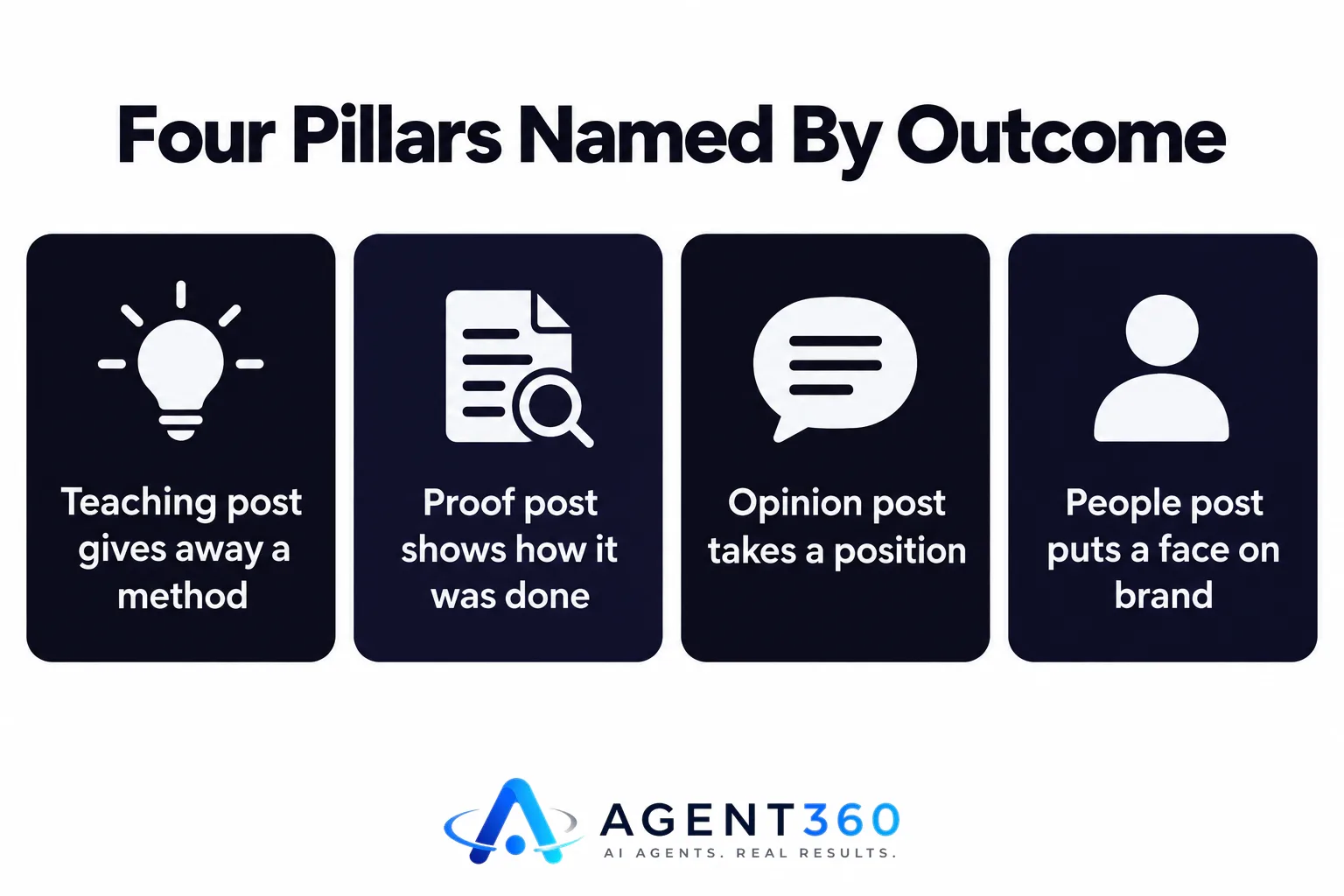
For a B2B team, four pillars built around jobs might look like this: a teaching post that gives away a method, a proof post that walks through how something was actually done, an opinion post that takes a position your competitors won't, and a people post that puts a founder or team member on camera. Every piece of content you could possibly post should fit into one of those four. That's the real test of whether a pillar set works. If a post doesn't fit any of them, either the post is off-brand or you're missing a pillar.
Run two teaching posts for every one pitch
Pillars without a ratio collapse into whichever one is easiest to write that week — almost always the pitch. A feed that leans on pitches stops getting shown. A feed with no pitches at all leaves people unsure what you actually sell. The fix is a fixed mix, not a feeling: for every pitch post, run two that teach something and one that proves something, a pattern covered in more depth in value vs pitch. The ratio matters more than the names ever will. Teams argue for weeks over what to call their four pillars, then post pitch-pitch-pitch anyway. They'd have done better with no pillars and a 2:1:1 rule.

Audit the last 20 posts before you add a new pillar
Before adding a fifth or sixth pillar, pull the last 20 posts and sort them into the set you already have. If one pillar holds twelve of them and another holds one, the problem isn't missing pillars. It's an unused one, and bolting on more won't fix an imbalance you're not correcting. If five or six posts don't sort cleanly into anything, that's the real signal a new pillar is earned — and it should be named for what those stray posts were doing, not for a topic that sounds good in a strategy doc.
This audit turns up a second problem, too: pillars that only exist on LinkedIn. A pillar should survive a platform switch even when the format changes. The same proof-post idea becomes a longer LinkedIn post, a tighter Instagram caption, and a 280-character line on X. If a pillar only works as a long LinkedIn post and falls apart everywhere else, it's a format wearing a pillar's name.
Assign one pillar per week, not one per post
Pillar rotation breaks down the moment it's decided post by post, because whoever's writing that day defaults to whatever's top of mind — usually the pitch. Assign a pillar to a week, or to a day of the week, and the daily decision disappears. Monday is always teaching. Wednesday is always proof. Friday is always the opinion post. A calendar view that shows pillar alongside publish date catches drift before a month goes by lopsided, which is the main thing a calendar built for this does that a plain scheduling grid doesn't.

Four pillars, a fixed ratio, a weekly assignment — that's the whole system. The hard part was never picking the pillars. It's staying inside them once the backlog of ideas runs dry and someone needs a post by Thursday. That's exactly where a tool starts to matter more than the strategy doc: BrandAgent learns a brand's voice and pillars once, through its Brand Kit, then drafts posts against that structure and scores each one against platform rules before it ever reaches you for approval. That's useful for marketing teams running a shared calendar, and for founders who have the pillars in their head but not the hours to write to them every week. Plans start at $97 a month on the pricing page, month to month.
Questions
How many content pillars should a small business have? Three is enough to start and five is the practical ceiling — fewer and the feed repeats itself, more and nobody tracks which pillar a post belongs to.
Should every pillar get equal posting frequency? No. Teaching content should outweigh pitch content roughly two to one, with proof and opinion filling the rest, so the feed earns attention before it asks for anything.
What's the difference between a content pillar and a content format? A pillar is the job a post does for the reader — teach, prove, argue, or introduce a person. A format is just the shape it takes: a list, a before-and-after, a hot take. One pillar can run through several formats without ever changing its job.
More articles
- Is a LinkedIn Ghostwriter Worth It? The Honest Math
- How Much Does a LinkedIn Ghostwriter Really Cost?
- Content Repurposing: How One Recording Becomes a Month of Posts
- How to Write a LinkedIn Post That Actually Gets Engagement
- How AI Talking Head Videos Actually Get Made
- Social Media Posts That Get Leads (Not Just Likes)
- The B2B Social Media Strategy That Actually Moves Deals
- How to Build a Personal Brand on LinkedIn (That Sticks)
