How ChatGPT Picks Which Local Business to Recommend

ChatGPT does not know your business. It reads what other sources say about your business, at the moment someone asks, and repeats the version it trusts most. Getting recommended is not a ranking game you win with a clever prompt on your own site — it is a consistency game you win by making sure every source ChatGPT checks agrees with every other one.
That changes what you should actually do this week. Not write more blog posts hoping an AI finds them. Fix the gaps between your listings, your reviews and your site that make an AI assistant unsure enough to recommend a competitor instead.
How do I get ChatGPT to suggest my business?
When ChatGPT answers a question like “best plumber near me” or “dentist that takes new patients in [city],” it is not reasoning from nothing. For live, local questions it pulls from the open web: search indexes, review aggregators like Google and Yelp, directory listings, and pages with clear structured data. If your business shows up consistently and specifically across those sources, you are easy to cite. If it shows up thin, outdated, or contradictory, the model picks the business it can describe with confidence — usually the one with more reviews, clearer service pages, and a Google Business Profile that matches the website word for word.
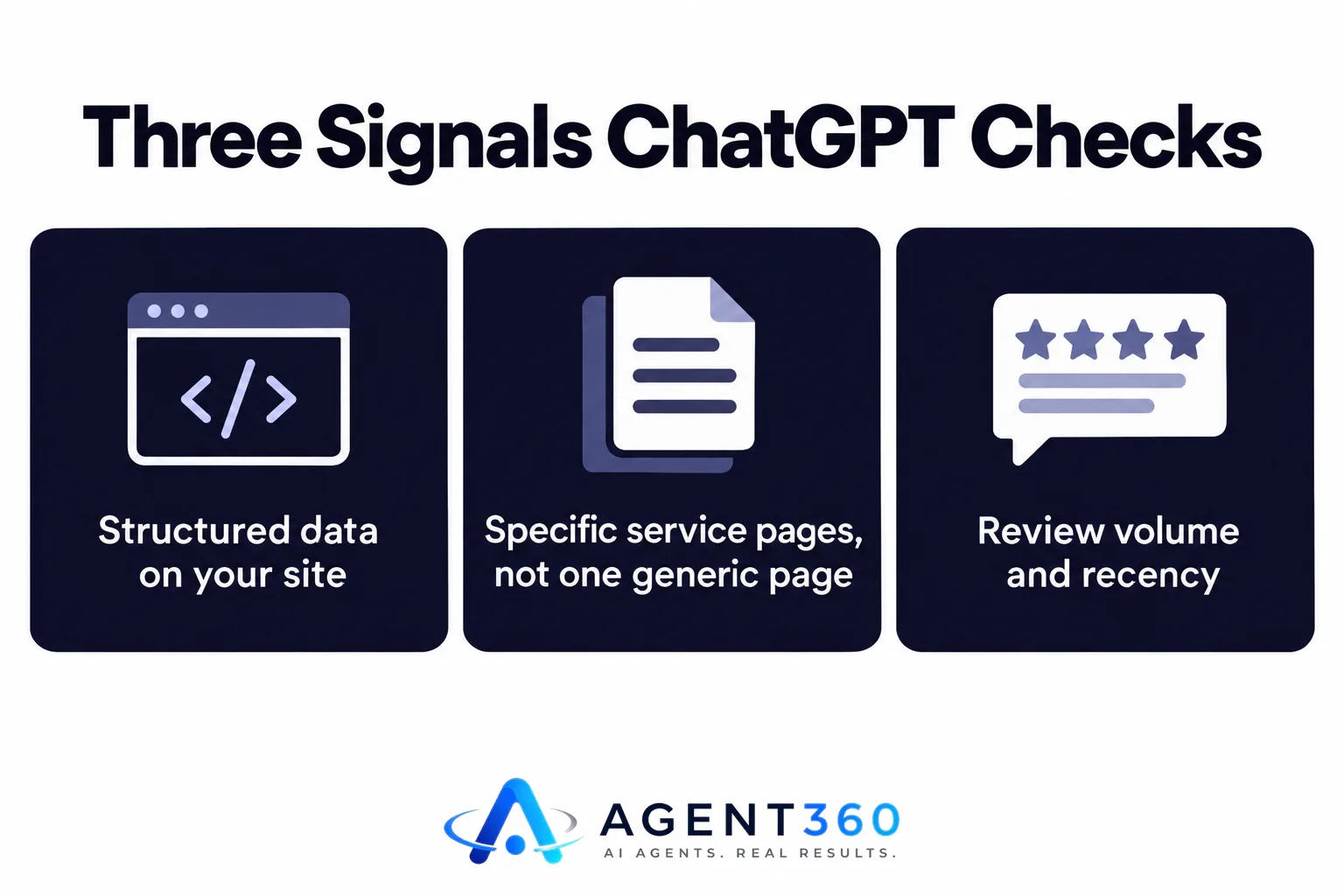
Three things move the needle in a way you can check yourself:
- Structured data on your site. LocalBusiness and FAQ schema give an AI a clean, labeled answer to pull from instead of guessing from paragraph text.
- Specific service pages, not one generic page. “We do plumbing” tells a model nothing. A page titled for the exact job — water heater replacement, drain camera inspection — gives it a sentence to quote.
- Review volume and recency. A business with 40 reviews in the last year reads as active and trustworthy. A business with 12 reviews from 2021 reads as closed or unreliable, even if it is neither.
This is the same work covered under SEO, AEO and GEO — getting found in Google search, the map pack, and AI answers is one job now, not three separate ones.
What not to tell ChatGPT (or anyone else, inconsistently)
The mistake is not something you say directly to ChatGPT — it is saying something different to ChatGPT than you say everywhere else. Generative engines cross-reference. If your website lists hours as 8 to 6, your Google Business Profile says 9 to 5, and a directory listing from three years ago says you closed at noon on Saturdays, the model has three conflicting facts and no way to know which is current. The safe move, from its point of view, is to not recommend you at all, or to hedge with “hours may vary, call to confirm” — which reads as weaker than a competitor it can describe plainly.
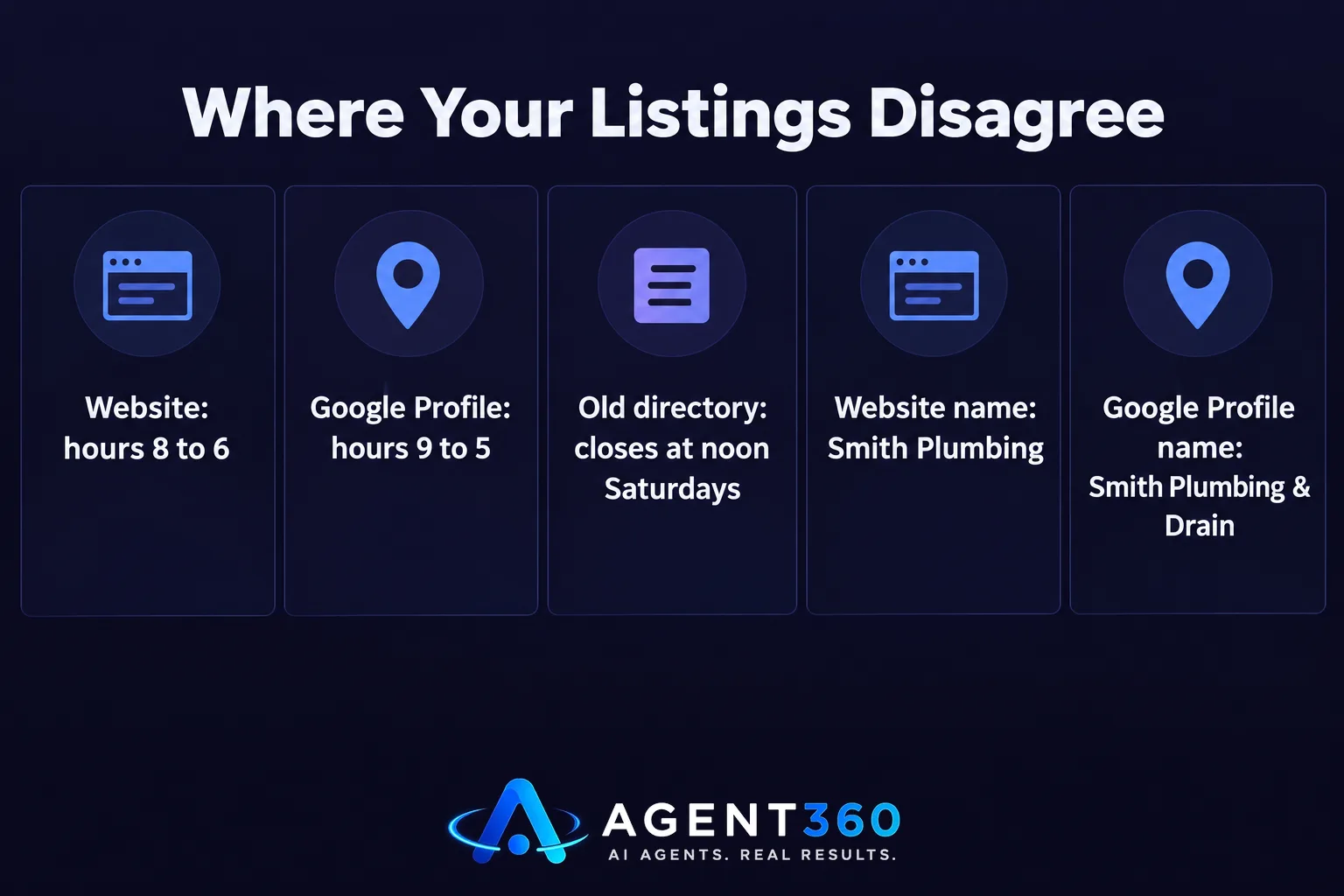
The same goes for service area, pricing language, and business name. If you operate as “Smith Plumbing” on your site and “Smith Plumbing & Drain” on your Google profile, you have split your own citations in half. Pick one name, one set of hours, one service area, and make every listing match it exactly. This is tedious, unglamorous work, and it is most of what actually moves AI recommendations — more than any amount of new content.
How to get more local customers once you are the answer
Getting named by ChatGPT or pulled into a Google AI Overview only matters if the person reading it can act in the next ten seconds. If the answer names you but your site takes four clicks to find a phone number or a booking link, you have paid for the mention and lost the customer anyway. The fix is the same one that works for every other traffic source: a clear path from “found you” to “booked,” with instant follow-up on anything that comes in as a form or a call instead of a direct booking.

Worth checking specifically:
- Does your Google Business Profile have a direct booking link, not just a phone number?
- Does your site load fast enough that someone arriving from an AI answer doesn’t bounce before it renders?
- Is there a way to book or request a quote without calling during business hours?
If you want the mechanics of the map pack piece specifically, the deeper breakdown is in how to get found on Google Maps, not just listed, and the profile-level fixes that move both Maps and AI answers are covered in Google Business Profile optimization.
Where Booked fits
Keeping a website, a Google profile, and every directory listing saying the exact same thing — while also producing the service pages and FAQ content an AI can quote — is a maintenance job most owners don’t have hours for. Booked runs SEO, local SEO, AEO and GEO together from $297 a month, as one part of a plan that also answers leads and takes the booking once someone actually clicks through. Pricing and what’s included at each tier is on the pricing page.
Questions
How do I get ChatGPT to suggest my business? Make sure your website, Google Business Profile, and directory listings all agree on your exact name, hours, and service area, add LocalBusiness and FAQ schema to your site, and keep review volume active and recent. ChatGPT recommends what it can confirm from multiple matching sources, not what you tell it directly.
What not to tell ChatGPT? Nothing you tell ChatGPT directly matters much for local recommendations — what matters is not having your website say one thing while your Google profile or an old directory listing says another. Conflicting hours, names, or service areas across sources make a model less confident recommending you at all.
How do I get more local customers? Combine being findable — in Google search, the map pack, and AI answers — with being fast to respond once someone does find you: a direct booking link, a quick-loading site, and instant follow-up on every form and missed call, so the traffic you’ve already earned doesn’t go to whoever answers first.
More articles
- Done-for-You Website and Marketing: What You Still Do
- Small Business Website and SEO Package: What Should Be Included
- All-in-One Marketing Agency vs. Separate Vendors: Who Wins?
- How Much Should a Small Business Spend on Marketing?
- Website and Marketing Packages: What a Fair Price Looks Like
- All-in-One Marketing for Small Business
- All-in-One Website & Marketing: What You Actually Get
- Small Business Marketing Budget: What to Actually Spend
