All-in-One Marketing for Small Business

All-in-one marketing for small business should mean one team, one login, one monthly price — your website, SEO, paid ads and lead follow-up handled by people who talk to each other, instead of four vendors who don't. That's the pitch. The execution is where most “all-in-one” offers quietly fall apart, because bundling invoices isn't the same as bundling the work.
Before you compare plans or prices, it helps to know what actually breaks when a bundle is a bundle in name only, and what to check before you hand over a card number.
Five logins rarely add up to one strategy
The usual setup for a small business: a web developer who built the site two years ago and now charges by the hour to touch it, an SEO contractor sending a monthly PDF nobody reads closely, a cousin or freelancer posting to Instagram, and an ad account nobody has logged into since the last agency churned. Each piece might be competent on its own. None of them talk to each other. The SEO contractor doesn't know what the ads are promoting. The social posts don't match the landing page. And nobody owns the number that actually matters: cost per booked customer.
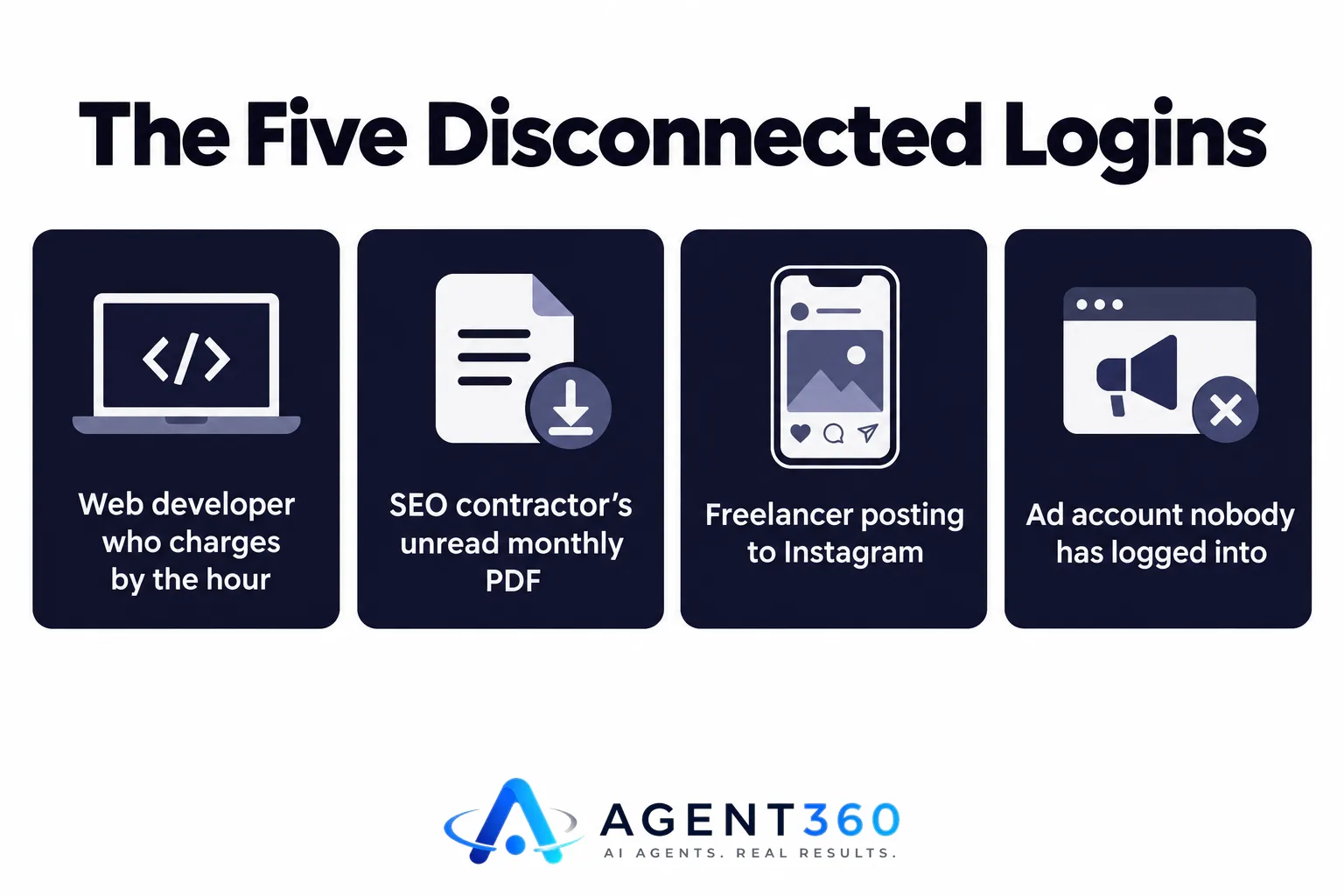
Real all-in-one marketing collapses that into one team working from one calendar and one set of numbers, so a change in ad targeting shows up in the same report as a change in search rankings. That's the whole point of the model — not fewer vendors for its own sake, but one party who can see the entire funnel and is accountable for the end of it, not just their slice.
Ask what happens in the first five minutes after a lead comes in
This is the fastest way to tell a real all-in-one setup from a repackaged list of services. Ask the salesperson: when someone fills out the form or calls after hours, what happens in the next five minutes? If the answer involves “someone checks email in the morning,” the bundle doesn't include follow-up. It includes a website and some ads sitting on top of the same gap that was always there. Speed to lead is where most marketing spend quietly leaks out, and a plan that doesn't text or email the lead instantly, and route a missed call to someone or something that can book it, is missing half the job. The half that turns clicks into customers. Lead response should be built into the platform, not bolted on as an upsell later — that's a reasonable line to hold before you sign.

Check whether the same people write the ads and the web copy
A common failure: the ad agency writes punchy copy promising same-day service, and it points to a landing page built by a different team months earlier that never mentions same-day service anywhere. The visitor bounces, the spend is wasted, and both vendors blame each other. If your marketing is genuinely all-in-one, the person approving this month's ad campaign and the person who can edit the landing page it points to should be the same team — able to make the change that same week, not on the next quarterly redesign cycle.
Ask to see a sample landing page built for a specific campaign, not just the homepage. A plan worth paying for builds a new page per offer and tests it, rather than sending every ad to the same general site.
Match the ad budget to the plan, not the other way around
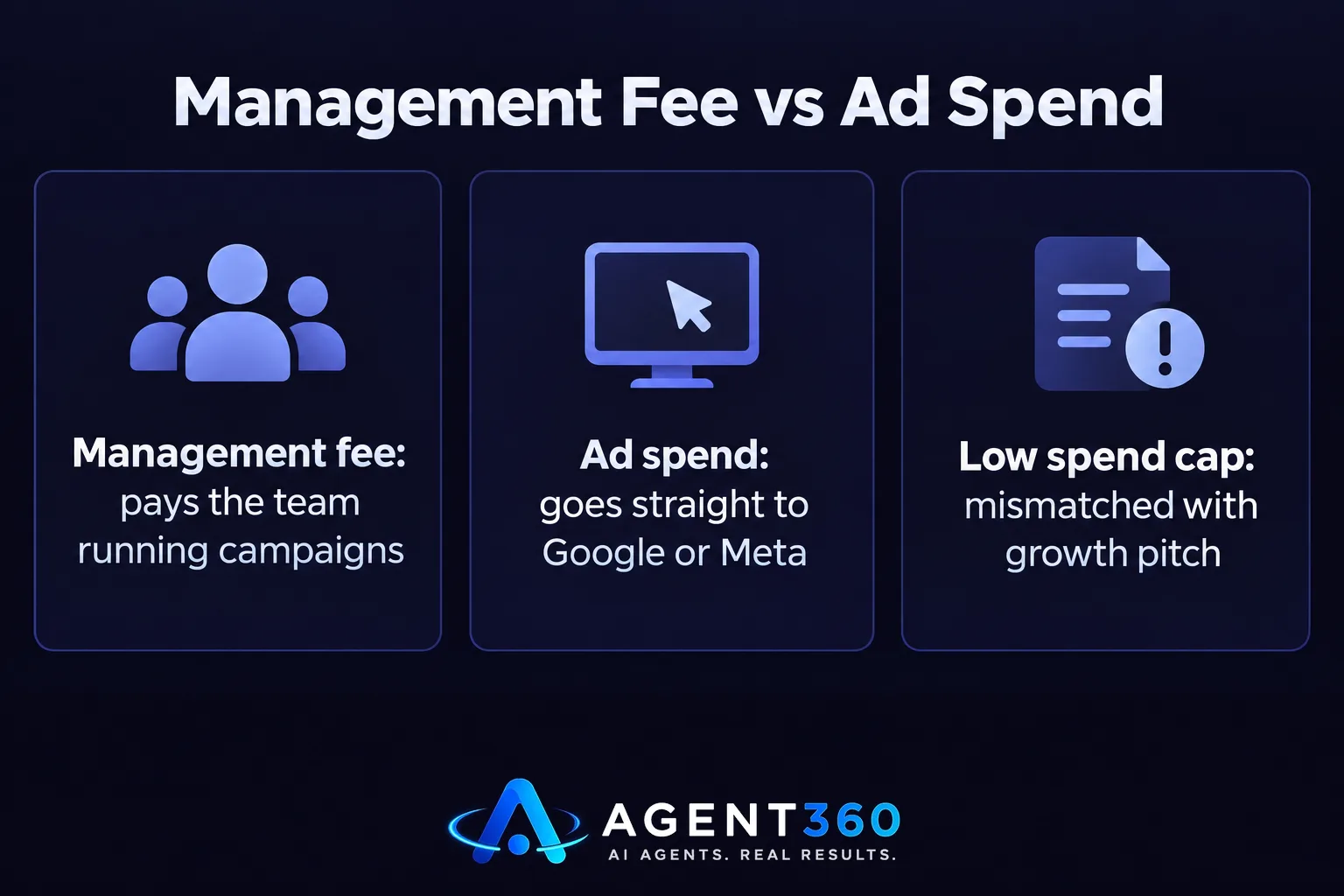
Management fees and ad spend are two different numbers, and a lot of confusion in small business marketing comes from blurring them. The management fee pays the team running your campaigns. The ad spend goes straight to Google or Meta and is yours to control. What you should actually budget depends heavily on your industry and market, but a bundle worth considering will tell you plainly what ad spend it can manage at each tier, rather than leaving you to guess how much of your fee is buying media versus overhead. If a plan caps managed spend at a low number but the sales pitch implies unlimited growth, that mismatch shows up fast the moment you try to scale.
One dashboard only matters if someone walks you through it
Nearly every provider now promises a “live dashboard.” The differentiator isn't the dashboard — it's whether anyone sits with you monthly and explains which lead came from which search term, which ad, or which post, and what it cost to book. A dashboard you never open is just another login. Ask what the monthly check-in actually covers before you assume reporting is handled.
Booked bundles the work, not just the invoice
Booked runs the website, SEO, AEO and GEO, social content, Google and Meta ads, and instant lead follow-up and booking as one plan starting at $297 a month, with no setup fee and no contract. Ad budget goes straight to Google and Meta from your own account, so the management fee and the media spend never get muddled together. You can see exactly what each lead cost and where it came from on one dashboard, reviewed with you monthly — details and the three available plans are on the pricing page.
Frequently asked questions
Is all-in-one marketing actually cheaper than hiring separately?
Usually, yes — mainly because one team shares the overhead across all four jobs instead of each vendor billing full retainer on top of their own. The bigger saving is time: one kickoff call and one monthly review instead of four.
Do I lose control if everything is run by one company?
No, as long as you keep your domain, your lead data and your customer list, which any reasonable provider confirms in writing before you sign. You should also be able to see every lead and every dollar spent in a dashboard you control, not one you have to request access to.
What should I ask before switching from separate vendors to one plan?
Ask what happens to a lead in the first five minutes, who writes both the ads and the landing pages they point to, what ad spend the management fee actually covers, and whether you can cancel month to month. A straight answer to all four is a good sign. A vague one on any of them means keep asking before you commit.
More articles
- All-in-One Website & Marketing: What You Actually Get
- Small Business Marketing Budget: What to Actually Spend
- Speed to Lead: Why the First Five Minutes Decide the Sale
- Lead Follow-Up for Small Business: The System That Works
- How to Get Recommended by ChatGPT for Your Business
- How to Get Found on Google Maps, Not Just Listed
- Website For Small Business: Builder, Cost, Or Done-For-You
- Google Ads for Local Business: What a Real Budget Looks Like
