Google Business Profile Optimization: What Moves Rankings
Three things decide where your Google Business Profile lands: how close you are to the searcher, how well your profile matches what they typed, and how much Google trusts you next to everyone else in the map pack. You can't touch distance. You can nudge relevance with wording. But prominence — trust — is where the real work happens, and it's the piece most profiles leave half-finished: category, reviews, photos, posts, the website behind it all.
Your primary category outranks your description every time
Google reads your primary category before anything else on your profile. List a plumber under “Contractor” instead of “Plumber” and he's invisible for plumbing searches, no matter how well-written the description is. Pick the most specific category that matches what you sell — “Emergency Dentist” beats “Dentist” if that's genuinely part of the business — and add secondary categories only when they're true, not when they sound impressive. A roofer who tacks on “General Contractor” to seem bigger often ranks worse for roofing searches, because Google spreads relevance across more categories instead of concentrating it where it counts.
How does Google Optimization work?
Google Business Profile ranking works differently from classic web SEO, though people throw the two terms around as if they're the same thing. For the map pack, Google runs a separate algorithm weighing proximity, relevance and prominence for local results specifically — it's not just your website's search ranking pasted onto a map. Prominence also comes from signals off the profile: how often the business gets mentioned and linked online, how consistent the name, address and phone number stay across directories, and how the website itself performs in regular search. A profile with five-star reviews but a slow, thin website usually loses to one with fewer reviews and a site that actually ranks. The two systems feed each other. Optimize one without the other and you cap what either can do.
What are the top SEO ranking factors for the Google Business Profile?
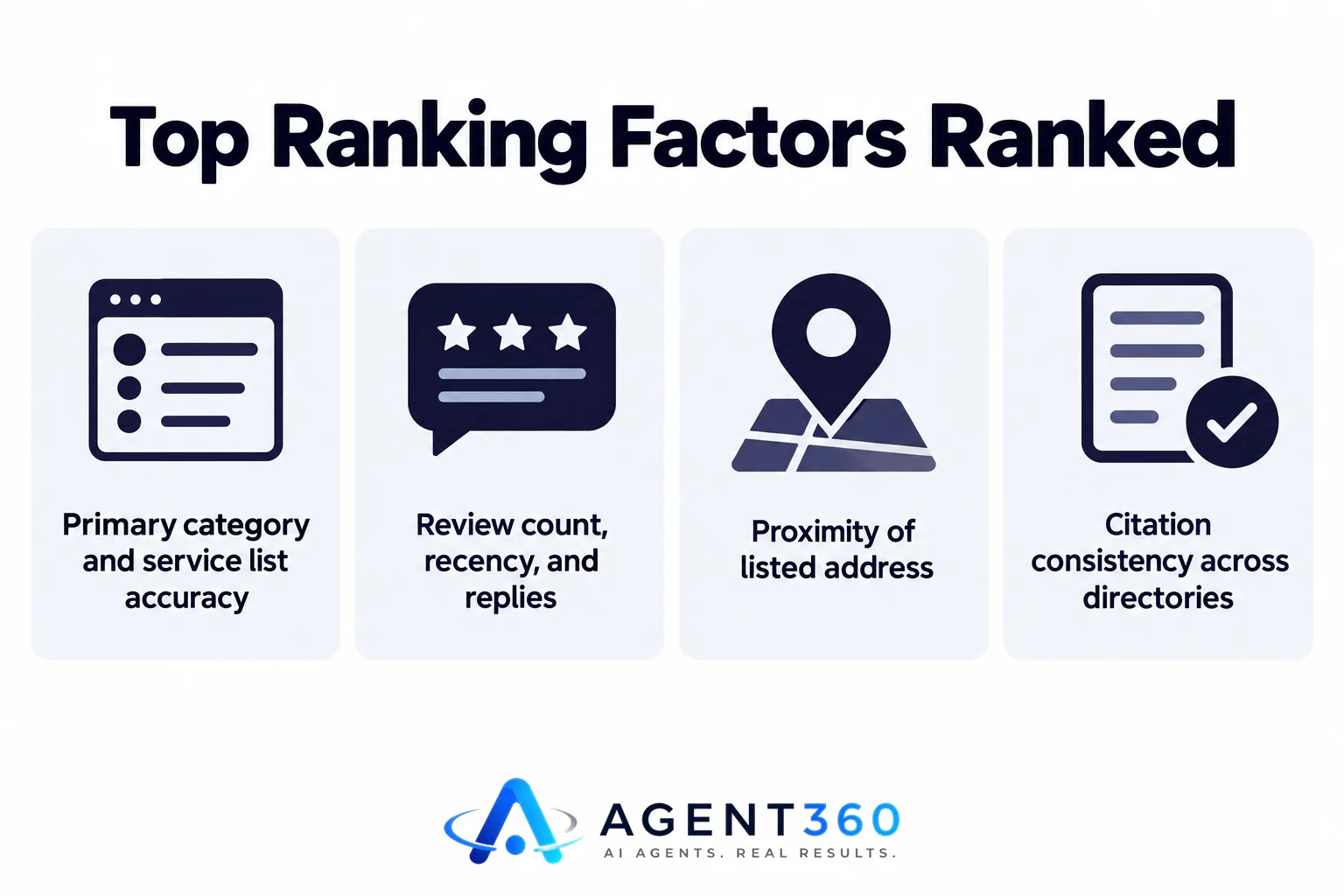
Roughly in order of weight: primary category and the accuracy of the service list; review count, review recency, and whether you reply to them; how close the listed address sits to the searcher; citation consistency across directories like Yelp and the Chamber of Commerce; and the strength of the website the profile links to. Photos and posts matter less than any of those, but they still work as activity signals — a profile that hasn't added a photo in eight months reads as dormant. None of this is published as an exact formula. Google doesn't release a weighted list, and anyone quoting precise percentages is guessing. The order above is the consistent pattern, not a scorecard.
Review velocity matters more than your total count
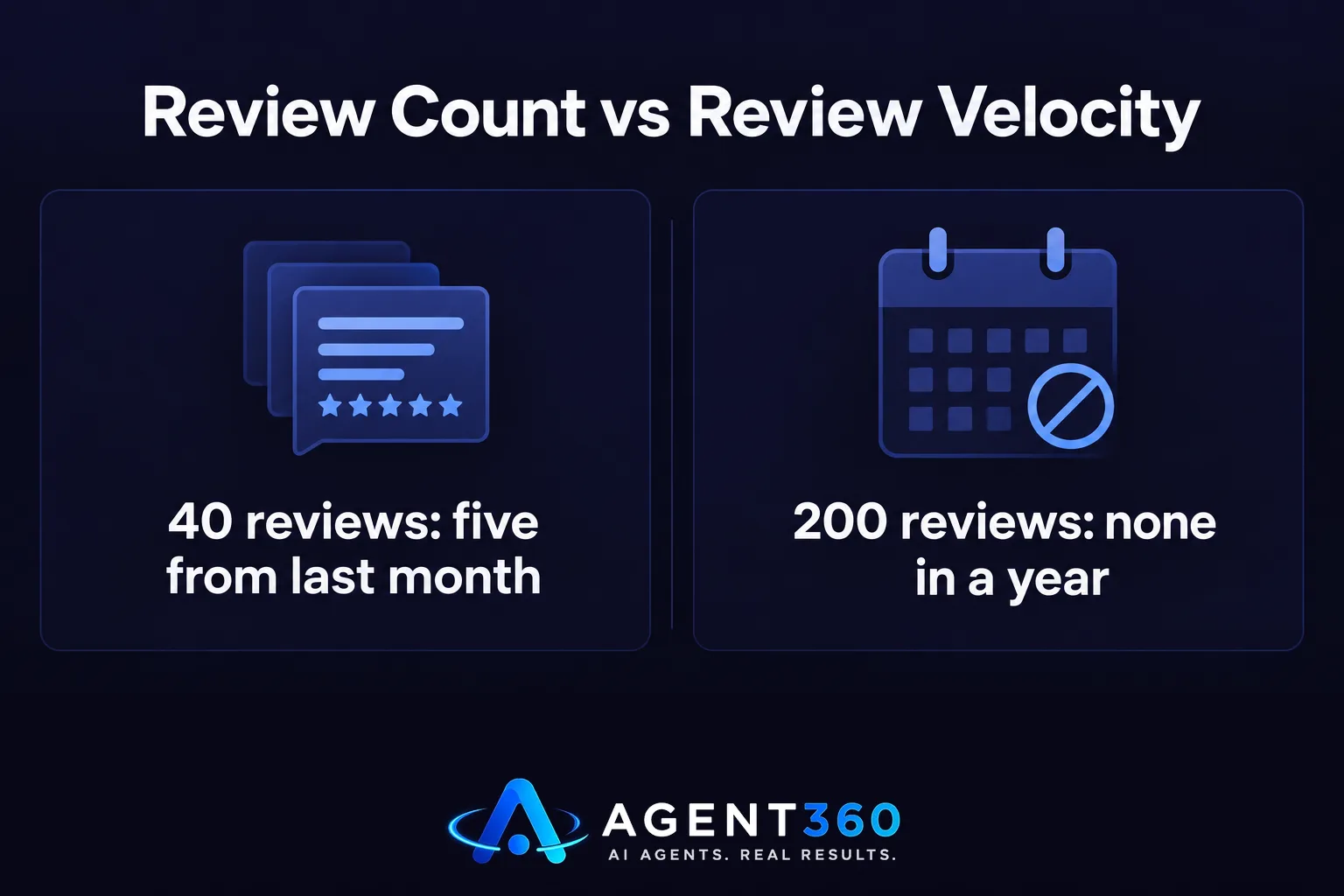
A profile with 40 reviews, five from the last month, will often outrank one with 200 reviews and nothing new in a year. Google treats recent review activity as proof the business is still open and still being chosen. The practical move is a standing habit, not a one-time push: ask every satisfied customer at the point of service, send one follow-up text if they don't leave a review, and reply to every review — good or bad — within a few days. A profile that visibly ignores its negative reviews signals the opposite of prominence.
Photos and posts are freshness signals, not decoration
Google Posts and photo uploads don't carry much direct ranking weight on their own. But they correlate with profiles that get treated as active, and active profiles rank. Upload real photos — the actual storefront, the actual crew, the actual job — on a regular cadence instead of one batch at setup. Stock photos and AI-generated images are easy for Google to spot and do nothing for trust once someone clicks through.

How do I check my website ranking on Google?
Don't trust what you see searching from your own phone. Google personalizes results by location and search history, so your business often looks ranked higher to you than it does to a stranger three miles away. Use Google Search Console to see the actual queries your site ranks for and your average position on each, or search from an incognito window with location services off. For the map pack specifically, rank depends on exactly where the searcher is standing, so one “I'm ranked #1” check from your office tells you almost nothing about how you look across the rest of your service area. A proper local rank tracker that checks from several points around your city is the only way to see the real picture — worth running before deciding your optimization is working or isn't. Our own growth check does exactly that scan.
What is Google Search Engine Optimization (SEO)?
Standard SEO is the work of ranking your website in Google's organic results — the ten blue links below the map pack and any AI Overview. It covers what's on the page itself (titles, headings, content matching what people actually search), the technical health of the site (load speed, mobile usability, whether Google can crawl it), and the authority signals pointing at it (other sites linking to or mentioning you). It's a different system from the Business Profile, but not an unrelated one: the same website signals that feed organic SEO also feed how much Google trusts the Business Profile. A business that optimizes the profile and ignores the site is leaving half the mechanism untouched.
Where this work actually gets done
Optimizing a profile properly — category, review cadence, photo schedule, citation cleanup, a website that backs it all up — never really finishes; it's ongoing, not a setup task you check off once. Booked runs this as part of every plan starting at $297 a month: local SEO and Google Business work alongside AEO and GEO, so the same effort that wins the map pack also gets you named when someone asks ChatGPT or Google's AI Overview who to call. See what's included on the pricing page, or look at how the get found service handles category, citations and review management as one job instead of three separate ones.
Questions worth asking before you touch your profile
Does changing my category hurt my existing ranking while Google re-indexes it? There can be a short dip — a few days to a couple weeks — while Google recalculates relevance for the new category. That's the reason to make category changes deliberately, not as something to test repeatedly.
Do I need a physical address if I only do house calls? You can hide the address and still show a service area. But Google generally ranks service-area businesses with a visible, verifiable address somewhat higher than fully hidden ones, since proximity gets harder to calculate without one.
How long before optimization changes show up in ranking? Category and citation fixes can shift results within a couple of weeks. Review-based and website-authority signals take longer — months, usually — because they build on an accumulating pattern of activity rather than a single edit.
More articles
- Marketing for Auto Repair Shops That Keeps Bays Full
- Restaurant Marketing Ideas That Actually Fill Tables
- Law Firm Marketing: What Actually Brings In Cases
- Marketing for HVAC Companies: What Actually Books Jobs
- Marketing for Dentists: What Actually Fills the Schedule
- Local SEO Services: What They Should Actually Do
- Done-For-You Marketing for Small Business: What It Buys
- Marketing for Small Local Businesses: The Rules Worth Keeping
