Website and Marketing Packages: What a Fair Price Looks Like

Budget $250 to $600 a month for the management fee on a fair website and marketing package, plus whatever you decide to spend on ads — that's a separate number entirely. Anything well under that range and the website is probably templated, with nobody actually watching your SEO or your ad accounts. Anything well over it, for one location, usually means you're paying for a sales team and a long contract, not more work.
That $250–$600 range covers the management fee only: the labor of building and running your website, your search presence, and your ad campaigns. Your ad budget is a different line item, one you should control directly, and it needs to stay that way. The rest of this piece is about telling the two apart, because most bad quotes blur them on purpose.
A fair package bundles five jobs, not one
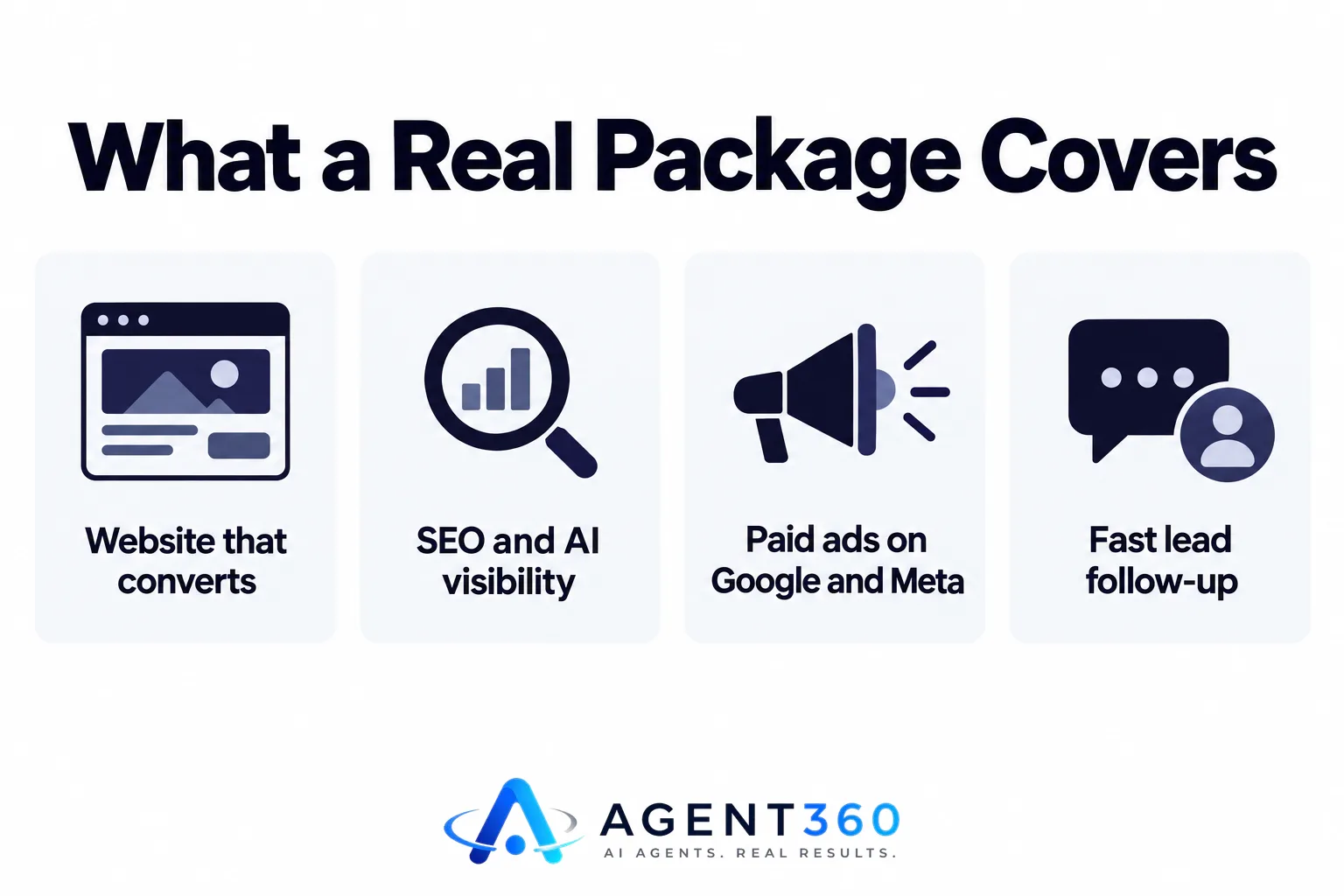
A website on its own doesn't bring in customers. Neither does a social calendar, or a boosted post here and there. A package only earns the name if it covers all five things a local business actually needs, working together: a website that converts, search and AI visibility (SEO, local SEO, and increasingly getting recommended by ChatGPT and similar assistants), paid ads on Google and Meta, fast follow-up on every lead, and ongoing content that keeps ranking. Cover only one or two of those and what you've bought isn't a package — it's a line item with a bigger invoice. Compare what's actually in scope using a services breakdown rather than a glossy one-pager, and ask directly what happens to the other four jobs if you only buy one.
Ad spend is never part of the management fee
This is where quotes get misleading most often. An agency that quotes “$1,200 a month, all in” and runs $800 of that as your actual Google and Meta budget is charging you $400 to manage ads and calling the rest a service. A fair structure keeps the two separate: you pay the management fee to the agency, and your ad budget moves directly from your own ad account to Google and Meta. That way every dollar is visible, and you can pull the budget whenever you want — it isn't sitting hostage inside someone else's invoice. If a proposal won't show you that split in writing, ask again before signing, or read what a realistic ad number looks like on its own in the small business marketing budget breakdown.
A setup fee is a signal, not just a cost
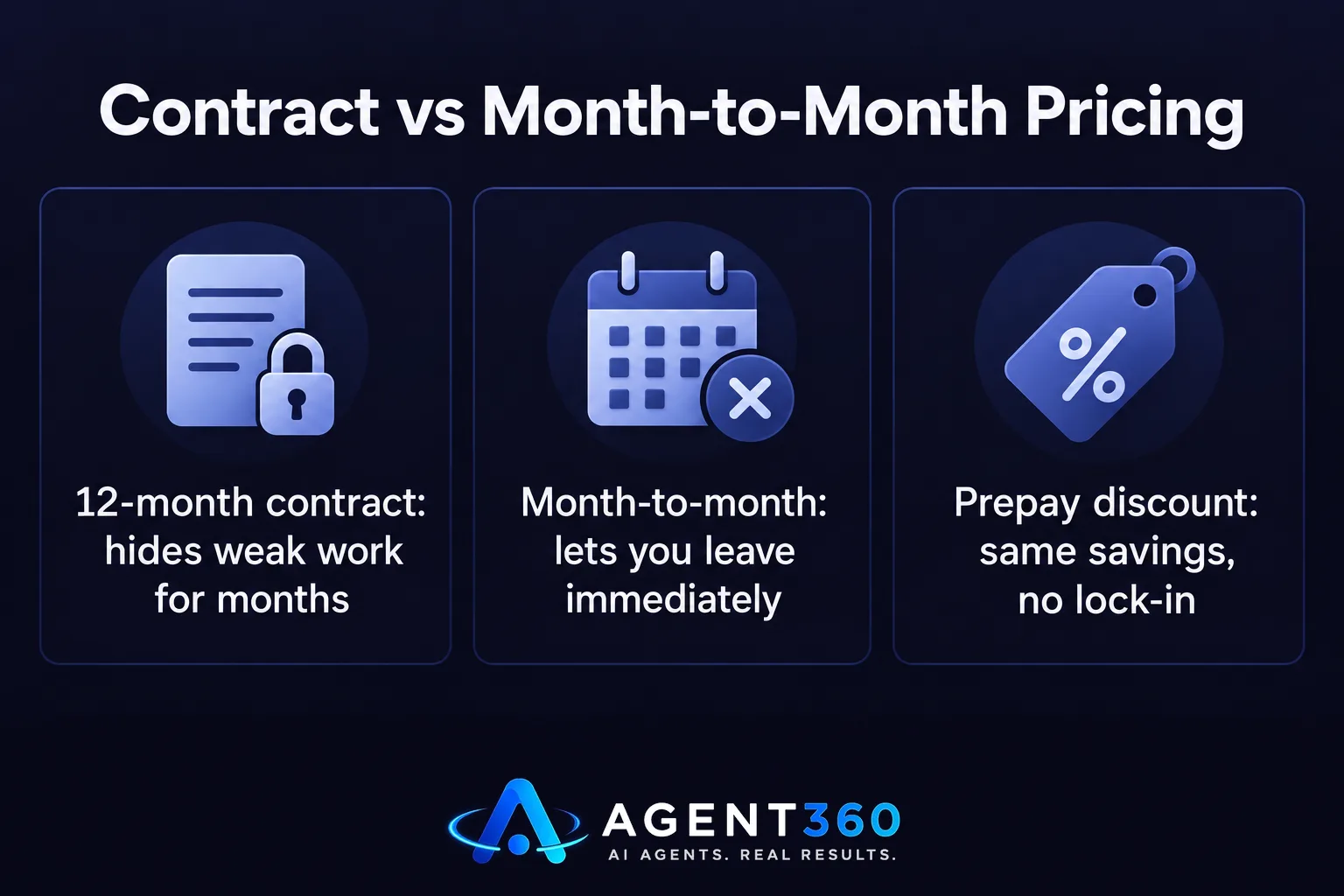
Setup fees of $500 to $2,000 are common, and not automatically unfair — building a site, a brand kit, and a first campaign is real work. A setup fee paired with a 12-month contract is a different story. That combination means the agency is betting you won't leave before they've recouped the cost of onboarding you, whether the work is good or not. A package with no setup fee and no lock-in has to earn your business every single month, and that changes how it behaves when results are slow in month two.
Month-to-month pricing exposes weak work faster than a contract does
A 12-month contract can hide a mediocre agency for most of a year. Month-to-month pricing can't. If the posts stop being good, the leads stop getting followed up, or the dashboard goes quiet, you leave at the start of next month with your domain, your leads, and your customer list intact. That's worth more than whatever discount the annual contract claims to offer. Want a lower rate anyway? Get it through prepayment — quarterly or annual billing at a discount — not a term contract. Same savings, no lost exit.
What actually changes the price
Four things move a package's price up or down, and “more creativity” isn't one of them:
- Ad spend tier managed — running $1,500 a month in ads takes less oversight than running $5,000 or an uncapped budget across campaigns.
- Number of locations — each location needs its own Google Business listing, its own local SEO, and often its own landing pages.
- Keywords and content volume tracked — tracking 25 keywords and publishing 10 posts a month is a different scope than tracking 250 and publishing 40.
- Response infrastructure — instant text and email reply is table stakes now; 24/7 AI phone answering and win-back campaigns to past customers are a step up, and should be priced as one.
If a quote climbs without a clear answer to “which of these four moved,” the increase is margin, not scope.
Where Booked fits this math
Booked prices on exactly these levers and nothing else. Starter runs $297 a month for one location: the website, SEO/AEO/GEO, Google and Meta ads managed up to $1,500 of your own ad spend, instant lead follow-up, booking, and a monthly dashboard — no setup fee, no contract. Pro, at $497, raises the managed ad ceiling to $5,000, doubles the content, and adds 24/7 AI phone answering plus a dedicated Customer Success manager. Scale, at $597, covers up to three locations, drops the ad spend cap entirely, and adds a dedicated strategist and competitor tracking. The full breakdown, including what moves between tiers, lives on the pricing page, and you can move plans up or down at the start of any month.

How to compare two quotes side by side
Put both quotes in front of you and ask three questions. First: is the ad budget separated from the management fee, in writing? Second: is there a setup fee, and if so, is there also a term contract — that combination is the one to push back on. Third: what happens to your website, your leads, and your customer list the day you cancel — do you keep them, or does the agency? A package that answers all three cleanly is fair, no matter which number sits on the invoice. For a longer look at what agencies charge and why the number swings so much by scope, the local marketing agency cost breakdown covers the full range.
Questions worth asking before you sign
How much should a small business pay for a website and marketing package? For one location, a fair management fee runs $250 to $600 a month, not including ad spend. The low end usually buys a basic website with limited ongoing SEO or ad management; the high end should buy active campaign management, content, and fast lead follow-up — not just a bigger invoice.
What should be included in the package versus billed separately? The management fee should cover the website, SEO/local SEO, content, ad campaign management, lead follow-up, and reporting. Your ad spend itself should always be billed separately, paid directly to Google or Meta from an account you control.
Why do some packages require a 12-month contract and others don't? A contract benefits the agency more than the client — it guarantees revenue regardless of results. Month-to-month pricing with no setup fee means the agency has to keep earning the relationship every month, and that's a far better signal than a locked-in term ever is.
More articles
- All-in-One Marketing for Small Business
- All-in-One Website & Marketing: What You Actually Get
- Small Business Marketing Budget: What to Actually Spend
- Speed to Lead: Why the First Five Minutes Decide the Sale
- Lead Follow-Up for Small Business: The System That Works
- How to Get Recommended by ChatGPT for Your Business
- How to Get Found on Google Maps, Not Just Listed
- Website For Small Business: Builder, Cost, Or Done-For-You
