All-in-One Website & Marketing: What You Actually Get

Ask ten agencies what “all-in-one website and marketing” means and you will get ten different answers, and most of them are wrong. Done right, it means one team runs your site, your search rankings, your ads, and your lead follow-up for a single monthly fee — instead of you juggling a web designer, an SEO freelancer, an ad agency, and a CRM that never talk to each other. The “all-in-one” part is not fluff if it is built right: one login, one invoice, one person to call when a lead gets missed. But most of what gets sold under that name is not that. It is a web designer who also “does SEO” by changing a title tag twice a year. Or an agency running ads with no idea whether any of those leads ever booked.
Here is what the phrase should actually buy you, what it should cost, and the questions that tell you whether the bundle in front of you is real or just a website with a marketing sticker on it.
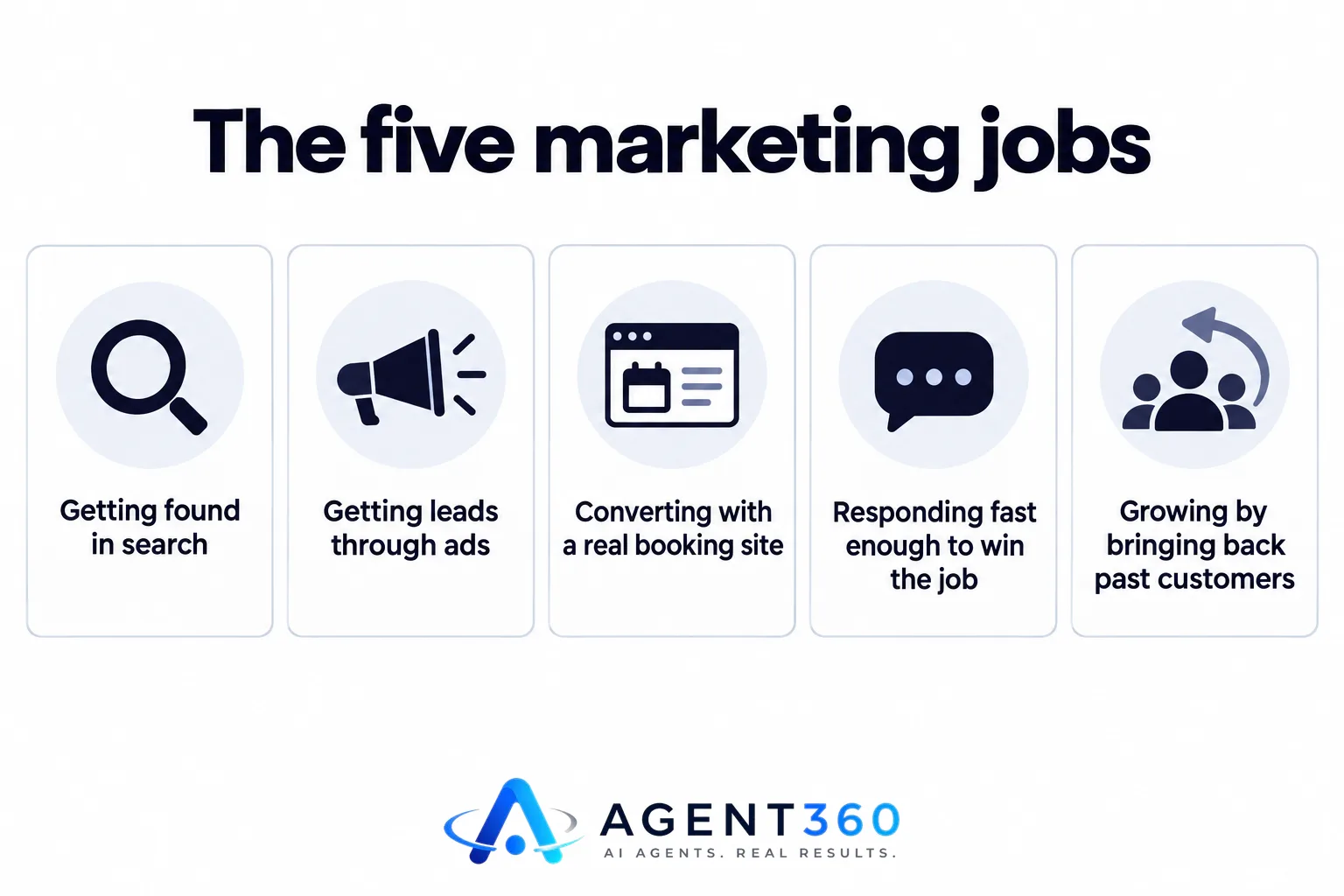
A real bundle covers five jobs, not two
Getting a local customer from search to booked appointment takes five separate functions: getting found (search, maps, and now AI answers), getting leads (paid ads), converting them (a site and landing pages that actually ask for the booking), responding (answering fast enough to win the job), and growing (bringing back the people who did not buy the first time). Most bundles sold as “all-in-one” cover two of these — usually a website and some social posts — and call it done. Before you sign anything, ask which of the five your invoice actually pays for. A real services list should name all five, not just the two that are easy to deliver.
Expect to pay $300 to $600 a month before ad spend
Below roughly $300 a month, something on that list is missing — usually the ad management, the AI search work, or the follow-up automation, because those take ongoing labor, not a one-time build. Above $600, you are often paying for a dedicated strategist or multi-location management you may not need yet. Ad spend is separate from the management fee in any honest setup. It should go directly to Google and Meta from your own account, not through the agency's card, so you can see exactly what was spent and shut it off any time. If a quote bundles ad spend into one number with no breakdown, ask for the split before you agree to anything. For a fuller breakdown of what a realistic monthly number looks like by business size, see our marketing budget guide.
Ask what happens to a lead at 9pm on a Saturday
This is the question that separates a marketing bundle from a lead-generation bundle. Driving traffic and running ads is the easy half. What happens the moment someone fills out a form or calls after hours decides whether that spend ever turns into revenue. If the answer is “we check messages Monday,” the rest of the package does not matter much — a lead that waits even thirty minutes past the first few has a real shot at calling the next business on the list instead. Ask specifically: does a missed call get a text back automatically? Does a web form trigger an instant reply? Is there a calendar the customer can book into without waiting on a callback? We wrote more on why the first few minutes decide the sale in our piece on speed to lead.

Ask who writes the content and who checks it
Most bundles now use AI to draft social posts, ad copy, and articles. That is not a red flag by itself — it is how 10 to 40 posts a month get produced for $300 to $600. The red flag is nobody reviewing it before it goes out under your name. Ask directly: does a person check each post and ad, or does it publish unreviewed? And can you see and approve anything before it goes live, or only after, in a monthly report? Both setups exist and both are fine. You just need to know which one you are buying, especially in a regulated field like dental or legal, where a wrong claim in an ad is a real problem, not just an embarrassing one.
Ask what you keep if you cancel
Some agencies build your site on a platform they control, so canceling means losing the website, the domain, or both. Ask before signing: who owns the domain, does the website move with you, and do you keep your leads and customer list if you leave. A month-to-month bundle with no contract is only actually month-to-month if walking away does not also mean starting over from zero.
One dashboard beats five logins
If your SEO lives in one tool, your ads in another, and your leads in a spreadsheet someone emails you, you cannot actually tell what is working. You are just trusting each vendor's own report card. A real all-in-one setup puts every lead next to the ad, search term, or post that produced it, and what it cost, in one place you can check whenever you want — not just on a monthly call.
Where Booked fits
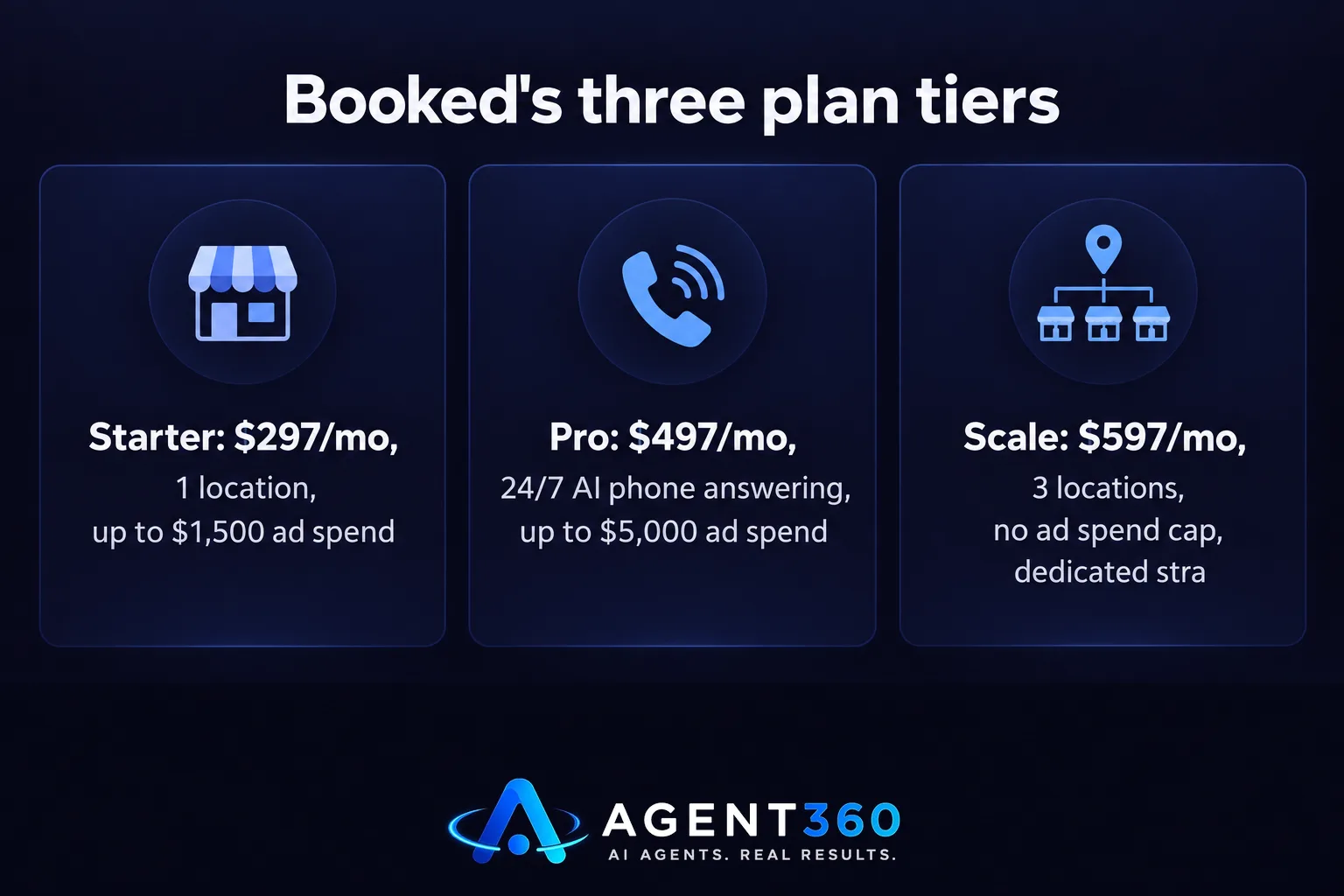
Booked runs all five functions — get found, get leads, convert, respond, grow — from one monthly plan with no setup fee and no contract. Starter runs the whole stack for one location at $297 a month with ad spend managed up to $1,500; Pro adds 24/7 AI phone answering and manages up to $5,000 in ad spend for $497; Scale covers up to three locations with no ad spend cap and a dedicated strategist for $597. Every plan includes a live dashboard showing exactly what each lead cost and where it came from. Full details are on the pricing page.
Is all-in-one marketing actually cheaper than hiring separately?
Usually, yes, for businesses under a few locations. A web designer, an SEO contractor, and an ads manager hired separately typically run well past $1,500 a month combined once you add their individual fees, and none of them talks to the others — so your site, your ads, and your search rankings never actually work toward the same number. A bundled plan trades some customization for coordination: the same team builds the landing page the ad points to and tracks whether that page converts.
Can I keep my existing website instead of switching?
A properly built bundle will improve a working site in place rather than force a rebuild. You only need a new site if the current one is slow, hard to edit, or simply not producing leads. Ask any provider this directly before signing: if the answer is “we always rebuild,” that is often about their process, not your site's actual condition.
Do I need a contract to get all-in-one pricing?
No. Contract length and bundling are unrelated. A legitimate all-in-one plan should be available month to month, with a discount offered for paying quarterly or annually rather than required as a condition of service. If month-to-month pricing is not offered at all, ask why — that answer tells you more than the pitch deck does.
More articles
- Small Business Marketing Budget: What to Actually Spend
- Speed to Lead: Why the First Five Minutes Decide the Sale
- Lead Follow-Up for Small Business: The System That Works
- How to Get Recommended by ChatGPT for Your Business
- How to Get Found on Google Maps, Not Just Listed
- Website For Small Business: Builder, Cost, Or Done-For-You
- Google Ads for Local Business: What a Real Budget Looks Like
- How to Get More Google Reviews: Timing Beats Begging
