Small Business Website and SEO Package: What Should Be Included
A real website and SEO package gives you a site built to convert, local SEO and a managed Google Business Profile, content that keeps going out month after month, and a way to see which pages and searches actually bring in calls or bookings. If a proposal stops at “we'll build your site and optimize it,” you're buying half a package.
Most people shopping this term have already been burned once: a $2,000 site nobody can find, or an “SEO package” that turned out to be a PDF of keyword ideas nobody ever acted on. Here's what separates a package that pays for itself from one that doesn't.
A website with no SEO behind it is a brochure nobody finds
Design agencies sell sites. SEO agencies sell rankings. Neither one alone gets you a customer. A site with clean code, fast load times and pages built around the searches your customers actually type will start showing up in Google within a few months. A beautiful site with none of that structure can sit on page four indefinitely, no matter how good it looks on a phone. Separate “design” from “SEO” into different line items with different vendors, and you'll spend your first year arguing about whose fault the missing traffic is instead of fixing it.
Ask what “SEO” means in the package, in writing
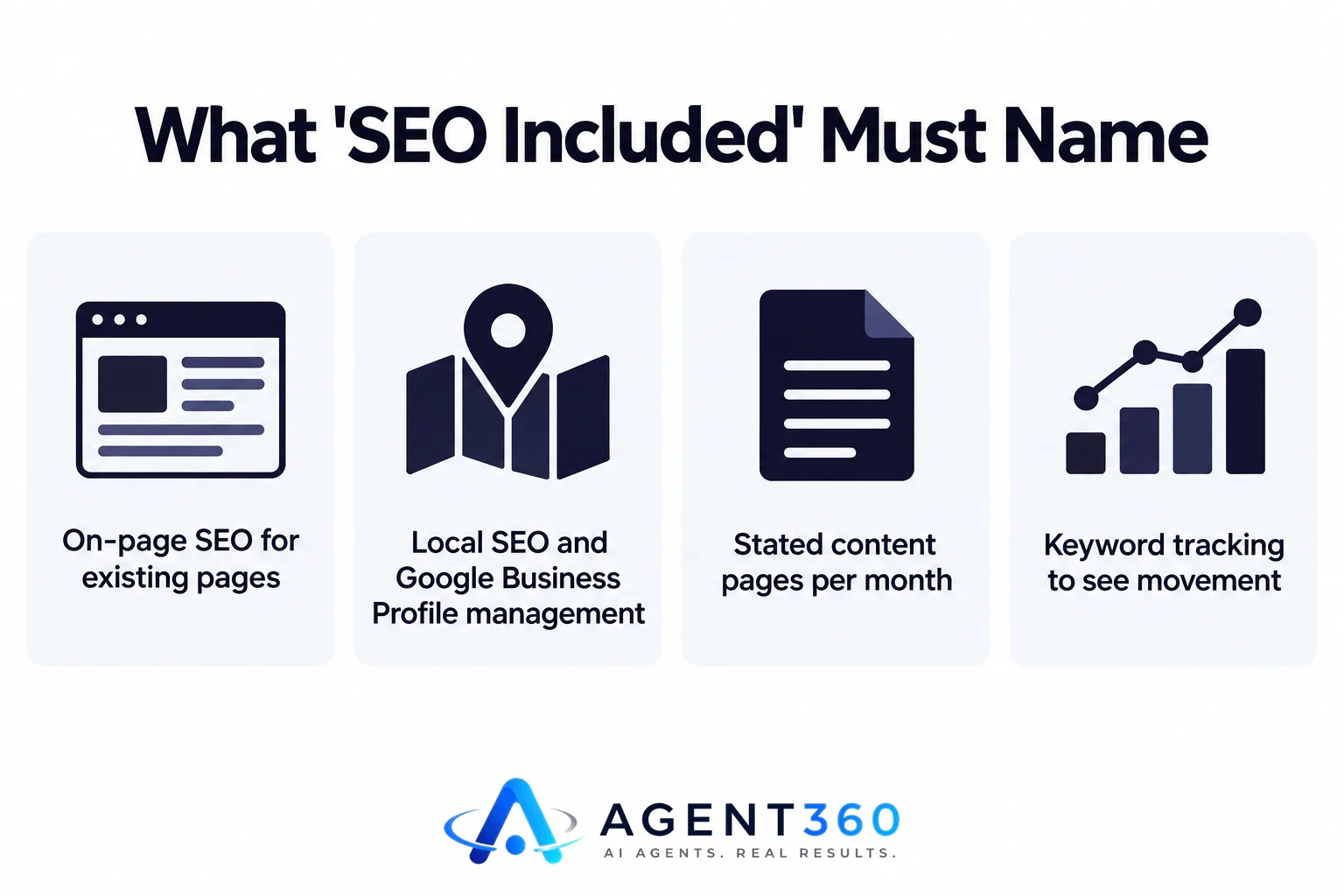
“SEO included” is not a deliverable. A package worth paying for will name the parts: on-page SEO for the pages that exist, local SEO and Google Business Profile management, a content plan with a stated number of pages or articles per month, and keyword tracking so you can actually see whether rankings move. If a salesperson can't tell you how many keywords they track or how many pieces of content they publish monthly, assume the number is low or doesn't exist. For a sense of what the work itself should look like month to month, see what's involved in getting found — it's more than a metatag update.
The site has to convert, not just rank
Ranking first for your category and still losing the job to the second listing is common, and it's avoidable. It usually means the site loads slowly, the phone number is buried, or there's no clear next step above the fold. A package should include landing pages built for specific offers, not just a generic homepage, and some form of conversion testing — swapping headlines, forms or calls to action and watching what actually gets more people to call or book. Traffic without conversion is just an expensive number on a dashboard.
Local SEO and Google Business Profile aren't an upsell
For almost every local business, the map pack brings in more calls than the organic listings below it. Treat Google Business Profile management as a $99 add-on, and you're underpricing the single most valuable move in local search: categories, service areas, posts, photos and review responses all feed into whether you land in the top three map results for your area. If local SEO isn't a named, core part of the package, you're paying for general SEO that mostly helps businesses with no physical service area — which is probably not you.
Content cadence is a leading indicator, not a vanity metric
Google rewards sites that keep publishing relevant, locally specific content over sites that built ten pages in 2019 and stopped. Ask directly: how many articles or pages go live per month, and who writes them? A handful of generic national blog posts a quarter won't move your local rankings much. Local, service-specific content on a real schedule will show up in search and, increasingly, in tools like ChatGPT and Google's AI Overviews when someone asks for a recommendation — a separate discipline now called AEO and GEO that a modern package should cover right alongside traditional SEO.
Know the price range before you negotiate
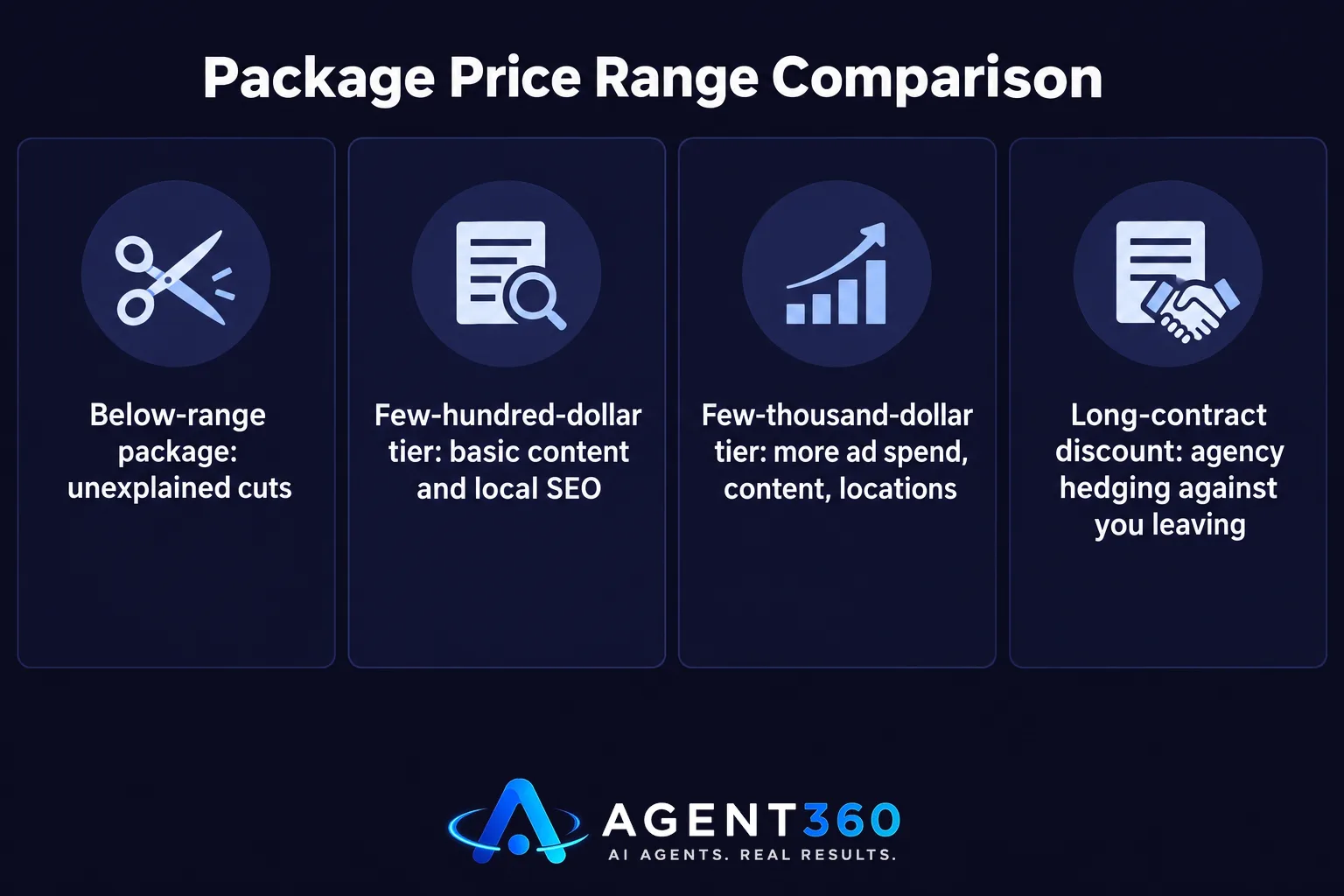
Website-plus-SEO packages for local businesses generally run from a few hundred to a few thousand dollars a month, and the spread mostly tracks ad spend management, content volume and how many locations are covered — not the website itself, which should be built once and then maintained. Be skeptical of anything priced far below that range with no explanation of what's been cut, and just as skeptical of anything that requires a long contract to earn a “discount.” A fair package is month to month; if the price only makes sense locked in for a year, that's the agency hedging against you leaving once you see the results. For a full breakdown of what belongs at each price point, compare plans side by side.
What a bad package looks like
The failure modes repeat themselves: a site built once and never touched again, quietly breaking as browsers and plugins update; an SEO retainer with no reporting beyond “rankings are improving”; a Google Business Profile nobody has logged into in months; no dashboard connecting a given lead back to the page, ad or search that produced it. If you can't answer “what did last month's spend actually bring in” in under a minute, the package is missing its most important piece — not the website, not the SEO, but the reporting that ties the two together.
Where Booked fits
Booked bundles the website, SEO, local SEO, AEO and GEO, plus the ads and the booking page, into one plan starting at $297 a month, month to month, with no setup fee and a live dashboard showing what each lead cost and where it came from. Each plan includes a set number of articles, social posts and tracked keywords, so you know the content cadence before you sign anything — see the full list on the pricing page.

Common questions
How much should a small business website and SEO package cost?
Expect a few hundred dollars a month at minimum for a package that includes ongoing content and local SEO, not just a one-time build. Price mostly scales with ad spend managed and content volume, not the site itself — a deeper breakdown is in how much a small business should spend on marketing.
Is it better to buy the website and SEO from one company or two?
One company that owns both removes the finger-pointing when traffic doesn't convert or rankings don't move — nobody can blame “the other vendor's site” or “the other vendor's SEO.” It's worth weighing against your specific situation; see all-in-one agency vs. separate vendors for the fuller case.
Do I need a new website if mine already ranks okay?
No. A good package can improve local SEO, content and conversion on an existing site that's performing reasonably well, and should only recommend a rebuild if the current site is slow, hard to edit, or structurally blocking search visibility — not just because it's a few years old.
More articles
- All-in-One Marketing Agency vs. Separate Vendors: Who Wins?
- How Much Should a Small Business Spend on Marketing?
- Website and Marketing Packages: What a Fair Price Looks Like
- All-in-One Marketing for Small Business
- All-in-One Website & Marketing: What You Actually Get
- Small Business Marketing Budget: What to Actually Spend
- Speed to Lead: Why the First Five Minutes Decide the Sale
- Lead Follow-Up for Small Business: The System That Works
