How Much Should a Small Business Spend on Marketing?
Most small businesses should spend between 6% and 12% of gross revenue on marketing each month. Closer to 12% if you're under three years old or chasing growth. Closer to 6% if you're established and mostly defending the customers you already have. On a business doing $600,000 a year, that's $3,000 to $6,000 a month, covering your website, content, ads and the tools that turn a lead into a booking. A flat number like “$500 a month” gets repeated so often because it's easy to say, not because it fits every business.
Revenue percentage beats a flat figure for one reason: it scales with what you can actually afford to lose if a channel underperforms. A $500 budget on $100,000 in revenue is a real commitment. The same $500 on $2 million in revenue is a rounding error that won't move a market either way.
Spend a percentage of revenue, not a fixed dollar figure
New businesses with no reviews, no rankings and no repeat customers need to spend more proportionally — often 12% to 20% of revenue — because they're buying awareness that older competitors already have for free. A business past its fifth year, with a full Google Business Profile and a steady stream of referrals, can often run on 5% to 8%, spent mostly on holding rankings and keeping newer competitors from eating into territory it's already won.
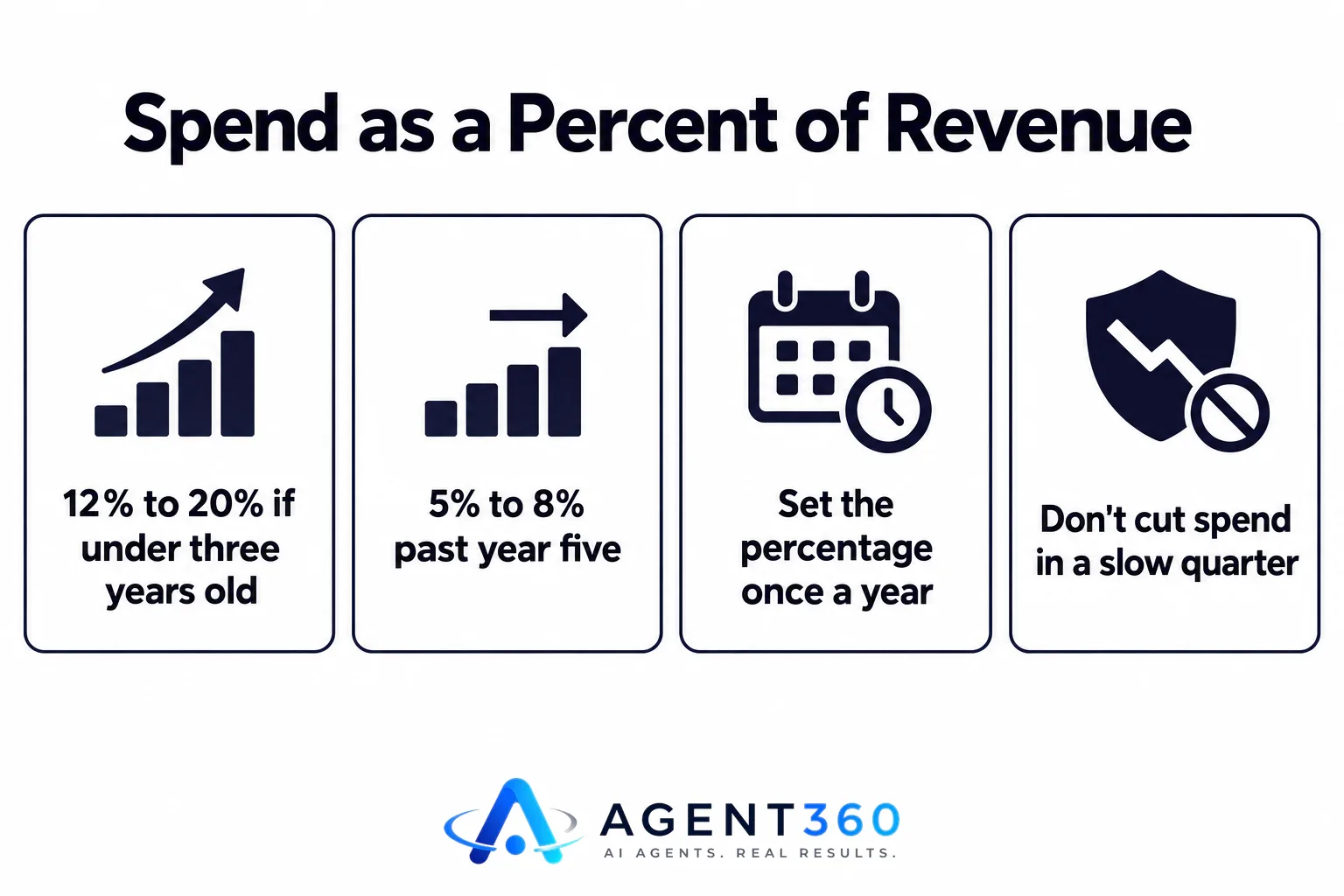
Here's the mistake worth flagging: treating the percentage as fixed instead of planned. Revenue drops in a slow quarter and the instinct is to cut marketing first — exactly backwards, since a slow quarter is when the pipeline needs the most help, not the least. Set the percentage once a year based on your prior twelve months. Don't reset it month to month based on how last week felt.
What is the 3-3-3 rule in marketing?
The 3-3-3 rule is a content rule, not a budget rule: spend no more than 3 minutes creating a post, publish across no more than 3 platforms, and limit yourself to 3 content formats so you're not reinventing the wheel every day. It answers “how do I stay consistent without burning out,” not “how much should I spend.” If you searched for a budget number and landed here, it's worth knowing this rule won't give you one — it governs effort and cadence, not dollars. Where it does help is inside whatever content budget you've already set, so the team isn't overproducing one format while ignoring the others.
What is the 70/20/10 rule for marketing budget?
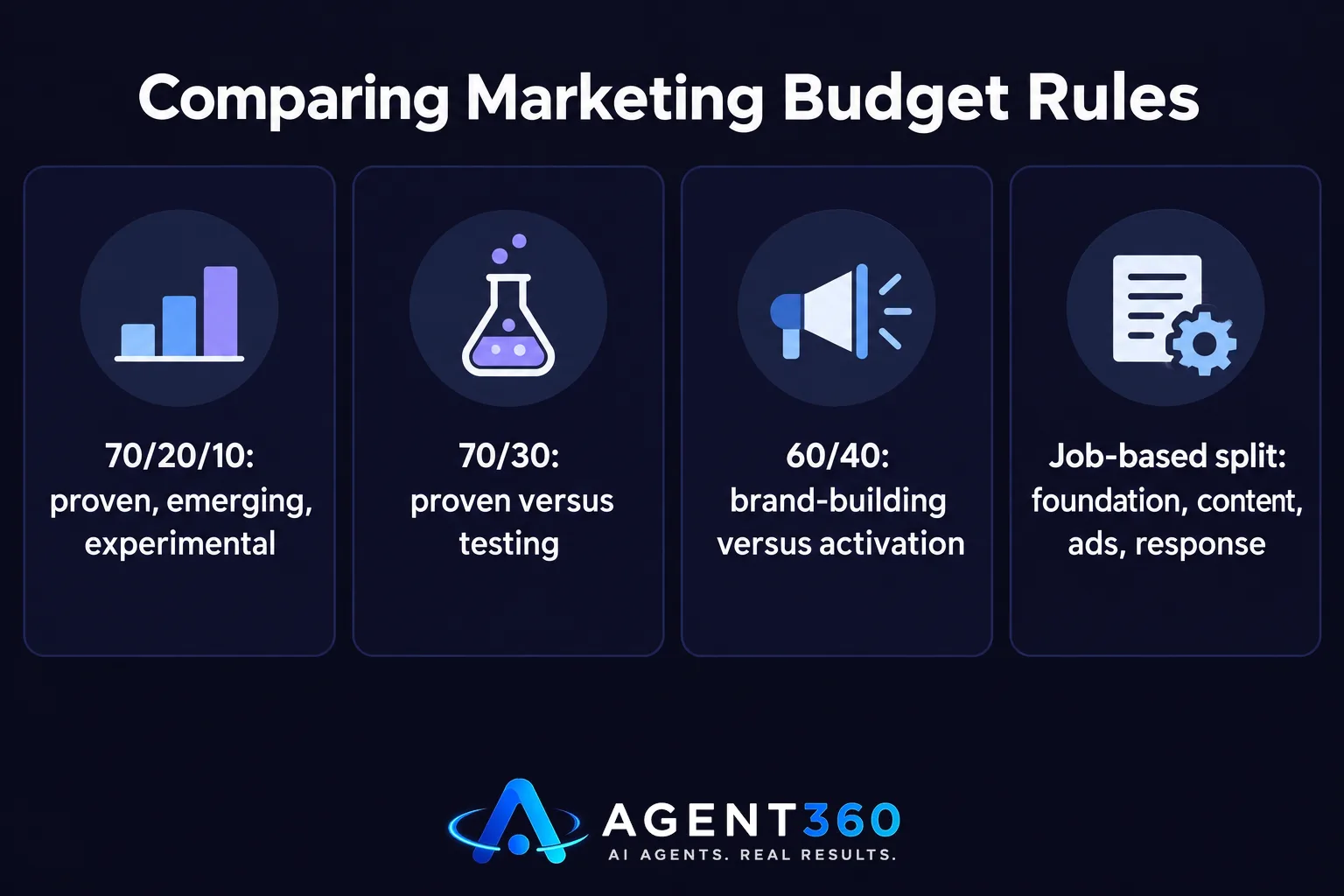
This one is a dollar rule. Put 70% of your budget into channels you already know convert — your highest-performing Google or Meta campaign, the SEO work keeping your top pages ranked. Put 20% into channels with early signal but no track record yet: a new ad format, a location you just expanded into. Put the last 10% into genuine experiments, a channel you've never tried, with no expectation it pays back this quarter. The rule exists to stop two failure modes at once: spending 100% on “safe” channels until they plateau, and spending too much on untested ideas before you've proven the core works.
What is the 70/30 rule in marketing?
The two-bucket version of the same idea: 70% to what's proven, 30% to testing. It's a simpler split for a smaller budget, where carving out three separate buckets (70/20/10) leaves the 10% slice too thin to learn anything from. If your total marketing spend is under $2,000 a month, 70/30 is the more honest version — a 10% experimental budget on $2,000 is $200, and $200 isn't enough to run a real test of anything.
What is the 60/40 rule in marketing?
This one comes from advertising effectiveness research on brand-building versus short-term activation: roughly 60% of spend toward building awareness and preference over the long term, 40% toward tactics that drive an immediate response. It was built for national ad budgets with months of data behind them, and it fits a local business poorly. A single-location business doesn't really have a “brand-building” budget separate from its lead-generation budget — your Google ads, your reviews and your ranked pages are doing both jobs at once. Treat 60/40 as a reminder that not every dollar needs to produce a lead this week, not as a split you need to track on its own line.
Split the budget by job, not by a ratio you found online
None of these rules replace building the budget from what your business actually needs done. A workable split for a local service business looks closer to this: foundation (website, booking, CRM) as a flat monthly cost that doesn't scale with revenue; content and SEO as a steady monthly commitment, since rankings take months to build and punish inconsistency; paid ads as the only line item that flexes with what you can afford to test this month; and response tooling — the systems that answer a lead in minutes and get it booked — funded before you add a dollar of ad spend, since an unanswered lead is money already spent and already lost. You can see how this splits across getting found, paid leads and responding fast enough to book them, rather than guessing at a ratio.
One rough floor worth stating plainly: under roughly $800 to $1,000 a month in total marketing spend, skip paid ads entirely and put everything into your Google Business Profile, reviews and a site that converts. Ad platforms need enough volume to learn from, and a budget that small gets eaten by the platform's own learning phase before it ever produces a booked job.
One flat-fee way to stop guessing
If re-litigating this budget every quarter isn't where you want to spend your time, a flat monthly plan removes the guesswork on the services side. Booked runs the website, SEO, AEO and GEO, social content, ad management and lead follow-up for one price starting at $297 a month, with ad spend paid directly to Google and Meta so you always see exactly what that part costs. You can compare what's included at each tier on the pricing page. Most businesses treat the plan fee as their foundation and content line, then set ad spend separately as the flexible piece.

Questions
How much should a brand-new business spend on marketing?
Plan for 12% to 20% of projected revenue in the first one to two years. You're buying awareness and reviews a competitor already has for free, and that costs more than defending a position you've already won.
Should I cut marketing spend when revenue is slow?
No. A slow quarter is usually a pipeline problem, and cutting the marketing that fills the pipeline just compounds it. Set your percentage annually off the prior year and hold it through a slow month instead of adjusting week to week.
What should I spend on before I touch paid ads?
A site that converts, a complete Google Business Profile, and a way to answer and book a lead within minutes of it coming in. Paid traffic sent to a slow site or an unanswered phone is spend with nothing to show for it — check where that gap is costing you with a quick ROI estimate before you commit a budget.
More articles
- Website and Marketing Packages: What a Fair Price Looks Like
- All-in-One Marketing for Small Business
- All-in-One Website & Marketing: What You Actually Get
- Small Business Marketing Budget: What to Actually Spend
- Speed to Lead: Why the First Five Minutes Decide the Sale
- Lead Follow-Up for Small Business: The System That Works
- How to Get Recommended by ChatGPT for Your Business
- How to Get Found on Google Maps, Not Just Listed
