Small Business Marketing Budget: What to Actually Spend
Seven to eight percent of revenue. That's the marketing spend for a business that's established and holding its ground. If you're newer, or still fighting for a customer base, push it to 12 to 20 percent. The range comes from guidance the U.S. Small Business Administration has repeated for years, and it still holds because the logic hasn't changed: a business fighting for market share has to spend more to get noticed than one coasting on referrals and a steady customer list.
The percentage isn't the hard part. The hard part is what it's supposed to cover, how to split it, and what to do when the number it spits out is too small to matter. That's where most owners trip up the first time they try this math.
What is the 70/20/10 rule for marketing budget?
Seventy percent goes into channels you already know work. Twenty percent goes into channels that look promising but are still unproven for your business. Ten percent is for genuine experiments — the kind you half expect to fail. It's a risk rule wearing a budget rule's clothes. The point isn't to protect that 70 percent forever; it's to stop a business from freezing all its spend on last year's winners, or from chasing every new platform with real money before testing it small.
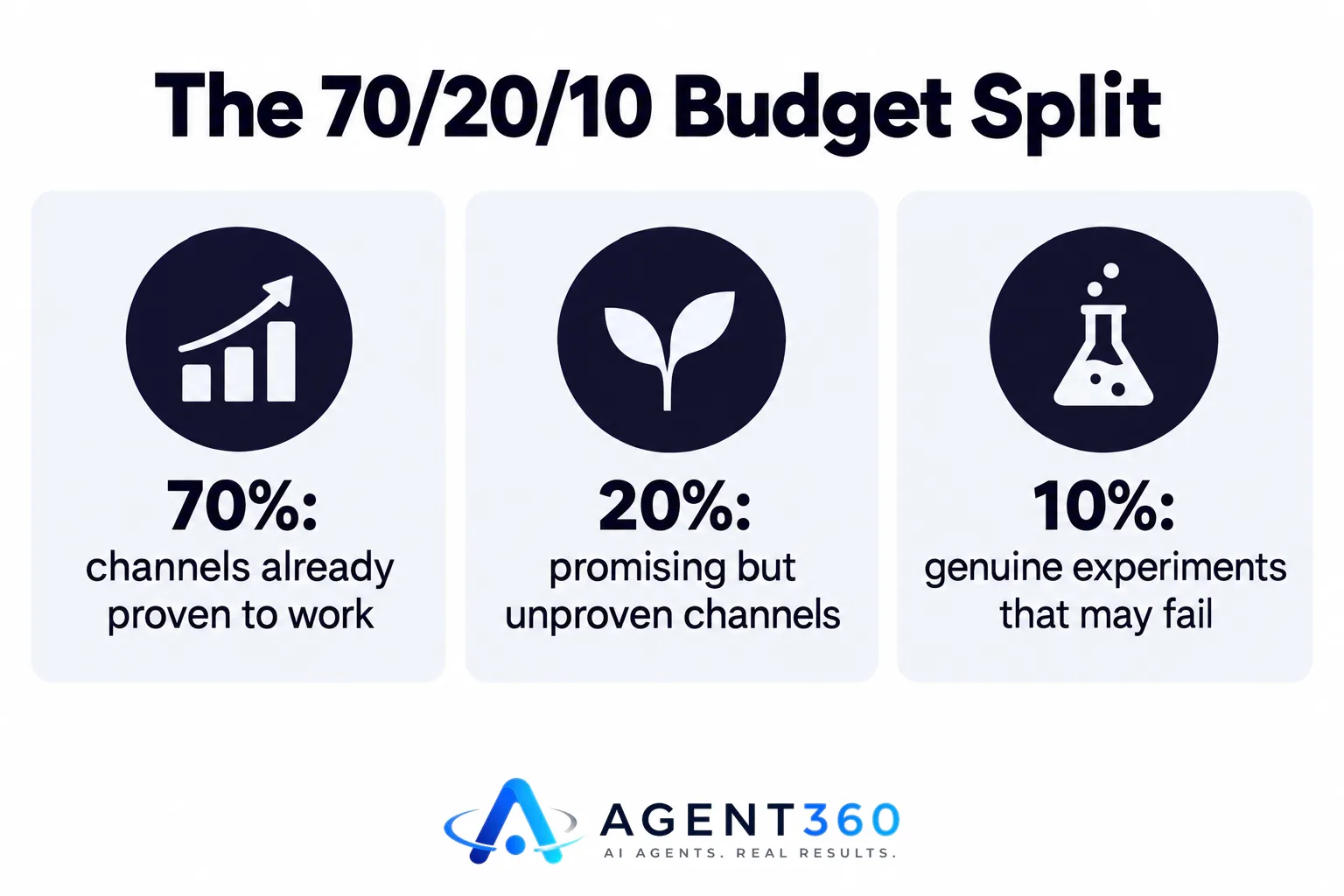
For a local service business, the 70 is usually the Google and Meta ads already producing booked jobs, plus the SEO and Google Business work keeping the map pack listing warm. The 20 is a channel you suspect could work — retargeting people who visited but didn't call, maybe a second ad platform. The 10 is where you try a short video ad or a new geography, sized small enough that a bad result doesn't sting.
What is the 40/40/20 rule in marketing?
This one splits a campaign's success, not a budget: 40 percent audience, 40 percent message, 20 percent creative execution. It comes out of direct response marketing, and it's worth knowing because it tells you where to look when a campaign flops. Most owners blame the ad — the photo, the headline, the video — when the real problem is usually who it's shown to, or what it's offering. Swap the image on a plumbing ad that isn't converting and it still won't convert. Narrow the audience to homeowners in a specific radius, or change the offer from “contact us” to “same-day diagnostic, $49,” and it usually does.
What should be included in a marketing budget?
Four categories. Skip any one of them and the budget looks fine on paper and fails in practice.
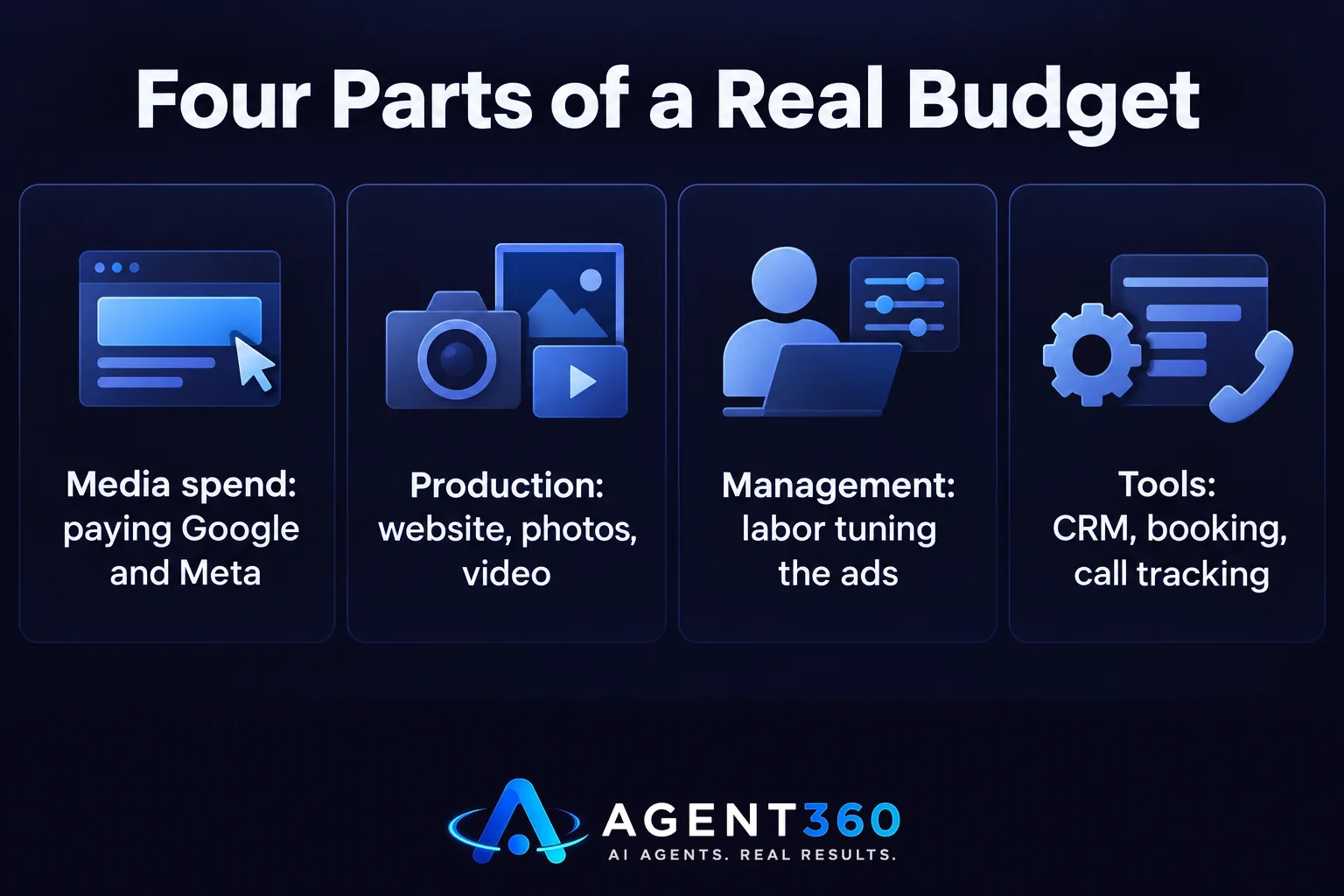
- Media spend — what you actually pay Google and Meta to show ads. This is what most people mean by “marketing budget,” and it's usually the smallest honest category.
- Production — the website, landing pages, photos, video, and the ongoing cost of keeping a site fast and current. A site that's three years out of date quietly taxes every dollar spent driving traffic to it.
- Management — the labor, in-house or agency, that writes the ads, tunes the bidding, and checks what's working. Leave ad spend unmanaged and it decays within weeks as costs per click drift and audiences go stale.
- Tools — the CRM, booking system, review software, call tracking. These rarely feel like marketing costs, since they don't buy attention. But without them you can't tell which spend is working, and slow follow-up quietly bleeds leads. A slow response to a hot lead wastes every dollar spent getting that lead in the door.
A budget that only lists ad spend isn't a marketing budget. It's a media plan.
On a shoestring, cut channels before you cut effort
When the total is small — a few hundred dollars a month, not a few thousand — the instinct is to spread it across ads, social, email, and a website refresh, and hope something sticks. That's the fastest way to make a tiny budget vanish with nothing to show for it.
Pick one channel. Pick one offer. For most local businesses, that's Google Search ads on your highest-intent keyword, pointed at a single landing page with one clear offer — not your homepage. Run it a full month before you judge it; most accounts need that long to generate enough clicks to read the data honestly. Everything else — social posts, a blog, review requests — costs time, not money, so run those in parallel. Just don't split the ad budget across platforms until one of them is proven. A realistic starting ad budget for a single local service area is usually smaller than owners expect, and it works better concentrated than scattered.
Where done-for-you marketing fits in the budget
Once a business outgrows doing this alone, the question becomes whether to hire in-house, hire an agency, or pay for a managed service that bundles the work. Booked runs the full stack — Google and Meta ads, SEO, the website, lead follow-up, and booking — for a flat monthly fee starting at $297, with ad spend paid directly to Google and Meta from your own account, so you always see exactly what's being spent and where. No setup fee, no contract — which matters most in the first few months, while you're still deciding whether the spend is earning its keep. Full plan details are on the pricing page.
How much money should I spend on marketing?
Start from revenue, not a flat number: 7 to 8 percent if the business is stable, 12 to 20 percent if you're newer or trying to take market share. Then check that figure against what a single new customer is actually worth. If a new customer is worth $800 over their lifetime, a $1,500 monthly budget needs to produce roughly two bookings just to break even — which tells you fast whether the percentage-of-revenue number is realistic for your market. The ROI calculator is built for exactly this check.
How do I get more customers on a small budget?
Concentrate spend on the one channel closest to someone already looking to buy — usually Google Search for a specific service, not broad brand awareness. Put the time you're not spending on ads into things that are free: requesting reviews after every job, answering every call and form within minutes, keeping the Google Business profile current. A tiny ad budget paired with fast follow-up will beat a bigger budget paired with slow response, every single time.

More articles
- Speed to Lead: Why the First Five Minutes Decide the Sale
- Lead Follow-Up for Small Business: The System That Works
- How to Get Recommended by ChatGPT for Your Business
- How to Get Found on Google Maps, Not Just Listed
- Website For Small Business: Builder, Cost, Or Done-For-You
- Google Ads for Local Business: What a Real Budget Looks Like
- How to Get More Google Reviews: Timing Beats Begging
- Missed Call Text Back: What To Send And Why It Works
