All-in-One Marketing Agency vs. Separate Vendors: Who Wins?

An all-in-one marketing agency runs your website, SEO, ads and lead follow-up under one contract and one login. Hire separately and you are the one stitching together a web developer, an SEO freelancer and an ad buyer. So which books more customers? It depends on whether you have the spare hours to be the general contractor, because that is the job nobody mentions when you hire specialists.
Separate vendors can genuinely be sharper at their one thing. A buyer who only runs Google Ads all day will usually out-tune a generalist shop. The question was never skill. It is what happens in the gaps between the specialists, and whether anyone is actually paid to care about those gaps.
The seam between vendors is where leads actually die
A lead fills out a form on a landing page your ad agency built. The form routes to a CRM your web developer set up two years ago, which nobody checks daily because checking it is not anyone's job. By the time a human sees it, four hours have passed. The ad agency reports a great cost per click. The web developer reports the site is up and fast. Nobody reports the lead went cold, because nobody owns that number.
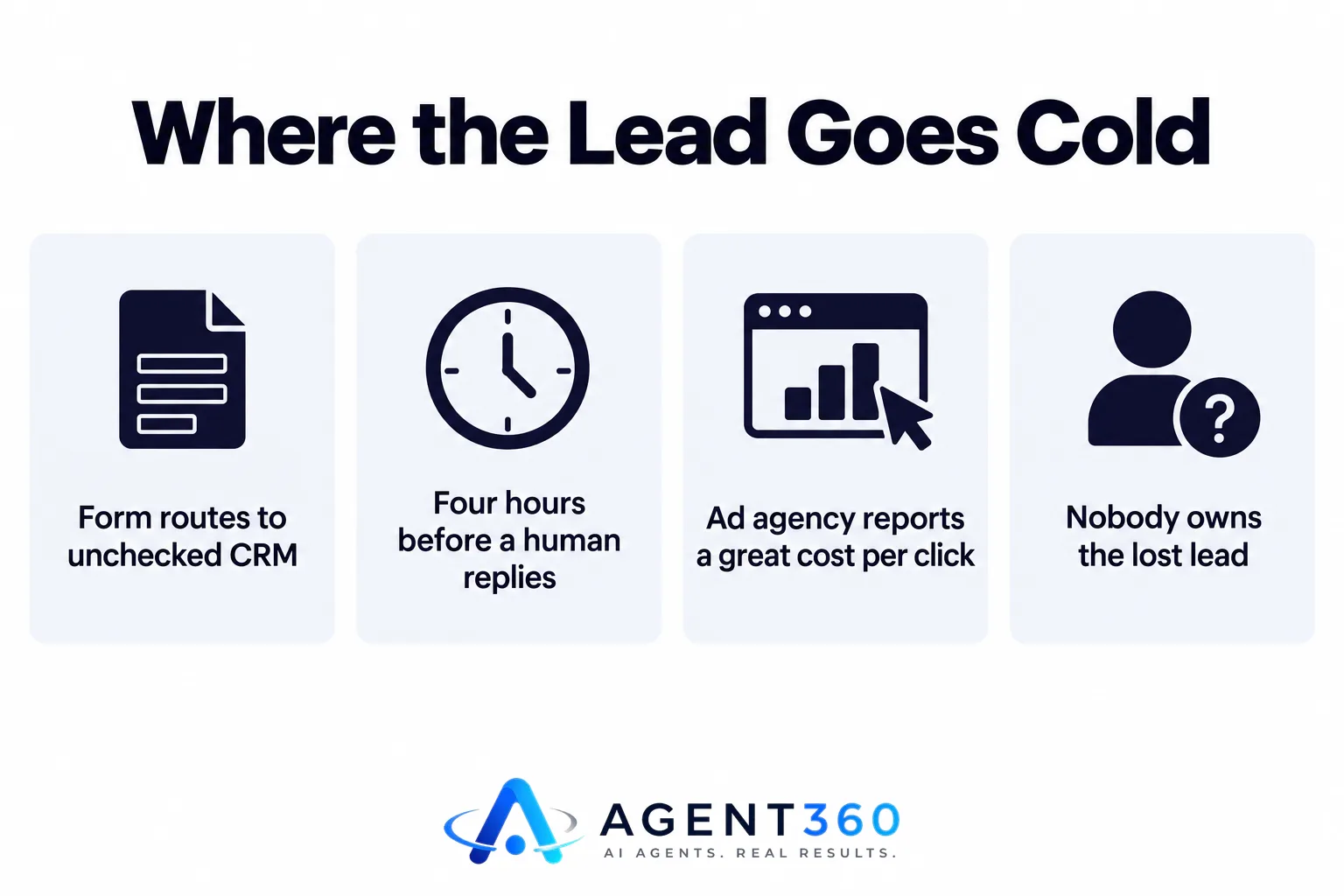
That is the real failure mode of hiring separately: every vendor points to their own dashboard and says their piece worked, while the business as a whole gets no customer. Response time in the first few minutes decides more deals than ad targeting does, and response time is exactly the thing that falls into the crack between an ad vendor and a web vendor — because it belongs to neither.
A single dashboard beats five logins, but only if someone reads it
With separate vendors you get separate reports: a rankings report from the SEO firm, a spend report from the ad buyer, a traffic report from whoever hosts the site. Turning all of that into one number — cost per booked customer — is unpaid work that lands on you. Most owners don't do it every month. Plenty don't do it every quarter either.
An all-in-one setup collapses this into one report because one team owns the full path: the ad, the landing page, the form, the follow-up, the booking. That doesn't make the work better by default — a bad all-in-one agency is still bad — but it kills the reconciliation job. The one number that matters, cost per booked customer, just shows up, instead of you building a spreadsheet to find it.
Specialists still win on raw technical depth, and that matters for some businesses
If your growth bottleneck is genuinely technical — an enterprise SEO migration, a paid search account structured across dozens of markets, a bespoke e-commerce platform — a narrow specialist with deep tooling can outperform a generalist. That's a real tradeoff. Worth naming instead of pretending every business needs the same answer.
Most local and service businesses aren't fighting that battle. The bottleneck for a dental practice, a salon or a home services company is rarely “our SEO isn't technical enough.” It's usually one of three plainer things: the site doesn't convert, nobody answers the phone fast enough, or nobody follows up with the lead that didn't book on the first call. Those are coordination problems, not depth problems. Coordination is exactly what an all-in-one setup is built to solve.
The real cost comparison is coordination hours, not line items
Businesses tend to compare the SEO retainer plus the ad management fee plus web hosting plus the CRM subscription against one all-in-one monthly price, and separate vendors sometimes look cheaper line by line. What that comparison leaves out is the hours you or your staff spend every week: approving creative in three different places, chasing why the CRM and the ad platform show different lead counts, noticing when a vendor quietly stops delivering. What a local marketing agency actually costs is rarely just the invoice.
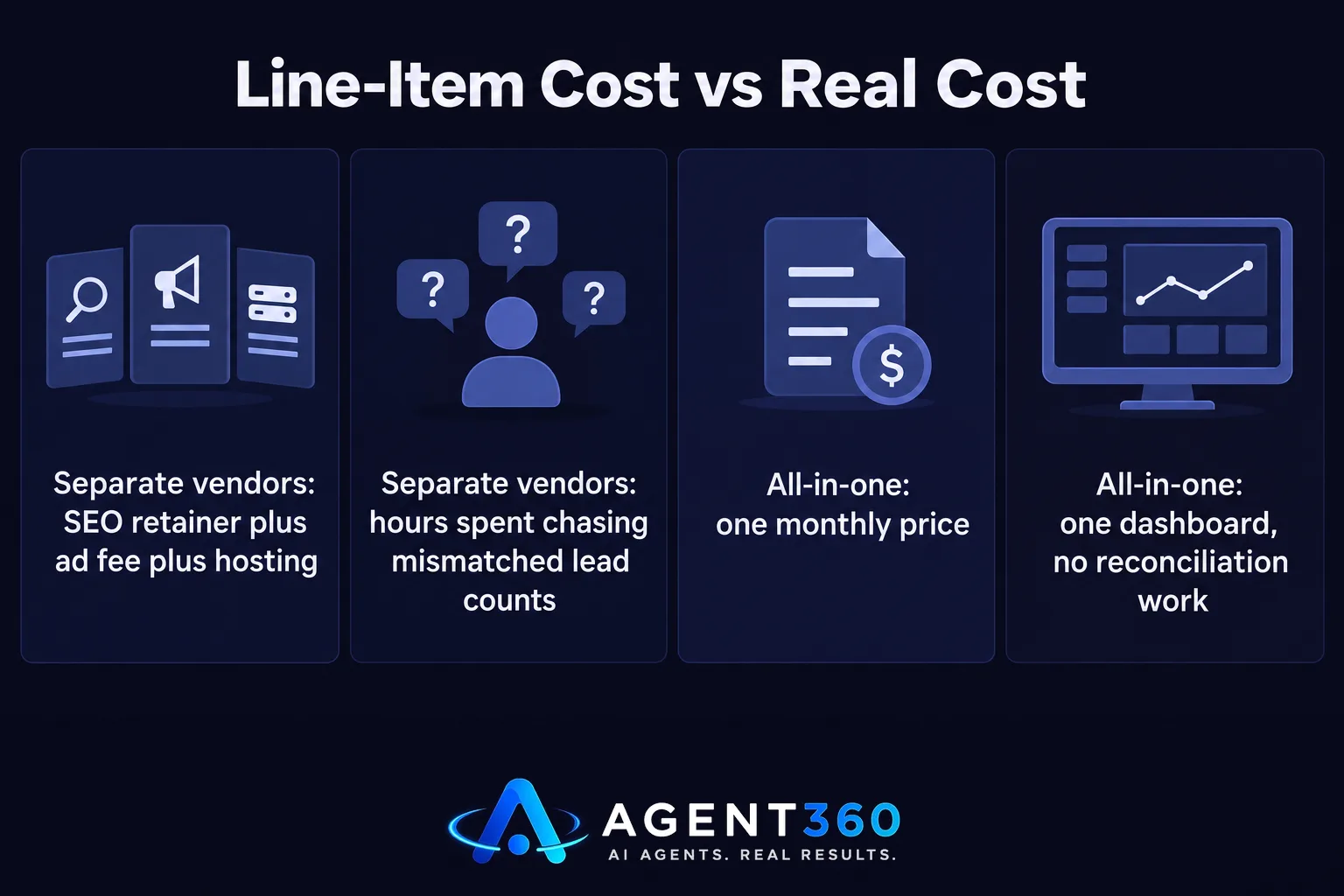
If that coordination time is worth less to you than the money saved, separate vendors can be the right call — especially if someone internal already manages vendors for a living. If that time is time you'd rather spend running the business, the math usually favors one accountable team.
Where Booked fits
Booked is built as the single-team alternative: one plan, from $297 a month, no setup fee, no contract, covering the website, SEO, AEO and GEO for AI search, Google and Meta ads, instant lead follow-up, and online booking with deposits and reminders — all reporting into one dashboard that shows what each lead cost and whether it booked. The full breakdown by plan is on the pricing page, and the lead follow-up and booking service is the piece most separate-vendor setups miss entirely, because no single vendor in a five-vendor stack is paid to own it.
What should I ask a vendor before switching from separate agencies?
Ask who is accountable for the full path from ad click to booked customer, not just their piece of it. If the answer is “that's not really our part,” you've just found the seam that will cost you leads. Ask to see a sample monthly report and confirm it shows cost per booked customer, not just clicks or rankings.
Will I lose specialist quality by switching to one provider?
Possibly, for highly technical or large-scale programs. For most local businesses, the bigger risk isn't depth — it's speed and ownership across the handoffs, which is what paid lead generation and follow-up need to do together, not separately.
Can I switch from separate vendors without a messy transition?
Yes, if the new provider keeps your domain and your existing customer data instead of starting you over from zero. Get it in writing that you keep your domain, your leads and your customer list if you ever leave — check the specifics on the FAQ page before you sign anything, not after.

More articles
- How Much Should a Small Business Spend on Marketing?
- Website and Marketing Packages: What a Fair Price Looks Like
- All-in-One Marketing for Small Business
- All-in-One Website & Marketing: What You Actually Get
- Small Business Marketing Budget: What to Actually Spend
- Speed to Lead: Why the First Five Minutes Decide the Sale
- Lead Follow-Up for Small Business: The System That Works
- How to Get Recommended by ChatGPT for Your Business
