Apollo vs Smartlead: Built-In Data Versus Your Own Lists
Apollo hands you a contact database to search and export from. Smartlead doesn't - it treats sending as the job and leaves the list-building to you. That one difference, built-in versus bring-your-own, ripples into price, data quality, and how much manual work sits between you and your first send.
The question founders usually land on is simpler: can I just switch fully to Apollo and drop the second tool? It comes down to where your outbound actually breaks - finding the right people, or getting emails delivered and answered once you've found them. Those are two separate problems, and each tool only fixes one.
Key Takeaways
- Apollo's value is the built-in contact database; the sending features ride along behind that.
- Smartlead ships with no contact data of its own, so list quality rests entirely on what you feed it.
- Running both means paying for data in one place and deliverability tooling in another, and that adds up over a year.
- If you'd rather have contact data and sending under one plan with no per-seat fees, see how Agent360 compares to Apollo.
- Check list accuracy before committing to either tool - a wrong email address costs you a reply no matter which platform sent it.
Table of Contents
What does Apollo actually include that Smartlead doesn't?
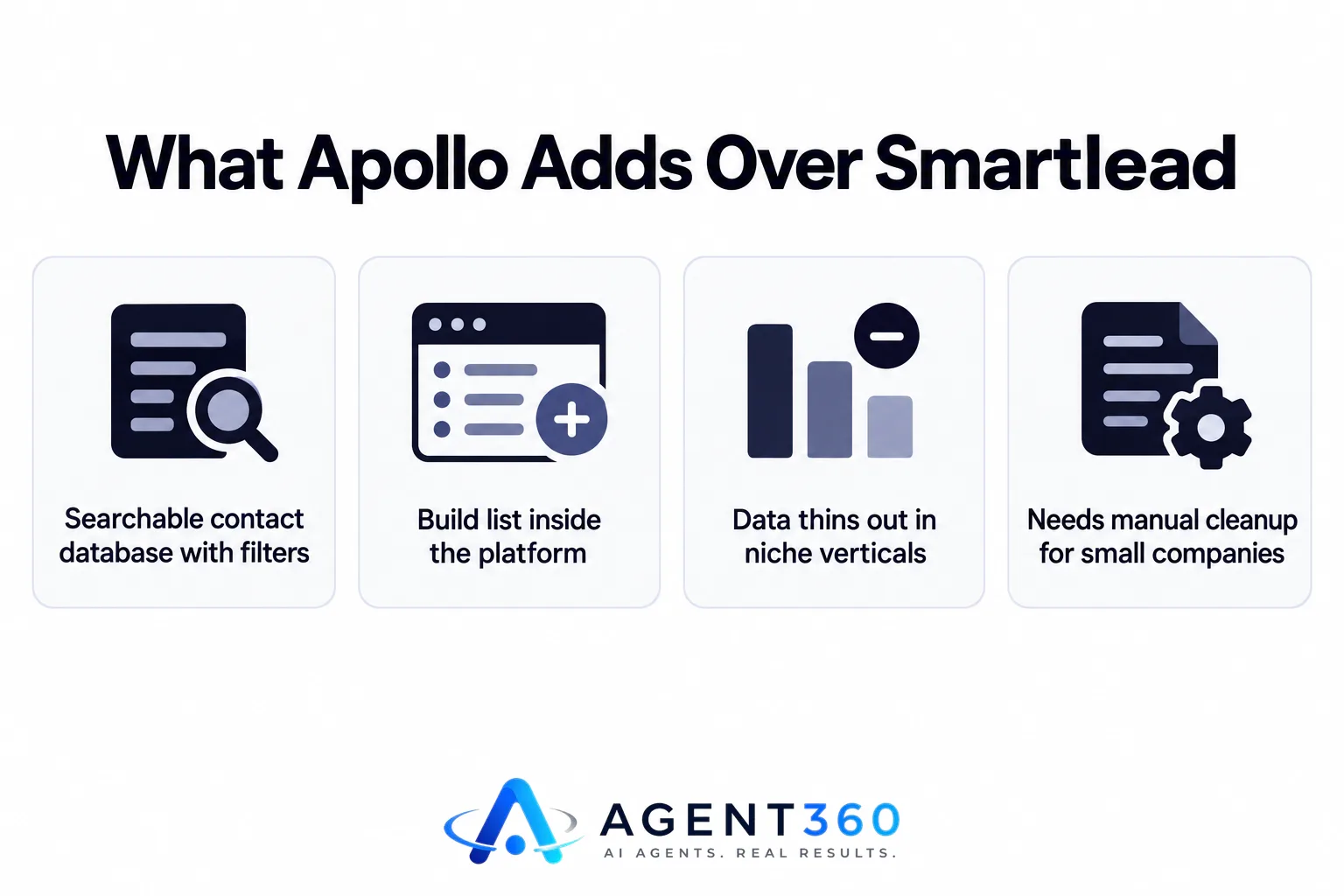
Apollo includes a searchable contact database with filters for title, industry, and company size; Smartlead includes none of that. Apollo's pitch: build the list inside the platform, then run sequences against it without ever exporting. Smartlead skips that step entirely - it assumes the list already exists somewhere, whether that's a CSV, a CRM export, or data pulled from a provider you're paying for separately.
Does that mean Apollo is the better starting point?
Only if you trust the database for your particular market. Apollo's data leans toward broad B2B segments, and it thins out fast in narrow verticals or smaller companies. A niche target list often needs heavy manual cleanup before it's usable - and that cleanup eats into the exact time savings Apollo is supposed to deliver.
Where does Smartlead expect your contact data to come from?
Smartlead expects you to bring a list from a separate source, whether that's manual research, a data provider, or an export from another tool. It has no prospecting layer of its own. Its strength sits on the sending side: warming up domains, rotating sending accounts, and holding deliverability steady across a high volume of email.
What happens if your imported list has bad data?
Smartlead sends to whatever addresses you upload, bounces and stale scrapes included. A high bounce rate from an old list can wreck sender reputation fast, no matter how well the sending infrastructure is tuned. Before loading any list into a pure sending tool, check how the data was sourced and how recently it was verified.
Which approach costs more over a year?
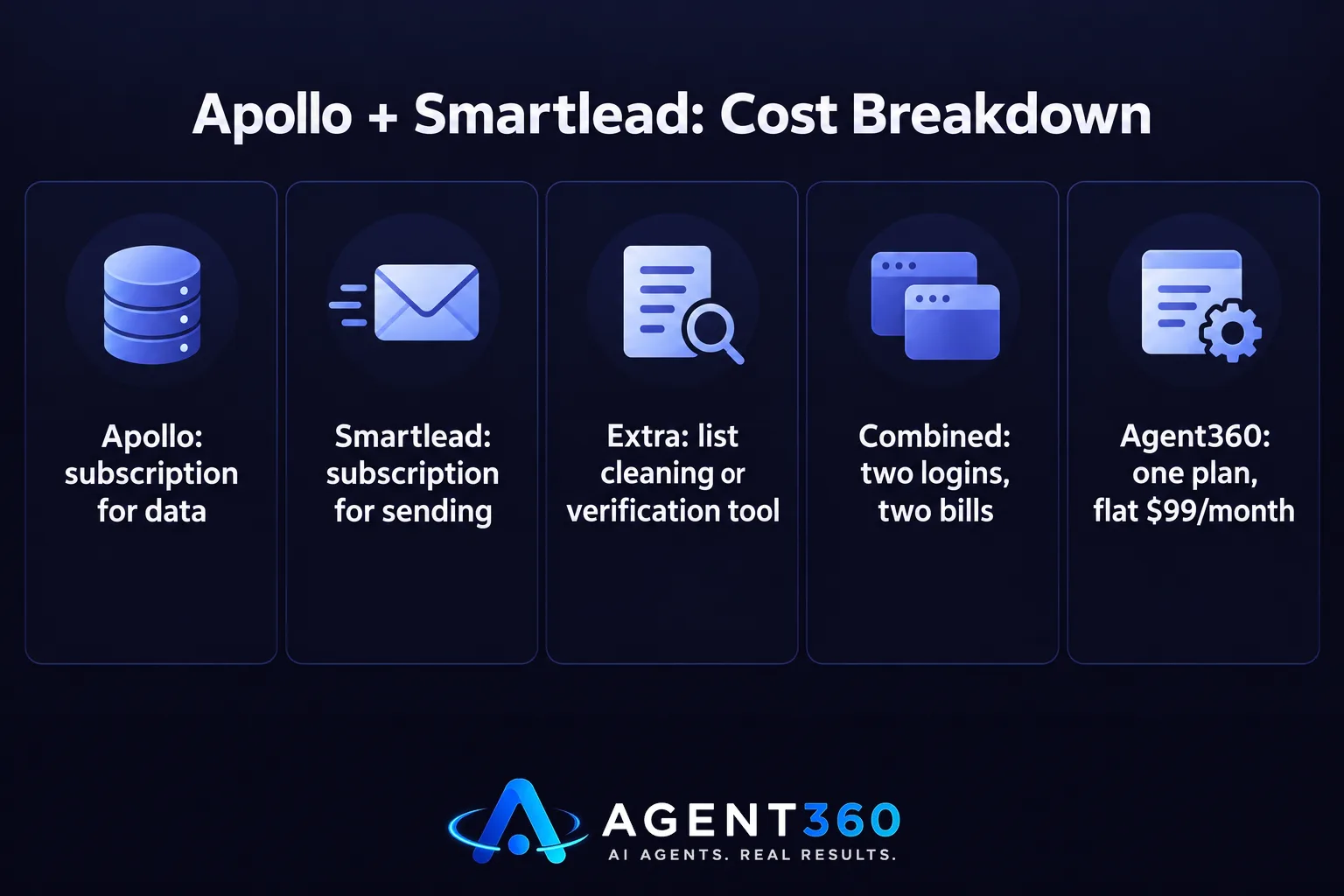
Running Apollo for data and Smartlead for sending usually means paying two separate subscriptions, plus whatever extra you spend on list cleaning or a third-party verification tool. Neither platform publishes a combined price for that stack, so the real cost depends on your seat count and send volume with each one. The practical move is to add up what you'd actually pay for both tools at the plan tier your team needs - not compare headline prices in isolation.
Is paying for two tools ever the right call?
Sometimes. Teams with particular data needs sometimes prefer a best-of-breed stack even at a higher cost, because no single tool nails both jobs. The tradeoff is operational: two logins, two support lines, and two systems to keep synced every time a prospect replies or unsubscribes.
Should you combine Apollo's data with Smartlead's sending?
You can, and some teams do, but it means managing the handoff between two systems yourself. That usually means exporting a list from Apollo, cleaning it, importing it into Smartlead, and keeping both tools current when someone replies or asks off the list. For a solo founder or a small team, that handoff is often where outbound actually stalls - not because either tool is bad, but because nobody owns the gap between them.

- Define your target list criteria first. Title, industry, and company size filters only work if you already know exactly who you're chasing.
- Pull and verify the list before sending. Catch bounce risk before it hits a sending tool, not after.
- Decide who owns replies. Someone needs to watch both systems for responses and unsubscribe requests.
- Track results somewhere central. If neither tool is your system of record, pick a CRM and route the data into it consistently.
What should founders and staffing agencies check before picking either?
Check whether the tool gives you verified contact data, sending capability, or both, and whether pricing scales per seat. A staffing agency selling to hiring managers works a narrower, faster-moving list than a SaaS company selling to a broad buyer persona, so data freshness matters more. A founder running outbound solo has to weigh setup time against the cost of a second tool, since every extra step is time not spent on calls.
What's the best software for price and quality when sending cold email?
There's no single answer, because “best” depends on your send volume, your list source, and whether you need per-seat pricing or a flat rate. The more useful question is whether a platform bundles verified data with sending - paying once for both is usually simpler than reconciling two tools and two bills every month.
Pick the Stack That Matches Your List Problem
If outbound has stalled because you don't trust the list, no sending tool fixes that - the data problem comes first. If the list is solid and emails still aren't landing, that's a deliverability problem, not a data one.
Agent360's Prospecting finds buyers and flags buying signals for your target market, and every plan includes one triple-verified lead for every email sent - so the data and the sending live in one system instead of two. Plans start at $99 a month, with unlimited seats and no per-user fees, and the Multi-channel Outreach tools run email, LinkedIn, and phone from that same place.
See how Agent360's prospecting works or check current pricing before deciding whether to run a split stack or a single one.
Frequently Asked Questions
Should I switch fully to Apollo.io?
That depends on where your bottleneck actually sits. Apollo handles contact-finding well for broad B2B markets but doesn't touch deliverability or sequencing depth the way a dedicated sending tool does.
Does Smartlead include any contact data?
No. Smartlead is a sending platform, full stop, and expects you to import a list from elsewhere - manual research, a CRM export, or a separate data provider.
Can I use Apollo's data inside Smartlead?
Yes - export contacts from Apollo and import them into Smartlead - though you'll be managing list cleaning and reply tracking across both systems yourself.
Why does list quality matter more than sending volume?
A bounce from a bad address damages sender reputation regardless of how well the sending infrastructure is set up. Clean, verified data is what protects the deliverability you're already paying for in a sending tool.
What's the cheapest way to run outbound with verified data included?
Look for a platform that bundles contact data with sending rather than billing for each separately - that's what keeps you off two subscriptions plus a verification tool. Check Agent360's pricing FAQ for what's included at each tier.
More articles
- MSP Sales Leads & Appointments: A Practical Playbook
- AI Competitor Gap Analysis Agent: What It Actually Does
- Skylead vs Dripify: Which LinkedIn Tool Fits Your Team?
- Cold Email for Recruiters: What Actually Works
- MSP Lead Generation Services: What to Look For
- AI Dialer: What It Actually Does and What to Check First
- Unlimited Seats Sales Software: What to Buy and Why
- Cold Email and LinkedIn Sequencer: What to Look For
