AI Competitor Gap Analysis Agent: What It Actually Does
An AI competitor gap analysis agent scans your competitors' websites, pricing pages, and public materials, then tells you what they cover that you don't. Instead of someone reading through ten competitor sites by hand and jotting notes, the AI pulls the pages, sorts them by topic or feature, and flags where the gaps sit.
For a founder running outbound solo, or a staffing agency owner pitching against three other firms for the same client, the report itself isn't the point. What matters is what you do with it — which prospects to target next, which objection to get ahead of, which message to send first.
Here's what the agent actually checks, how to build a repeatable process around it, and how to turn the output into something your outreach can actually use.
Key Takeaways
- An AI competitor gap analysis agent compares your content, positioning, and market coverage against named competitors and flags the differences.
- Gaps fall into three types: topics you don't cover, prospects you don't target, and messaging angles you don't use.
- A gap is only useful once it's tied to a specific audience segment or outreach sequence, not left as a slide in a deck.
- Run the analysis on a schedule, not once, since competitor positioning changes as fast as your own.
- If the goal is booked meetings rather than a report, pair the analysis with AI prospecting that acts on what the gaps reveal.
Table of Contents
What is an AI competitor gap analysis agent?
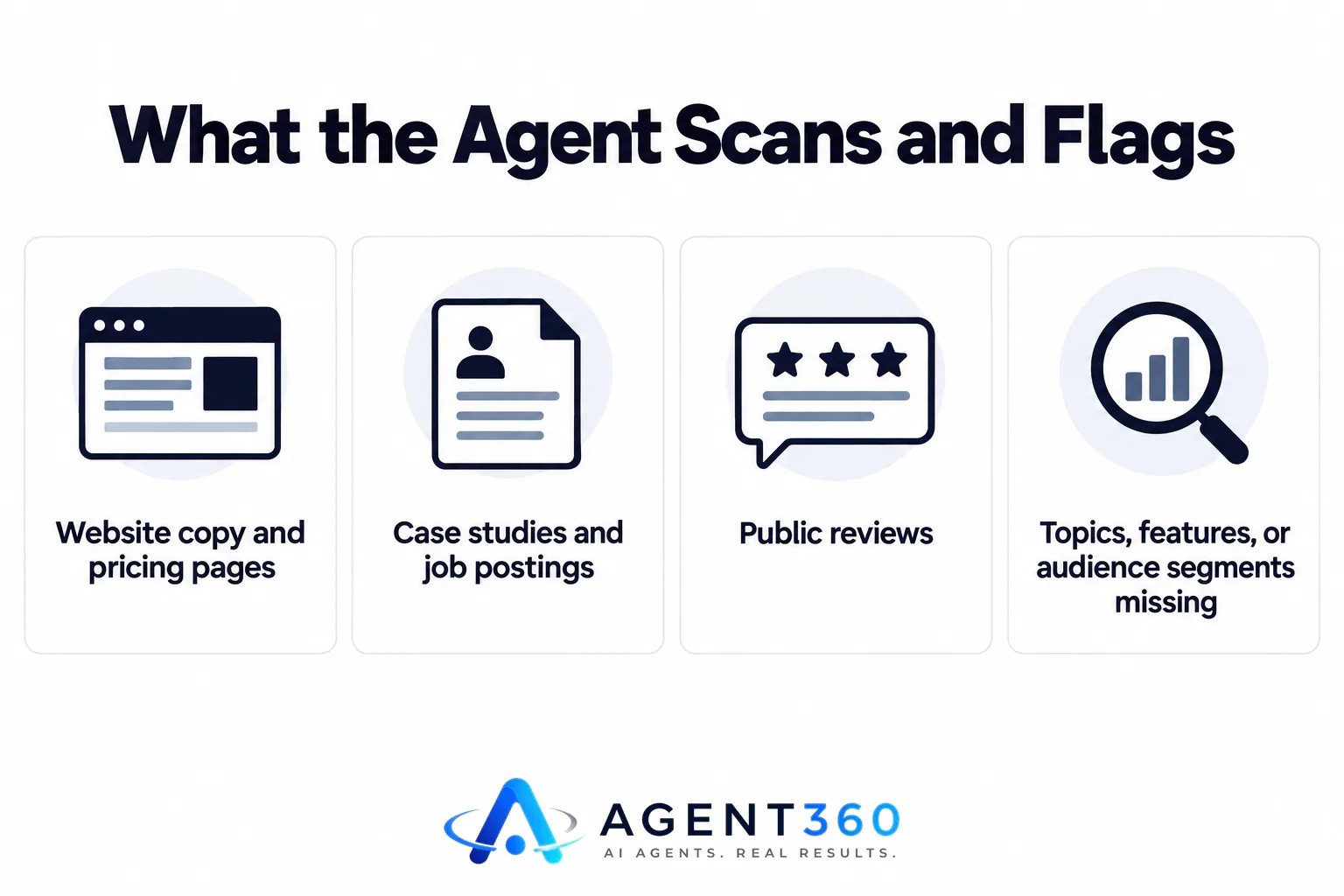
It's a process, usually AI-assisted, that scans named competitors' public content, offers, and positioning, then compares it to yours to find what's missing on your side. It can look at website copy, pricing pages, case studies, job postings, public reviews — whatever's public. The output is a list of topics, features, or audience segments where a competitor shows up and you don't.
What makes it different from traditional competitor research?
Traditional competitor research means someone reading sites and typing up notes — slow work that goes stale fast. An AI-assisted version re-scans competitor sites and public materials on a schedule and flags what changed, so the comparison reflects this month, not whenever someone last sat down and did it by hand.
Anyone using AI for competitive analysis — how do you set it up?
Start with a short, named list of real competitors and a fixed set of things to compare, then let AI handle the scanning while a person handles the judgment. AI is good at pulling and sorting large volumes of public text. It's much weaker at deciding which gap actually matters to a buyer.
- Name three to five real competitors. Pick the ones you actually lose deals to, not the biggest logos in the space.
- Pick what to compare. Common choices: website messaging, pricing structure, case studies, job postings (a signal of where they're investing), and public reviews.
- Feed the AI public sources. Website pages, G2 or Capterra reviews, LinkedIn company posts, and job boards are all public and fair to scan.
- Review the output with someone who talks to prospects. A gap only matters if it's something a buyer has actually asked about or pushed back on.
- Re-run it monthly or quarterly. Competitor positioning shifts; a one-time report is stale before you've even acted on it.
Anyone have a good process for content gap analysis?
A content gap analysis compares the topics and questions your competitors cover in public content against the ones you cover, and flags what prospects are searching for that nobody — not you, not often your competitors — answers well. That matters for outbound because those gaps often point straight at messaging prospects haven't heard anywhere else.
What signals indicate a real gap?
Look for topics competitors repeat across different pages — a sign it's a real buyer concern, not a one-off blog post — objections that show up in public reviews of their product, and questions that come up on sales calls but aren't answered anywhere on anyone's site. A gap mentioned once in competitor copy is weaker evidence than one that shows up on their pricing page, in their case studies, and in their job postings for sales roles.
What do you do once you've found the gaps?
Turn each gap into a specific outreach target or message, not a general observation. A gap analysis that lives in a slide deck doesn't book meetings. The same analysis, turned into a target list or a sequence angle, does.
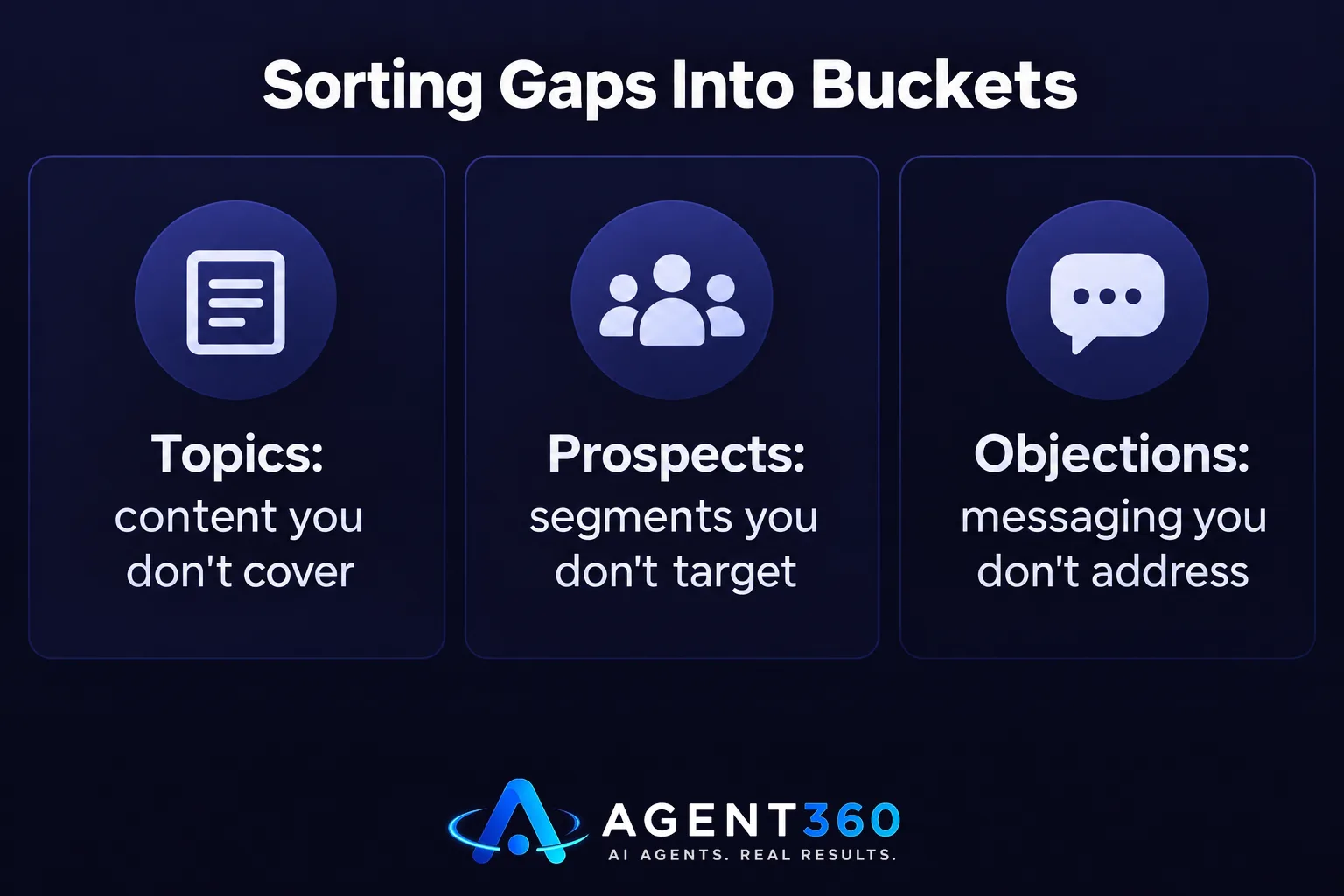
- Sort gaps into three buckets. Topics you don't cover, prospect segments you don't target, and objections you don't address in outreach.
- Match each gap to a buyer signal. If a competitor's reviews show complaints about a specific feature, that's a line you can use in a first message to prospects who use that competitor.
- Build the message before the list. Write the specific sentence that uses the gap, then find the accounts it applies to.
- Hand it to outreach, not just strategy. A gap is worth more inside a live sequence than inside a quarterly review document.
This is also where “interesting research” splits from “pipeline.” A staffing agency that spots a gap in how a competitor talks to hiring managers about speed-to-fill can turn that straight into a cold email line. A B2B founder who finds a feature competitors never mention can lead with it in a LinkedIn message. Either way, the gap needs an address and a sentence — not just a slide.
Turn Competitor Gaps Into Outreach That Books Meetings
Finding the gap is half the job. Acting on it inside live outreach — at the volume it takes to turn a few good messages into a steady flow of meetings — is the other half. Agent360's AI Prospecting finds buyer accounts and detects buying signals, so a gap you've spotted in a competitor's weak point gets matched to the right prospects automatically instead of built into a list by hand.

From there, multi-channel outreach puts the message in front of those prospects across LinkedIn, email, and phone, and meeting booking puts qualified replies straight onto your calendar. The Agent360 Platform starts at $99/month with leads included, unlimited seats on every plan, and a sequencer plus dialer and CRM built to run the whole thing; for teams that would rather hand it off, VIP Done-For-You Outbound runs the entire process with a dedicated GTM engineer for $2,000/month plus $250 per booked meeting.
See how the pieces fit together on the how it works page, or book a demo and walk through turning one specific competitor gap into a running sequence.
Frequently Asked Questions
Is an AI competitor gap analysis agent the same as a competitive intelligence tool?
They overlap, but they're not the same thing. A competitive intelligence tool usually tracks ongoing changes across many competitors continuously; a gap analysis agent typically runs against a short, specific list to answer one question — like which topics or segments a competitor covers that you don't.
How often should I re-run a competitor gap analysis?
Monthly or quarterly works for most B2B teams — competitor pricing, messaging, and case studies don't usually shift week to week. Run it sooner if you lose a deal to a specific competitor and want to know what they said that you didn't.
Can AI do the whole competitor gap analysis without a person?
It can gather and sort the information, but deciding which gap actually matters to a buyer needs someone who talks to prospects regularly. Treat the AI output as a shortlist to review, not a finished verdict.
What sources are fair to use for this analysis?
Public website pages, pricing pages, job postings, and public reviews on sites like G2 or Capterra are standard and fair game. Avoid anything behind a login or gated by an NDA, even if a tool can technically reach it.
Does a content gap analysis help with cold outreach specifically?
Yes — the topics and objections it surfaces often become the opening line in a cold email or LinkedIn message, especially when they point to something a prospect's current vendor doesn't cover. Pairing that message with buying-signal detection helps you target the accounts most likely to care about the specific gap you found.
More articles
- Skylead vs Dripify: Which LinkedIn Tool Fits Your Team?
- Cold Email for Recruiters: What Actually Works
- MSP Lead Generation Services: What to Look For
- AI Dialer: What It Actually Does and What to Check First
- Unlimited Seats Sales Software: What to Buy and Why
- Cold Email and LinkedIn Sequencer: What to Look For
- Staffing Agency Lead Generation: A Practical Playbook
- AI SDR for Staffing Agencies: What to Look for Before You Buy
