First Sales Hire vs Outbound Software: Which First?
First sales hire vs outbound software comes down to one question: do you need a person who can think on their feet, or do you need volume and consistency first? Most founders ask this the moment they realize they cannot keep doing outbound by hand, but they are not sure if the answer is a salary or a subscription.
Both options are meant to solve the same problem: pipeline that does not depend entirely on you. The right pick depends on how predictable your buyer is, how much cash you can commit before revenue proves out, and how much time you can give a new hire to ramp.
Key Takeaways
- A first sales hire costs more upfront and takes months to ramp before producing consistent meetings.
- Outbound software gets prospecting and outreach running in days, without adding payroll risk.
- Software works best when your pitch and target buyer are already defined; a hire works best when the sale needs judgment software cannot replicate.
- Read the full breakdown in SDR vs outbound software before you commit to either path.
- Many founders run software first, then hire once the pipeline justifies the salary.
Table of Contents
What's the real difference between hiring your first salesperson and buying outbound software?
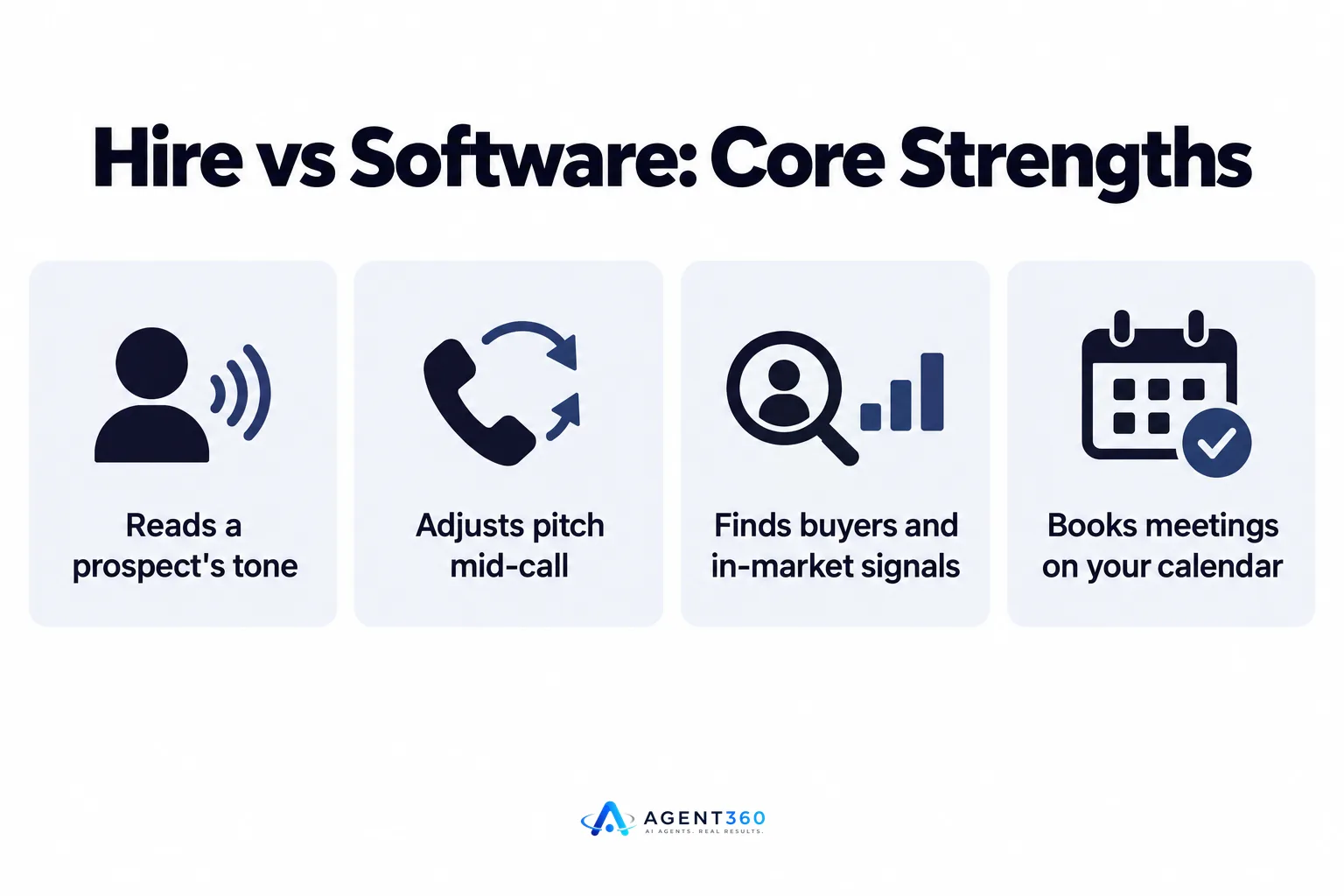
A hire brings judgment and relationship skills; software brings volume and consistency. A first sales hire can read a prospect's tone, adjust a pitch mid-call, and handle objections that do not fit a script. Outbound software does not do any of that. It finds the right people, sends the first touches across email, LinkedIn, and phone, and books meetings on your calendar. What it will not do is close the deal for you.
Does outbound software replace a salesperson entirely?
No. Software fills the top of the funnel: finding buyers, detecting signals that they are in-market, and getting a meeting on the calendar. Someone still has to run that meeting and close it. For many founders in the early stage, that someone is still the founder.
What can a first sales hire do that software cannot?
A hire can qualify ambiguous situations, build a relationship over multiple touches that do not fit a template, and represent the company in a way that feels personal. If your sale is complex, high-ticket, or relationship-driven, that judgment matters more than raw volume.
How much does each option cost in the first year?
A first sales hire costs far more than software once you add salary, ramp time, and management overhead. An entry-level sales hire in most markets needs a base salary, commission, benefits, and a laptop before they book a single meeting. Then there is ramp time: ninety days is a common floor for a new rep to learn the product, the market, and the pitch well enough to perform. During that window, pipeline is thin and the cost is fixed.
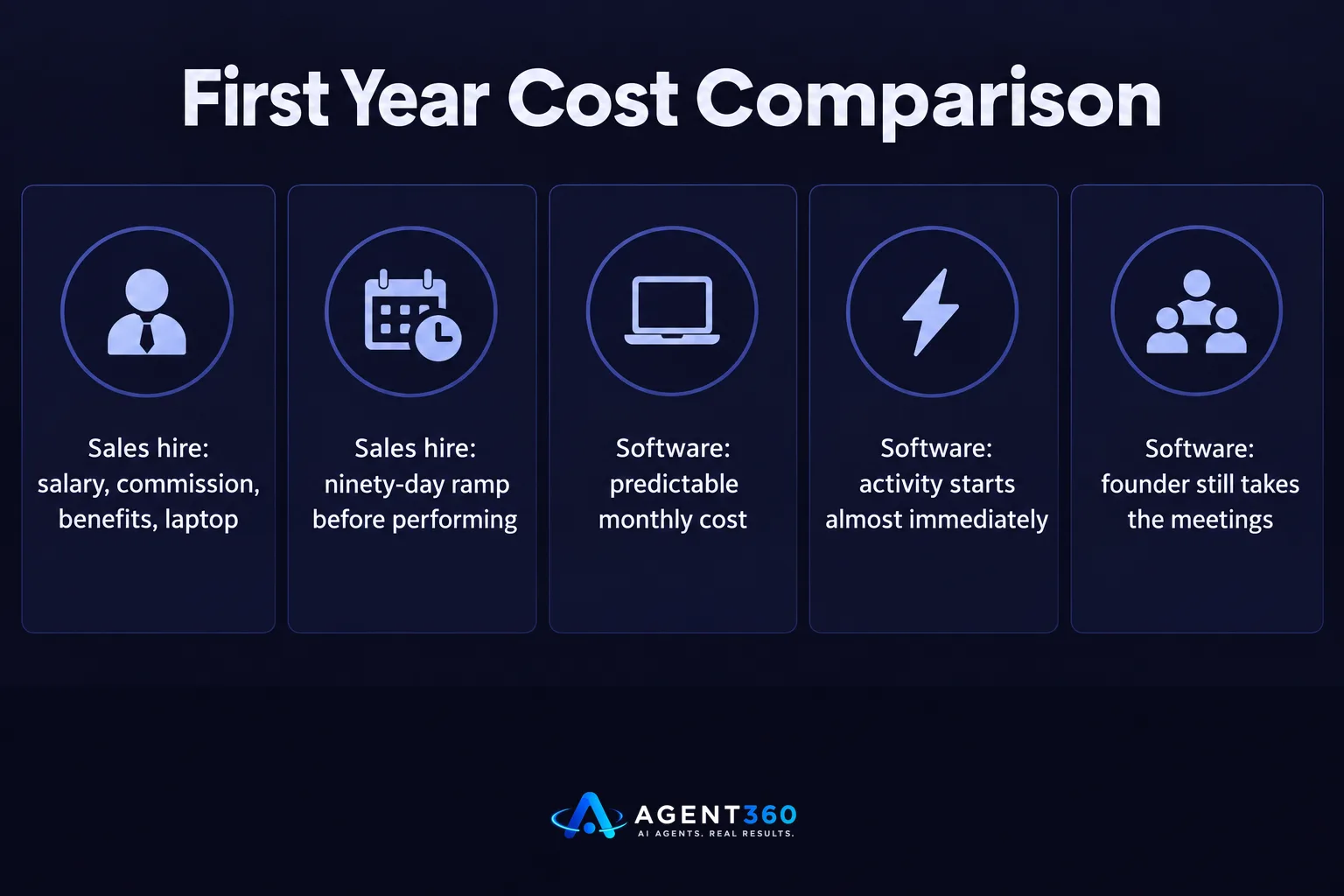
Outbound software has a predictable monthly cost and starts producing activity almost immediately. There is no ramp curve in the same sense, because the system does not need to learn the job the way a person does. The tradeoff is that someone, usually the founder, still has to take the meetings it books.
What happens if the first hire does not work out?
You lose the salary paid during ramp, the time spent managing them, and the pipeline that did not materialize. That is the core risk of hiring before you have a repeatable process: you are paying a person to discover what works, instead of paying for a system that already works and testing it on your own calendar first.
What signals tell you it's time to hire instead of relying on software?
Hire when the software is producing more qualified meetings than you can personally run. That is the clearest signal. If outbound software is booking meetings consistently and your calendar is the bottleneck, not the pipeline, a hire extends your capacity instead of replacing an unproven process.
- Confirm your pitch converts. You should be able to describe who buys, why they buy, and what objection kills the deal most often.
- Check your meeting-to-close rate. If meetings are converting to deals at a rate you can repeat, that proves the process, not just the person running it.
- Measure your personal capacity. Count how many qualified meetings you can run per week without outbound slipping.
- Decide what the hire should own. A hire that inherits a working process is set up very differently than one asked to invent it from scratch.
Is it risky to hire a salesperson before the process is proven?
Yes. A new hire without a documented, working process has to build the pitch, find the buyers, and figure out objections at the same time they are supposed to be producing revenue. That is a slow and expensive way to learn what outbound software can surface in weeks. The guide on whether to hire an SDR walks through this timing question in more detail.
Can you use both instead of picking one?
Yes, and many founders do, just not at the same time. A common sequence is software first, to prove the pitch and the target market with low fixed cost, then a hire once there is a repeatable process to hand off. Running both from day one usually means the hire spends their first months doing the same discovery work the software could have done faster and cheaper.
Does the order matter?
It does. Software before a hire gives you data: who responds, what message lands, which channel books more meetings. Handing a new rep that data on day one shortens their ramp considerably compared to asking them to find it themselves.
Test Outbound Before You Commit to a Salary
Agent360 handles AI prospecting, multi-channel outreach across LinkedIn, email, and phone, and books meetings directly on your calendar, with CRM tools to track the pipeline as it builds. That gives you a working process to test before you decide whether a first sales hire is worth the cost.

If the software proves out, a hire inherits a process that already books meetings, instead of starting from zero. If it does not, you have spent far less finding out than you would have on a salary and months of ramp.
See current plans on the pricing page and decide which option fits where you are right now.
Frequently Asked Questions
Is outbound software cheaper than a first sales hire?
Yes, in direct cost. Software has a predictable monthly fee, while a hire adds salary, commission, benefits, and management time before producing a single meeting.
Can one founder run outbound without hiring anyone?
Yes, as long as the founder has time to take meetings once they are booked. Outbound software handles prospecting and outreach; the founder still needs to close.
How long does it take a first sales hire to ramp up?
Ramp time varies by company and sale complexity, but ninety days is a common floor for a new rep to learn the product and market well enough to perform independently.
What should I check before hiring my first salesperson?
Confirm you have a repeatable pitch, a clear target buyer, and a meeting-to-close rate you can describe. Hiring before those exist means the new rep has to discover them on the job.
Does outbound software work for complex, high-ticket sales?
It can fill the top of the funnel for any B2B sale, but complex deals still need a human to handle objections and close. Software gets the meeting; judgment closes the deal.
More articles
- Outsourced SDR vs In-House SDR: How to Decide
- What Does an SDR Cost? The Real, Fully Loaded Number
- AI SDR vs Hiring an SDR: Which Fills Pipeline Faster?
- Hire an SDR or Use Software? How to Decide
- Should I Hire an SDR? A Founder's Decision Guide
- Sales Software for Founders: What to Buy First
- B2B Outbound for Small Companies: A Practical Playbook
- How to Book Sales Meetings Without Hiring an SDR
