AI SDR vs Hiring an SDR: Which Fills Pipeline Faster?
AI SDR vs hiring an SDR comes down to three things: cost, speed to first meeting, and how much judgment the job actually needs. AI SDR software handles prospecting, outreach, and meeting booking as a flat-cost system that starts fast. A human SDR costs more, takes longer to ramp, but brings judgment and relationship-building that software cannot fully replace.
Neither option is right for every stage of a company. The choice depends on your deal size, sales cycle, and how much budget you have before the first meeting even gets booked.
Key Takeaways
- AI SDR software is priced as a flat subscription, while a human SDR carries salary, commission, benefits and management time.
- AI SDR software can start sending outreach within days; a human hire typically needs weeks of recruiting plus a ramp period before they're productive.
- Human SDRs still make sense for complex, high-touch sales cycles that depend on judgment calls software can't make.
- Run a defined trial before committing to either option, and read our SDR decision guide if you're still weighing the two.
Table of Contents
What does an AI SDR do differently than a human SDR?
An AI SDR finds prospects, sends outreach, and books meetings on autopilot, while a human SDR does the same tasks plus judgment and relationship work. Both are trying to fill the top of your pipeline. The difference is in what happens when a prospect's answer doesn't fit a script.
What tasks does AI SDR software handle end to end?
AI SDR software typically covers prospecting against your target market, multi-channel outreach across email, LinkedIn and phone, and booking meetings directly on a calendar. It also logs activity in a CRM so you can see where every prospect stands without manual data entry.
What can a human SDR do that software cannot?
A human SDR can read tone in a reply, improvise on a call when a prospect raises an objection that isn't in any playbook, and build a relationship over multiple touches in a way that feels personal rather than templated. For long, complex sales cycles, that judgment can matter more than speed.
What does each option cost?
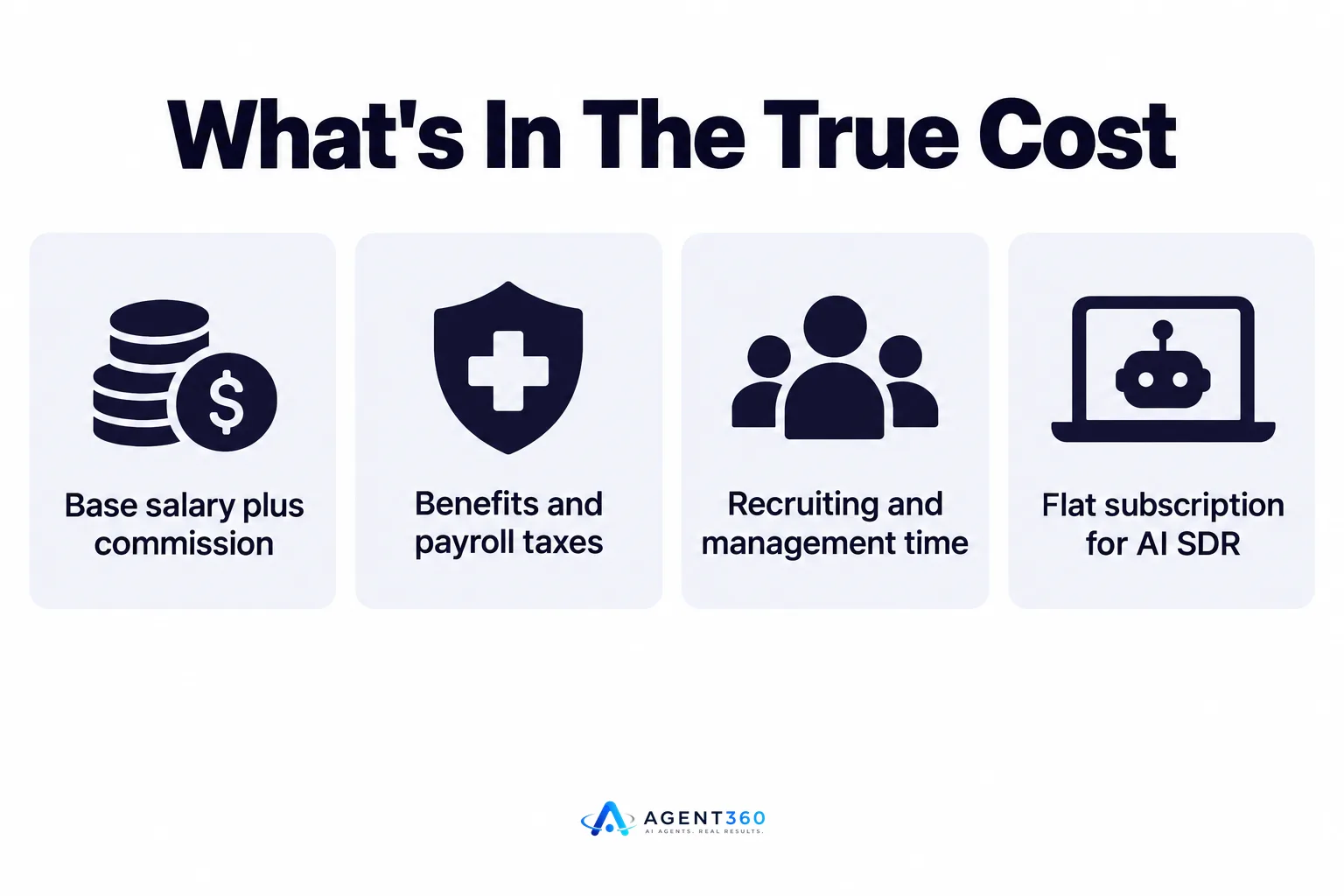
Hiring a human SDR costs a base salary plus commission, benefits and management time, while AI SDR software is usually a flat subscription regardless of how many prospects you reach. The full cost of a hire rarely shows up in the offer letter.
What's included in an SDR's true cost?
Beyond salary and commission, a human SDR hire comes with payroll taxes, benefits, a laptop and software stack, and the time a founder or sales manager spends recruiting, onboarding and coaching. None of that shows a return until the rep is fully ramped.
How is AI SDR software priced?
AI SDR software is generally sold as a subscription that bundles prospecting, outreach and meeting booking into one price, so the cost doesn't change based on headcount. Check a pricing page directly, since structures vary by vendor.
How fast can each option start booking meetings?
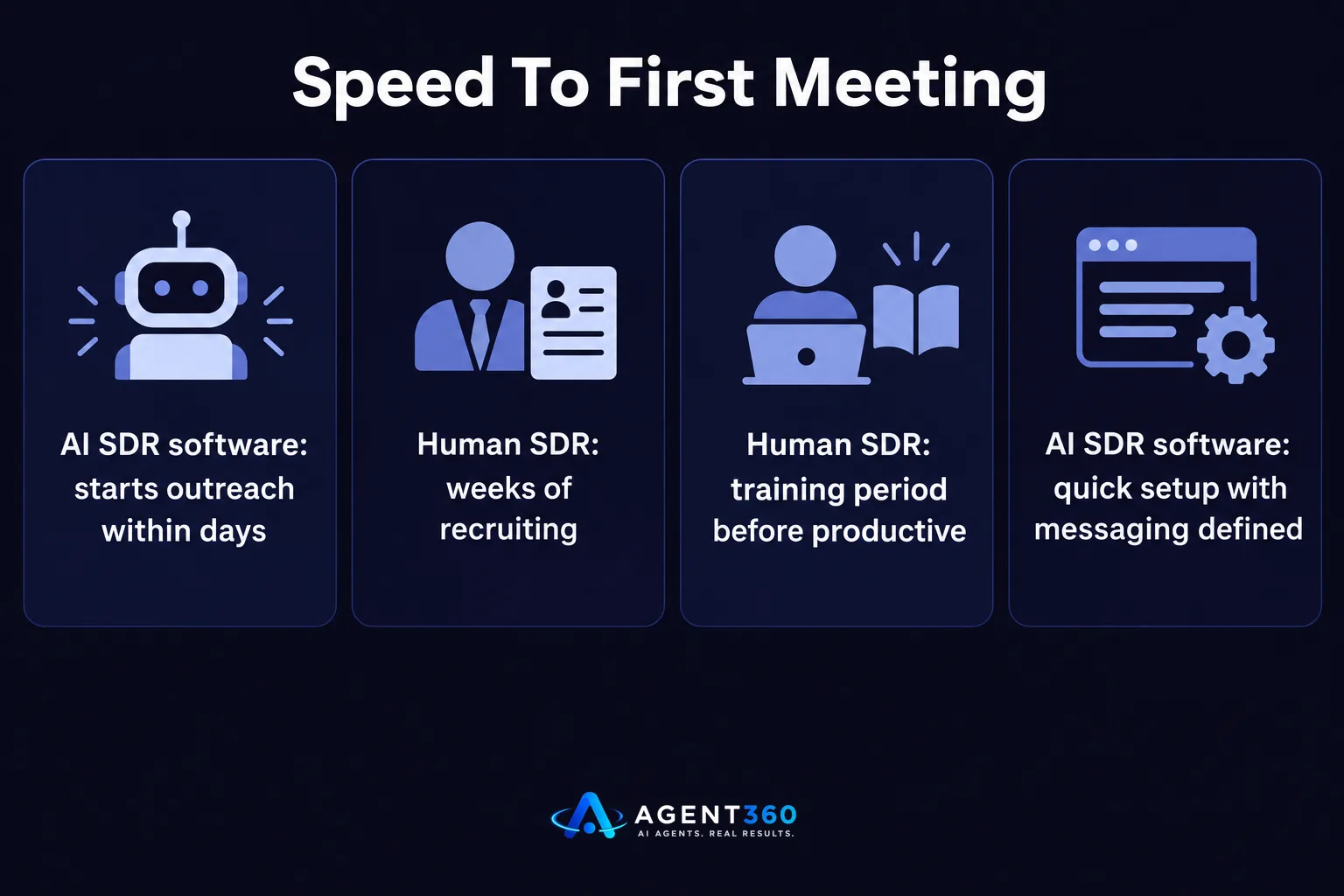
AI SDR software can begin outreach within days of setup, while a human SDR hire typically needs weeks of recruiting and a training period before they're fully productive. Speed to the first booked meeting is often the clearest difference between the two.
How long does it take to hire and ramp a human SDR?
Recruiting alone can take several weeks, and once hired, most SDRs need a training period to learn your product, messaging and tools before they're sending outreach independently. During that ramp, pipeline contribution is usually low.
How long until AI SDR software is running outreach?
Setup for AI SDR software mainly involves defining your target buyer and messaging, after which outreach can begin quickly. Some providers also include done-for-you setup, which shortens the time between signing up and the first meeting on your calendar.
When does hiring a human SDR still make sense?
Hiring a human SDR makes sense when your sales cycle is long and high-touch, or when your deal volume justifies building a full sales team around them. Software can run volume well, but it doesn't replace a dedicated rep who owns a territory and a quota.

What signals suggest you need a human hire?
If closing a deal requires multiple stakeholders, custom proposals, or weeks of back-and-forth negotiation, a human SDR's ability to manage that relationship directly can outweigh the speed advantage of software. Budget matters too: a full-time hire only pays off once there's enough deal flow to keep them busy.
How do you decide which fits your current stage?
Decide by testing, not guessing: measure your deal volume, calculate the real cost of a hire, and compare it against a defined trial of AI SDR software. The numbers usually make the choice clearer than instinct does.
- Count your current deal volume and sales cycle length. This tells you whether you have enough pipeline work to justify a full-time hire right now.
- Calculate the fully loaded cost of a human SDR. Add salary, commission, benefits and your own time spent managing them, not just the base pay.
- Run AI SDR software for a defined trial period. Set a fixed window and track meetings booked against the subscription cost.
- Compare results against the hire's break-even point. Choose the option that gets you to a booked meeting fastest for the budget you actually have.
Take the Next Step With a Clear Outbound Decision
You don't have to choose blind. Agent360 combines AI prospecting, multi-channel outreach across LinkedIn, email and phone, meeting booking, and CRM tools in one subscription, so you can test what AI SDR software actually delivers before you commit to a full-time hire.
If you're a founder running your own outbound, or a staffing firm owner who needs pipeline without adding headcount, start by seeing how the setup works for your team.
Book a demo to see how Agent360 books meetings on your calendar.
Frequently Asked Questions
Is an AI SDR the same thing as a chatbot?
No. An AI SDR handles prospecting, outreach and meeting booking across channels like email, LinkedIn and phone, working more like an outbound system than a conversational chatbot on a website.
Can AI SDR software fully replace a human SDR?
It can handle prospecting, outreach and booking without a human doing the manual work, but complex deals that need judgment calls or custom negotiation still benefit from a person involved in the process.
Does AI SDR software work with an existing CRM?
Most AI SDR platforms include CRM tools or sync with one, so meetings and pipeline activity are tracked without manual entry. Confirm compatibility with your specific CRM before switching.
How much does it cost to hire an SDR versus use AI SDR software?
A human SDR's cost includes salary, commission, benefits and management time, which varies widely by market and experience level. AI SDR software is typically a flat subscription, making the cost easier to predict upfront.
What's the biggest risk of choosing the wrong option?
Hiring too early means paying full-time costs before you have enough deal volume to justify them. Relying only on software too long when your sales cycle needs relationship-building can mean losing complex deals that need a human touch.
More articles
- What Does an SDR Cost? The Real, Fully Loaded Number
- Hire an SDR or Use Software? How to Decide
- Should I Hire an SDR? A Founder's Decision Guide
- Sales Software for Founders: What to Buy First
- B2B Outbound for Small Companies: A Practical Playbook
- How to Book Sales Meetings Without Hiring an SDR
- Cold Email for Founders: A Practical Way to Start
- Outbound Sales for Founders: How to Book Meetings Yourself
