How Long Does SEO Take? The Honest Timeline
Four to eight weeks for the first flicker of movement, four to six months for page one on an easy term, nine to twelve months before growth starts compounding on its own. That's the short version. For a new page on a site with some existing authority, expect to appear somewhere in the top 100 for a target term inside the first four to eight weeks. Page-one placement on low-to-moderate competition terms usually lands at four to six months. The part everyone actually wants — traffic that keeps climbing without new publishing — tends to arrive at nine to twelve months. Against funded incumbents on competitive head terms, eighteen months is normal. Not a failure, just the timeline. Anyone promising page one in thirty days is either selling paid traffic and calling it SEO, or lying to you.
Those ranges aren't fixed. They move based on three things: how old and trusted your domain already is, how many comparable pages are already ranking well, and how consistently you publish. A seven-year-old domain with decent backlinks will outpace a six-month-old one running identical content, every time.
If SEO is done correctly, how long does it take to rank?
Stop asking for one number. Think in phases instead. Weeks one to four: Google crawls and indexes the page. Nothing to see yet, and checking daily is wasted effort. Months two to three: the page enters the index and starts showing for long-tail variants, usually outside the top 50. Months four to six: if the page answers the query better than what's currently ranking, it climbs into the top 20, sometimes the top 10 on less contested terms. Months six to twelve: rankings settle, and pages that were hovering near page one cross over as Google gathers more signal — click-through rate, time on page, other sites linking in.
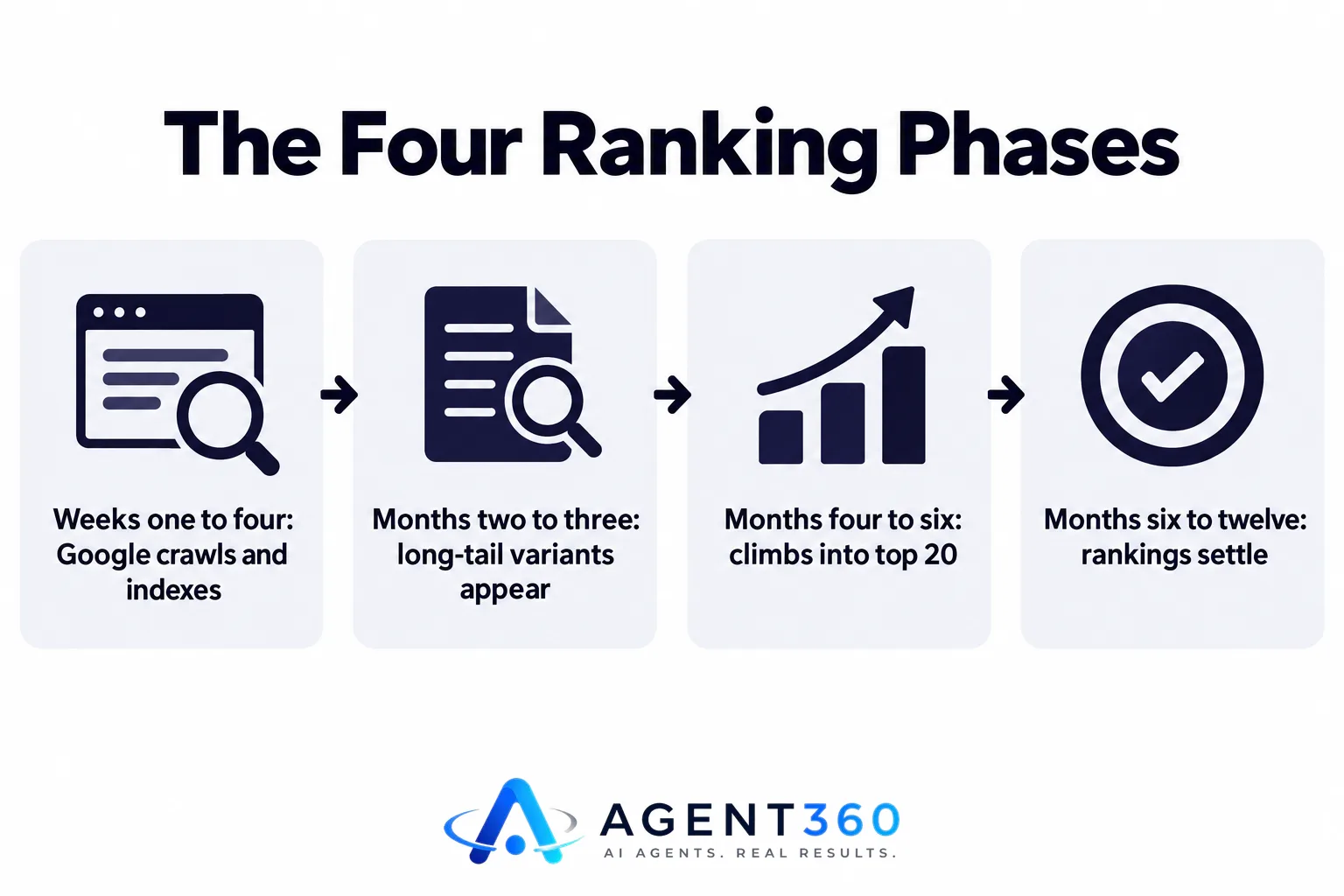
The phase people skip is the first one. A page published this week and checked next week will show nothing, and that silence gets misread as failure. It's just the index doing its job slowly. This is also why tracking rank position weekly beats checking daily — daily checks mostly show noise, not progress. A nightly pull from Search Console data across your tracked terms shows the real trend line instead of the day-to-day jitter.
What is the 80/20 rule for SEO?
A small share of your pages will carry most of your organic traffic. A small share of fixes will drive most of your gains. In practice: before writing forty new articles, check whether ten existing pages have a fixable problem — a weak title tag, a missing header structure, two pages competing for the same term and splitting the ranking signal between them. Fixing a cannibalization issue between two existing pages often moves the needle faster than publishing five new ones, because you're consolidating signal instead of diluting it further.
The 20% that matters most, in order: fix pages competitors are beating you on where the topic is clearly yours to win, fix technical issues blocking crawlers, then expand into genuinely new topics. The long tail of small content additions — the other 80% of the effort — pays off slowly. Do it after the quick fixes, not before.
Is SEO dead or evolving in 2026?
Neither framing is quite right. Search volume for informational queries is down in places because AI answers resolve the question before a click happens — Google's AI Overviews, ChatGPT, Claude. What hasn't changed: someone still has to write the page an answer engine draws from. The timeline above still governs getting indexed and ranked; a new layer has stacked on top of it, where you also need to show up when someone asks ChatGPT or Google's AI Overview the same question instead of typing it into the search box. Budget for both. One good page, structured clearly with a direct answer near the top, tends to serve classic ranking and AI citation at the same time. Where the two disciplines overlap and where they split is laid out in more detail in SEO vs AEO vs GEO.
Is SEO difficult to learn?
The mechanics aren't hard to pick up in a weekend: title tags, internal links, matching a page to search intent. What's hard is doing it on a schedule for a year with no visible payoff for the first four months — and reading your own analytics well enough to know whether it's working at all. Most in-house efforts fail not from lack of knowledge but from stopping at month three, right before the compounding part starts. If nobody on your team can commit to a consistent weekly cadence — researching gaps, writing, checking what's ranking, adjusting — that's a staffing problem, not a knowledge problem. Worth being honest about which one you're actually solving. A rough guide on cadence is in how many blog posts a week SEO actually needs.
The stress is almost always a timeline mismatch, not the work itself
Most of what makes SEO feel stressful — as a job, as a function inside a company — isn't the research or the writing. It's reporting on week six to someone who was told, somewhere along the way, that results would show by week four. Fix the expectation before the work starts: show the phase breakdown above to whoever's funding the effort, and report on leading indicators — indexed pages, impressions trending up, position movement on terms close to page one — rather than final rankings alone, which lag everything else by design.
Where SearchAgent fits if you want this tracked without guessing
Most of that stress comes from not knowing whether month three is actually working or quietly failing. SearchAgent reads your Google Search Console every night and tracks up to 200 terms, so the position-movement signal that matters in months two through six is visible as it happens, not reconstructed later from memory. It also checks whether ChatGPT, Claude and Google AI Overviews name your business for the questions your buyers ask, since that clock runs on its own schedule. Plans start at $297 a month with no contract — details are on the pricing page, and the full picture of what it tracks and what it skips is on the SearchAgent overview.

Questions
How long until SEO pays for itself?
Most sites see traffic that justifies the spend somewhere between month six and month twelve, once a handful of pages reach page one and keep earning clicks without further work. Before that, the honest metric is movement toward page one, not revenue.
Does switching agencies or tools reset the timeline?
Partially. Published pages keep their index history and backlinks, so you don't start at zero. But a change in strategy — new target terms, a different content structure — effectively restarts the ranking clock for whatever changes, even if the domain's overall trust carries over.
Will AI answers make the timeline faster or slower?
Neither, directly — Google's own index still runs on the same crawl-and-trust schedule it always has. But a page written to answer a question directly, with the answer near the top, tends to get picked up by AI Overviews faster than it climbs traditional rankings, since citation doesn't need the same accumulated trust that a top-three ranking does.
More articles
- The Local SEO Checklist That Actually Moves the Map Pack
- B2B SEO Strategy: How to Compete When Buyers Ask AI First
- How to Get Backlinks Without Outreach Emails
- SEO Content Plan Template: The 9 Columns That Matter
- Competitor Keyword Gap Analysis: Find What You're Missing
- Google Search Console for Beginners: Where to Start
- Keyword Cannibalization Fix: Merge, Redirect, or Split
- Content Refresh SEO: What Actually Moves Rankings
