Keyword Cannibalization at Enterprise Scale: The Real Fix
At enterprise scale, keyword cannibalization almost never looks like two near-duplicate blog posts. It looks like a product marketing page, a regional site, a partner-facing landing page, and a blog post from three re-orgs ago — all ranking for variations of the same term, none of them winning, because four different teams built them without knowing the others existed.
Fixing a ten-page site takes a merge and a 301. Fixing a thousand-page site takes a process. The pages keep multiplying faster than any one person can audit them by hand.
What is keyword cannibalization in SEO and how can it be addressed?
Cannibalization happens when two or more pages on the same domain target the same search intent, so Google splits ranking signals between them instead of consolidating authority on one page. The usual symptom: both pages sit on page two, swapping positions week to week, and neither breaks into the top five.
At small scale, the fix is simple — pick the stronger page, merge the content, redirect the loser. At enterprise scale, that same move first requires knowing which pages exist at all, across subdomains, localized sites, and CMS instances that different teams own. The technical fix doesn't change: merge, redirect, canonical tag. What changes is the detection work that has to happen before any of that.
What is enterprise SEO, and why does it make cannibalization worse?
Enterprise SEO is SEO where the constraint isn't content quality. It's coordination. A company with one marketing team and two hundred pages can keep a mental map of what targets what. A company with product marketing, regional teams, a content team, a PR team, and a partner program all publishing into the same domain cannot. Each team optimizes its own page for the obvious term, nobody checks what else already ranks for it, and the overlap compounds every quarter.
That's why cannibalization audits built for a mid-size site — a spreadsheet, a few hours, done once — don't hold up here. By the time the audit's finished, three new pages have shipped that need the same check. This isn't a one-time cleanup. It's an ongoing leak that needs a standing process, not a project.
The real failure mode is organizational, not editorial
If you're the person stuck fixing this and not sure where to start: the content itself is usually fine. The problem is that nobody owns the full map. A regional team ships a localized page targeting the same core term as a global page the content team published last year. Neither team sees the other's Search Console data. Both pages get traffic, both plateau, and leadership asks why rankings haven't moved despite steady publishing.

Fixing this needs two things most enterprise teams don't have by default: a single view of what every page ranks for across the whole domain, and a standing owner for that view — someone whose job includes checking overlaps before new pages go live, not just after they've been competing for six months. Skip that owner, and you'll keep finding and fixing the same class of problem every year instead of preventing it.
Is keyword research part of SEO, or a separate discipline at this scale?
Past a few hundred pages, keyword research and cannibalization prevention are the same discipline. You can't do one without the other. Research that only asks “what term should this new page target” without checking “does anything else on our domain already rank for this” is exactly how the overlap gets created in the first place. The research step has to include a domain-wide check, not just a market check.
Most keyword tools don't default to that workflow. A typical research tool tells you what people search for. It won't tell you that your own site already has a page sitting at position 14 for that exact phrase. You need both pieces of information in the same place, ideally before the brief gets written — which is what a proper content plan built from real search gaps is supposed to catch. It should flag an overlap before a writer starts, not after an editor notices two pages fighting in Search Console.
Build a standing overlap check, not an annual audit
A practical cadence for an enterprise domain: run a full cannibalization pass quarterly across every page, and run a lighter check on every new page before publish — does anything else on the domain already target this term or a close variant. The quarterly pass catches drift between teams. The pre-publish check stops new overlaps from forming in the first place. Skip the second one, and you'll be running the same quarterly cleanup forever.
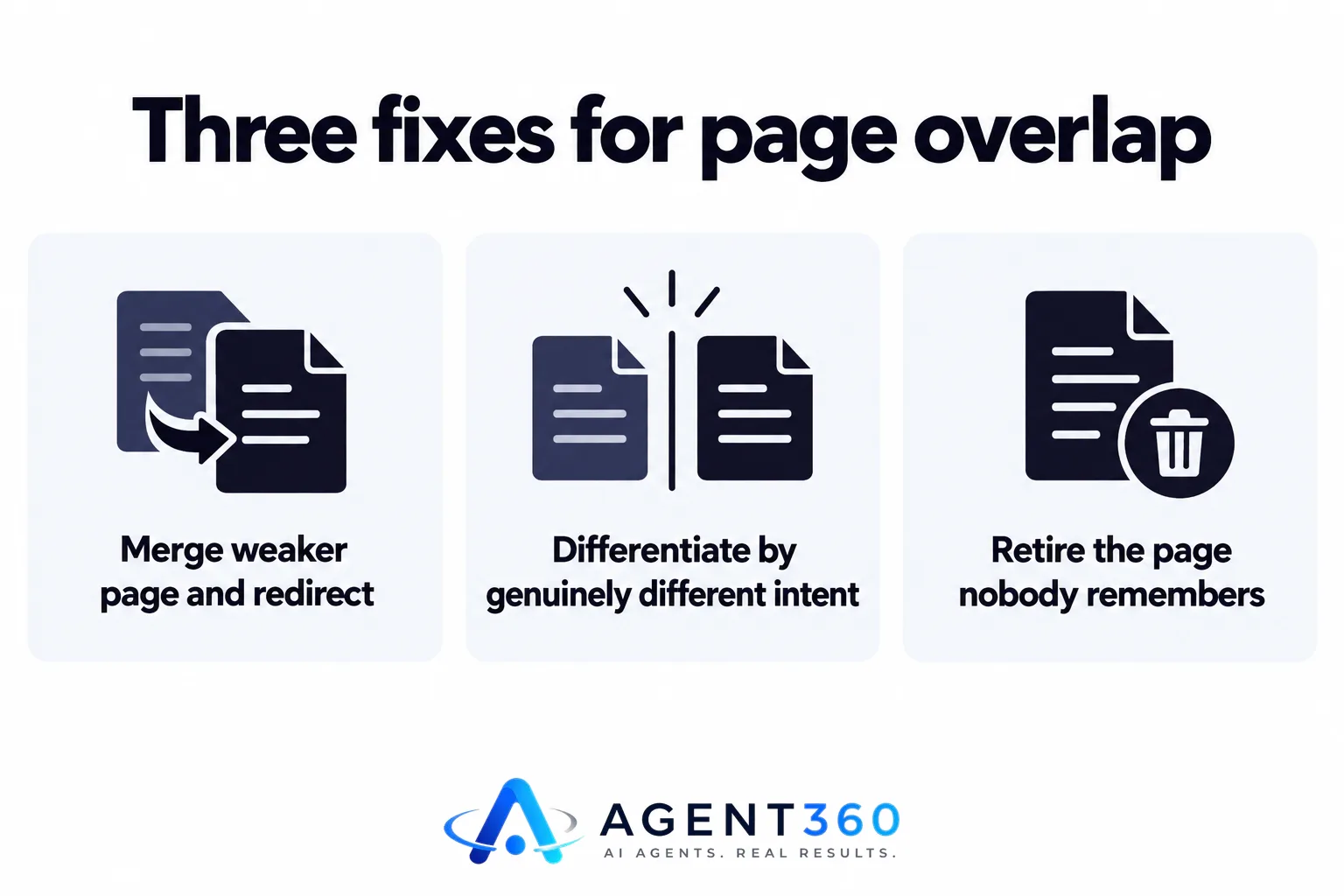
When overlap turns up, the fix is almost always one of three moves: merge the weaker page into the stronger one and redirect; differentiate by genuinely different intent (a comparison page and a feature page can coexist if they answer different questions); or retire the page nobody remembers publishing. The decision logic matters more than the mechanics — a guide to spotting and fixing overlapping pages walks through how to tell which of the three applies before anyone touches the CMS.
Where SearchAgent fits
Enterprise teams asking for “a better keyword management tool” usually mean they want overlap detection and research in one place, instead of stitched together from exports. SearchAgent's Research Agent pulls related searches from what Google and Bing suggest, and its Strategy Agent turns search gaps into page ideas before they're written — so a new page gets checked against what already ranks before it's drafted, not after. It tracks up to 200 terms on the Pro plan and flags overlapping pages as part of that tracking; see what's included on the pricing page. It won't make the ownership decision inside your org — nothing automated will — but it removes the excuse of not knowing the overlap existed.
Frequently asked
How many pages before cannibalization becomes a real risk?
There's no fixed number. Risk rises sharply once more than one team publishes to the same domain without shared visibility into each other's rankings — that can happen at a few hundred pages or a few thousand, depending on how fragmented the publishing is.
Does fixing cannibalization always mean deleting pages?
No. Plenty of overlaps resolve by differentiating intent rather than removing content — a buyer's-guide page and a pricing comparison page can both rank if they answer different questions, even for similar terms.
Is this different from how smaller companies should approach it?
The diagnosis and the fix are the same. What's different is the detection step: smaller sites can check manually, enterprise sites need a standing, automated check because the overlap gets created faster than any team can audit by hand. Weighing a research-heavy platform against something that also flags these overlaps automatically? Worth checking against a deep research suite before deciding which fits your process.
More articles
- Set Posts Per Week From Your Gap List, Not a Calendar
- GEO Tools: Buy the Fix, Not Another Dashboard
- SEO Reporting for Small Business: One Page, Five Numbers
- AI Overview Search Visibility: Check It, Then Fix It
- How to Appear in AI Overviews (and Why You Can't Opt In)
- How to Get Your Firm Featured in Google's AI Overviews
- How to Get Into Google's AI Overview, Really
- Hur du rankar i ChatGPT (och vad det egentligen betyder)
