How to Appear in AI Search Results, Step by Step
Getting named in Google's AI Overview and getting named in ChatGPT are not the same job, though most advice treats them as one. The Overview is a ranking problem with a new layer stacked on top. ChatGPT is a training-and-retrieval problem with almost no visible rules. Treat them as the same task and you'll end up optimizing for neither.
Below is what moves each one — plus a word on Google's AI Mode, which is neither of these things.
How to show up in Google AI search results
The AI Overview is a summary Google builds from pages it already ranks well. Miss the top 10 to 15 organic results for a query and you're very unlikely to get pulled into the overview sitting above them — it's built from material Google already trusts, not from some separate index.
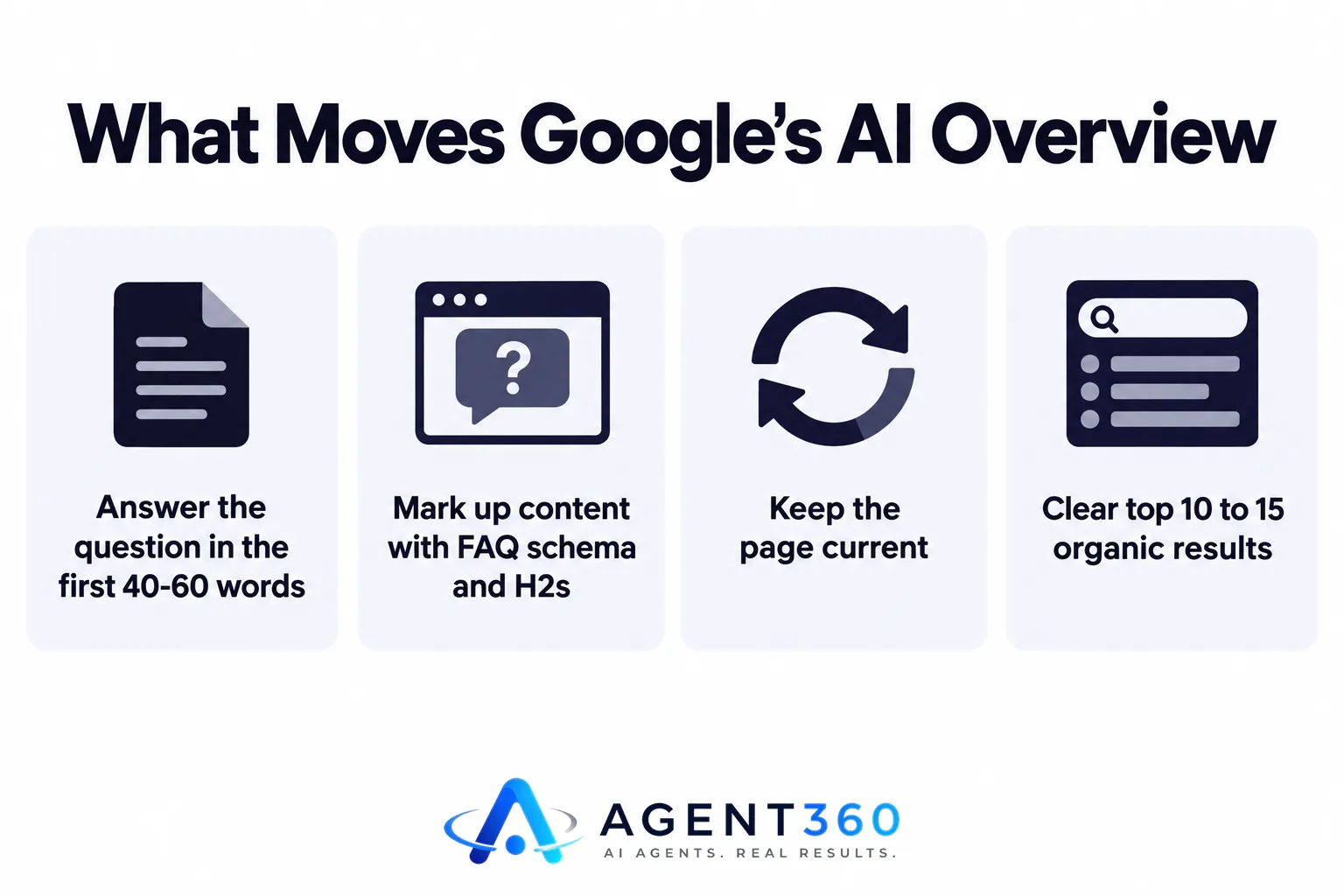
Clear that bar, and three things move the needle:
- Answer the question in the first 40-60 words of the page. Google's summarizer favors passages that state the answer plainly before adding context, not pages that build up to it.
- Mark up the content. FAQ schema, clear H2s phrased as questions, and tables for comparisons give the summarizer a clean unit to lift. Unstructured prose with the right answer buried in paragraph four gets skipped.
- Keep the page current. Overviews lean on recently-updated pages for anything time-sensitive — pricing, “best of” lists, how-to steps that change. A page that hasn't been touched in a year is a weaker citation even if it still ranks.
None of it replaces ordinary ranking work — it sits on top of it. For the mechanics specific to this engine, see how to appear in Google AI Overviews.
How to appear in ChatGPT search results
This is a different mechanism, full stop. There's no dashboard, no submission form, no confirmed ranking-factor list — OpenAI hasn't published one. What you can observe is that ChatGPT's answers draw from two sources: what was baked into its training data, and what it retrieves live when it browses.
The live-browsing path responds to the same signals as Google's Overview: direct answers, clear structure, recent dates. The training-data path has no fast fix. It reflects everything written about you — by you and by everyone else — across the web, over time. Slower to shift, and much harder to audit by hand.
What you can influence now:
- Make sure your own site states who you serve and what you do without requiring inference — ChatGPT paraphrases what's explicit, it doesn't guess well at what's implied.
- Get mentioned on third-party pages that already rank and get cited often: comparison posts, “best X for Y” roundups, review aggregators. ChatGPT names businesses it has seen named elsewhere, not just on their own site.
- Publish the comparison and alternative content your buyers would ask about directly — “X vs Y,” “alternatives to X” — since these are exactly the prompts ChatGPT gets asked.
For the full walk-through on this engine, see how to rank in ChatGPT.
Stop guessing and start checking what's actually happening
Here's the honest problem with most AI-search advice: you can't tell if it worked. Make the changes, wait three weeks, and you still don't know whether Google's Overview names you for the dozen questions that matter — or whether ChatGPT just recommended your competitor instead.

That's a tracking gap, not a content gap. The fix: ask the same questions your buyers ask, on a schedule, and log who gets named — across Google AI Overviews, ChatGPT and Claude. SearchAgent's AI Visibility Agent runs that check for you and turns every miss into the next page to write, instead of a mystery to guess at. Plans start at $297 a month, no contract; see pricing for what's tracked at each tier.
Why “optimizing for AI search” isn't one skill
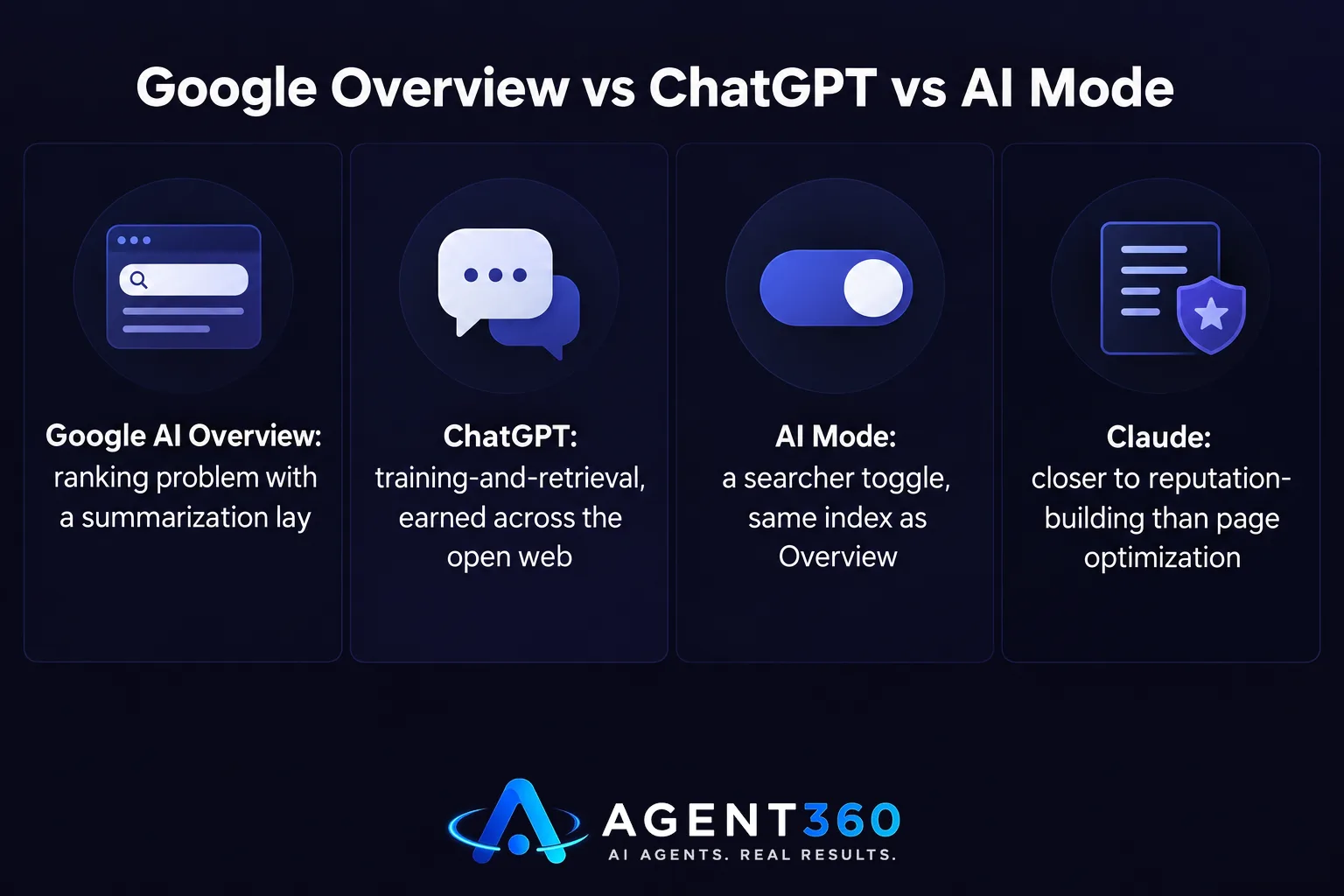
If a vendor pitches one checklist for “ranking in AI,” ask which engine they mean. Google's Overview is still a search-ranking exercise with a summarization layer stacked on top — it overlaps heavily with ordinary SEO. ChatGPT and Claude are closer to earning a reputation across the open web than to optimizing one page. What works for one won't automatically work for the other. That's why it helps to separate answer engine optimization, which covers the summary layer, from the broader work of getting named by AI assistants at all.
How to activate AI Mode in search?
AI Mode is a toggle Google gives the searcher, not a setting a business flips on. People switch to it in the Google app or on the results page, when it's available to them. There's nothing for you to activate — your only lever is the same one that affects the regular Overview. Rank well, answer clearly, keep the page current. AI Mode pulls from the same index and the same kind of passage-level summarizing.
How do I get into AI search?
There's no form to fill out and no application to file. You get into AI search results the way you get ranked anywhere: be a source the engine already trusts for the query, then make your answer easy to lift — stated plainly, structured clearly, kept current. For ChatGPT and Claude, getting written about favorably on sites those models already trust matters just as much as anything on your own pages.
More articles
- How to Show Up in AI Search Results, Not Just Google
- Whitelabel GEO: What to Check Before You Sign a Vendor
- An AI Competitor Gap Analysis Agent: What to Expect
- How to Get Found on Google AI: What Actually Works
- How to Show Up in AI Overviews When Rivals Don't
- How Long Does SEO Take? The Honest Timeline
- The Local SEO Checklist That Actually Moves the Map Pack
- B2B SEO Strategy: How to Compete When Buyers Ask AI First
