B2B SEO Strategy: How to Compete When Buyers Ask AI First
Half your buyers already asked an AI assistant who to call before they typed anything into Google. A B2B SEO strategy built only around keyword rankings doesn't see that happen, which means it's already behind. Your buyers still use Google, sure. But a growing share of them also ask ChatGPT or Google's AI Overview to shortlist vendors before your category ever hits a search box. The strategy that competes in 2026 has to win both places: the list of blue links, and the paragraph an AI writes above or instead of them.
That changes what “compete” means. It's no longer just outranking a competitor's page. It's being the name an AI assistant says out loud when a buyer asks it who handles a problem like theirs.
Your buyers skip the search box now
The old B2B funnel assumed a buyer typed a problem into Google, clicked three to five results, and compared notes. Increasingly, that comparison happens inside a chat window first. A buyer asks “what's the best tool for X” or “who are the top vendors for Y in [industry]” and gets a short list with reasoning attached — before any of your pages get a click.
This doesn't replace Google rankings. It sits alongside them. You still need to rank — Search Console is still the most reliable record of what people search and whether you show up for it — but a ranking strategy that ignores how AI assistants answer the same questions is only measuring half the field. The distinction matters enough that it has its own vocabulary now: SEO gets you into the list, AEO gets you quoted in the answer, and GEO gets you named by name.
Compete on specificity, not domain authority
If your competitor has a ten-year-old domain and a content team, you're not going to out-publish them on broad terms like “project management software” or “logistics consulting.” Don't try. The pages that win for newer or smaller B2B sites are narrow: “project management software for architecture firms with under 20 employees,” “freight consolidation for mid-size importers shipping from Vietnam.” Specific pages rank faster, because fewer sites bother competing for them, and they convert better, because the buyer reading them is further along than you'd think.
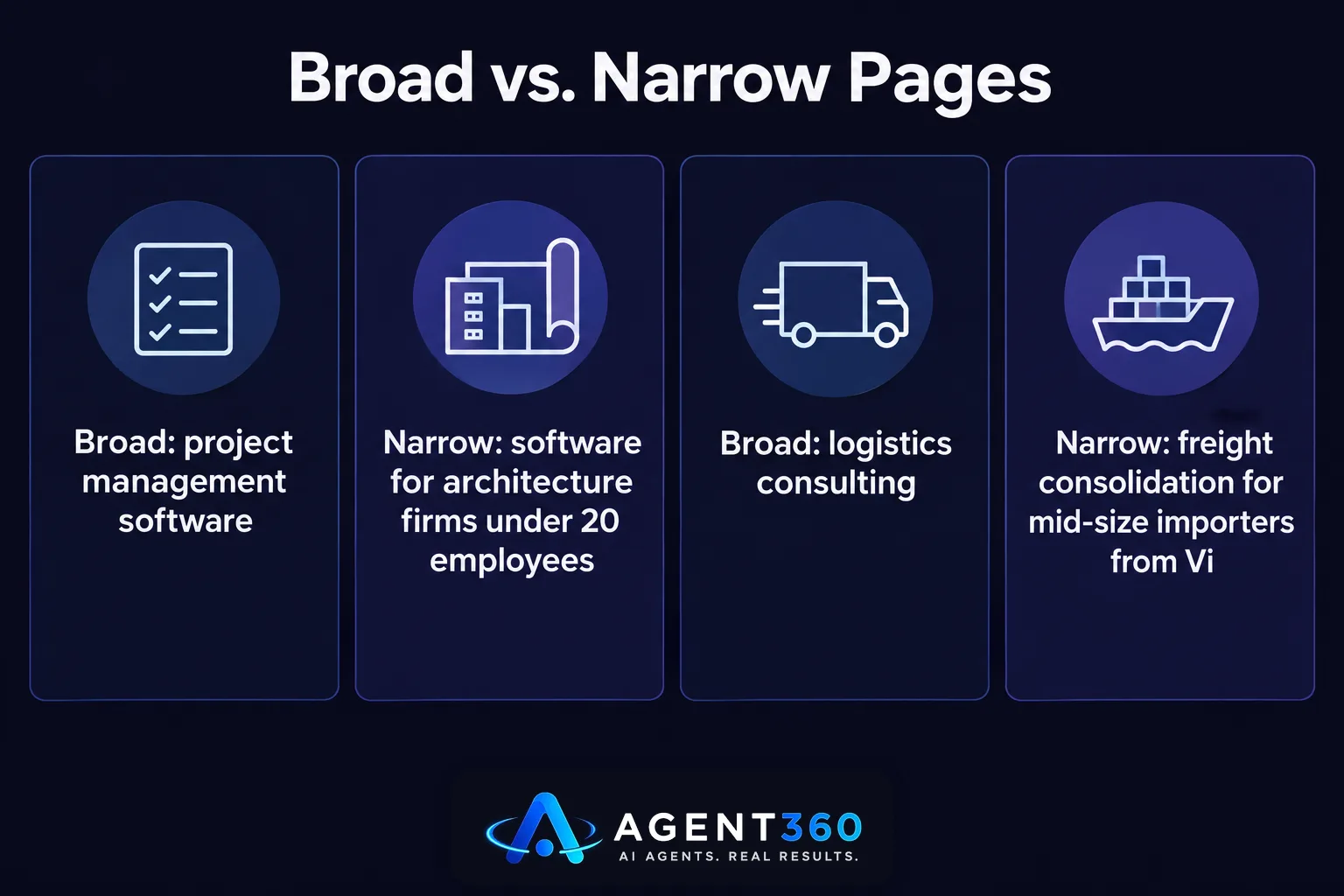
This is also where AI answers reward specificity more than Google ever did. Ask a model a narrow question and it has fewer candidates to choose from — a page that answers that exact question directly has a real shot at being the one cited. A page trying to be everything to everyone rarely gets quoted by anything.
Build around the shortlist, not the funnel
Traditional content strategy maps pages to funnel stages: awareness, consideration, decision. That model still works, but B2B buyers increasingly compress it — they ask one question and expect a shortlist with reasoning, not a slow nurture sequence. You need pages built for exactly that moment: “X vs Y,” “alternatives to X,” “best tools for [use case],” “how to evaluate a [category] vendor.” These are the pages AI assistants pull from when a buyer asks for a comparison, and they're also the pages that close deals when a prospect reads one two days before a demo call.
Check whether you're already losing this ground to a competitor before you write anything new. A gap analysis against the sites currently ranking for your category will usually turn up three or four comparison pages you don't have and they do.
Track three answers, not one ranking
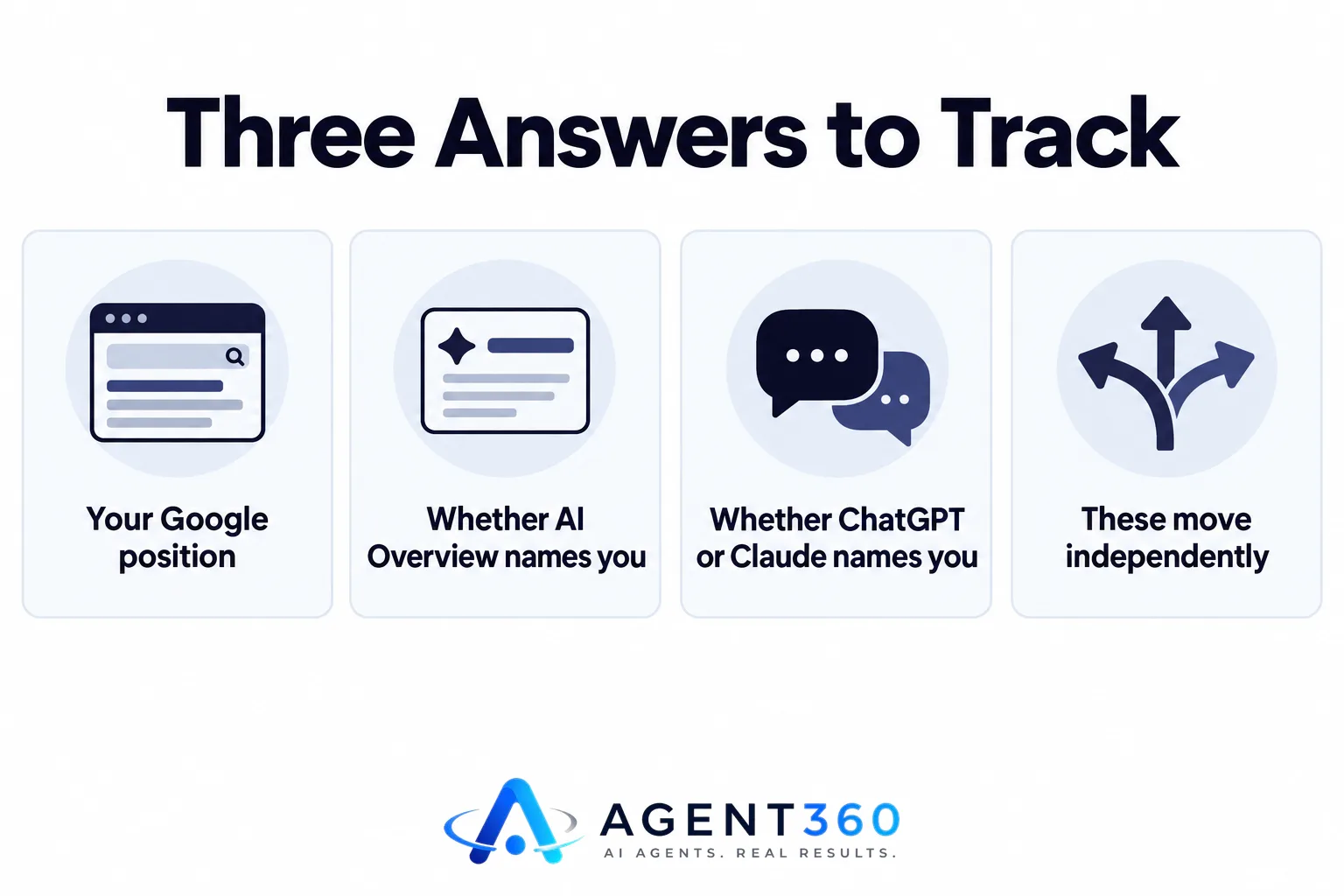
A ranking strategy measures one number per term: position on Google. A B2B strategy built for 2026 has to track three — your Google position, whether Google's AI Overview names you, and whether ChatGPT or Claude names you when asked your buyer's actual question. These move independently. You can rank third on Google and never get a mention from ChatGPT, or the reverse. Treat them as one metric and you'll miss the moment you quietly disappeared from the channel that actually shapes the shortlist.
If you sell into other businesses specifically, this gap cuts deeper. B2B buyers lean on AI recommendations harder than consumers do, because the purchase is higher-stakes and nobody wants to justify weeks of manual research. Buyers often ask for a shortlist before they ever book a demo, which means the AI's answer is sometimes the only shot you get.
Where this breaks down
Most B2B teams trying to do both — rank and get named — hit the same wall: they write a page, publish it, and never check whether it changed anything in either channel. Rankings take months to move. AI answers can shift week to week depending on what the model last crawled. Without a standing check on both, you're guessing. This is also where a lot of SEO retainers come up short: an agency delivers four articles and a monthly report, but nobody's asking ChatGPT your buyer's questions on a schedule to see if the answer changed. That's a different job, and it's worth knowing what an agency retainer typically does and doesn't cover before you commit a budget to one.
A workable starting plan
Pull your last twenty closed-won deals and ask what they searched, or what they'd have asked an AI assistant, before they found you. Turn those into a short list of comparison and use-case pages. Publish the narrowest ones first — they rank faster and tell you quicker whether the approach is working. Then set a recurring check: once a month, ask ChatGPT and Google's AI Overview the same questions your buyers would ask, and note whether you're named. If a competitor keeps showing up instead, that's your next page topic. Not a mystery.

SearchAgent runs this as a standing process instead of a quarterly scramble: it asks your buyers' questions to ChatGPT, Claude and Google AI Overviews on a schedule, reads your Search Console nightly for the terms you're actually ranking for, and turns the gaps in both into a content plan you approve before anything gets written. Plans start at $297 a month with no contract — details are on the pricing page.
Common questions
How is B2B SEO strategy actually changing in 2026?
The biggest shift is that buyer research increasingly starts in an AI chat window rather than a search box. A strategy built only around Google rankings now misses the step where a model recommends two or three vendors by name before the buyer ever searches directly.
How do I compete against bigger B2B competitors with more content?
Compete on specificity rather than volume. Narrow pages built around a specific use case, industry, or comparison rank faster against established competitors and are more likely to be the exact answer an AI assistant quotes when a buyer asks a precise question.
Do I still need to track Google rankings if buyers are asking AI instead?
Yes. Google rankings and AI answers move independently and both still drive buyers to you. Tracking only one gives you half the picture of whether your strategy is working.
More articles
- How to Get Backlinks Without Outreach Emails
- SEO Content Plan Template: The 9 Columns That Matter
- Competitor Keyword Gap Analysis: Find What You're Missing
- Google Search Console for Beginners: Where to Start
- Keyword Cannibalization Fix: Merge, Redirect, or Split
- Content Refresh SEO: What Actually Moves Rankings
- How Many Blog Posts a Week Does SEO Actually Need?
- SEO Agency Alternative: What Actually Replaces the Retainer
