How to Show Up in AI Search Results, Not Just Google
Two different jobs are hiding inside the phrase “show up in AI search.” One is ranking high enough in classic Google results that an AI Overview pulls your page into its summary. The other is getting named by ChatGPT or Claude when someone asks a question with no search engine involved at all. Most advice lumps these together and hands you one list of fixes. They're not the same problem, and a page built for one can be invisible to the other.
Short version: Google's AI Overviews come out of the normal ranking process, so standard search work still counts. ChatGPT and Claude aren't reading a live ranking of your site at all — they're pulling from training data and whatever they fetch in the moment, weighted toward sources that look authoritative and get cited elsewhere. You have to work both angles, and they don't move on the same clock.
AI Overviews pull from the top ten, but ChatGPT and Claude don't
Google's AI Overview is generated from pages that already rank well for the query. If you're nowhere near the top ten, there's nothing of yours for the Overview to summarize. So the oldest SEO advice still holds: clear headings, a direct answer near the top, internal links that give the page context. The gap between ranking and getting cited is usually the structure of the page, not the subject matter.
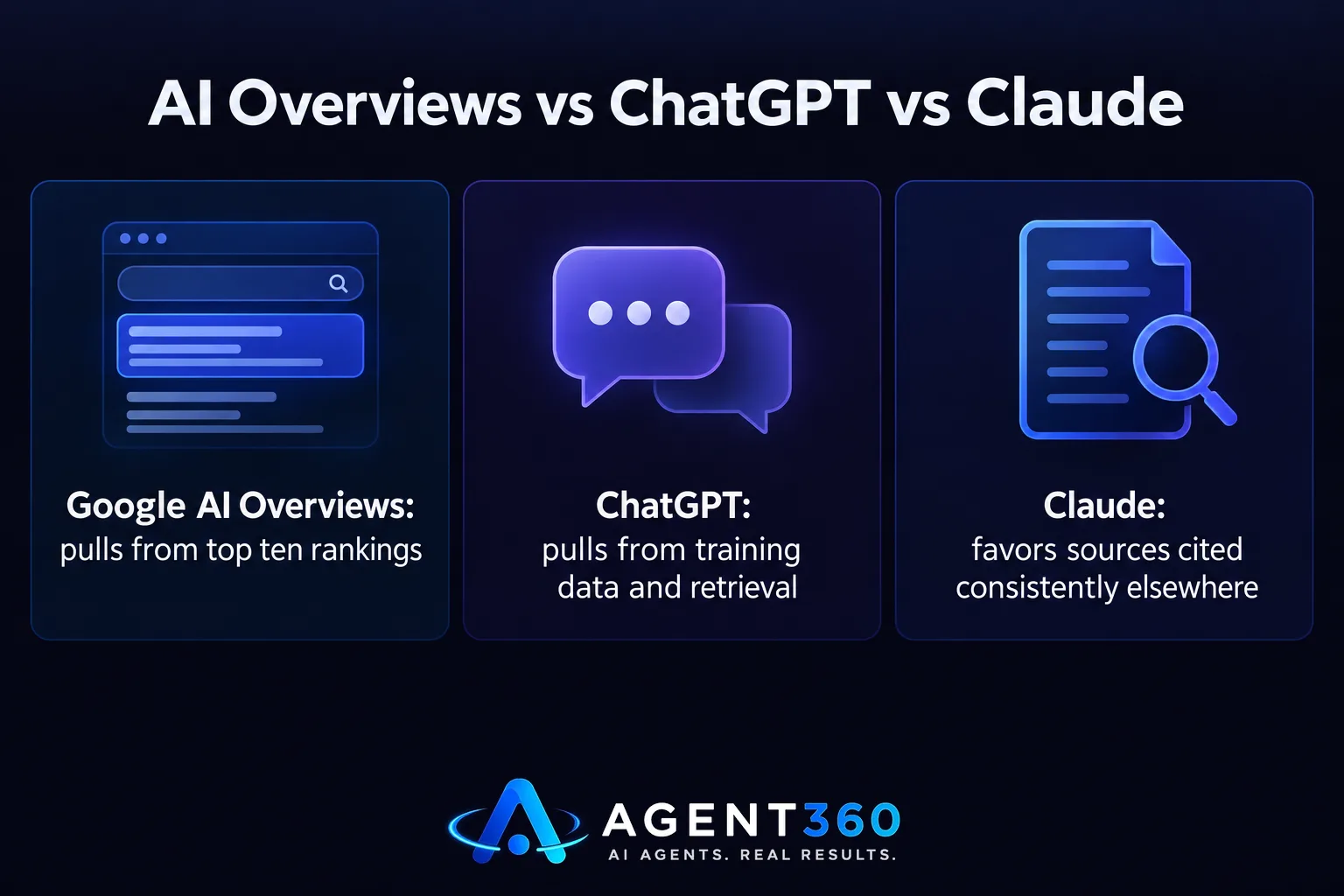
ChatGPT and Claude run on a different clock entirely. Neither one scans a live top ten before answering. They lean on what they learned in training plus anything retrieved on the fly, and they tend to favor sources that get cited consistently elsewhere, written in plain declarative sentences, with a single fact easy to lift out. You can sit on page one of Google and still never get named in a ChatGPT answer, because the two systems reward different things. The line between SEO, AEO and GEO comes down to exactly this split.
What are the types of searches in AI?
Not every question gets the same treatment. Knowing which bucket a search falls into tells you whether being named is even on the table. Four types matter here:
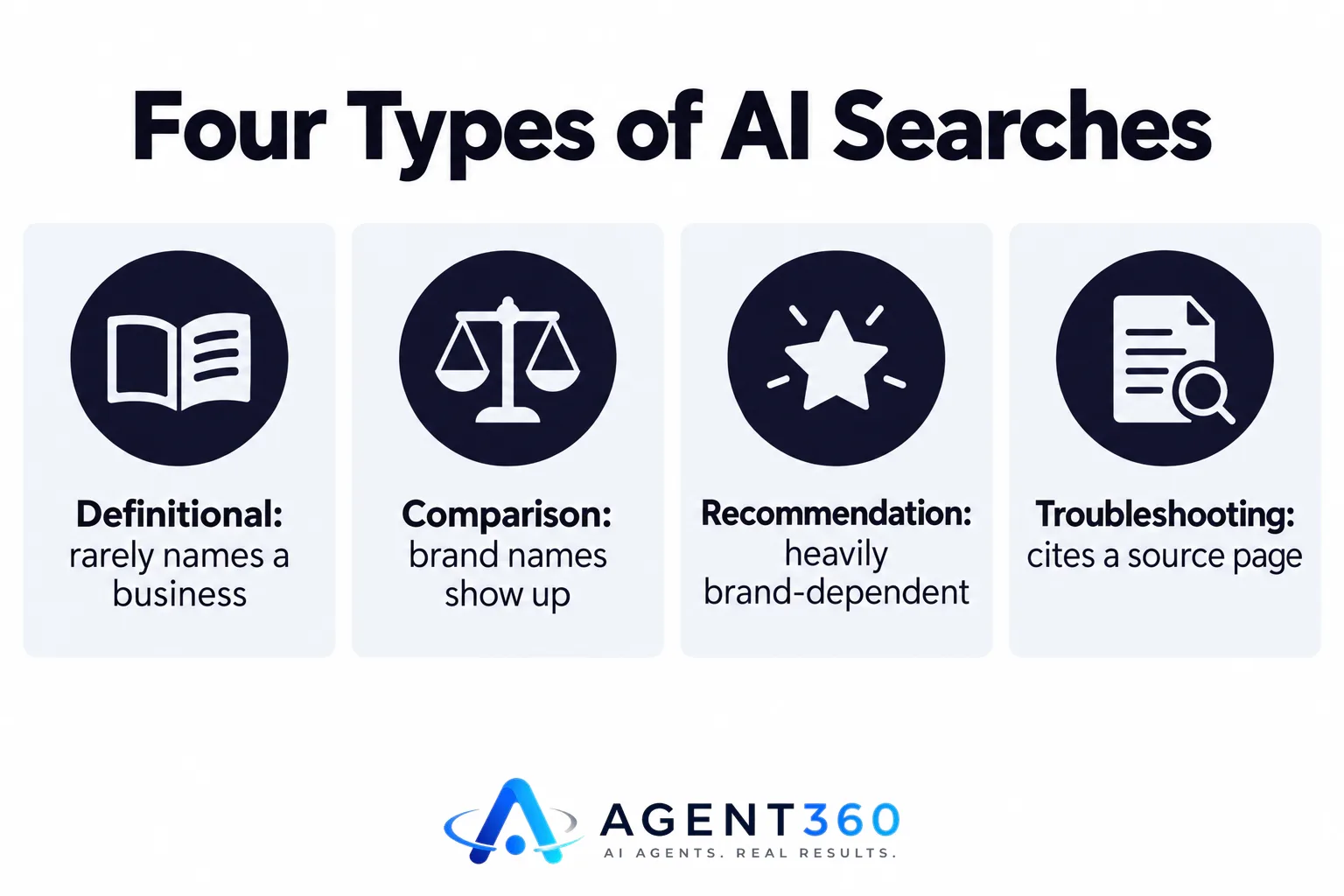
- Definitional — “what is X” — the AI usually answers from general knowledge and rarely names a specific business.
- Comparison — “X vs Y” or “best X for Y” — this is where brand names show up, and where your competitors get listed if you don't.
- Recommendation — “who should I use for X” or “X near me” — heavily brand-dependent, and the category most worth tracking.
- Troubleshooting — “how do I fix X” — rarely names a vendor, but often cites a source page, which counts as a visibility win even without the brand mention.
If your product only turns up in definitional and troubleshooting searches, you're getting traffic without demand — people reading your page but never hearing your name said aloud by the AI. The fix is to build pages that go straight at the comparison and recommendation questions your buyers actually type, not just the educational ones.
How do I see Google Search results?
Typing your own query into a browser tells you almost nothing. Google personalizes results by your location, history and device, so what you see isn't what a stranger in another city sees. The only reliable view is Google Search Console, which shows the real queries that surfaced your pages, the position you held, and how that position moved over time. If you haven't connected it yet, do that first, before trying to diagnose any AI visibility problem — a nightly read of your Search Console data is the only honest record of where you stand on classic search, separate from whatever an incognito tab happens to show you that day.
Test with the exact question your buyer would type, five times, across a week
AI answers aren't deterministic. Ask ChatGPT the same question twice in a row and you can get two different answers, with a different name on top each time. One screenshot proves nothing. For a real signal, ask the same question across several days, log who gets named and who gets cited, and look for a pattern instead of a single lucky result. A repeatable method for tracking brand mentions over time is the only way to know if a change you made actually moved anything.
Fix the page before you fix the prompt
Before you chase AI answer engines with new content, check whether what you already have is even readable by them. That means a direct, one-sentence answer near the top of the page instead of three paragraphs of throat-clearing; structured data and FAQ markup that make the key facts easy to pull out; and confirmation that AI crawlers aren't blocked by your robots file. A page can score well for human readers and still score poorly for AI crawlers — one check looks at whether a person can scan the page, the other at whether a bot can parse it cleanly. Run both before you write another word.

Where SearchAgent fits
SearchAgent asks the exact questions your buyers ask across ChatGPT, Claude and Google AI Overviews on a schedule, records who got named and who got cited, and turns the misses into page ideas that its writer agents draft and publish. It also reads your Search Console nightly for the classic ranking side, so you're not juggling two tools for two halves of the same problem. Plans start at $297 a month on the pricing page, month to month, no contract.
Questions people ask
Does ranking on Google guarantee an AI mention? No. Ranking well makes you eligible for Google's AI Overview, but it has no bearing on whether ChatGPT or Claude names you, since those systems don't consult a live ranking at the moment of answering.
How often do AI answers change? Often enough that one check tells you nothing — the same question can return a different named business from one day to the next, which is why tracking has to run on a schedule, not a one-time basis.
Should I track ChatGPT and Claude separately from Google? Yes. They draw on different sources and reward different page structures, so one dashboard that treats them as a single metric will hide which one you're actually winning or losing.
More articles
- Whitelabel GEO: What to Check Before You Sign a Vendor
- An AI Competitor Gap Analysis Agent: What to Expect
- How to Get Found on Google AI: What Actually Works
- How to Show Up in AI Overviews When Rivals Don't
- How Long Does SEO Take? The Honest Timeline
- The Local SEO Checklist That Actually Moves the Map Pack
- B2B SEO Strategy: How to Compete When Buyers Ask AI First
- How to Get Backlinks Without Outreach Emails
