How to Appear in Google AI Overviews
Appearing in a Google AI Overview is not about tricking an algorithm. Google builds the overview from pages that answer the exact question in plain, extractable sentences. Those pages also carry markup that tells Google what they’re about, and they come from a site Google already trusts enough to crawl and index without friction. Rank well and you improve your odds. But if you rank well and hide the answer under three paragraphs of marketing copy, you often lose to a competitor who answered in sentence one.
Here’s what actually decides if you appear, and what you can control.
What triggers Google AI Overviews?
Google decides, query by query, whether synthesizing an answer beats showing ten blue links. It leans toward an overview when the question needs more than one fact, a comparison, or a process explanation — “best crm for a 10-person sales team,” “how does title insurance work,” “x vs y for small business.” It leans away from an overview on short navigational or transactional queries where a direct answer or a product listing already serves the searcher. It also avoids many sensitive medical, legal and financial queries where Google is cautious about summarizing at all.
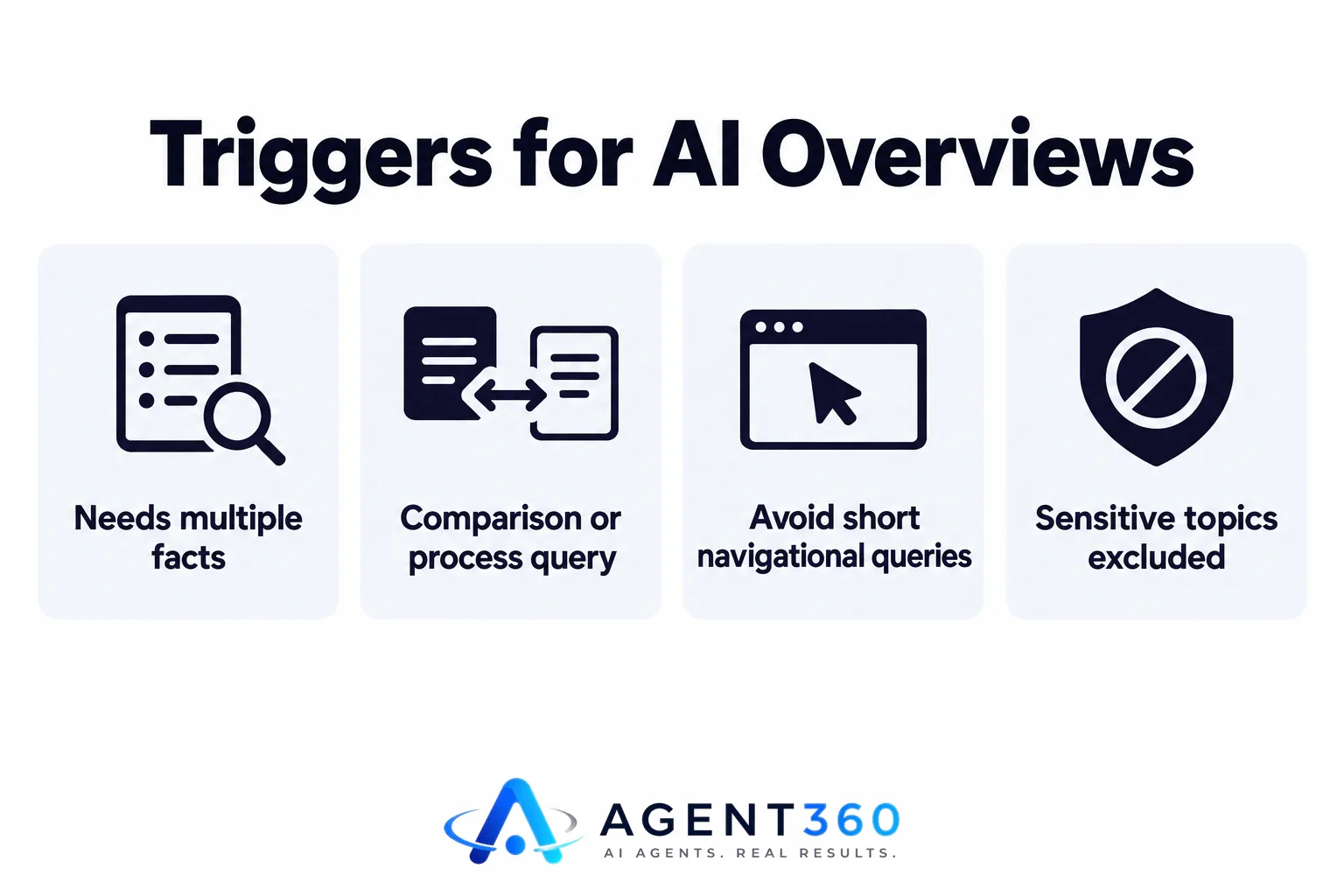
Bottom line: if your target search is a simple brand or product lookup, don’t expect an overview. If the query contains “how,” “why,” “best,” or a comparison, an overview is possible – and you might be missing it.
Why is the AI Overview not showing?
Four causes account for most of it:
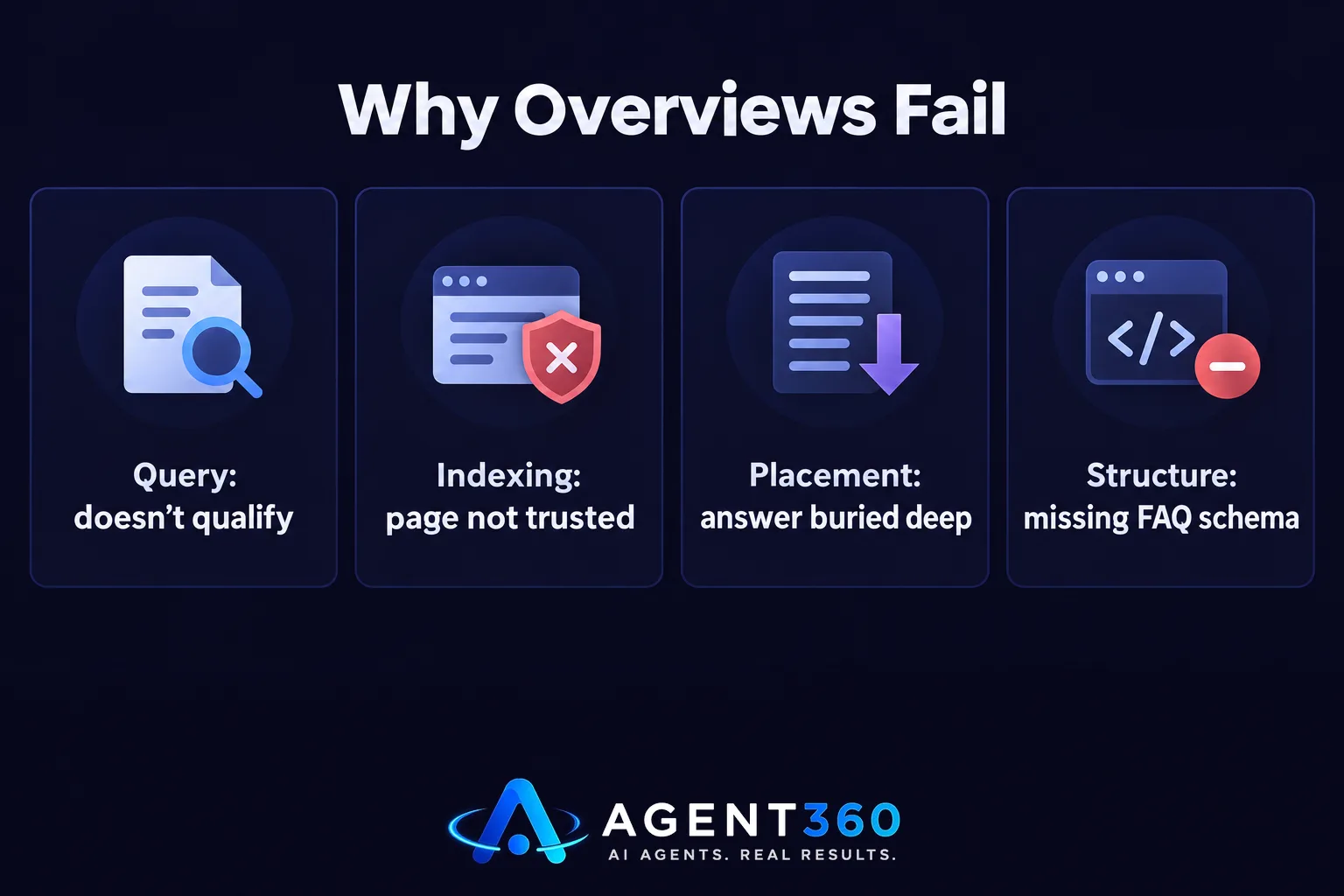
- The query doesn't qualify. Some searches simply don’t get an overview, no matter how good your page is. Test the exact phrase yourself, logged out, before blaming your content.
- Your page isn't indexed, or isn't trusted yet. A page with no backlinks, thin crawl history, or a recent publish date is less likely to be pulled into a synthesized answer, even if it ranks on page one for the regular result.
- The answer isn't where Google can lift it. If the direct answer sits three paragraphs down, after an intro about your company, Google has to work harder to extract it — and often won’t bother when a competitor states it in the first sentence.
- There's no structure confirming what the page answers. No FAQ schema, no clear heading matching the question, no clean list or table. Structured data doesn’t guarantee inclusion, but it removes friction for the systems deciding what to lift.
A Site Health check that scores titles, headings, structured data and crawler access against what AI answers actually need is a faster way to find which of these is your actual blocker — see Site Health Agent — Site health.
Turning on Google AI Mode changes what you see, not whether you're cited
People searching “how do I turn on Google AI Mode” are usually asking as a user, not a business owner. AI Mode is a search experience you opt into in Google Labs, a tab that replaces the normal results with a fuller conversational answer. There’s no equivalent switch for a business to flip. What you can do is use AI Mode yourself to test how your pages perform under a more conversational, multi‑step query than a plain search box would produce, since AI Mode tends to ask follow‑up questions the way a buyer actually would.
Getting named: structure beats tricks
If you want a specific page to have a shot at an overview:
- Put the answer in the first sentence of the section, not the fifth. Google rewards extractable answers, not a well‑written build‑up.
- Match your heading to the exact phrasing people use — “why is my invoice late” beats “billing timelines.”
- Add FAQ schema to question-and-answer content; it's a direct signal, not a guess.
- Keep one page per distinct question. Two pages chasing the same query split Google's confidence in both, which is the same mechanism covered in When your pages compete — it hurts AI Overview inclusion the same way it hurts ranking.
- State facts plainly and specifically. Vague claims rarely get lifted; a specific number, step, or definition does.
This is the same discipline that underpins answer engine optimization broadly, not a Google‑only trick — see What is AEO? for how the same pages that earn an overview also get cited by ChatGPT and Claude.
How to get an AI Overview on Google of yourself?
For a name search — your own, or your business's — overviews draw on whatever the web says consistently about you: a bio or about page with clear, unambiguous facts, Person or Organization schema, and agreement across your site and the directories, LinkedIn profiles and press mentions that already exist. Conflicting facts across sources (a wrong job title on one site, a different founding year on another) make Google less confident summarizing you at all. You can't force an overview on a name search, but you can remove the reasons Google hesitates.

Where tracking fits
Knowing whether you're currently named in an overview, for which questions, and what changed after an edit is the part most people skip — they check once, see nothing, and give up. AI Visibility Agent — AI answer tracking asks your buyers' actual questions to Google AI Overviews, ChatGPT and Claude on a schedule and records who got named, which turns this from a one‑time search into an ongoing check you can act on.
Questions
Why is the AI Overview not showing for my page? Most often because the query itself doesn't trigger an overview, the page isn't indexed or trusted enough yet, the direct answer is buried below marketing copy, or there's no structured data confirming what the page answers. Check the query alone first, logged out, before assuming the content is at fault.
What triggers Google AI Overviews? Questions that need synthesis — comparisons, “how” and “why” questions, multi‑part queries — are far more likely to get one than short transactional or navigational searches, which Google usually answers with a direct result instead.
Does turning on Google AI Mode help my business get cited? No — AI Mode is a toggle in the searcher's experience, in Google Labs, not a setting a business controls. Bottom line: you can’t flip a switch to get cited; you have to give Google a clear, easy‑to‑lift answer.
More articles
- An AI Blog Writer Won't Rank You. Here's What Will
- SEO Content Automation: What to Automate, What Not To
- What Is llms.txt and Do You Actually Need One?
- AI Visibility Tracking: What to Measure and How Often
- Track Brand Mentions in ChatGPT Without Fooling Yourself
- How to Get Mentioned by ChatGPT: A Practical Playbook
- How to Rank in ChatGPT: What Actually Gets You Named
- Generative Engine Optimization: What Actually Works
