Whitelabel GEO: What to Check Before You Sign a Vendor
Whitelabel GEO means buying AI-visibility tracking and content work from a vendor, putting your own logo on the reports, and billing clients for it as your own service. Some people write it as two words, “white label.” Others squash it into one, “whitelabel.” Same arrangement either way. The idea itself is sound: most agencies can't build a system that asks ChatGPT, Claude and Google AI Overviews the same question on a schedule and turns the gaps into published pages. The failure mode isn't the concept — it's signing with a vendor before checking four things that only surface after the first client complains.
Here's what to check before the contract, not after.
Ask who owns the client relationship when something breaks
Some whitelabel vendors answer client emails directly, your branding stripped off the subject line if you're lucky. Others route every request through you — which means you need to know the product well enough to explain why a ranking dropped, or why an AI answer stopped naming the client. Ask the vendor, in writing, what happens when a client wants to know why. If the answer is “we'll jump on the call,” find out whose name that call happens under. A whitelabel deal that quietly turns into a three-way call with your client, your vendor, and you as the confused middleman isn't whitelabel. It's a referral fee with extra steps.
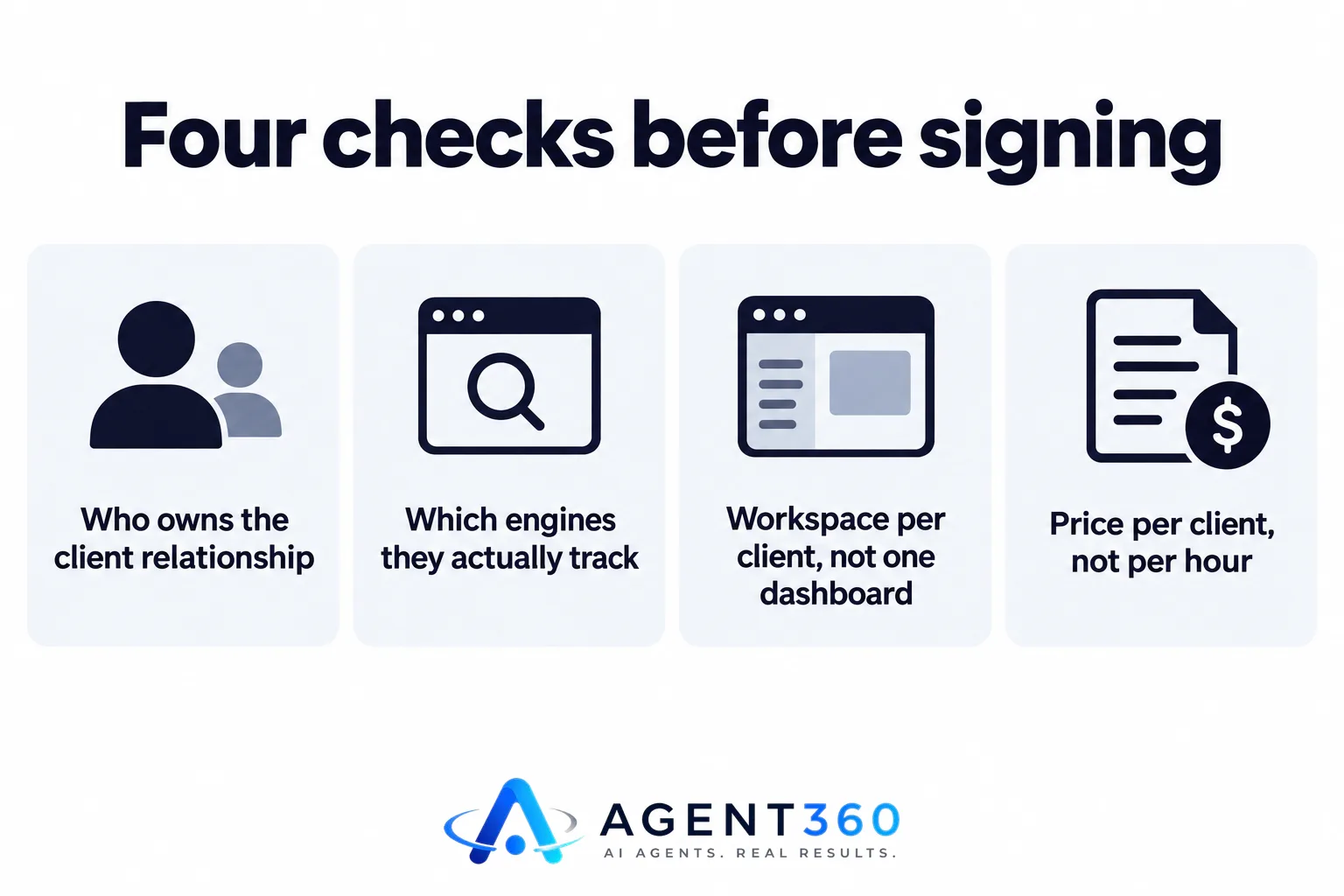
Check which engines they actually track, not just claim
“AI visibility” on a sales deck can mean almost anything. Some vendors track one engine and call it GEO. Ask specifically: does the tracking cover ChatGPT, Claude, and Google AI Overviews — or just one of the three? Ask how often the questions get re-asked. Weekly tracking tells a different story than daily, especially for a client who wants proof of movement inside a 90-day retainer. And ask what happens with Perplexity and Gemini, because no vendor covers every engine today. A vendor who claims otherwise is the one to doubt, not the one to trust.
Demand a workspace per client, not one dashboard you screenshot
If the vendor's answer to “how do I report to ten different clients” is “export the data and build your own slides,” you've bought a tool, not a service. A real whitelabel setup gives each client its own tracked terms, its own content plan, and its own published articles — so you hand over an actual workspace, not a PDF you assembled at midnight. That's the difference between reselling a result and reselling your own labor with someone else's data underneath it.
Price per client, not per hour you don't control
Hourly-based reselling breaks the moment a vendor changes its process, because your margin depends on hours you don't set. Price by client workspace instead. What does one more client cost you at the vendor, and what do you charge on top for strategy, onboarding and the relationship? That gap is your real margin, and it should survive a vendor's price increase without you renegotiating every client contract. If a vendor's pricing makes that math hard to do on one page, that's useful information on its own — compare how a flat monthly plan structure scales against an hourly one before you commit a dozen clients to it.
Walk before you run
Sign one client on the arrangement before you sign ten. A pilot surfaces the gaps a sales call never does: how long onboarding actually takes, whether reporting matches what you promised, whether articles land on the schedule you quoted. Agencies that skip the pilot and roll the offer out to the whole client list tend to find the gaps during a renewal conversation — the worst possible time to find them.

Where SearchAgent fits if you're evaluating this now
SearchAgent gives each client its own workspace with its own tracked terms, content plan and published articles, so an agency can score a prospect's site for free on the sales call and then put the same agents to work once they sign — that flow is laid out on the agencies page. It tracks ChatGPT, Claude and Google AI Overviews alongside Google rankings, starting at $297 a month per workspace with no setup fee and no contract, so the pilot above costs one month, not a quarter.
What's actually being compared
Most of what gets called “GEO” overlaps heavily with SEO — the same pages that earn a citation in an AI answer tend to be the pages that rank well in Google, as covered in the breakdown of what GEO actually is. The honest pitch to a client isn't “we do something completely new.” It's “we track a channel nobody else is reporting on, and we write the pages that close it.” If a vendor's deck leans hard on GEO being a separate universe from search, read that as marketing, not mechanism.
How it stacks against hiring or an agency retainer
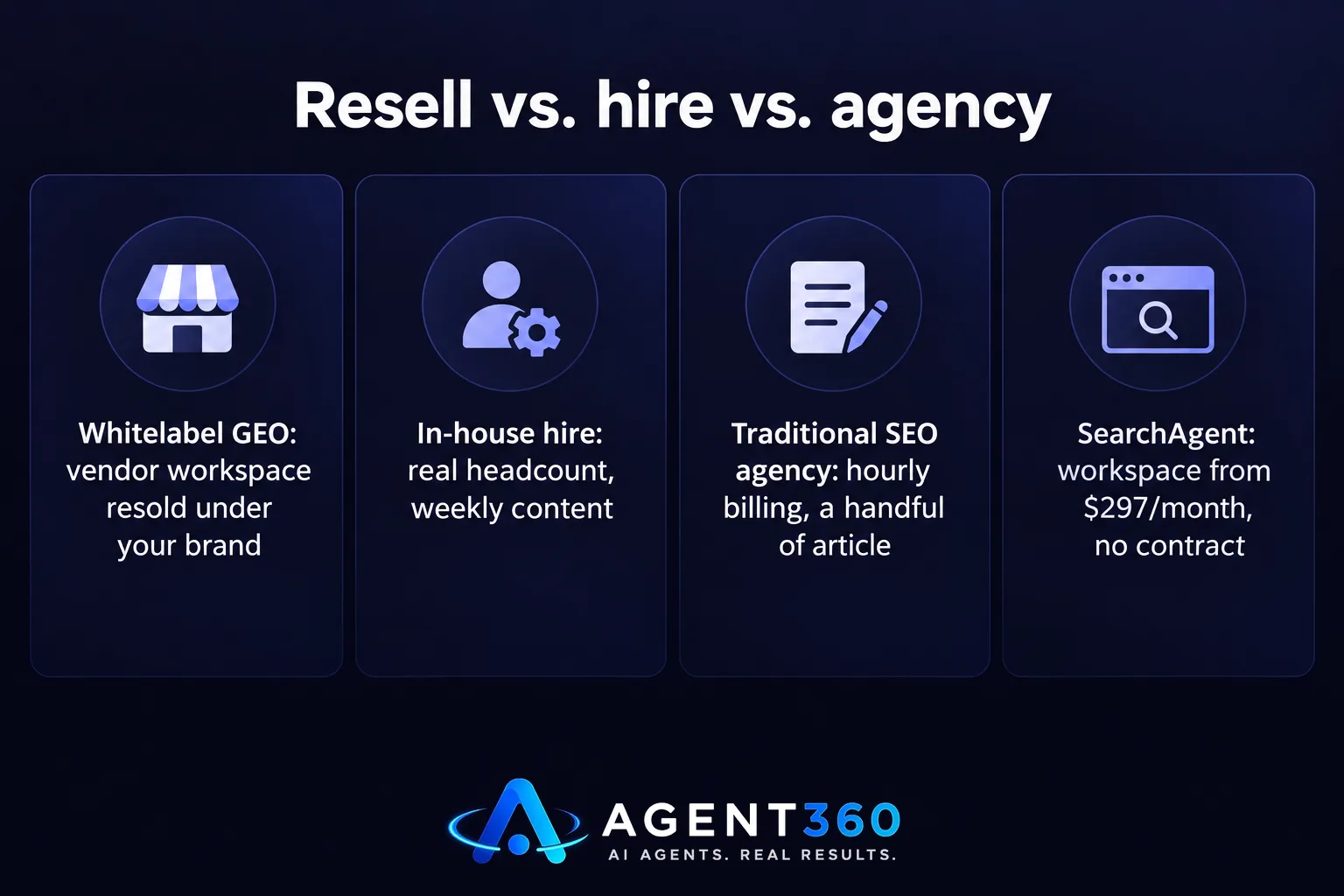
The other two options are building this in-house — hiring someone who can track AI answers and ship content weekly, a real headcount decision — or outsourcing to a traditional SEO agency that bills by the hour and delivers a handful of articles a month with a report. The tradeoffs of that third path are laid out on the agency comparison, and they apply just as much when you're the one deciding what to resell as when you're the client deciding what to buy.
What does whitelabel GEO mean?
It means buying AI-visibility tracking and the content work that closes the gaps from a vendor, then reselling it to your own clients under your own brand. Your clients see your name on the reports, not the vendor's.
Is whitelabel GEO the same as whitelabel SEO?
Mostly the same underlying work — content, tracking, site fixes — plus one addition: GEO also tracks whether AI assistants like ChatGPT and Claude name the client in answers, not just whether the client ranks on Google.
How much should I charge clients for it?
Start from what the client workspace costs you at the vendor, then add a margin that covers onboarding, strategy calls and the relationship. Skip the hourly rate — it breaks the first time the vendor changes its process.
More articles
- An AI Competitor Gap Analysis Agent: What to Expect
- How to Get Found on Google AI: What Actually Works
- How to Show Up in AI Overviews When Rivals Don't
- How Long Does SEO Take? The Honest Timeline
- The Local SEO Checklist That Actually Moves the Map Pack
- B2B SEO Strategy: How to Compete When Buyers Ask AI First
- How to Get Backlinks Without Outreach Emails
- SEO Content Plan Template: The 9 Columns That Matter
