An AI Competitor Gap Analysis Agent: What to Expect
An AI competitor gap analysis agent watches the searches you care about, records who currently holds each top-ten spot, and flags the ones where you're absent. That's the whole job. The difference between that and a manual gap analysis isn't the idea — comparing yourself to competitors is old news — it's the schedule. A spreadsheet export tells you what was true the day you pulled it. An agent tells you what's true this week, without anyone opening a tool.
Most teams already know the concept. Pull your terms, pull the top ten, see who's missing you. The problem has never been the concept. It's that nobody reruns it. Rerunning it by hand for even thirty terms takes an afternoon, and an afternoon a month doesn't happen in practice — not because people don't care, but because there's always something more urgent that day. That's the real case for turning this into an agent rather than a quarterly project: the analysis isn't hard, doing it on a cadence is just tedious enough that humans skip it.
A gap analysis agent should name the competitor, not just the keyword
A lot of what gets sold as competitor tracking is really just rank tracking with a second column bolted on. You see your position, and next to it a column that says “competitor average” or “top result domain rating,” and that's supposed to pass for competitive insight. It doesn't tell you anything you can act on.
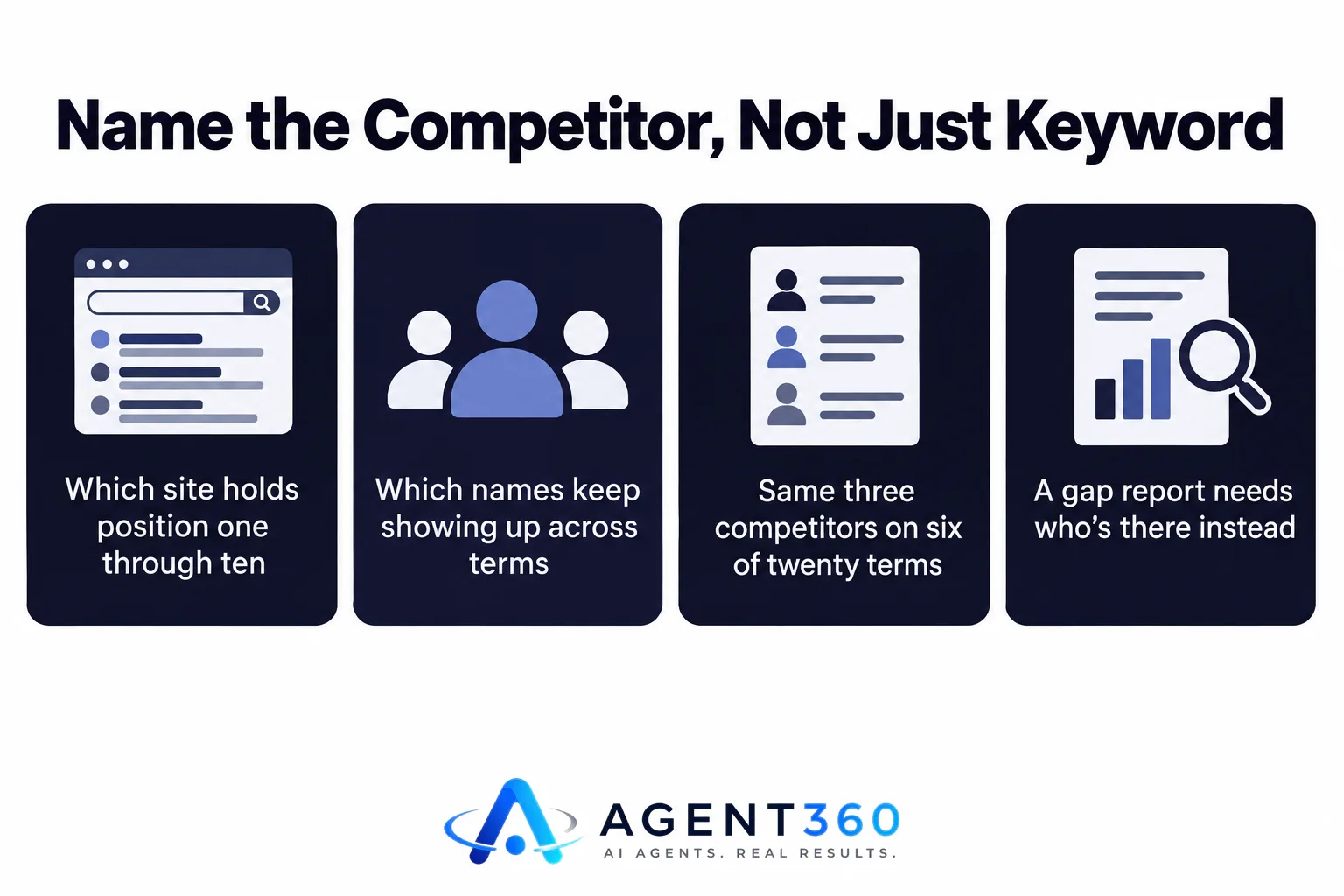
What you actually need is the name. For each of your terms: which specific site holds position one through ten today, and which of those names keep showing up across your whole list. If the same three competitors occupy six of your top twenty terms, that's worth a conversation internally — maybe they have a content format you don't, maybe a page type you've never built. A gap report that just shows “you: not ranked” without naming who's there instead is half a report.
Weekly re-checks catch the gaps that a one-time report misses
Search results move. A competitor publishes a comparison page and takes a spot you held. A directory listing drops off and a gap opens that nobody built content for. None of this shows up if the last check was three months ago.
Weekly is the cadence that catches movement before it compounds. It doesn't need to be daily — rankings for most commercial terms don't shift meaningfully day to day, and checking that often mostly produces noise. But monthly or quarterly is too slow to treat as a working signal. By the time you see the gap, it's usually been open long enough for someone else to have filled it with three more pages.
Local results need a local agent, not a generic one
If you run a local business, a generic gap analysis will mislead you. The top ten for “commercial roofer” nationally has nothing to do with who ranks in your city, and a tool that doesn't know your location will happily compare you to businesses three states away. A useful agent adjusts the check to your town automatically, so the competitors it names are the ones actually taking your customers, not a generic national list. This matters more than most of the tool's other features combined — for local terms, the entire value of the analysis depends on it being geographically honest.

What to do with a gap once you have it
A list of gaps is not a strategy. The useful next step is turning each real gap into a page brief: the term, the intent behind it, what the competitor's page covers that yours doesn't, and who owns writing it. Skip that step and gap analysis becomes a recurring report that gets skimmed and archived — close to worthless, since the insight exists in the report but never makes it into anything published.
This is also where a lot of gap analysis tools stop short. They'll tell you Competitor B outranks you on fourteen terms, then leave the “now what” entirely up to you. A tighter loop connects the gap straight to a content plan, so the gaps that matter turn into drafts instead of line items on a spreadsheet nobody reopens.
One thing worth deciding up front: how many competitor terms you actually need tracked. Thirty terms covers most small and mid-size businesses well; tracking two hundred terms against competitors mostly produces a long list nobody reads. Depth on the terms that drive revenue beats breadth across every term you could plausibly rank for.
Where SearchAgent fits
SearchAgent's Competitor Agent reads Google's top ten for up to 30 of your terms, adjusts to your town when it knows one, names who holds each spot, and re-checks every week rather than on request. Gaps feed directly into the Strategy Agent's content plan, so a missing spot becomes a draft rather than a line in a report. It's not a research suite like Ahrefs, which gives you far deeper competitive data and leaves the work of acting on it to you — SearchAgent tracks less but closes the loop to published pages. Plans start at $297 a month on the pricing page, with competitor tracking included from the Starter tier.
Questions
How is this different from a rank tracker?
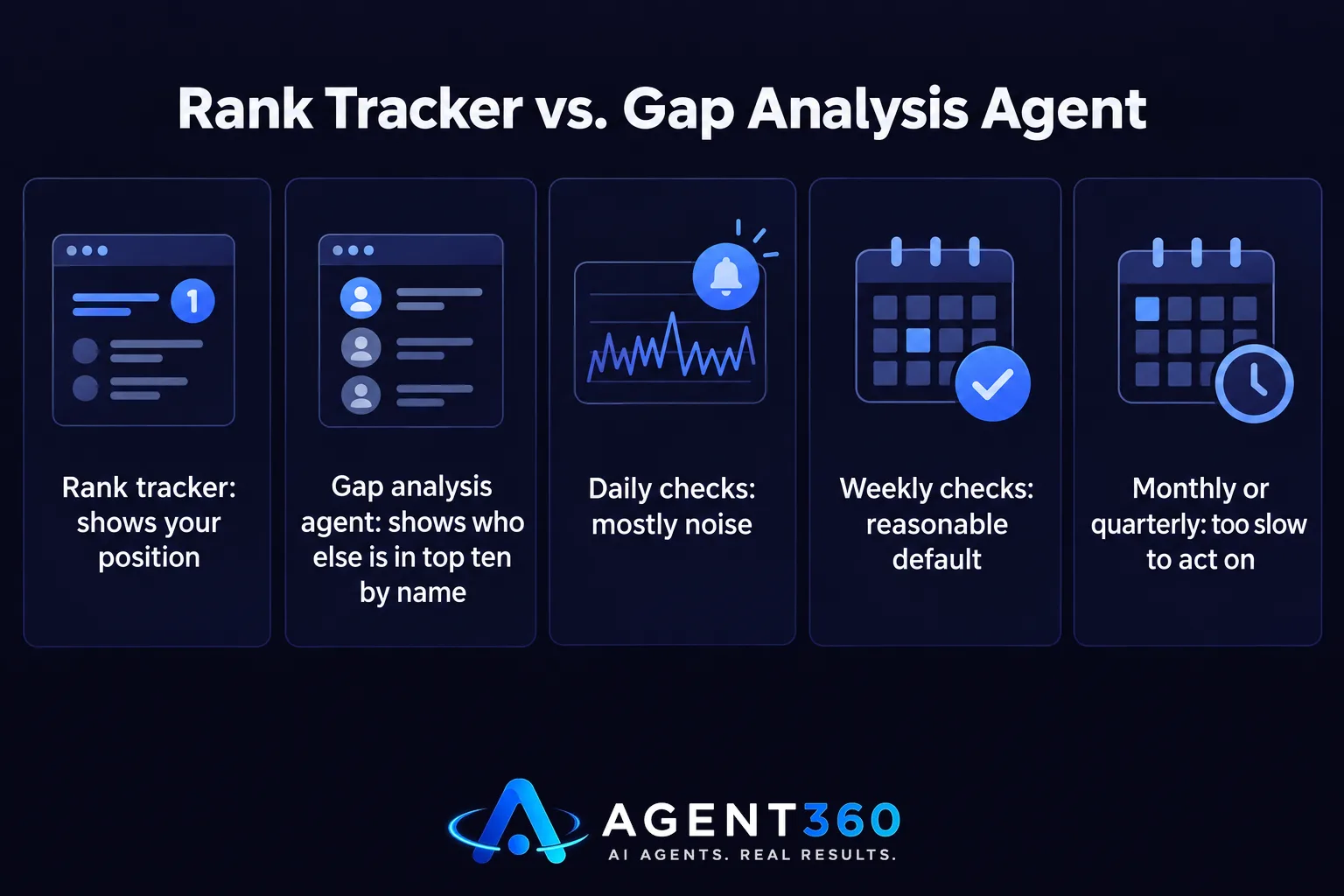
A rank tracker shows your position. A gap analysis agent shows who else is in the top ten, by name, so you know exactly who you're losing the spot to and can decide whether their page is worth matching or beating.
Do I need Search Console connected for this to work?
No. Competitor gap checks read Google's public results for your terms, not your own search data, so they work without a Search Console connection — though pairing the gap list with your own ranking data from Search Console makes prioritizing the gaps easier.
How often should a competitor gap analysis actually be rerun?
Weekly is a reasonable default for most businesses. Daily checks mostly add noise since rankings for commercial terms rarely move that fast, and monthly or less lets real gaps sit open long enough for a competitor to build three more pages against you before you notice.
More articles
- How to Get Found on Google AI: What Actually Works
- How to Show Up in AI Overviews When Rivals Don't
- How Long Does SEO Take? The Honest Timeline
- The Local SEO Checklist That Actually Moves the Map Pack
- B2B SEO Strategy: How to Compete When Buyers Ask AI First
- How to Get Backlinks Without Outreach Emails
- SEO Content Plan Template: The 9 Columns That Matter
- Competitor Keyword Gap Analysis: Find What You're Missing
