How to Rank in ChatGPT: What Actually Gets You Named

ChatGPT has no leaderboard to climb. Google gives you ten blue links and a position you can push up or down. ChatGPT gives you one answer, written in prose, and your business is either in it or it isn't. “Ranking in ChatGPT” really means getting named in that one answer, and that runs on different inputs than getting to position one on Google.
That distinction matters because most of the advice going around treats ChatGPT like a search engine with a hidden scoring formula. It isn't. Fix the mental model first, and the tactics get a lot clearer.
ChatGPT doesn't rank pages, it recalls or retrieves them
ChatGPT answers a question one of two ways. Either it pulls from what it learned during training — a frozen snapshot of the web, months or years old — or, when browsing is turned on, it runs a live web search, reads a handful of pages, and writes a summary with sources. Those are two different problems.
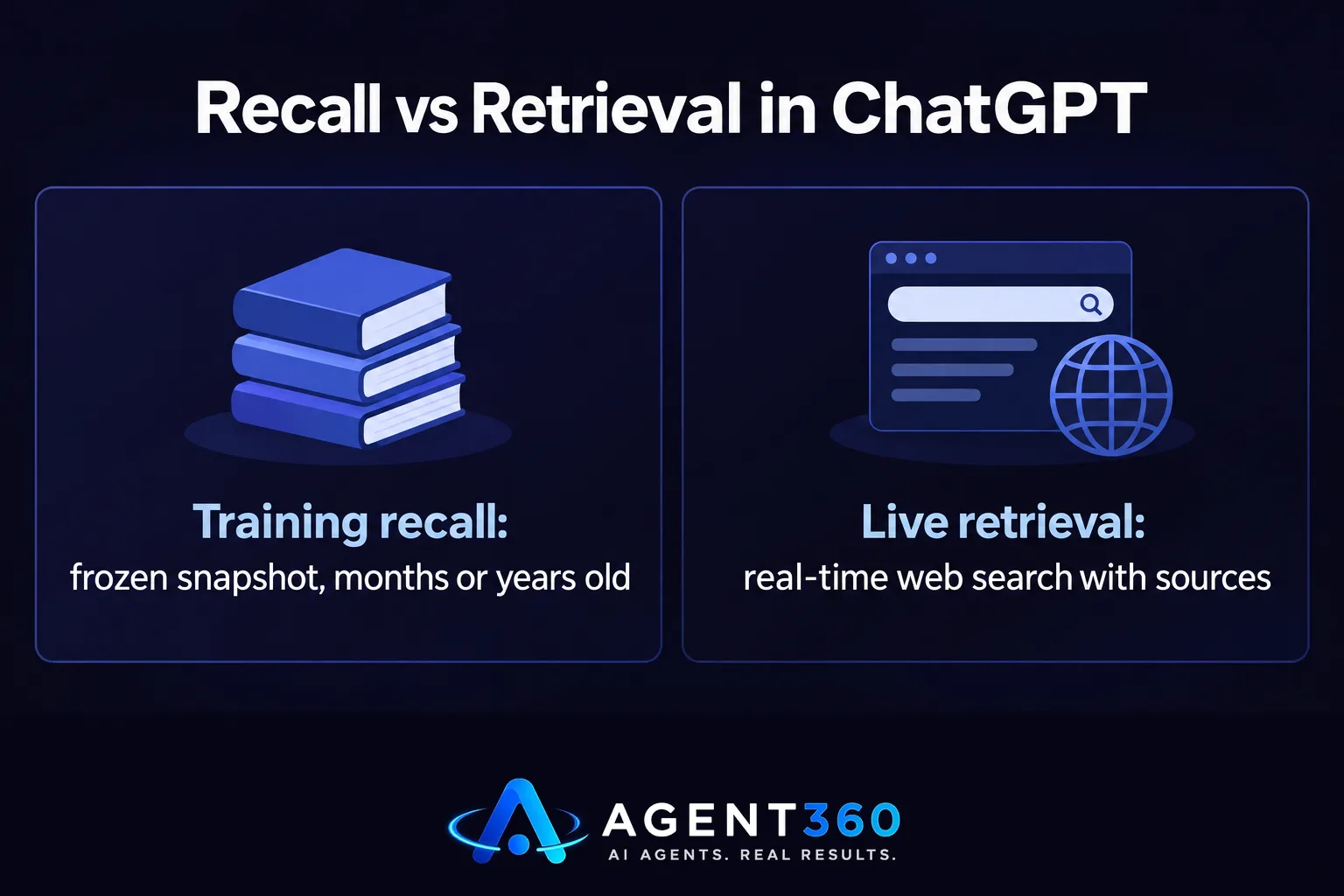
You can't buy your way into the training snapshot faster. It updates on OpenAI's schedule, not yours. What you can influence right now is the live-retrieval path: the pages ChatGPT fetches when it searches the web on your behalf. If your site doesn't show up in that fetch, you don't exist for that answer — no matter how good your product is.
How to get mentioned in ChatGPT
Three things make a page easy for a model to pull from and repeat accurately:
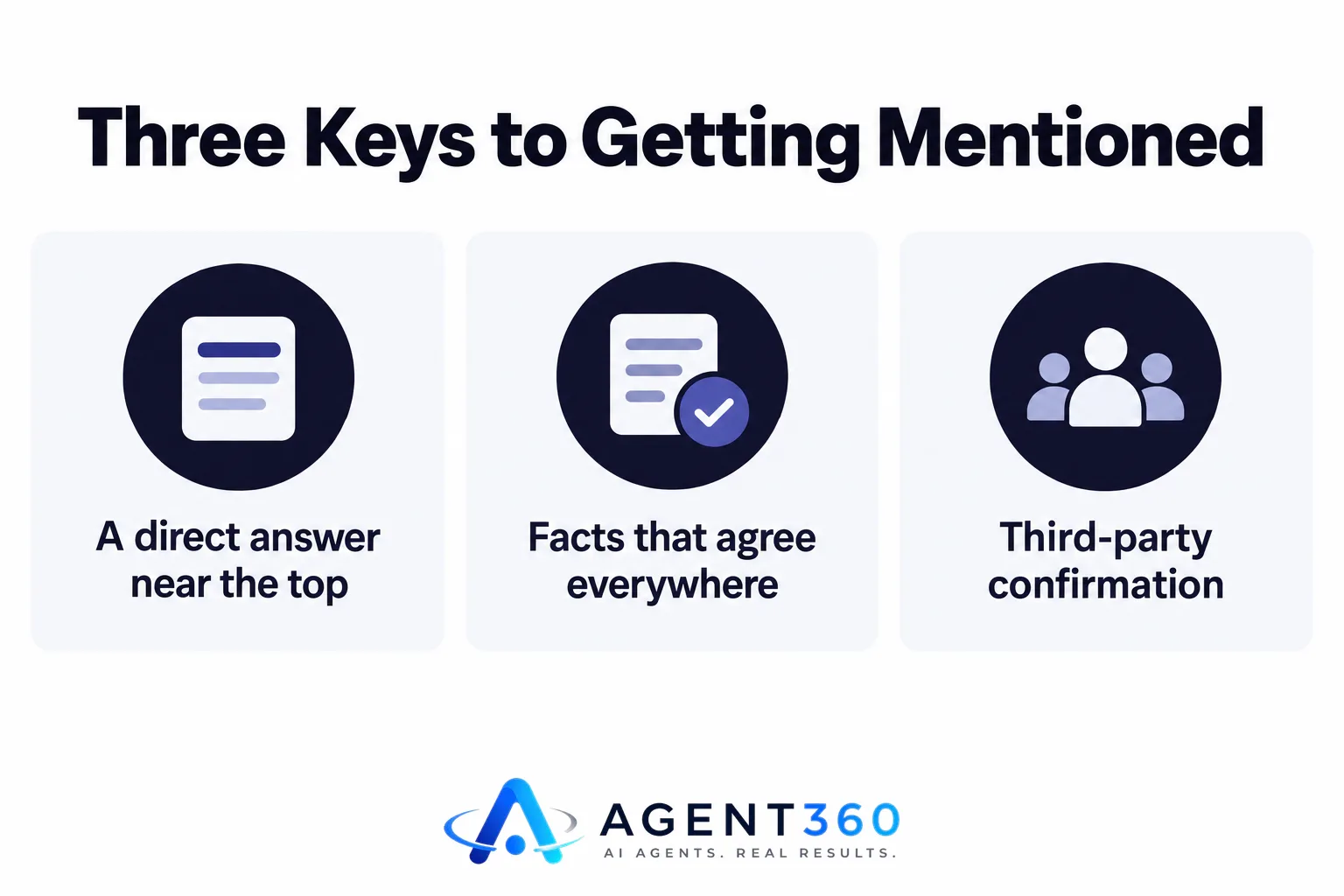
- A direct answer near the top. If someone would ask “who does X in [your city]” or “what's the best tool for Y,” your page should answer that exact question in the first two sentences, in plain language — not buried under three paragraphs of brand story.
- Facts that agree everywhere. Your name, your category, your pricing, your service area — if your site says one thing and your directory listings, review sites and press mentions say something slightly different, a model retrieving from several sources at once has no clean fact to repeat, so it picks the source that's unambiguous. Usually that isn't you.
- Third-party confirmation. Models weight what other sites say about you alongside what you say about yourself. A page that only exists on your own domain is a claim. The same claim repeated on a review site, a comparison page, or an industry roundup is closer to a fact a model will repeat.
None of this is exotic. It's the same discipline behind getting named in Google's AI Overviews, because both systems are reading the same open web and making the same kind of retrieval decision.
How to do SEO for ChatGPT? Start with the pages already ranking
When ChatGPT browses, it frequently leans on the same web index that powers conventional search. That means pages already ranking reasonably well on Google are more likely to get pulled into a ChatGPT answer than pages buried on page four. Clear titles, fast pages, structured data, a crawlable site — none of that goes away just because the destination is a chat window instead of a results page. It's the substrate the AI answer is built on.
So “SEO for ChatGPT” isn't a separate discipline you bolt on. It's the same on-page and technical work, aimed at a slightly different outcome: not just a ranking position, but a sentence a model is willing to lift and attribute to you. For a fuller breakdown of where the two overlap and where they split, see SEO vs AEO vs GEO.
Don't ask ChatGPT how it ranks things
A tempting shortcut: ask ChatGPT itself for tips on ranking in ChatGPT. It will happily answer, and the answer will be generic SEO advice assembled from its training data — not an account of its own retrieval mechanism. A language model has no introspective access to the system that decided to cite it; it's pattern-matching on how people write about “ranking” elsewhere. Treat that answer as a writing sample, not a technical spec.
Measure it before you optimize it
Here's the honest problem with all of the above: a single question to ChatGPT tells you almost nothing. Ask the same question twice in a row and you can get two different answers, because the model's outputs vary and live retrieval can surface different pages each time. One good result doesn't mean you've “ranked.” One bad result doesn't mean you've failed. What you need is the same question, asked on a schedule, with the results logged, so a run of misses or a run of hits actually means something. There's a repeatable method for doing this by hand in Track your brand in ChatGPT.

Where SearchAgent fits
If you'd rather not run that tracking by hand, this is close to the one job SearchAgent does for AI answers: its AI Visibility Agent asks the real questions your buyers ask to ChatGPT, Claude and Google AI Overviews on a schedule, logs whether you were named and who was named instead, and turns each miss into a page brief your writing queue can act on. Plans start at $297 a month, month to month, with no setup fee — details are on the pricing page.
Frequently asked
How to get ChatGPT to rank on AI results?
There's no rank to hold — ChatGPT writes one answer per question. The closer target is being the business it names or the source it cites, which depends on your content directly answering the question, your facts matching across the web, and other sites independently confirming what you claim.
How to get mentioned in ChatGPT?
Write pages that answer a specific buyer question in the opening lines, keep your name, category and claims consistent across your own site and third-party listings, and get that same information echoed on review sites or comparison pages you don't control. Models repeat what multiple independent sources agree on.
How to do SEO for ChatGPT?
Mostly by doing the SEO work that already matters: a crawlable, fast, well-structured site that ranks decently in conventional search. ChatGPT's live browsing often draws from that same web index — a page invisible to Google is usually invisible to ChatGPT, too.
More articles
- An AI Blog Writer Won't Rank You. Here's What Will
- SEO Content Automation: What to Automate, What Not To
- What Is llms.txt and Do You Actually Need One?
- How to Appear in Google AI Overviews
- AI Visibility Tracking: What to Measure and How Often
- Track Brand Mentions in ChatGPT Without Fooling Yourself
- How to Get Mentioned by ChatGPT: A Practical Playbook
- Generative Engine Optimization: What Actually Works
