An AI Blog Writer Won't Rank You. Here's What Will

Give an AI blog writer a prompt and it'll hand you 1,200 words before your coffee cools. Ranking is a different job entirely, and most of the frustration people run into with ai blog writer for seo tools comes from asking the first thing to do the second.
Here's the split: writing is one input into ranking, alongside what you target, how fast you publish, what you fix when a page slips, and whether you're closing a gap a competitor already owns. An AI writer handles the first part. Nothing handles the rest unless you build it or buy it.
Which AI writer is best for blogs? Wrong question
People ask this expecting a leaderboard — GPT-4 versus Claude versus whatever launched last month. But the output gap between frontier models on a standard how-to article is small, and it shrinks further once you add a decent prompt and an editing pass. The gap that actually moves rankings sits somewhere else: does the tool know what you're missing?
A model with no view into your Search Console data, your competitors' top-ten pages, or the AI answers that leave you out will write a competent article about nothing in particular. It won't catch that three of your existing pages already compete for the same search term — a problem covered in more detail in our piece on when your pages compete. It won't tell you a competitor three towns over owns the top spot for a term you haven't even tried. Next to that, model choice is a rounding error.
Is it okay to use AI to write blog posts?
Yes. Google has said as much directly: it ranks content on quality signals, not on whether a human or a machine typed it first. What gets penalized isn't AI authorship — it's the pattern AI makes easy to fall into: thin pages, generic answers, dozens of near-duplicate posts shipped in a week to game volume. That pattern existed before AI writers. They just made it cheaper to produce at scale, which is exactly why it got flagged.
The real test isn't “did AI write this” but “does this page answer something a real search asks, with specifics a template wouldn't have.” A post that names thresholds, explains a mechanism, or walks through a decision a reader actually faces clears that bar no matter how the draft got written. A post that restates the obvious under five different headings doesn't, no matter how human the byline.
Are blogs still a thing in 2026?
The format isn't going anywhere. The undifferentiated version of it is. Fewer people click through ten blue links to read a 2,000-word explainer when ChatGPT or an AI Overview will just summarize it for them. That shifts the job of a blog post from “rank in the top ten” to “get cited inside the answer” — and that still requires a page that exists, is specific, and gets checked often enough to stay current. Posts that go stale get quietly dropped from citations the same way they slide down rankings. The format survives. The maintenance schedule gets stricter.

What separates a published draft from a page that ranks
Three things an AI writer alone doesn't supply:
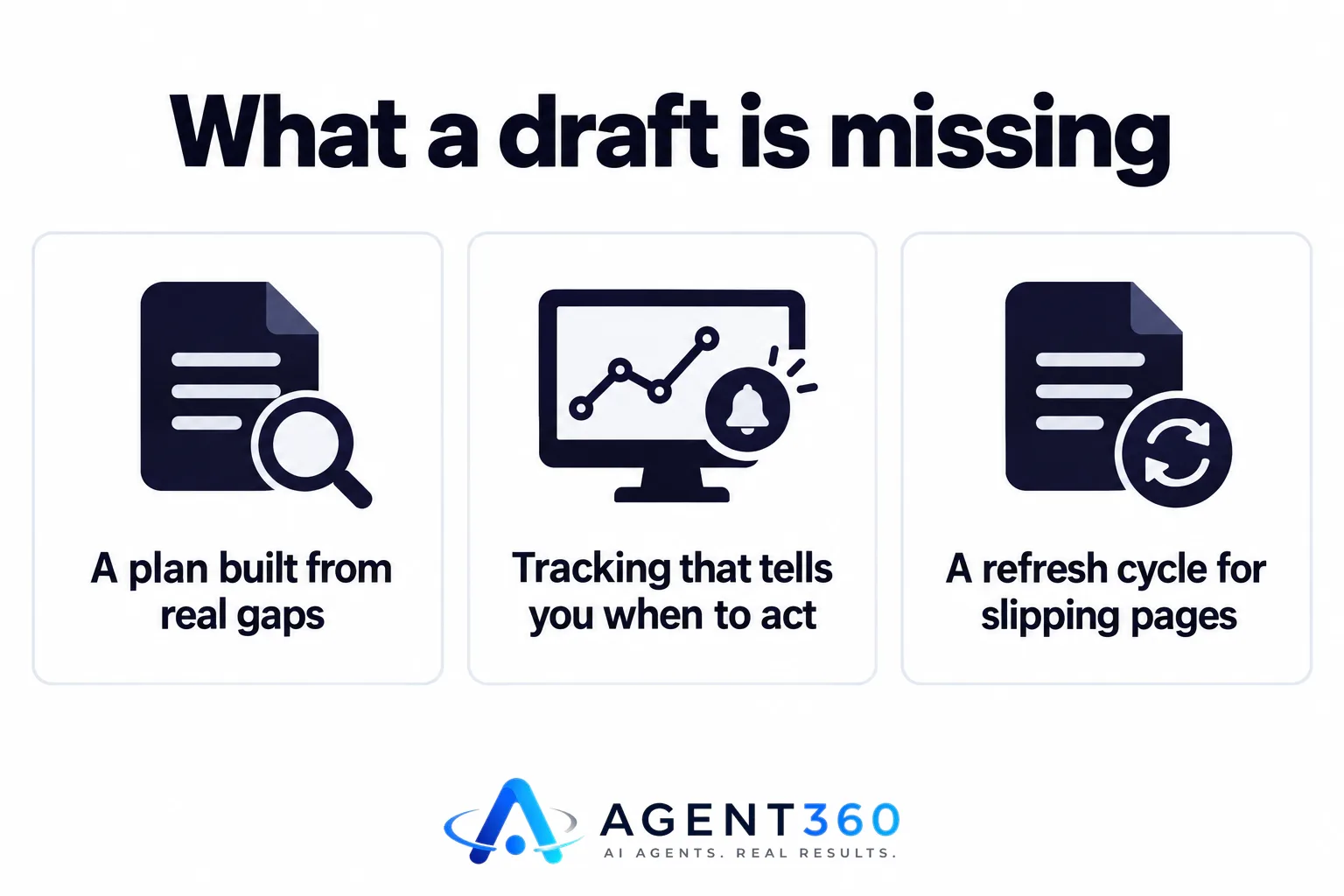
- A plan built from real gaps. Not a brainstorm, but a list pulled from the searches you're losing, the AI questions where competitors get named instead of you, and the terms with traffic but no page targeting them.
- Tracking that tells you when to act. A page can rank at position 14 for months and nobody notices unless something is reading Search Console on a schedule and flagging the drop.
- A refresh cycle. Search results and AI answers both reward pages that get touched. A post published once and never revisited slips as competitors update theirs; a weekly or biweekly rewrite of slipping pages is cheap compared to writing a new one from scratch.
Tools built purely for research, like Ahrefs, hand you the data for all three and leave the execution to you — worth knowing if you're comparing the two approaches, which we break down in SearchAgent vs Ahrefs. An AI writer with none of this attached is just a faster typewriter.
Where SearchAgent fits
SearchAgent pairs the writing with the rest of the stack: a content plan drawn from your actual search gaps and AI answer misses, articles written every morning from that plan, and a nightly read of Search Console that flags what's moving. Plans start at $297 a month with no contract — see pricing for what's included at each tier, or look at how the plan and the writing connect on the content plan and articles pages.
Questions
Does Google penalize AI-written blog posts? No. It ranks on quality signals like depth, originality and usefulness, regardless of whether a human or a model wrote the first draft. It does penalize the thin, repetitive content that AI makes cheap to mass-produce.
How many blog posts should I publish per week for SEO? There's no fixed number that works for every site. What matters more is whether each post targets a real gap and gets revisited when it slips, rather than how many go out on a schedule.
Can an AI tool alone make my content SEO-friendly? It can produce a readable, structured draft. But “SEO-friendly” depends on targeting a search a real person makes, competing against pages you've actually checked, and staying current — and the writing step alone won't do any of that for you.
More articles
- SEO Content Automation: What to Automate, What Not To
- What Is llms.txt and Do You Actually Need One?
- How to Appear in Google AI Overviews
- AI Visibility Tracking: What to Measure and How Often
- Track Brand Mentions in ChatGPT Without Fooling Yourself
- How to Get Mentioned by ChatGPT: A Practical Playbook
- How to Rank in ChatGPT: What Actually Gets You Named
- Generative Engine Optimization: What Actually Works
