Hiring a Local Marketing Agency: What It Actually Costs
Most local marketing agencies land somewhere between $300 and $5,000 a month, not counting the money you hand directly to Google or Meta for ads. Where you fall in that range comes down to two things: how many channels you want managed, and how much hand-holding you need. A single-channel retainer — just SEO, or just ads — sits at the low end. A full-service retainer covering your website, search, ads, content and lead follow-up sits in the middle. Multi-location or aggressive growth programs push past it. Here's how to read that range, what you're actually paying for, and how to tell if it's worth it before you sign anything.
How much does it cost to hire a marketing agency?
Three bands show up again and again. A single-service retainer — someone just running your Google Ads or just handling local SEO — usually runs $300 to $800 a month. A full-service retainer bundling your website, SEO, ads, content and lead response typically lands between $1,000 and $3,000. A multi-location or high-spend program, where the agency manages serious ad budget across several markets, can run $3,000 to $5,000-plus. In every case, ask whether that number includes ad spend or sits on top of it. A lot of first-time buyers assume the retainer covers their Google and Meta budget. It almost never does — ad spend goes straight to the platform, and the retainer pays for the work of running it.
The other question nobody asks up front: is there a setup fee, and is there a contract? Some agencies charge $500 to $2,000 to build your initial campaigns and brand assets before the monthly fee even starts, then lock you into six or twelve months regardless of results. Neither is something you have to accept. Plenty of month-to-month options exist with no setup charge, and a long contract should read as a red flag, not a sign of commitment.
What is the 3-3-3 rule in marketing?
There's no single official definition here. Ask five marketers and you'll get five answers, because the phrase gets recycled for different frameworks. The version worth adopting for a local marketing budget is a simple three-way split: one third to the channel you already know converts — your proven search or map-pack traffic — one third to testing one new channel at a time, and one third held in reserve to pour into whatever the test proves out. The discipline isn't the exact thirds. It's refusing to bet your whole budget on one unproven idea, and refusing to stop testing just because the current channel is “working fine.” If your agency can't tell you which third of this month's spend was the test, they're not running a strategy. They're running last month's campaign on autopilot.
What does a marketing agency do?
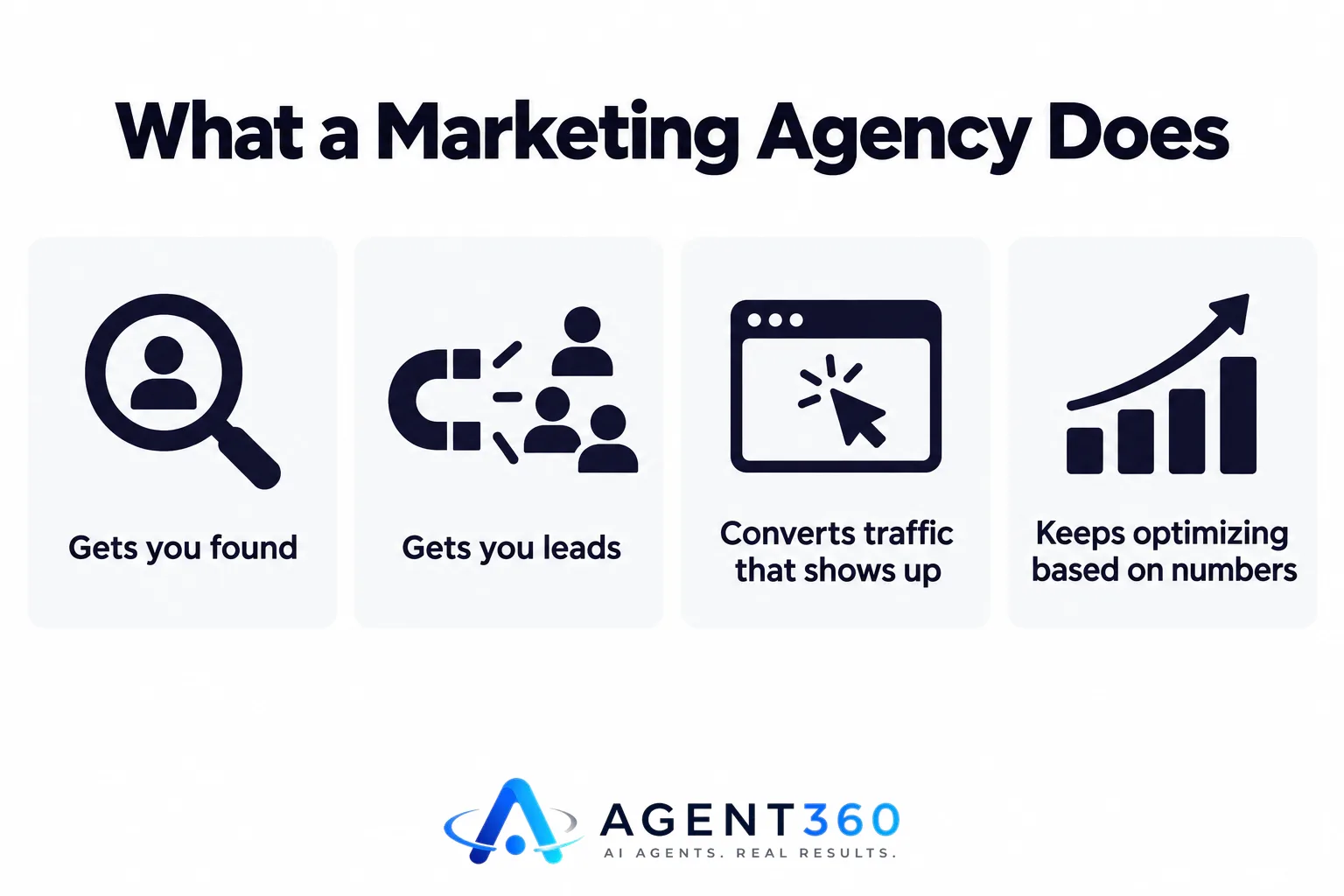
Strip away the jargon and a local marketing agency does five things: gets you found, gets you leads, converts the traffic that shows up, responds before a competitor does, and keeps optimizing based on what the numbers say. In practice, that's managing your Google Business Profile and local search so you show up in the map pack, running paid ads on Google and Meta, building or maintaining a website and landing pages built to convert rather than just look nice, answering and following up on leads fast enough that they don't call the next name on the list, and sending a report that ties dollars spent to jobs booked. Any agency worth paying should lay this out the same way — as a set of connected functions, not a grab bag of social posts and a boosted Facebook ad. A home services company and a med spa need the same five functions. They just weight them differently, which is why industry context matters more than most pitch decks let on.
Is it worth it to hire a marketing agency?
It's worth it when the math clears two bars: the agency's fee plus your ad spend costs less than hiring and managing the same work in-house, and the leads it produces convert at a rate that beats what you're doing now. Run the numbers before you sign. Take your average job or customer value, estimate how many bookings a month would cover the retainer and ad spend with room to spare, and ask the agency directly whether that number is realistic for your market. If they won't give you a straight answer, or they promise a specific ranking or lead count without knowing your service area, walk. No one can guarantee rankings or ad results, and an agency that claims otherwise is selling confidence, not a plan. What you should get instead is a clear dashboard showing every lead, where it came from, what it cost, and whether it booked. Ask to see what that reporting actually looks like before you commit a dollar.
It's usually not worth it when your business can't handle more volume yet — a one-person plumbing outfit already booked three weeks out doesn't need more leads, it needs pricing or staffing changes — or when the agency's only move is more spend on the channel you're already saturating. More ads on top of a website that doesn't convert just makes expensive traffic bounce faster.
A flat-fee, done-for-you option exists if you'd rather skip the retainer math
If comparing custom quotes sounds like more work than it's worth, Booked runs the whole stack — website, SEO, AEO and GEO, Google and Meta ads, landing pages, instant lead follow-up, booking and reporting — for a flat monthly fee starting at $297, with no setup charge and no contract. Ad spend still goes directly to Google and Meta from your own account, so you always see exactly what it bought. Compare what's included at each tier on the pricing page, whether you run one location or are weighing plans built for home services, dental practices, or multi-location operators.
How long before a local marketing agency shows results?
SEO and Google Business improvements typically take six to twelve weeks to show movement, because search engines need time to re-crawl and re-rank your pages. Paid ads can produce leads within days, but the first two to three weeks usually go to tuning targeting and messaging. Judge ad performance on month two, not week one.

Should I hire one agency for everything or separate specialists for SEO, ads and web design?
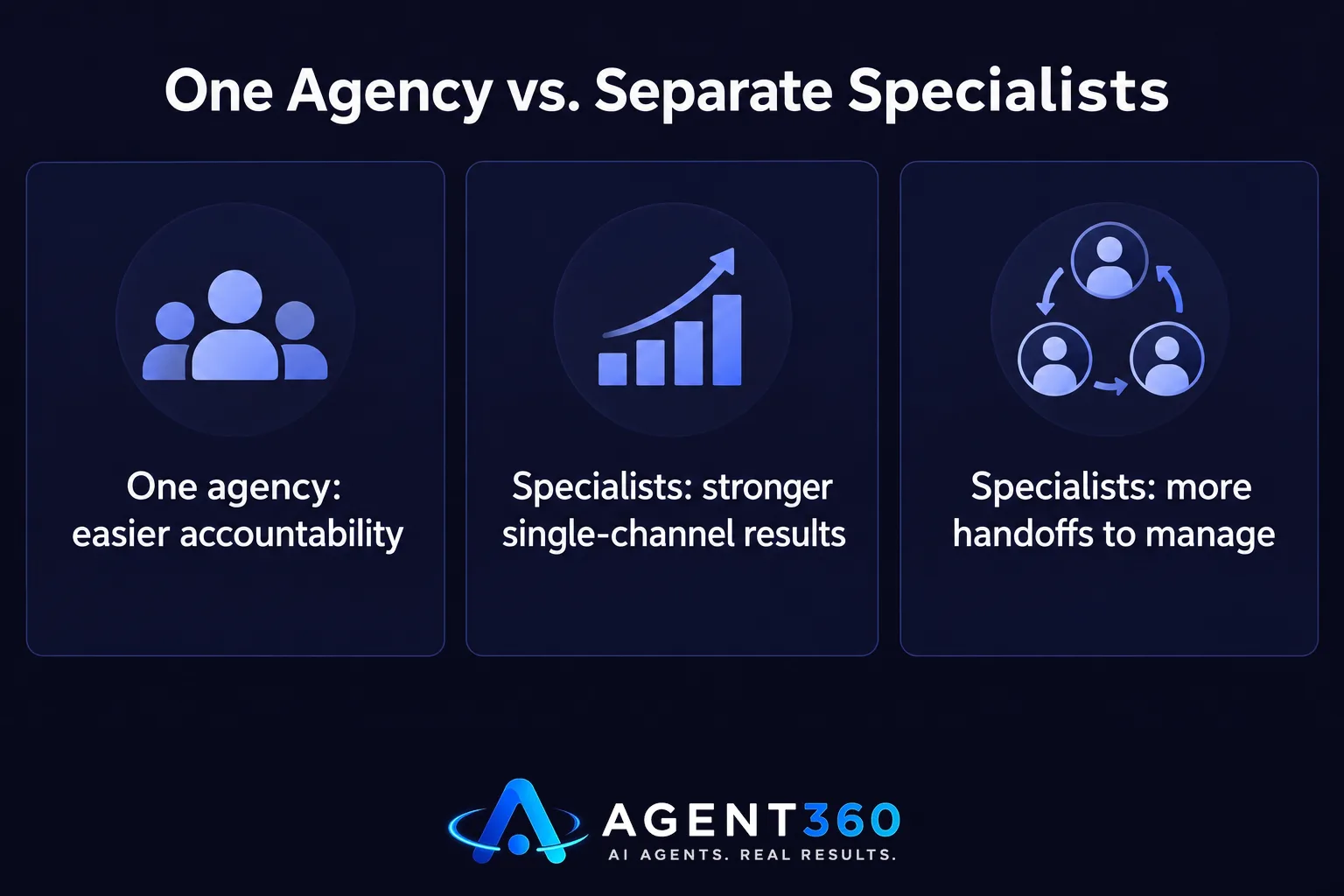
One agency is easier to hold accountable, because there's nowhere for a dropped lead to hide between vendors — the website team can't blame the ad team, and vice versa. Separate specialists can outperform a generalist on any single channel, but only if you have time to manage the handoffs between them. Most local business owners don't, which is the whole argument for keeping it under one roof.
More articles
- Marketing for Auto Repair Shops That Keeps Bays Full
- Restaurant Marketing Ideas That Actually Fill Tables
- Law Firm Marketing: What Actually Brings In Cases
- Marketing for HVAC Companies: What Actually Books Jobs
- Marketing for Dentists: What Actually Fills the Schedule
- Google Business Profile Optimization: What Moves Rankings
- Local SEO Services: What They Should Actually Do
- Done-For-You Marketing for Small Business: What It Buys
