How to Get Recommended by ChatGPT for Your Business
Ask ChatGPT for “a good electrician near me” and it won't open your homepage to judge your copy. It runs a search behind the scenes, reads a handful of results, and writes its answer from whichever sources look current, consistent, and independently verified. Getting recommended, then, has almost nothing to do with your website's keywords and almost everything to do with what other sources say about you. Your job is to be well-represented where the model is actually looking, not to out-write your competitors on your own site.
That's a different job than classic SEO, even though the two overlap. It's also why a business with a mediocre website and a clean, consistent presence everywhere else can get named ahead of a business with a beautiful site and nothing backing it up elsewhere.
ChatGPT answers local questions by searching, not by remembering
Training data goes stale fast. So for anything with a timestamp attached — hours, prices, “best of” lists, who's still in business — most AI tools now run a retrieval step: a search-like query, a scan of the top results, then a written answer with sources attached. In effect, the model is reading a simplified version of a search results page and picking what to trust. The pages that land on that page are the same ones you'd expect to rank well for local intent: your Google Business Profile, review aggregators, local directories, and any content that directly answers the question being asked.
The practical consequence: if your Google Business Profile is incomplete, unclaimed, or inconsistent with what's listed elsewhere, you're invisible at the exact moment the model is deciding who to mention. Get that profile right before you touch anything else — see what actually moves a Google Business Profile if you haven't looked at yours in a while.
Consistency across directories matters more than polish on any one of them
A name, address, or phone number that doesn't match across your website, Google Business Profile, Yelp, Apple Maps, and any industry directory creates exactly the kind of conflicting signal that makes a model hedge or skip you entirely. It can't tell which version is current, so it defaults to a competitor whose listings agree with each other. This is tedious to fix and rarely gets done, which is exactly why fixing it is worth the afternoon it takes: pull every directory listing you can find and make the basics identical everywhere.
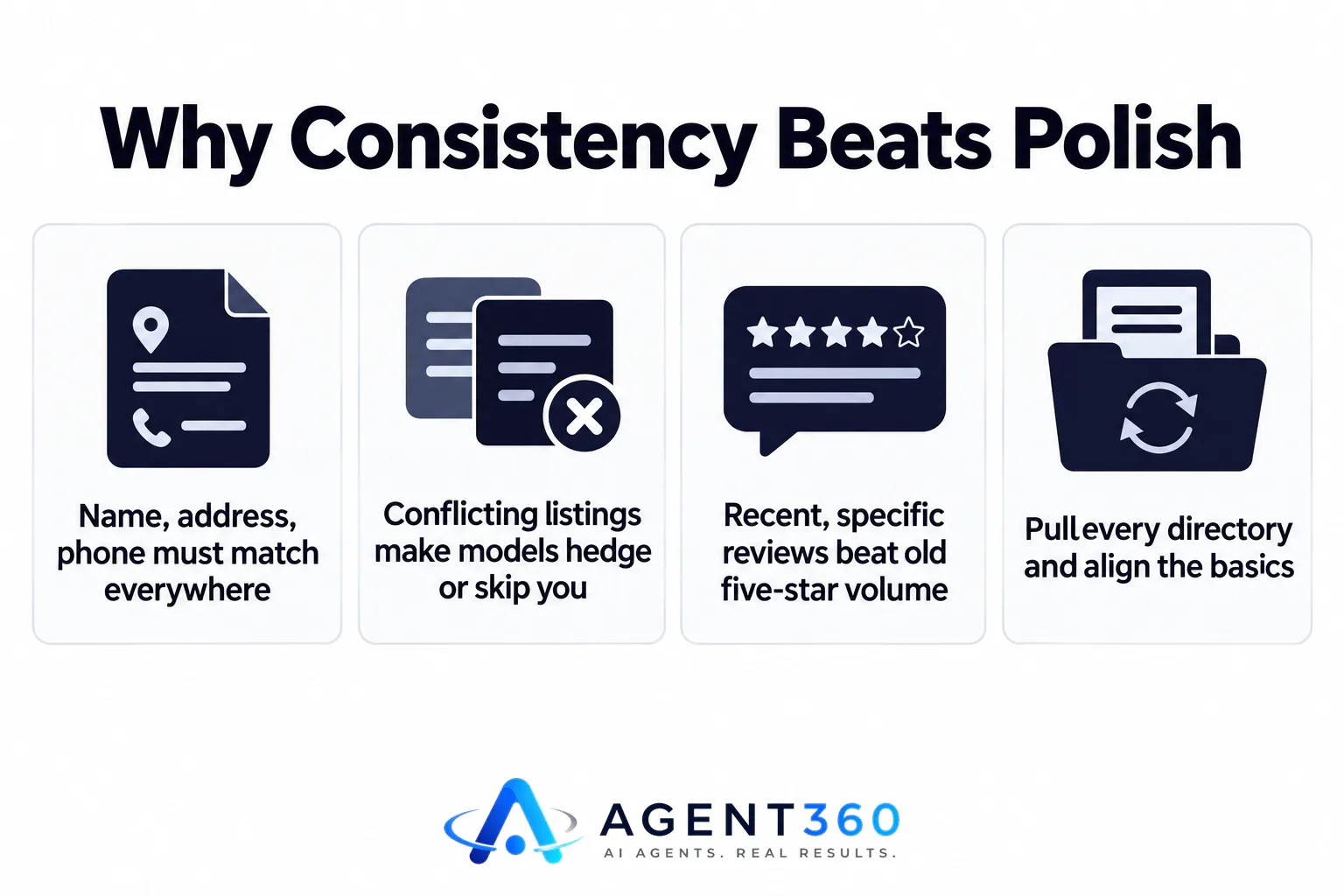
Reviews play into this too, but not the way most owners think. Volume matters less than recency and specificity. A page of five-star reviews from eighteen months ago reads as stale; a steady trickle of recent reviews that name specific services reads as alive and trustworthy — and those specific mentions are exactly the kind of text a model can quote back as a reason to recommend you. If your review flow has gone quiet, timing your ask matters more than the wording of it.
Third-party mentions carry more weight than anything you publish yourself
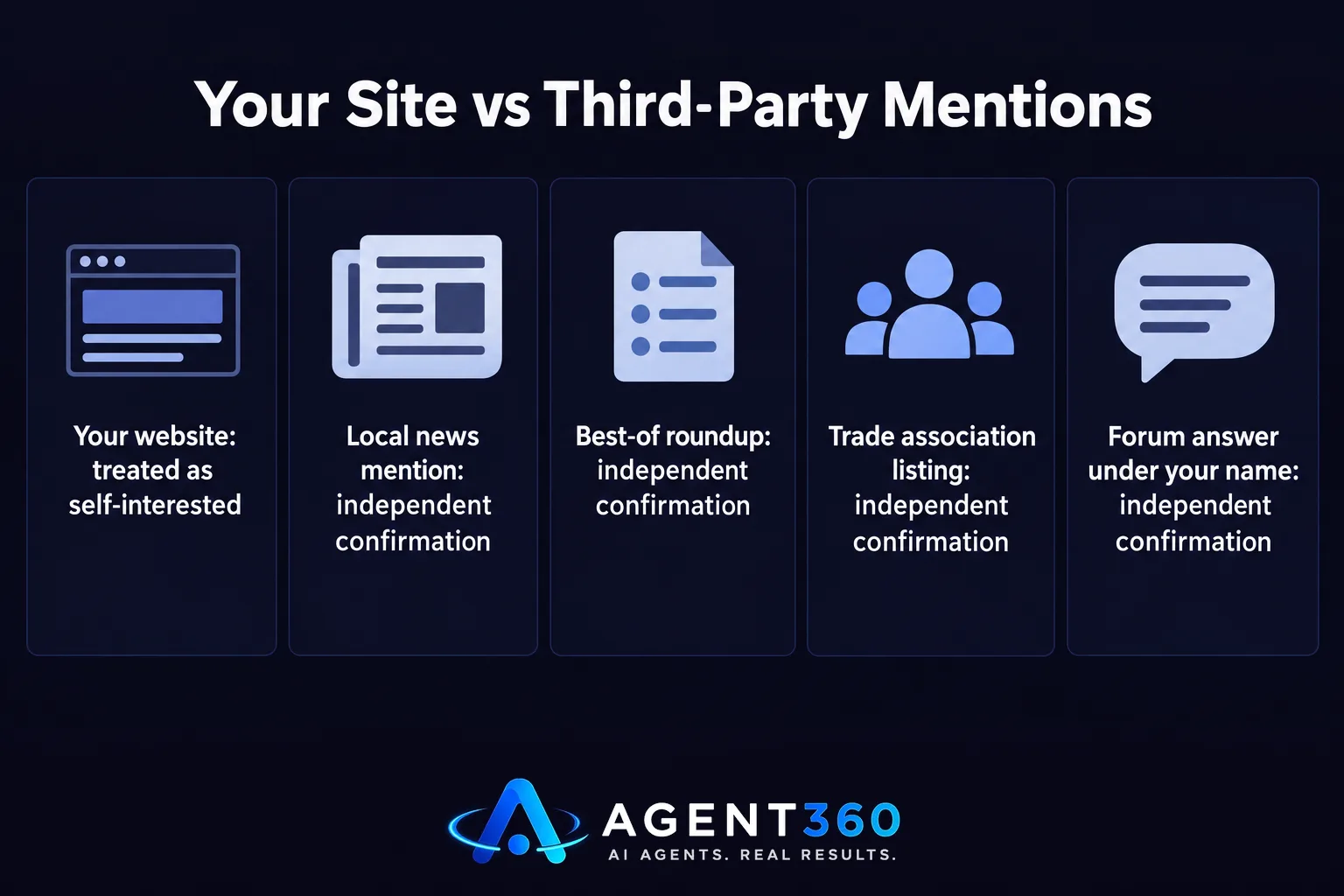
A model treats your own website as an interested party — of course you say you're the best. It treats a local news mention, a “best of” roundup from a city blog, a trade association listing, or a detailed forum answer as independent confirmation, and weighs it accordingly. Most businesses skip this entirely, because it doesn't fit neatly into a marketing checklist. Getting quoted in a local paper, sponsoring something that generates a write-up, answering questions in industry forums under your real business name, or landing in a local guide all do more for AI visibility than another blog post on your own domain.
None of this replaces having good content on your own site. It just means your content's job is slightly different than you might assume: write pages that say plainly what you do, where, and for whom, in language close to how someone would actually ask the question. “Emergency plumber serving [city], available after hours” extracts cleanly into an answer. A paragraph of brand voice about your company's journey does not.
Structured data gets you parsed correctly, not ranked higher
Adding LocalBusiness schema markup to your site — hours, address, service area, price range — won't make you more likely to be chosen, but it does make it more likely that whatever source reads your site gets the facts right instead of guessing. Think of it as making sure the facts about you are machine-readable, not as a lever you can pull to climb a list. It's cheap to add, there's no real downside, so it belongs on the list. Just not at the top of it.
Check this monthly, the same way you'd check rankings
Pick the three or four questions your actual customers would type into ChatGPT — “best [service] in [city],” “[service] near me open now,” “who should I call for [specific job]” — and ask them yourself, monthly, the same way you'd check a Google ranking. Note whether you're named, who is instead, and what sources the answer cites. That citation list tells you exactly where to focus next: if a competitor keeps getting pulled from a directory you're not listed on, that's your next afternoon of work.

Where Booked fits into this
AEO and GEO work — getting chosen as the answer in AI Overviews and getting named by tools like ChatGPT — is part of every plan at Booked, alongside standard SEO and local SEO, because the two now run together in practice. It's handled inside the broader get found work: Google Business Profile, directory consistency, and review flow included, not sold as a separate add-on.
Questions worth asking before you start
Does ChatGPT use Google rankings to decide who to recommend?
Not directly, but the two overlap heavily because both are reading the same underlying sources — your Google Business Profile, review sites, and directories. A business that's invisible in local search is usually invisible to AI tools for the same reasons.
How long does it take to get recommended by ChatGPT?
There's no published timeline, because the companies behind these tools don't disclose how often they refresh their retrieval results. Treat it the way you'd treat local SEO: fix the foundational signals, check monthly, and expect gradual movement rather than a fast flip.
Do I need to pay ChatGPT or Google to be listed as a recommendation?
No. Being named in a conversational answer is earned through the sources described above, not purchased. Paid ads on Google and Meta are a separate channel entirely, covered under paid lead generation, and they don't influence whether an AI tool recommends you organically.
More articles
- How to Get Found on Google Maps, Not Just Listed
- Website For Small Business: Builder, Cost, Or Done-For-You
- Google Ads for Local Business: What a Real Budget Looks Like
- How to Get More Google Reviews: Timing Beats Begging
- Missed Call Text Back: What To Send And Why It Works
- AI Receptionist for Small Business: What It Costs and Does
- Fitness Studio Marketing: Why the 3-3-3 Rule Falls Short
- Real Estate Agent Marketing: What Actually Gets You Clients
