Do SDR Agencies Offer Flexible or Custom Engagement Terms?

Yes, most SDR agencies will offer flexible or custom terms — but how far they bend depends on their model. Agencies that staff dedicated reps tend to negotiate scope, channel mix and contract length more freely than shops selling a fixed, packaged service. Get it in writing before you sign. “Flexible” means something different at every agency.
If you're a founder running your own outbound, or a staffing agency owner trying to add client meetings without hiring a BD team, the terms you negotiate matter just as much as the meeting count an agency promises. Here's what usually bends, what doesn't, and what to check before you commit a budget line to it.
Key Takeaways
- Scope, channel mix, and contract length are the parts of an SDR engagement that agencies most often customize.
- Pricing model and exit terms are where flexibility tends to disappear, so read those clauses closely.
- A month-to-month or short-term pilot is a reasonable ask from almost any SDR agency worth hiring.
- Compare a managed agency against running outbound in-house on a platform like Agent360's outreach tools before you commit to a long contract.
- Check the fine print on lead ownership and data portability before any engagement ends.
Table of Contents
What Is an SDR in B2B?
An SDR, or sales development representative, is the person or function responsible for finding and qualifying prospects before they reach a closer. In B2B, SDRs work the phones, inbox and LinkedIn — booking meetings for account executives or founders rather than closing deals themselves. Some companies hire SDRs in-house. Others outsource the function to an agency, or run it through software instead.
What Is SDR in BPO?
Inside a BPO arrangement, SDR work usually means a third-party call center staffs reps who follow a script and chase volume targets — often across several clients at once. A dedicated SDR agency works differently: reps (or AI-assisted workflows) are typically assigned to fewer accounts, with messaging built around your ideal customer profile. If an agency's SDR function sits inside a bigger BPO operation, ask directly how dedicated the reps really are, and how much of their day goes to other clients.
What Is SDR Outsourcing?
SDR outsourcing means paying an outside firm to run prospecting and outbound for you, instead of hiring and managing that function in-house. The firm handles list building, messaging, sequencing and booking meetings, then hands you the qualified conversations. It's an alternative to hiring SDRs as employees — the tradeoff is less day-to-day control.
Outsourcing looks different depending on the model. Some firms sell a fully managed service with a dedicated strategist. Others sell access to a platform you run yourself, with support on the side. Each model carries its own level of flexibility — which is really the question behind “do SDR agencies offer flexible terms.”
Do SDR Agencies Offer Flexible or Custom Engagement Terms?
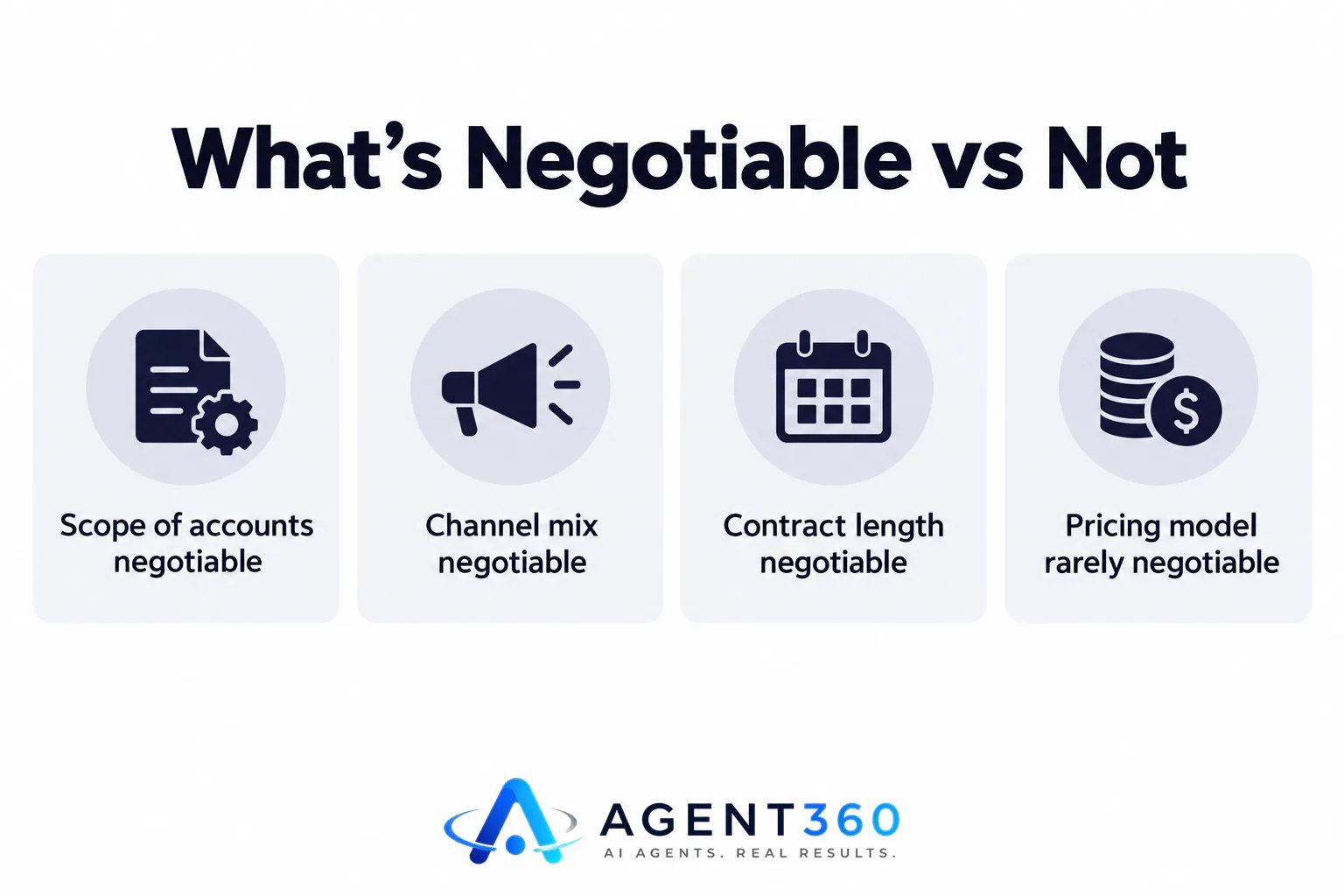
Most SDR agencies will customize scope, channels and timeline, but fewer will customize pricing structure or exit terms without pushback. The easiest things to negotiate are usually the things that cost the agency little to change: how many target accounts you cover, which channels you use — email, LinkedIn, calling — and how long the initial term runs. What's hardest to move is the pricing model itself, and what happens to your data once the contract ends.
What Terms Are Usually Negotiable?
Scope of accounts, industry focus, messaging cadence and pilot length are the terms agencies negotiate most readily — none of them change how the agency gets paid. Contract length moves too. Many agencies will start with a 30 to 90 day pilot before asking for a longer commitment. Ask for that upfront. Don't assume it's on offer.
- Ask for the pricing model in writing. Retainer, per-meeting, hybrid or flat monthly fee — each shifts risk differently between you and the agency.
- Ask what happens to your lead and prospect data if you leave. Some agencies retain lists and sequencing history; others hand everything over.
- Ask for a defined pilot period before a long-term commitment. A firm confident in its process should be comfortable proving results in a short window first.
- Ask who owns the messaging and sequences. If the agency built your email and LinkedIn copy, confirm you keep rights to reuse it elsewhere.
- Ask about exit notice. Thirty days' notice is common; anything longer locks you in past the point where you'd want out.
For the clauses worth reading closely before you sign, see what to check before you sign an SDR outsourcing contract. And if long-term lock-in is the thing keeping you up at night, this breakdown of whether outsourced SDR firms require long-term contracts covers it directly.
What Should You Compare Before Choosing an Agency?
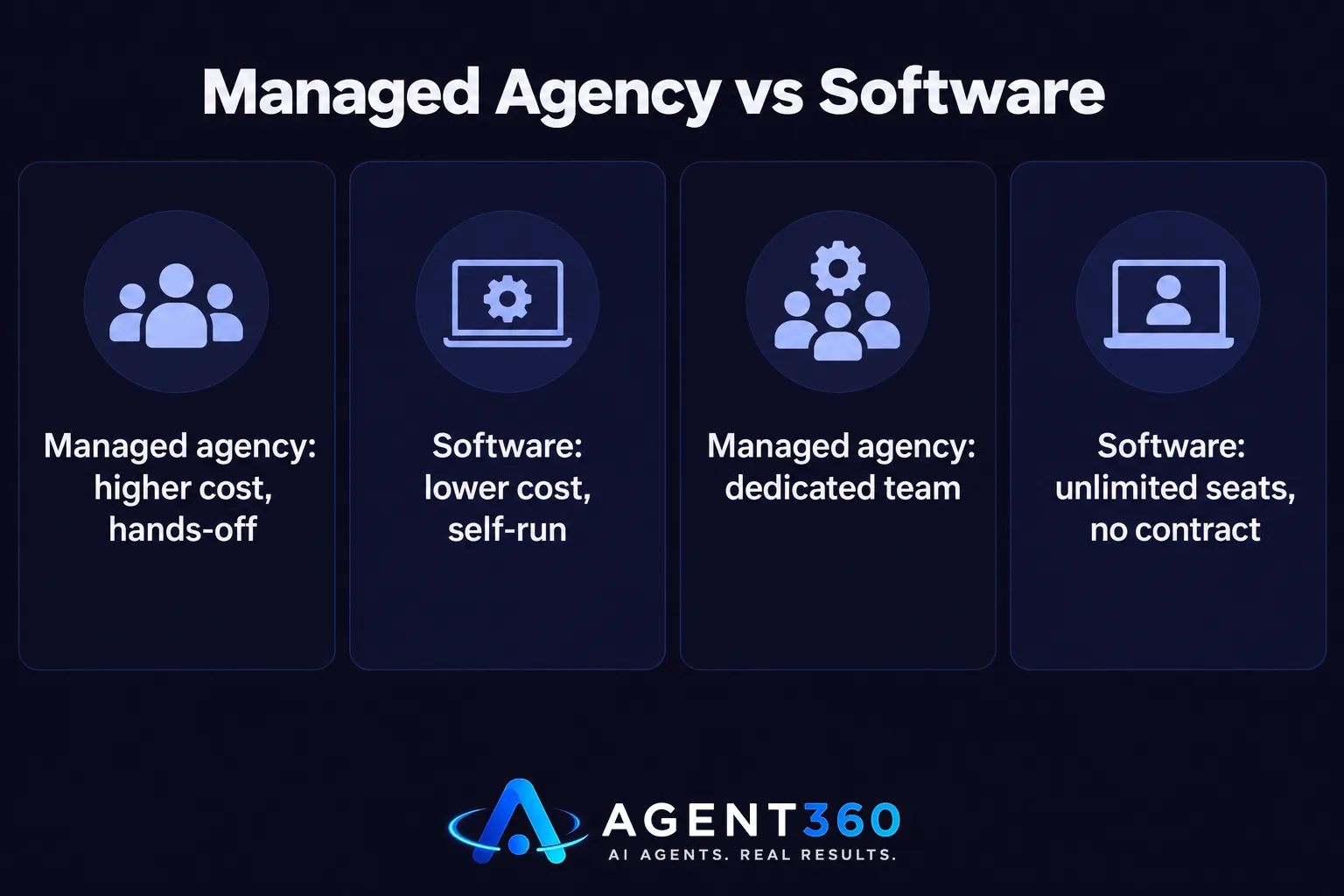
Compare how each option prices its commitment: a fully managed agency with a dedicated team, versus software you run yourself with support. A managed agency usually costs more per month, but it takes day-to-day management off your plate entirely. Software-led outreach costs less — but it assumes someone on your team, or you directly, is actually running the sequences.
Is Software a More Flexible Alternative?
Running outbound on a platform you control is, by definition, as flexible as your own calendar — there's no agency contract to negotiate in the first place. The tradeoff: you or someone on your team has to build the lists, write the sequences and manage the replies. The comparison between SDR agencies and outbound software lays out that tradeoff in more detail, if you're weighing the two paths.
Choose the Terms That Match Your Stage
Want a dedicated team running outbound end to end? Agent360's VIP Done-For-You Outbound starts at $2,000 a month plus $250 per booked meeting, with a GTM engineer and strategist handling the work while you take the meetings. Prefer to keep outbound in-house without building the stack yourself? The Agent360 Platform starts at $99 a month — unlimited seats, no per-user fees, a lead and LinkedIn sequencer, a parallel dialer, a CRM, and one triple-verified lead included for every email you send.

Both options skip the long, rigid contracts that make some SDR agencies a poor fit for a growing team. Check current terms and pricing on the pricing page, or book a demo and ask about scope and contract length before you commit to anything.
Frequently Asked Questions
What is an SDR in B2B?
An SDR — sales development representative — finds and qualifies prospects through outbound email, LinkedIn and calls, then hands the qualified conversations to a closer instead of closing deals themselves.
What is SDR in BPO?
Inside a BPO arrangement, SDR work is usually handled by reps splitting their time across several clients under one outsourcing operation — different from a dedicated agency, which assigns reps mainly to your account.
What is SDR outsourcing?
SDR outsourcing is hiring an outside firm to run prospecting and outbound on your behalf instead of employing SDRs directly — you trade some day-to-day control for less management overhead.
Can I pause an SDR engagement instead of canceling it?
Some agencies will write in a pause clause for slow seasons or budget gaps, but it's not standard. Ask for it explicitly in the contract — don't assume it's there.
Do shorter contracts cost more per month?
Often, yes — agencies price in the risk of a short commitment. But a shorter term can still cost less overall if it lets you walk away from a poor fit quickly.
What is the difference between a managed agency and running outbound myself?
A managed agency assigns people to run outbound for you under contract. Running it yourself means using a platform like Agent360's outreach tools and controlling the lists, sequences and timing directly.
More articles
- Clay vs LeadSwift: Which Fits Your Outbound Job?
- Local SEO Checklist: What to Fix First, in Order
- Agent360 vs Belkins: a fair, side-by-side comparison
- Best done-for-you marketing package for local service businesses?
- How to Get Your Business Mentioned in Google AI Answers
- Who Should You Use for Done-For-You Auto Shop Marketing?
- What's a White Label GEO Agency and Who Offers It?
- The Best Marketing Strategy for an Auto Repair Shop
