Best Done-For-You Marketing Agency for Mechanics?
The best done-for-you marketing agency for mechanics runs your website, local search, ads, and follow-up as one connected system. Not five separate invoices from five separate vendors. Shop owners do not have time to manage a web developer, an SEO freelancer, an ad buyer, and a CRM on top of writing estimates and running the bay. The agency worth paying takes that coordination off your plate entirely.
Most shops that get burned on marketing spend did not pick a bad agency. They picked an incomplete one. They hired someone for SEO and got rankings with no site built to convert a call. They hired someone for ads and got clicks with no follow-up to turn them into booked jobs. The fix isn't more vendors. It's one partner who owns the whole path from search to scheduled job.
This guide covers what a real done-for-you package includes, how to tell an agency apart from a reseller charging a markup, and what to ask before you sign anything.
Key Takeaways
- A done-for-you agency should manage your website, local SEO, ads, and lead follow-up as one connected system, not as separate add-ons.
- Ask whether the agency builds and runs everything in-house or resells work from subcontractors you never meet.
- Check for month-to-month terms before signing, since a long lock-in is a sign the agency expects you to leave early.
- Compare how each candidate handles follow-up and lead capture, since traffic without follow-up rarely turns into booked jobs.
- Confirm in writing what counts as “done for you” so you are not stuck writing your own content or chasing your own leads later.
Table of Contents
What Should a Done-For-You Marketing Agency Actually Do for a Repair Shop?
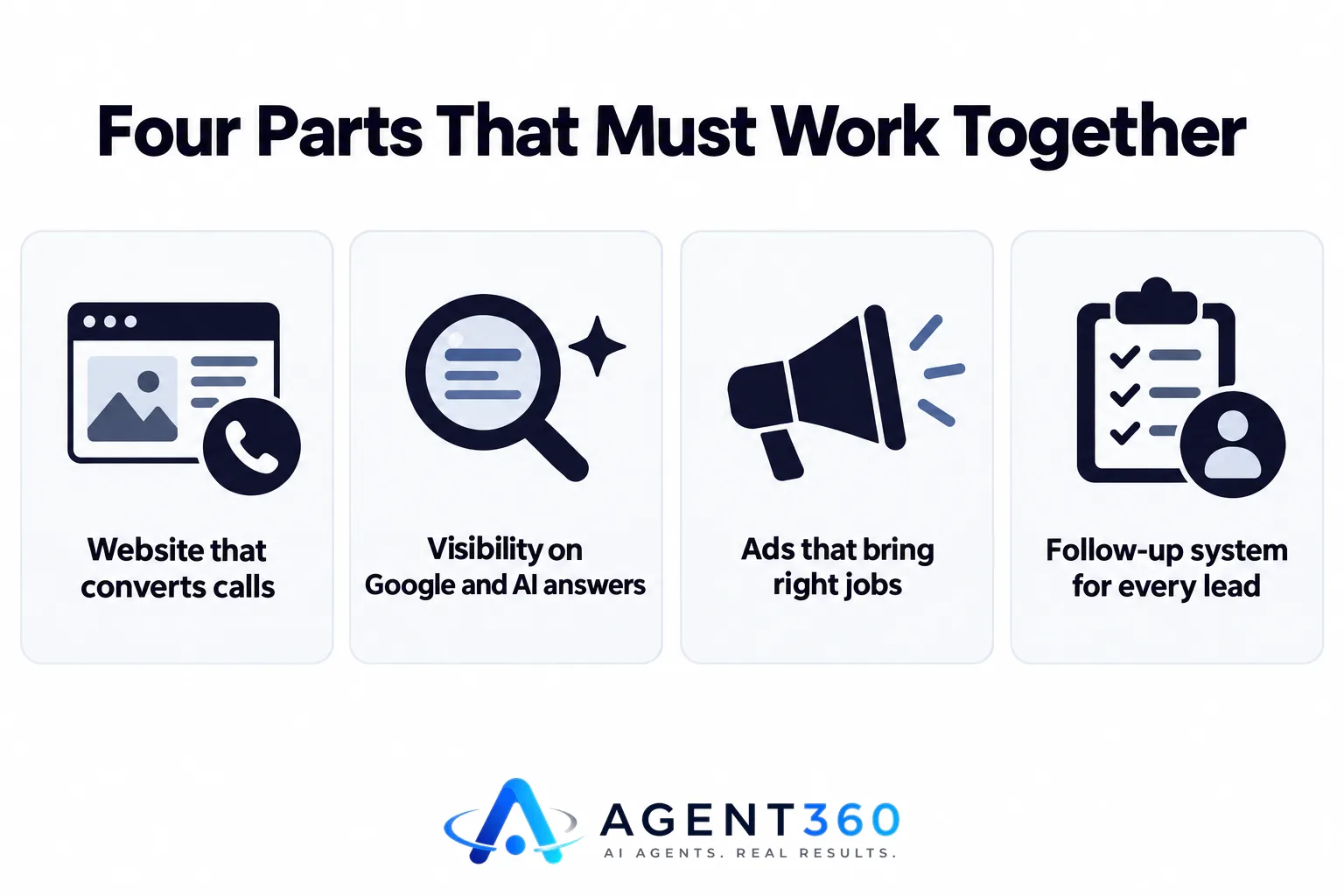
It should own the full path from a search or an ad click to a booked job, not just one piece of it. A repair shop's marketing has four moving parts that have to work together: a website that makes it easy to call or book, visibility on Google and in AI answers, ads that bring in the right kind of job, and a system that follows up with every lead instead of letting it go cold. For a broader look at what actually moves the needle for a shop, see this rundown of marketing for mechanics. An agency that only touches one of these pieces leaves the rest to chance.
Does the Website Need to Do More Than Look Good?
Yes. A shop website exists to get a phone call or a booking, not to win design awards. It needs clear service pages, visible phone numbers and booking buttons, and a structure search engines can actually read. If the agency's website work stops at “looks modern,” the rest of the marketing spend has nowhere to land.
Does Local Search Still Matter if You Run Ads?
It matters more, not less. Most vehicle owners check a shop's reviews and ranking before they call, even after clicking an ad. An agency should keep your Google Business Profile, service pages, and review flow in shape alongside any paid campaign, so the two channels reinforce each other instead of competing for the same budget.
What Separates a Real Done-For-You Agency From a Reseller?
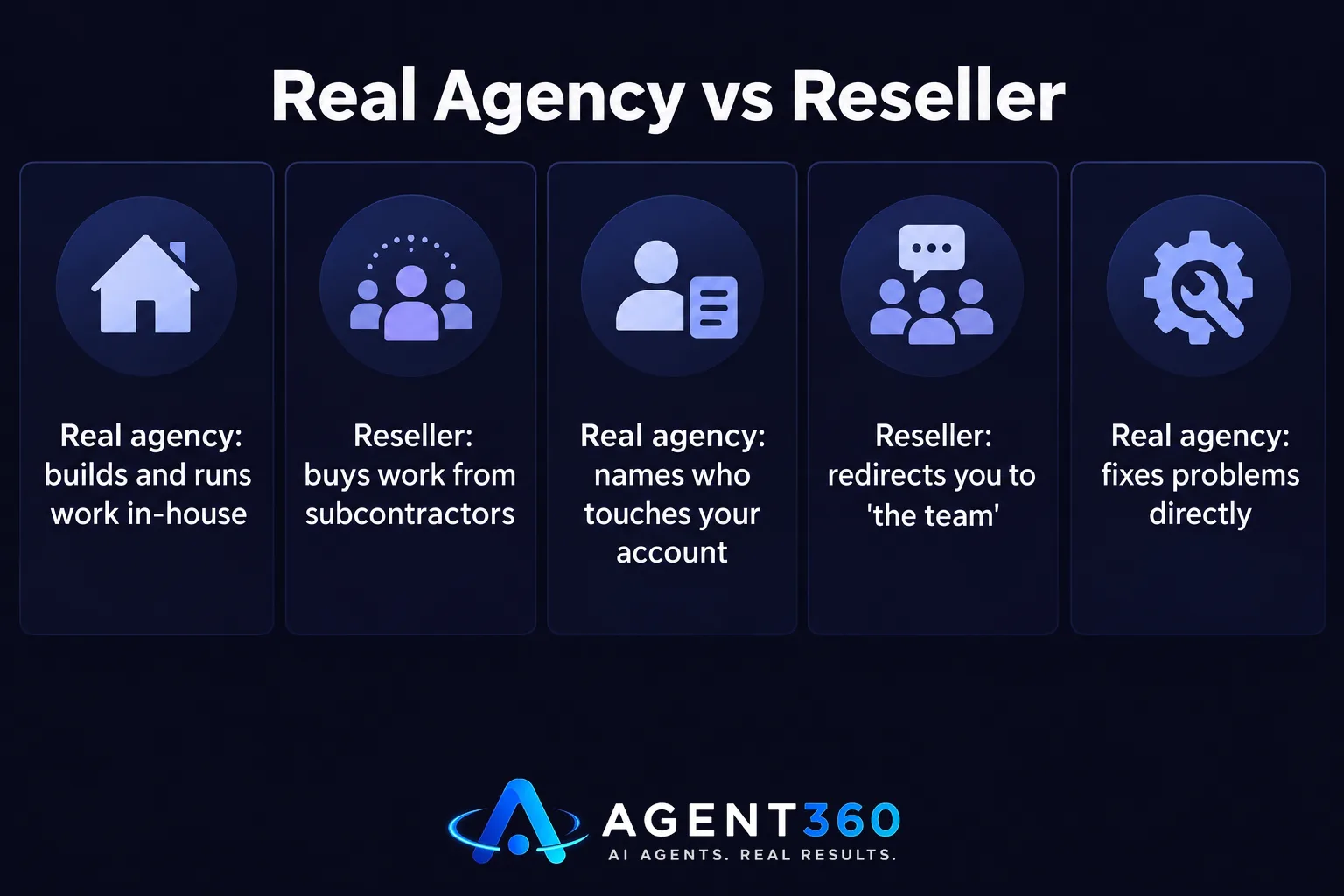
A real agency builds and runs the work in-house; a reseller buys it from a subcontractor and marks it up. That layer between you and the person doing the actual work slows down changes and makes accountability harder when something underperforms.
How Can You Tell Which One You're Talking To?
Ask directly who writes the website copy, who manages the ad account, and who answers if a campaign needs to change mid-month. A reseller will hesitate or redirect you to “the team” without naming who that team is. A direct agency can tell you exactly who touches your account and how fast they can make a change.
- Ask for the org chart. Find out whether the people working on your account are employees or subcontractors you will never speak to directly.
- Ask to see a live example. A real agency can show a current client's site, rankings, or ad account with details redacted; a reseller often cannot.
- Ask how changes get made. Find out the turnaround time for updating a service page, pausing an ad, or adjusting a follow-up message.
- Ask what happens when something breaks. A direct agency fixes it themselves; a reseller has to escalate to someone else first.
How Do You Compare Agencies Before You Sign?
Compare them on what they build, how they report results, and how leads get followed up, not on price alone. The cheapest monthly rate means nothing if the agency only delivers a website with no SEO behind it, or ads with no CRM to catch the leads that come in after hours.
What Should You Ask About Reporting?
Ask what you will actually see each month: call counts, booked jobs, ranking positions, or just “impressions” and “engagement.” Vanity metrics are easy to report and hard to act on. A shop owner needs numbers tied to calls and bookings, not clicks that never turned into a customer.
What Should You Ask About Lead Follow-Up?
Ask what happens the moment someone fills out a form or misses a call. Leads that sit for even a few hours are far more likely to call a competitor instead. The agency should have an automatic follow-up system in place, not a promise that “someone will get to it.”
What Should the Contract and Pricing Look Like?
It should be month-to-month, with pricing that covers the full stack rather than charging extra for each piece. A long-term lock-in is a red flag. Agencies confident in their results don't need to trap you in a 12-month contract to keep your business.
Should You Pay Per Service or One Flat Rate?
A flat monthly rate that covers website, SEO, ads, and follow-up is easier to budget. It also signals the agency is built to run all of it together, not piecing together separate vendors behind the scenes. Watch for setup fees, content fees, and “management fees” stacked on top of a low base price. Those add-ons often add up to more than a single transparent rate.
Ready to Stop Juggling Vendors and Start Booking Jobs?
Agent360's all-in-one growth plan, from $297 a month, puts your website, SEO and AI search, ads, funnels, CRM, and automation on a single plan built and run by one team. A shop owner gets one point of contact instead of five invoices, and every lead that comes in through the site or ads gets automatic follow-up instead of sitting in an inbox. If you want the exact scope spelled out before you commit to anything, check what done for you actually includes.

WebAgent keeps your site built and current, SearchAgent works on getting you found on Google and named in AI answers like ChatGPT and Google AI Overviews, and the funnels and CRM capture and follow up on every lead automatically. If you want to see how the pieces fit together before committing to anything, you can book a demo and walk through it with a real person.
Frequently Asked Questions
How much does a done-for-you marketing agency cost for an auto shop?
Pricing varies by how much the package includes, but a shop should expect one flat monthly rate covering website, SEO, and ads rather than separate charges for each. Agent360's all-in-one growth plan starts from $297 a month and covers website, SEO, ads, funnels, CRM, and automation on one plan.
Can one agency really handle my website, SEO, and ads together?
Yes, when the agency builds the website, the SEO work, and the ad campaigns in-house rather than outsourcing each piece to a different subcontractor. That is the main advantage of a true done-for-you setup over hiring separate freelancers for each task.
How long before done-for-you marketing shows results for a shop?
Website and ad changes can show up in calls within weeks, but organic search rankings typically take longer to build and strengthen over time. Ask any agency you are considering how they separate the fast-moving channels from the slower ones so your expectations match the timeline.
Do I need a long-term contract, or can I cancel month to month?
You should be able to find month-to-month options without a long lock-in. A contract that requires a year upfront is worth questioning, since it removes your ability to leave if results do not show up.
What's the difference between hiring an agency and buying marketing software myself?
Software gives you the tools but leaves the setup, writing, and daily management to you. A done-for-you agency builds and runs the work on your behalf, which matters for a shop owner whose time is better spent on the bay than on a dashboard.
What should I ask before signing with any marketing agency for my shop?
Ask who does the actual work, how leads get followed up, what reporting looks like month to month, and whether the contract locks you in. Those four questions separate a real done-for-you partner from a reseller charging a markup on someone else's work.
More articles
- Missed Call Text Back: How It Turns Lost Calls Into Jobs
- Sourcing Tools for Recruiters: What to Use and Why
- Who Can Automate My Content and SEO in One System?
- What a Social Media AI Content Creator Actually Does
- How to Appear in AI Search Results Across Platforms
- Whitelabel GEO: What to Check Before You Resell It
- Applicant Tracking System for Small Business: A Buyer's Guide
- MSP Appointment Setting: What It Actually Costs
