Agent360 vs Clay: A Fair, Side-by-Side Comparison
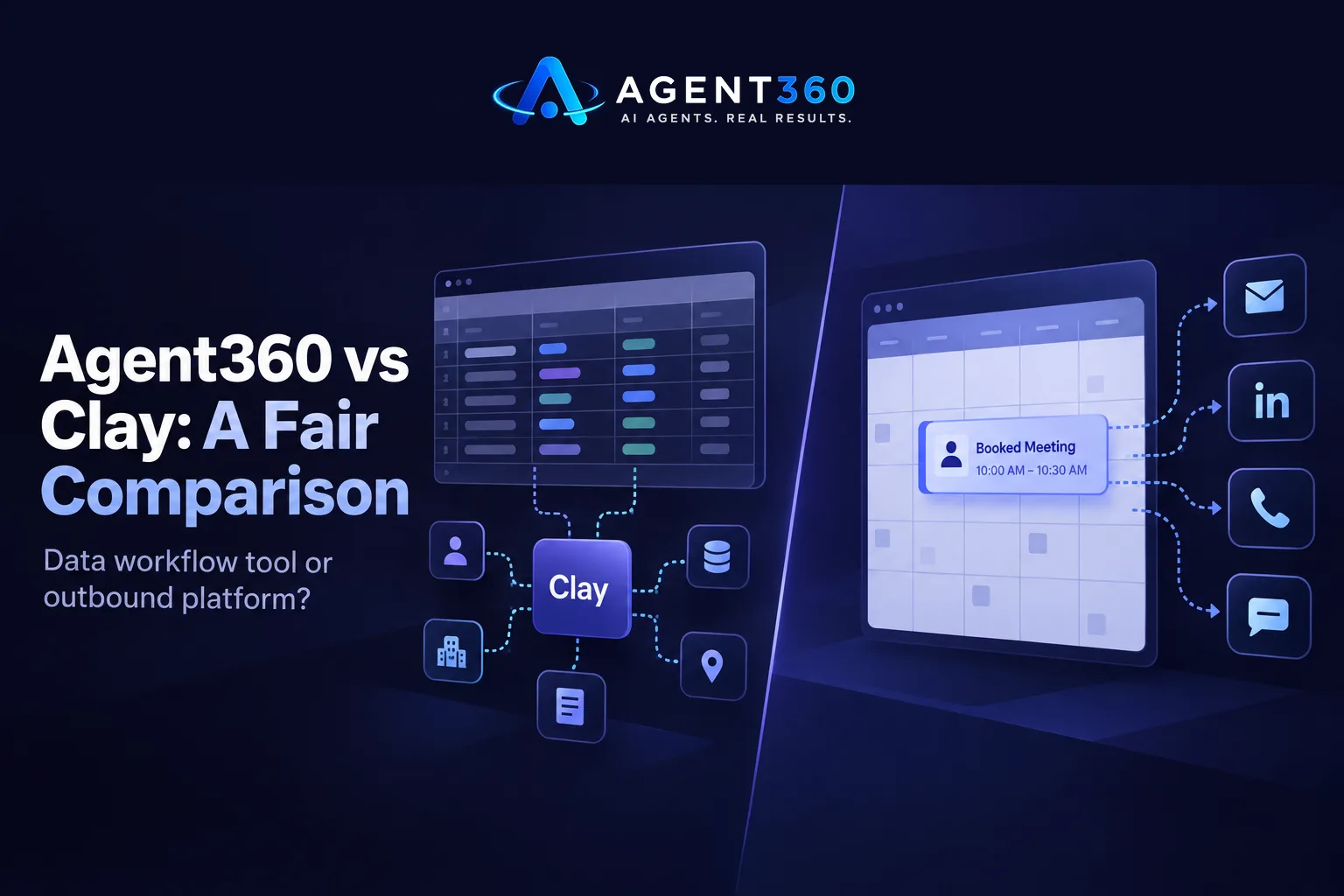
Agent360 vs Clay comes down to one question: do you want to build your own data and outreach workflow, or do you want a system that finds buyers, reaches them, and books meetings for you? Clay is a data enrichment and research tool. You wire up data providers and AI prompts inside a spreadsheet-style interface to build custom lead lists. Agent360 is an outbound platform that finds buyers, detects buying signals, sends outreach across LinkedIn, email and phone, and books the meeting on your calendar.
Both tools touch the top of your pipeline. They are not solving the same problem. This comparison breaks down where each one fits, so you are not paying for workflow-building power you will never use, or buying a sending tool when what you actually need is enrichment infrastructure.
Key Takeaways
- Clay is built for teams that want to design custom data and enrichment workflows, column by column.
- Agent360 is built for teams that want outreach running without building anything first, using AI prospecting and sequencing out of the box.
- Clay does not send multi-channel outreach or book meetings by itself; it typically feeds other tools.
- Agent360 includes unlimited seats on every plan, so cost does not climb as your team grows.
- Staffing and recruiting firms that need client meetings, not just lead lists, usually need the sending and booking layer Clay does not provide.
Table of Contents
What's the core difference between Agent360 and Clay?
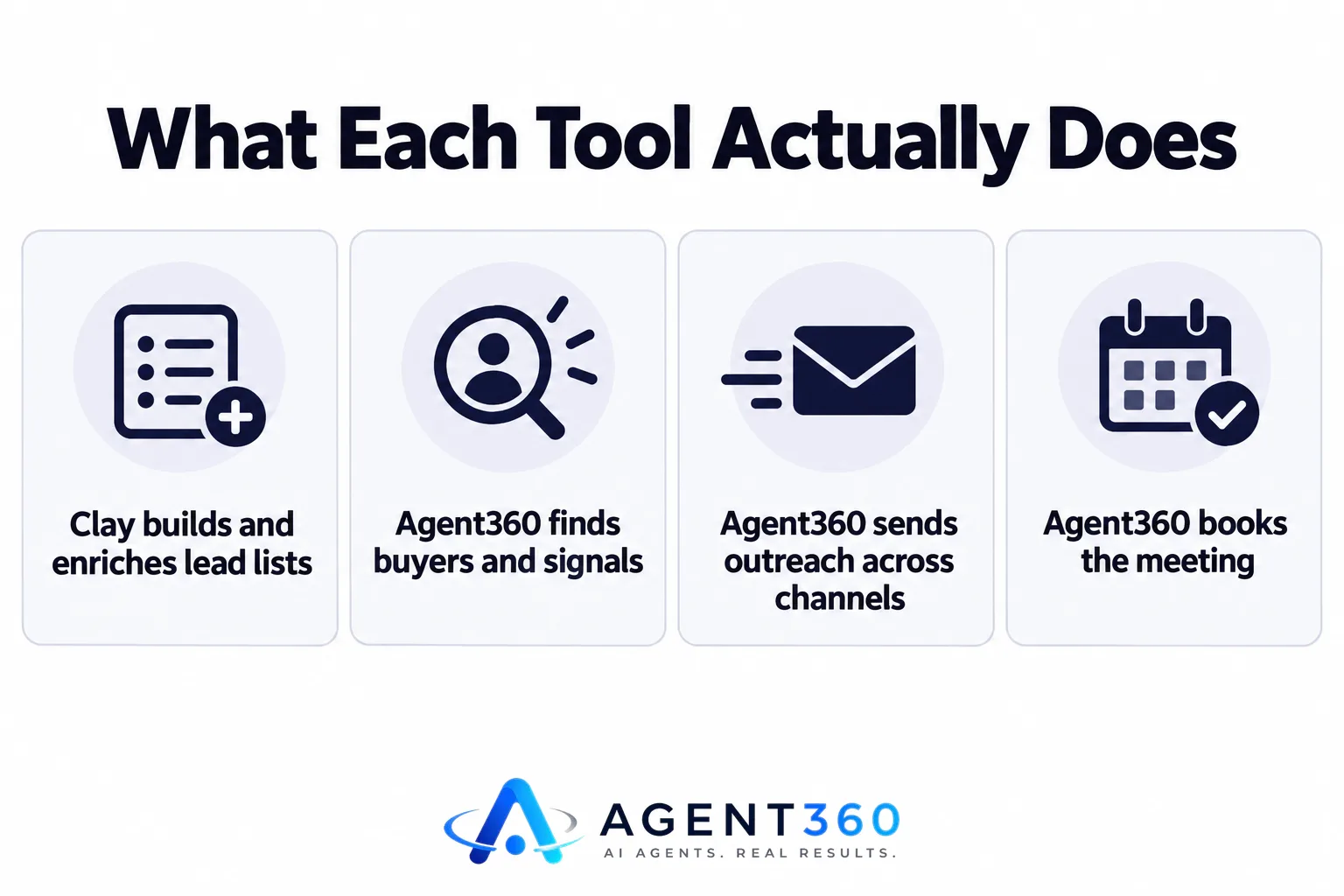
Clay builds and enriches lead lists; Agent360 finds buyers, contacts them, and books the meeting. Clay's strength is its enrichment waterfall: you connect multiple data providers and AI research steps to build a precise, custom list, row by row. That list still needs to go somewhere to actually produce conversations. Agent360 starts from the other end: it finds your ideal buyers, watches for buying signals, and runs the outreach sequence across channels, so the output is a booked meeting, not a spreadsheet.
Does Clay send outreach on its own?
Clay is not a sending platform by design. Most Clay workflows export or push enriched records into a separate email or LinkedIn tool to actually make contact. That means a Clay setup typically requires stitching together at least two systems before a single message goes out.
Does Agent360 replace the need for a separate data tool?
Yes, for most outbound use cases. Agent360 includes AI prospecting and one triple-verified lead for every email sent, so finding and verifying contacts is part of the same system that sends the message and books the meeting, with no separate enrichment step to manage.
Which one fits a founder running outbound alone?
A founder with no SDR and limited time usually needs fewer moving parts, which points to Agent360. Clay rewards teams with the time and technical patience to design a workflow before any outreach begins. A solo founder trying to fill pipeline this week does not have that runway. Agent360's platform starts at $99/mo with leads included and a sequencer and dialer already built, so outreach can start the same week instead of after a build phase.
What if a founder wants someone else to run it?
That is what the Done-For-You option is for. At $2,000/mo plus $250 per booked meeting, a dedicated GTM engineer and strategist run outreach end to end and the founder just takes the meetings, which removes the workflow-building step entirely.
Which one fits a staffing or recruiting agency?
Agencies selling to hiring managers need booked meetings, not just enriched contact records, which favors Agent360. A recruiting firm's growth problem is rarely a lack of data on who the hiring managers are. It is the time cost of reaching out consistently while recruiters are busy filling roles. Clay can sharpen a target list, but it still leaves the agency building and running the outreach itself. Agent360's multi-channel outreach and meeting booking handle that layer directly, so new client conversations show up on the calendar without adding headcount to business development.

Can a staffing firm use Clay and still get meetings booked?
Only by adding a separate sending tool and a calendar workflow on top of Clay. That is a workable setup for a team with an ops person to maintain it, but it adds steps an agency focused on filling roles may not want to own.
What does each one cost to run?
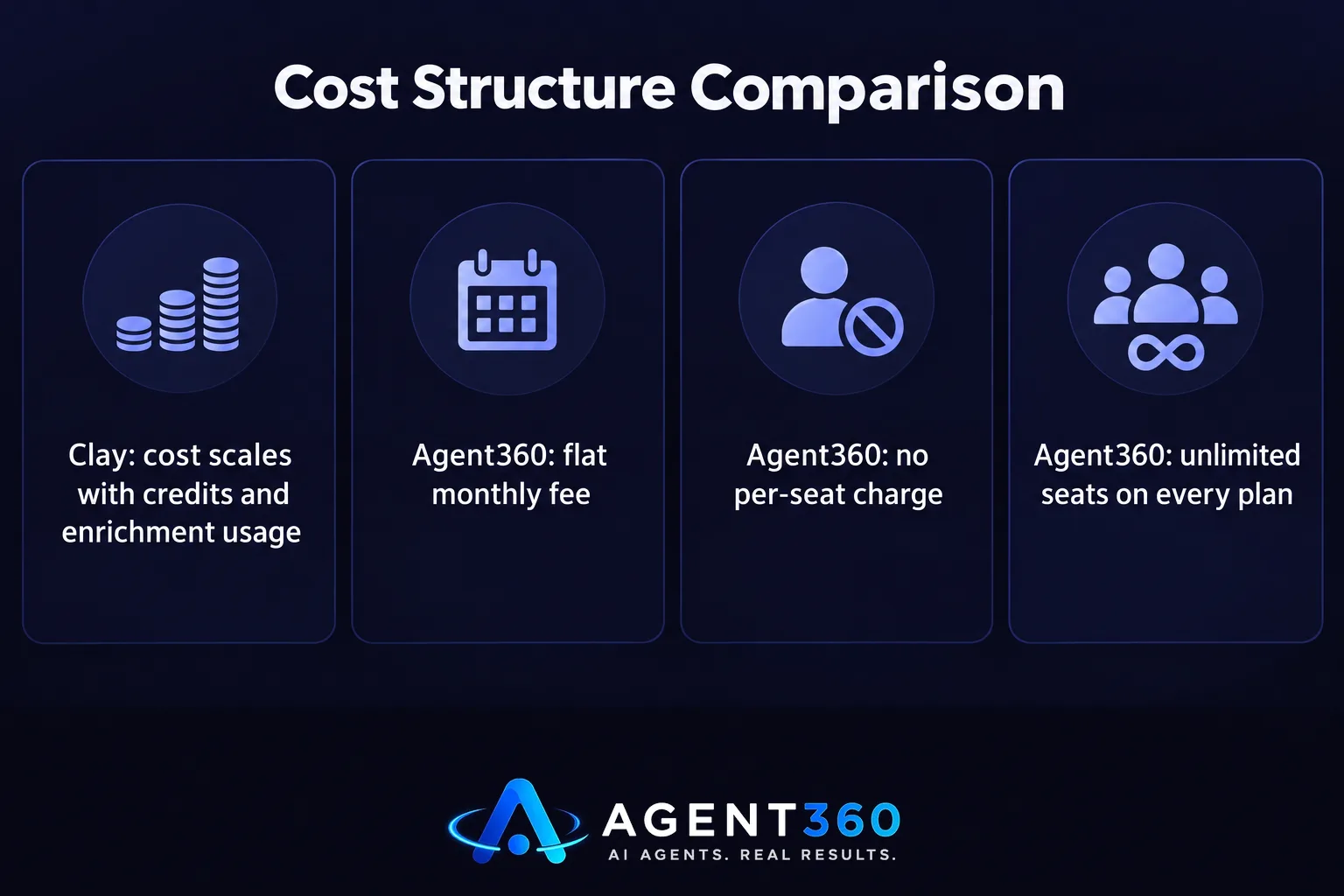
Clay's cost scales with enrichment and credit usage; Agent360's cost is a flat monthly fee with no per-seat charge. Clay pricing is tied to credits consumed by data providers and AI steps, so cost moves with how much enrichment a workflow performs, and that is worth checking directly on Clay's own pricing page before committing. Agent360 charges per plan, not per person. Unlimited seats are included on every plan, so adding a second or third person to run outbound does not add to the bill.
- Check how many people need access. If more than one person will touch outreach, per-seat pricing elsewhere adds up fast; unlimited seats remove that variable.
- Check how much setup time you can spend before sending. A workflow-building tool needs time invested before results; a ready-to-go platform does not.
- Check whether you want the data layer and the sending layer in one system. Running two separate tools means two bills and two places something can break.
Ready to Start Outreach Instead of Building a Workflow?
Agent360 combines AI prospecting, multi-channel outreach across LinkedIn, email and phone, meeting booking, and CRM tools in one platform, with unlimited seats on every plan and one triple-verified lead included for every email sent. The $99/mo platform is built for teams that want to run outbound in-house without assembling the pieces themselves, and the VIP Done-For-You option runs it end to end for teams that would rather take the meetings than run the sequences.
See how the full process works on the how it works page, or compare the two paths directly before you decide.
Book a demo to see how fast outbound can start without a workflow build.
Frequently Asked Questions
Is Clay a replacement for a sending tool like Agent360?
No. Clay focuses on building and enriching lead lists through connected data providers. It is typically paired with a separate email or LinkedIn sending tool to actually contact prospects, while Agent360 includes prospecting, sending and meeting booking in one system.
Can Agent360 do the kind of custom data enrichment Clay does?
Agent360's AI prospecting is built to find ideal buyers and surface buying signals for outreach, not to serve as an open-ended data workflow builder. Teams that need highly custom, multi-source enrichment logic may still want a dedicated tool for that specific need.
Which one is faster to get running?
Agent360's platform is built to start outreach without a setup phase, since leads, sequencing and a dialer are included from day one. Clay generally requires building the enrichment workflow first, which takes longer before a message goes out.
Do I need technical skills to use either tool?
Clay workflows involve configuring data columns, provider waterfalls and prompts, which suits a technical or ops-minded user. Agent360 is built so a founder or agency owner can run outreach without a technical build step.
Which is better for a staffing agency's business development?
A staffing agency generally needs meetings with hiring managers, not just an enriched contact list. Agent360's outreach and booking layer is built for that outcome directly, while Clay would need to be paired with additional sending tools to get there.
More articles
- Agent360 vs HeyReach: A Fair, Side-by-Side Comparison
- Is Smartlead Better Than Instantly for Cold Email Outreach?
- What's the Best Done-for-You Outbound Agency for Agencies?
- Who Offers Pay-for-Meetings Outbound Without an SDR Team?
- What's the Safest LinkedIn Automation Tool Right Now?
- Best LinkedIn Automation Tool for B2B Lead Generation?
- Expandi vs Heyreach: Which Is Better for Cold Outreach?
- Skylead vs HeyReach: Which LinkedIn Automation Tool Wins?
