Keyword Gap Meaning: What It Is and How to Find Yours
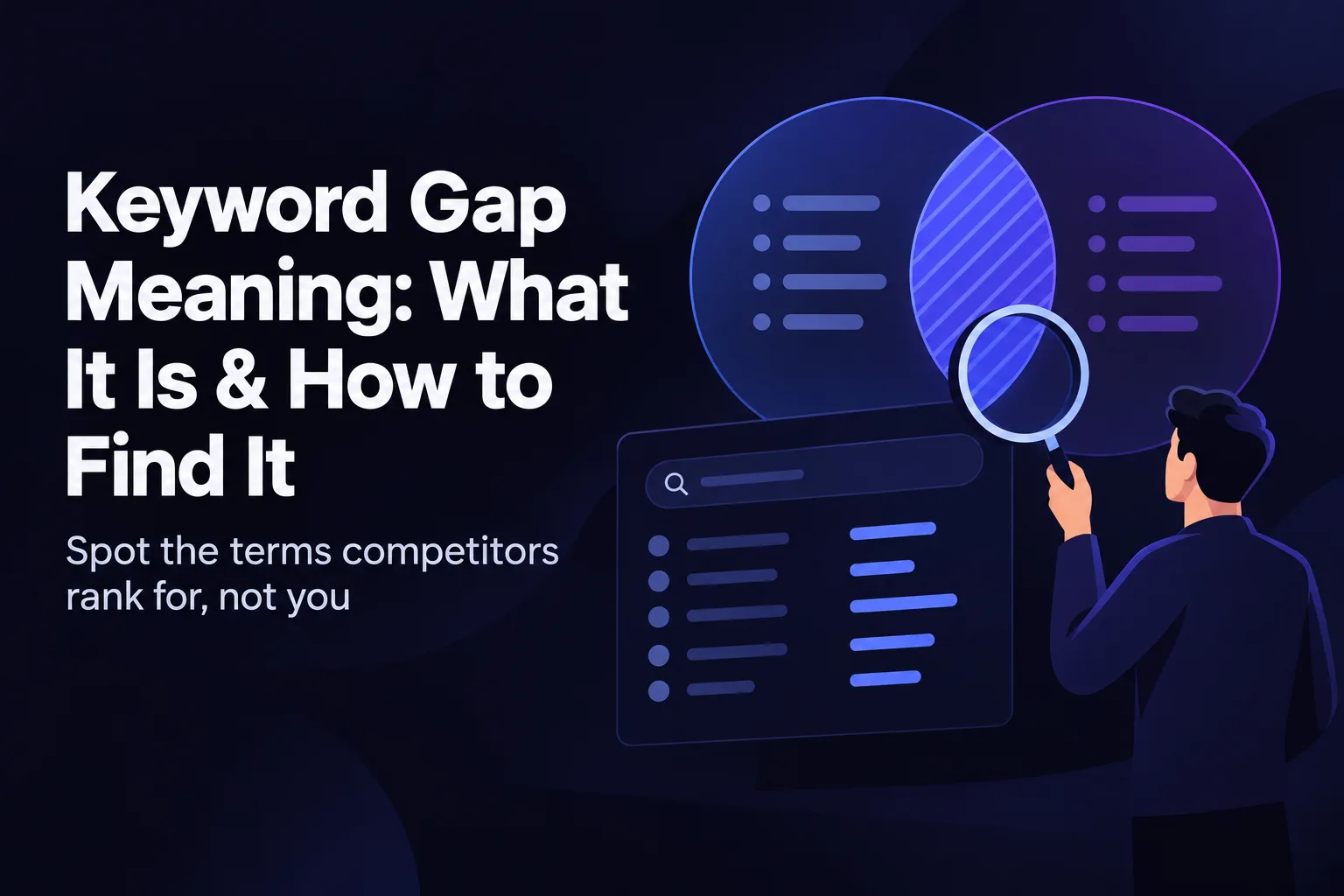
Type “keyword gap meainig” into Google and what you actually want to know is simple: do I have one, and how bad is it? A keyword gap is the set of search terms your competitors rank for on page one that you don't rank for at all, or rank for far below them. It's not some hidden metric. Lay your competitors' ranking terms next to yours, subtract the overlap, and whatever's left is the gap — searches your buyers are already making, where someone else is giving the answer and you aren't.
People mix this up with “content gap” and “search gap,” and honestly the three blur together in practice. A content gap is the page you haven't written. A keyword gap is the specific term that page needs to target. None of it matters unless the term reflects something a real buyer types — which is why checking competitor keywords beats guessing at words that merely sound relevant.
What is a keyword in SEO?
A keyword in SEO is the exact phrase someone types into the search box — not the word you've decided your business is “about.” That distinction matters more than it sounds. A page built around the word “flooring” almost never ranks for “how much does vinyl plank flooring cost per square foot,” because Google reads those as different questions from different buyers at different stages. The pages that perform well target one primary phrase plus a cluster of close variants. Not a single generic noun.
Keywords also carry intent, and that's where most new SEO work goes wrong. The same word means different things depending on context: “quickbooks” is probably navigational, “quickbooks vs xero” is a commercial comparison, “how to reconcile in quickbooks” is informational. Match the page to the intent behind the phrase, not just the phrase itself. That's what separates a page that ranks from one that merely contains the right words.
What are the 16 types of SEO keywords?
There's no official list of 16 anywhere — different blogs slice the same ideas into different counts, which is why one site says 8 and another says 20. What stays consistent is the handful of overlapping axes keywords get grouped along. The labels you'll run into are combinations of these:
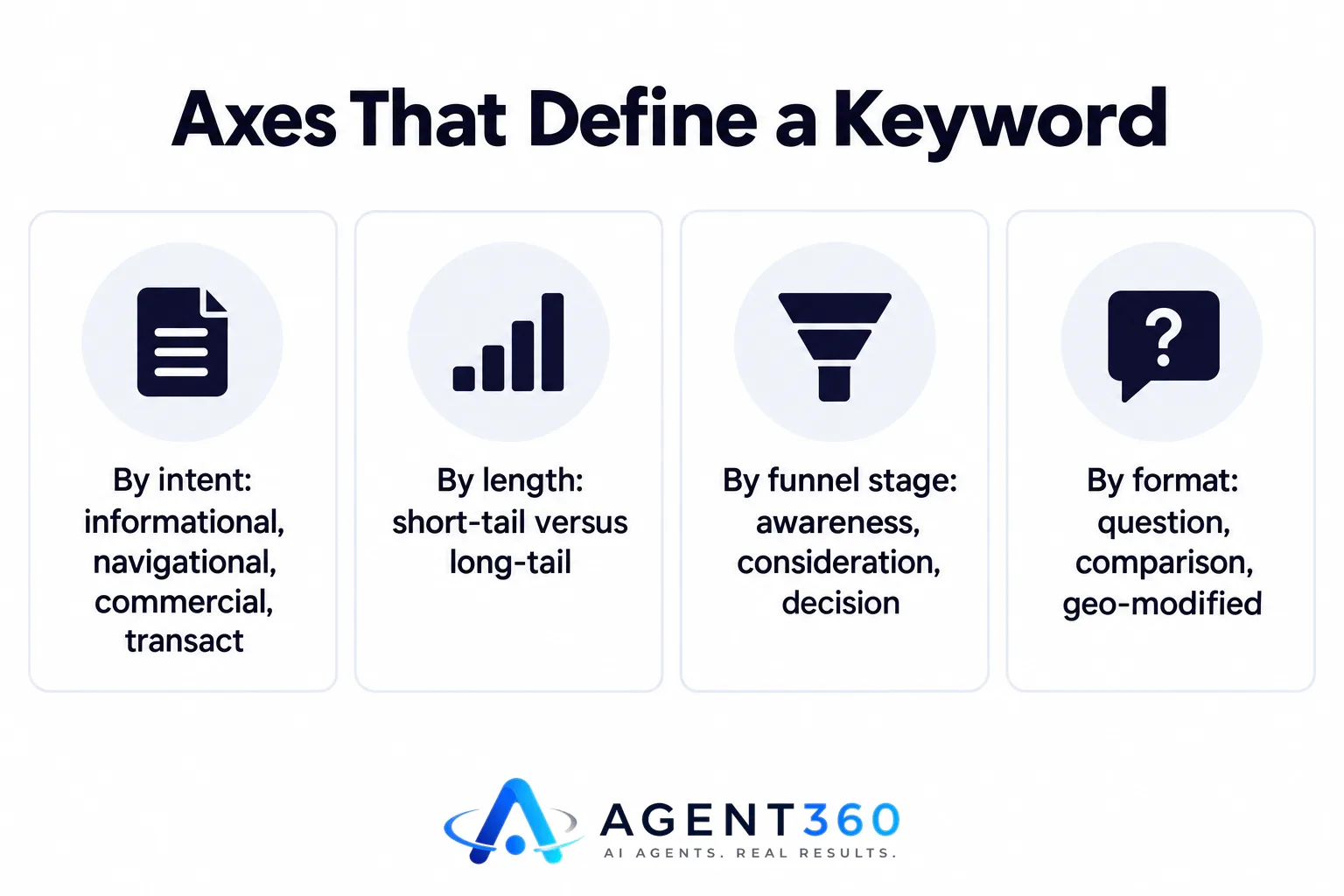
- By intent: informational, navigational, commercial, transactional.
- By length: short-tail (one or two words, broad and competitive) versus long-tail (three or more words, specific and easier to rank for).
- By funnel stage: awareness, consideration, decision — roughly mapping to the intent types above.
- By branding: branded (includes a company name) versus non-branded (generic).
- By format: question keywords (“how,” “what,” “why”), comparison keywords (“x vs y”), and geo-modified keywords (“near me,” city names).
- By relationship to your product: product-defining terms, problem-aware terms, and LSI or related terms that reinforce a page's topic without being the main target.
Stack those axes together and you can land on 16, or 12, or 24 — the number itself is arbitrary. For gap analysis, only two of those axes matter: intent and funnel stage. They tell you whether a missing keyword is worth chasing or just noise.
How can I check competitor keywords?
Start with the competitors who actually fight for your buyer, not the biggest names in your industry. Pick three to five sites that keep showing up when you search your core terms. Then look at what else ranks on their domain — the blog, the comparison pages, the category pages. Note the phrases sitting in their titles and headings. Without a paid research tool, that's a reasonable proxy for what they're targeting.
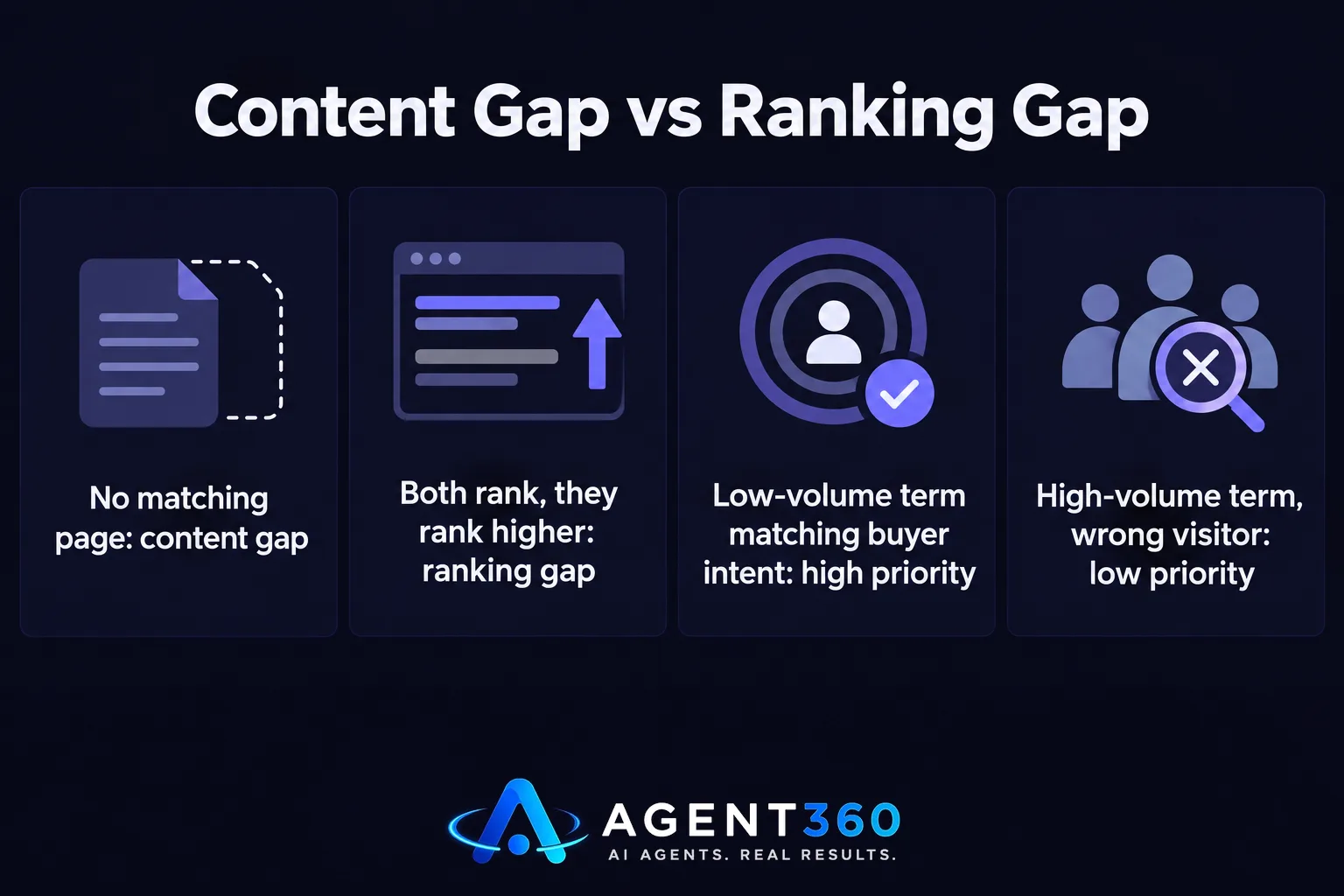
Cross-check that list against your own Google Search Console queries, including the ones where you're buried on page two or three. Anything a competitor ranks for on page one that doesn't show up anywhere in your Search Console data is a clean gap. Anything where you both appear, but they sit higher, is a ranking gap rather than a content gap. You likely already have a page for it — it just needs work, not a rewrite.
A dedicated competitor check does this on a schedule instead of once and done. SearchAgent's Competitor Agent reads the top ten for your tracked terms every week and shows who holds each spot, so the gap list updates itself instead of going stale a month after you pulled it. For a deeper walkthrough of the comparison step, see our competitor keyword gap analysis guide.
How to do a gap analysis step by step?
- List your own ranked terms. Pull every query from Search Console where you appear in the top 50, not just the top 10 — you need the near-misses too.
- Pick three to five real competitors. Use the sites that actually outrank you for your priority terms, not the market leader by revenue.
- Gather their ranking pages. Note the title, the heading, and the apparent target phrase for each page that competes with your category.
- Diff the two lists. Anything on their side with nothing matching on yours is a gap; anything where you're both present but they rank higher is a ranking problem, not a content problem.
- Bucket by intent. Separate informational gaps (blog-style) from transactional ones (service or pricing pages) — they need different page types, not the same article reskinned.
- Prioritize by fit, not just volume. A low-traffic term that matches exactly what your paying customers ask is worth more than a high-traffic term that brings the wrong visitor.
- Assign each gap to a page. One gap, one page — resist the urge to stuff three gaps into a single article, which usually produces a page that ranks for none of them.
Repeat the diff every few months — don't treat it as a one-time project. Competitors publish new pages, your rankings move, and a gap list from six months ago is just a photo of a market that's already changed.
Doing this by hand doesn't scale past a handful of terms
Manual gap analysis is fine for a one-time audit. It falls apart as a recurring habit, because competitor rankings move weekly and nobody wants to re-pull ten competitor sites every month by hand. SearchAgent runs that comparison continuously, turns the gaps it finds into page ideas through its content plan, and has its Writer Agent draft the pages once you approve them. Plans start at $297 a month, no contract, detailed on the pricing page.

Questions worth asking before you start
Is a keyword gap the same as a content gap? Not quite. A keyword gap is the missing or underperforming search term. A content gap is the missing page that would target it. Every content gap implies a keyword gap, but not every keyword gap needs a brand-new page — sometimes an existing page just needs the term added and strengthened.
How many competitors should I compare against? Three to five is enough for most businesses. Go higher and the list gets noisy with terms only one outlier competitor cares about. Go lower than three and you risk building your plan around one site's quirks instead of a real pattern.
Do I need a paid tool to find keyword gaps? No. Search Console plus a manual look at competitor pages gets you a usable first pass. A paid or automated tool just saves you from redoing that comparison by hand every month.
More articles
- How to Appear in AI Search Results, Step by Step
- How to Show Up in AI Search Results, Not Just Google
- Whitelabel GEO: What to Check Before You Sign a Vendor
- An AI Competitor Gap Analysis Agent: What to Expect
- How to Get Found on Google AI: What Actually Works
- How to Show Up in AI Overviews When Rivals Don't
- How Long Does SEO Take? The Honest Timeline
- The Local SEO Checklist That Actually Moves the Map Pack
