Competitor Keyword Gap Analysis: Find What You're Missing
Your competitor ranks for forty searches you don't even show up for. A gap analysis is just the method for finding which of those forty are worth chasing and which are junk. Compare the searches your competitors rank for against the searches you rank for, and the difference — the gap — becomes a list of pages you should write. That's the whole idea. The hard part isn't the concept. It's doing this without drowning in a 4,000-row spreadsheet that tells you nothing about which 15 rows matter this month.
Most people who search for this are stuck at one of two points. Either they don't know how to pull the comparison in the first place, or they've got the list and can't tell a real gap from noise. Both are fixable.
A real gap has three things, not one
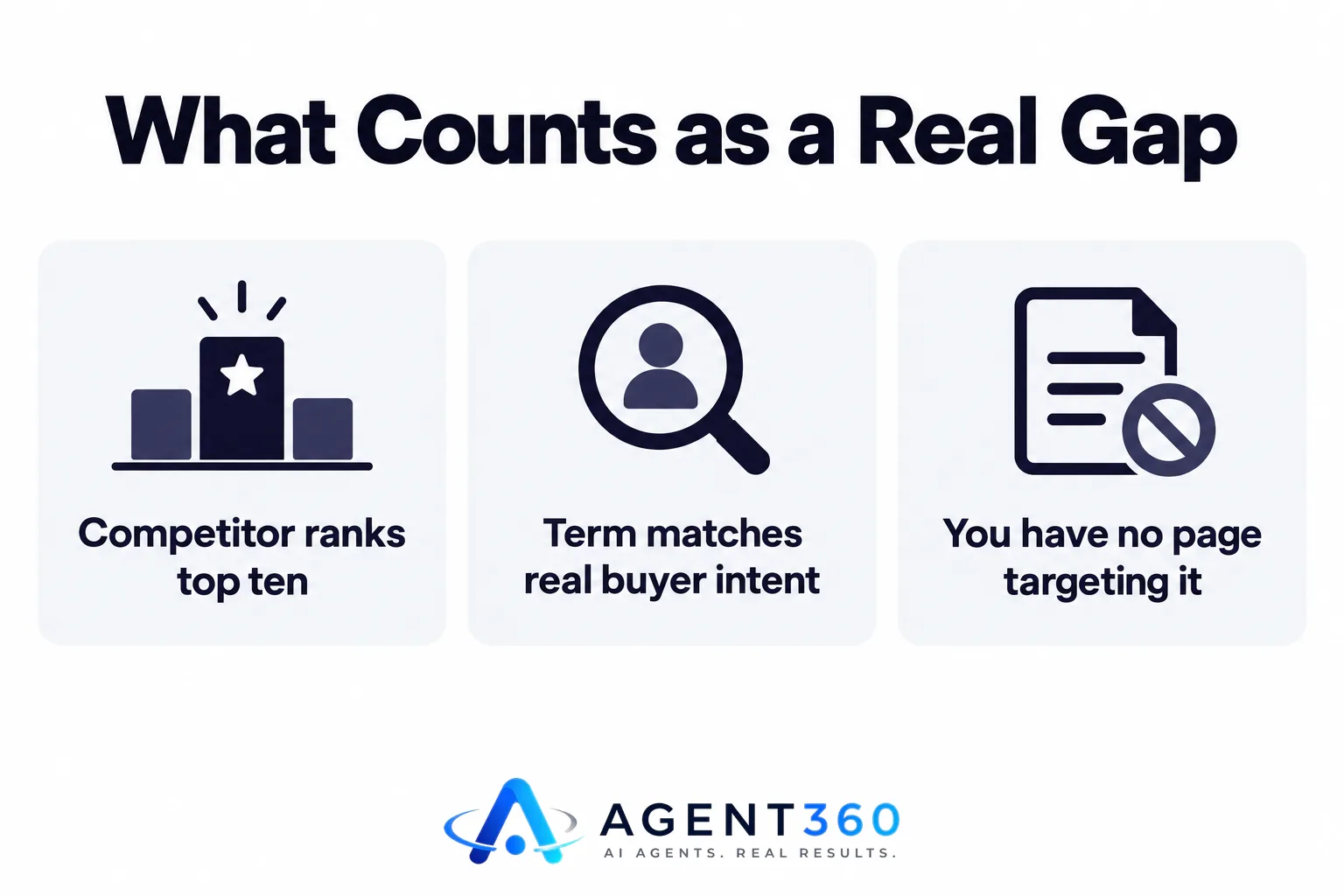
A row in a keyword gap report isn't automatically worth your time. Call it a real gap only when three conditions hold together: a competitor ranks in the top ten for it, the term matches something your buyers actually ask (not a brand name, not a term with no commercial intent), and you currently have no page that targets it. Drop any row missing one of those. In practice this cuts a raw export by 70 to 90 percent — most of what a tool spits out is noise: competitor brand terms, long-tail variants of a page you already have, or searches with no buying intent behind them.
Pull the list before you analyze anything
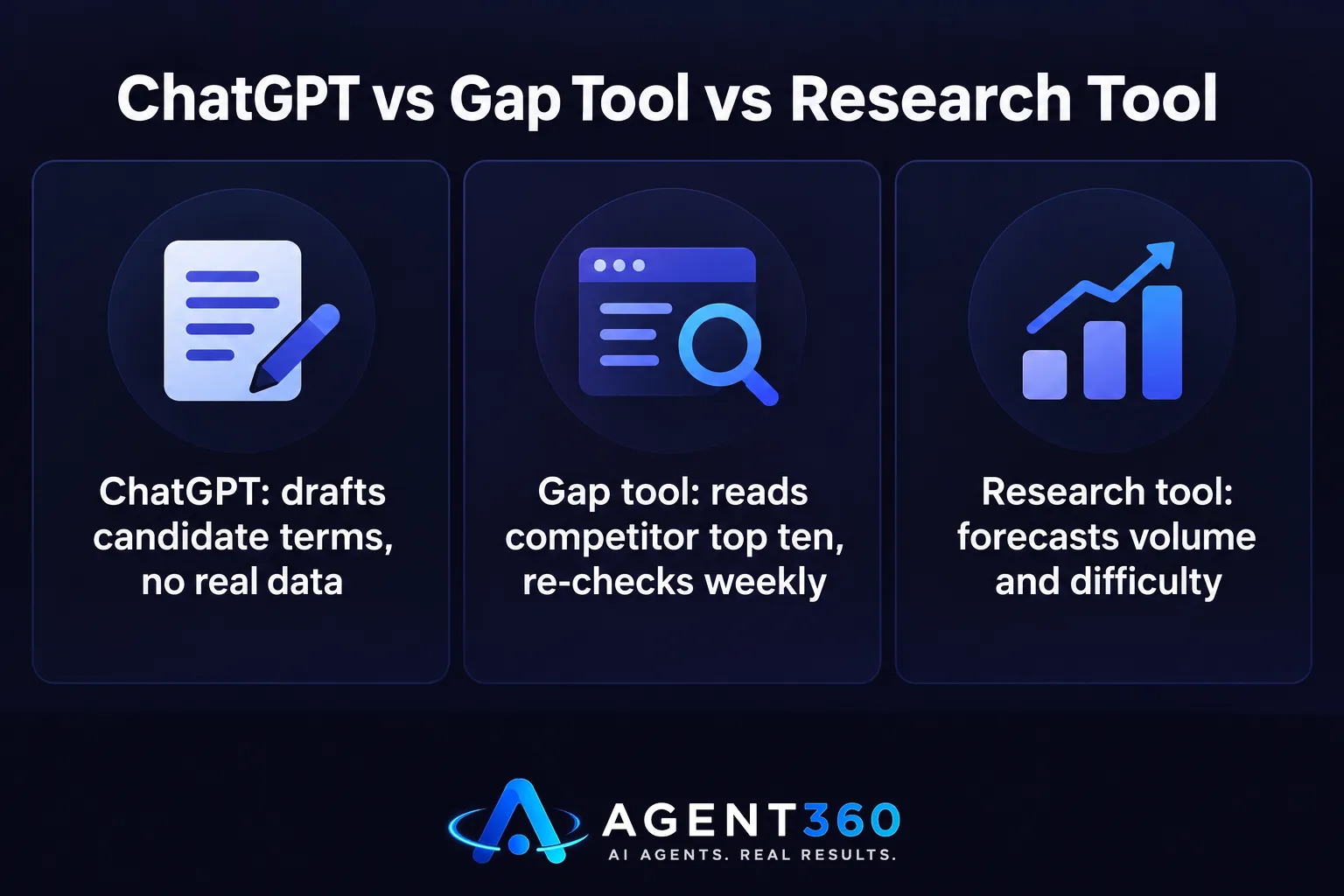
You need two inputs: your own ranking terms and your competitors' ranking terms, for the same market and the same date range. Your own list comes from Google Search Console — export the Queries report, filter to page one and page two, and you've got what you currently rank for. Getting a competitor's list is the part that requires a third-party tool, because you can't see their Search Console. A dedicated gap tool reads a competitor's top ten for a batch of terms and tells you who holds each spot; that's a different job from research tools that forecast volume and difficulty, and the trade-off is worth understanding before you pick one — see how that split plays out in a comparison of a research suite against a tool built to track gaps and publish against them.
How do you perform a keyword gap analysis, step by step
Pick two to four direct competitors — not aspirational ones three times your size, ones actually fighting you for the same buyers. Run each through a gap tool against your domain. Export the combined list. Filter using the three-condition test above. Then sort what's left by how close the term sits to a buying decision: a term like “pricing” or “vs [competitor]” or “near me” beats a broad educational term every time, because it converts faster even at lower volume. A tool that rechecks the top ten weekly matters here, because rankings move. A gap you found in January can close itself by March if a competitor's page slips, and you don't want to spend a week writing toward a gap that's already gone.
Can ChatGPT do a gap analysis?
It can draft one. It can't run one. Ask ChatGPT to list search terms a buyer in your category might use, and it'll produce a plausible-sounding set — but it has no access to your Search Console, no access to a competitor's actual rankings, and no way to confirm any of those terms exist as real searches at any volume. What it's good for is the opposite direction: once you have a confirmed gap, ask it to generate related phrasings and question variants a buyer might type. That widens your list before you check what Google and Bing actually suggest for those phrases. Treat its output as a hypothesis generator, never as the data.
Content gaps are not the same as keyword gaps
A keyword gap is a missing search term. A content gap is bigger: a whole topic, angle, or buyer question your competitor covers and you don't, even across several of their pages. You find these by reading a competitor's best-performing pages directly rather than their keyword list — look at their comparison pages, their pricing FAQ, their “for [industry]” pages. If three competitors all have a page comparing themselves to the market leader and you don't, that's a content gap a keyword tool alone won't surface, because no single term captures it. Fix content gaps before chasing the long tail of small keyword gaps. One comparison page usually closes more ground than ten thin articles aimed at low-intent terms.
One failure mode worth naming: writing a new page for a gap term when a page you already have is close enough that the new one just competes with it in search results instead of adding reach. Before publishing, check whether the gap term overlaps with an existing page's topic — two pages chasing the same search usually end up splitting the ranking rather than doubling it.
Where this breaks down without ongoing tracking
A gap analysis is a snapshot, not a record. Competitors publish new pages, Google reshuffles the top ten, and a gap list from last quarter is partly wrong by the time you've written three articles against it. The practical fix: treat competitor tracking as a standing job, not a one-time export. Something that re-pulls the top ten on a schedule and flags new gaps as they open, instead of a spreadsheet you build once and forget.
Where SearchAgent fits
SearchAgent's Competitor Agent reads Google's top ten for up to 30 of your terms — local to your town when it knows it — shows who holds each spot, and re-checks weekly, then feeds anything you're missing straight into a content plan a writer agent can draft against. Plans start at $297 a month, month to month, with no setup fee; see what's included at each tier or browse how the research side works if you'd rather build the list yourself first.

What is competitor gap analysis?
It's the practice of comparing the search terms a competitor ranks for against the terms you rank for, and turning the difference into a prioritized list of pages to write. The output is only useful once you filter it to terms with real buying intent and no existing page of yours already targeting them.
How to analyze competitor keywords?
Export your own ranking terms from Search Console, run two to four direct competitors through a gap tool against your domain, then filter the combined list to terms that are real buyer searches, where a competitor ranks top ten, and where you have no competing page. Sort what remains by purchase intent, not by volume alone.
Can ChatGPT do a gap analysis?
No — it has no access to your Search Console or a competitor's actual rankings, so it can't confirm real gaps. It's useful for generating candidate phrasings and question variants once you already have a confirmed gap to expand around.
How do you perform a keyword gap analysis?
Pull your own ranked terms, pull two to four competitors' ranked terms for the same market, combine the lists, and keep only the rows where a competitor ranks, the term reflects real buyer intent, and you have no page for it yet. Check back on the list every so often — competitor rankings shift, and gaps have a way of closing themselves.
More articles
- Google Search Console for Beginners: Where to Start
- Keyword Cannibalization Fix: Merge, Redirect, or Split
- Content Refresh SEO: What Actually Moves Rankings
- How Many Blog Posts a Week Does SEO Actually Need?
- SEO Agency Alternative: What Actually Replaces the Retainer
- SEO for Local Businesses: Win the Map, the List, and the Answer
- Automated SEO for Small Business: What to Automate First
- An AI Blog Writer Won't Rank You. Here's What Will
