Social Media Content for Small Business: The Rules That Work
Search ‘social media content for small business’ and you will land on three different rules — the 3-3-3, the 5-5-5, and the 5-3-1 — and none of them agree with each other. Here is the short version: they are the same idea dressed up three ways, and the idea matters more than the number. No single post should carry your whole marketing load. You need a mix of post types, not one more hack for picking hashtags.
What is the 3-3-3 rule for social media?
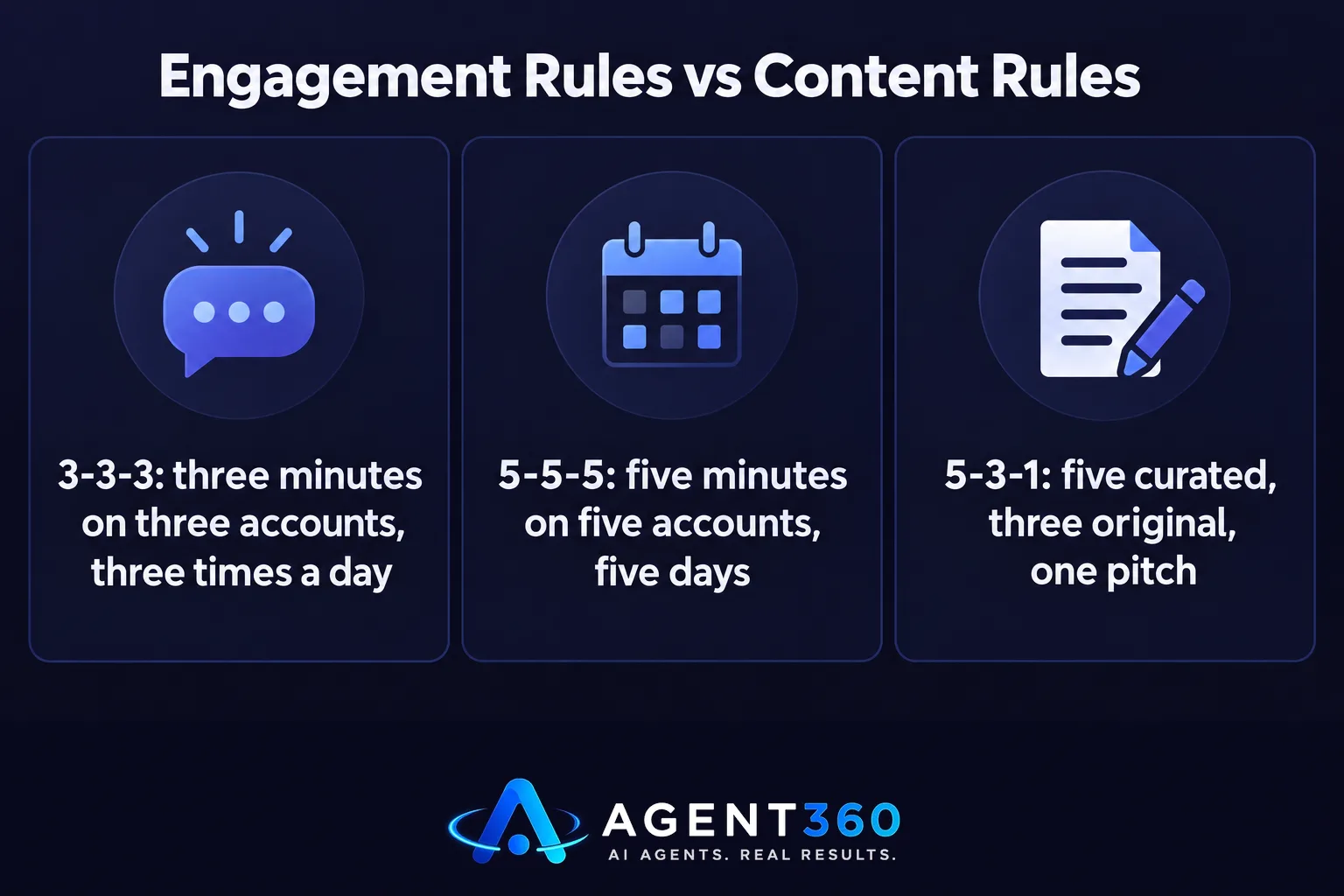
The 3-3-3 rule says to spend three minutes engaging with three accounts, three times a day — it is an engagement habit, not a content rule. People misquote it as a posting formula because the number is catchy, but the original idea is about showing up in other people's comments, not about what you publish. For a small business owner with forty other jobs, three sessions a day of manual engagement is not realistic. Skipping it will not hurt you nearly as much as skipping the actual content does.
The useful version for a business, not a personal brand chasing followers, is this: pick three accounts in your industry — a supplier, a competitor, a trade publication — and comment on one post from each, once a week. That is enough to stay visible without turning your week into unpaid community management.
What is the 5 5 5 rule for social media?
The 5-5-5 rule asks you to spend five minutes commenting on five accounts for five days. It is the 3-3-3 rule's cousin, built on the same mistaken idea that engagement time is what grows an account. For a founder or a two-person marketing team, this is a losing trade. Twenty-five minutes a day of commenting is more time than most small businesses spend planning what they actually post, and comments under other people's posts do not get indexed, do not build a portfolio, and disappear from your own profile the moment you stop.
If you have twenty-five spare minutes a week, put them into writing one real post instead. A post you own and control compounds — it shows up on your profile a year from now. A comment on someone else's post does not.
What is the 5-3-1 rule on social media?
This is the one actually about content, and it is worth following. For every nine posts, publish five pieces of other people's content with your take added, three pieces of your own original content, and one direct pitch for your product or service. The ratio forces a discipline most small businesses skip: it stops your feed from turning into a wall of offers, which is the fastest way to get a feed stop showing your posts to anyone who isn't already a customer.

The exact numbers matter less than the shape. Swap the ratio toward original-heavy if you do not have time to curate other people's work — most small businesses don't — but keep the constraint that direct asks stay a minority of what you post. The reasoning behind that split gets covered in more depth in the guide on value versus pitch, which is the same mechanism under a different name.
What are some good social media posts for small businesses?
Posts that answer a question a real customer has asked you, in person, more than once. That is the test. If three different customers have asked how your product compares to the cheaper alternative, that question is your next post, not a product photo. Beyond that, five categories cover almost everything a small business needs:

- A before-and-after of a job, project or result, with the numbers if you have them.
- A direct answer to a question you get asked in sales calls or at the counter.
- A short opinion on something happening in your industry, stated plainly, not hedged.
- A behind-the-scenes look at how the work actually gets done.
- A customer's own words, used with permission, with no polish added.
Rotate through these instead of treating every post as a fresh blank page. A content pillar system beats waiting for inspiration every time, because inspiration runs out by week three and pillars do not.
Pick a cadence before you pick a rule
None of these rules say how often to post, and that is the decision that actually determines whether a small business shows up consistently. Three solid posts a week, published on a fixed schedule, will beat a daily post that gets skipped every time something urgent comes up — and something urgent always comes up. Decide the days before you decide the ratio, put them on a calendar you can actually see next to your meetings, and treat a missed slot as a problem to fix, not a week to shrug off.
This is also where most small businesses quietly fail. The plan is fine; the execution isn't, because writing, designing and scheduling a post alone takes longer than it does with a system built for it. BrandAgent writes posts in your brand's voice from your website, draws a matching picture, and publishes on the schedule you set across LinkedIn, Instagram, YouTube and X — plans start at $97 a month, detailed on the pricing page, no contract attached.
Frequently asked questions
What is the 3-3-3 rule for social media?
It is an engagement habit — three minutes commenting on three accounts, three times a day — not a rule about what to post. Most small businesses get more value scaling it back and spending the time on original content instead.
What is the 5-5-5 rule for social media?
It is a variant of the 3-3-3 rule asking for five minutes on five accounts over five days. Like its cousin, it is about engagement time, not content strategy, and it rarely pays off for a business with limited hours to spend on social media.
What is the 5-3-1 rule on social media?
Out of every nine posts, five are curated content with your commentary added, three are original content, and one is a direct pitch. The exact numbers matter less than the constraint: keep direct pitches a minority of what you publish.
Which rule should a small business actually follow?
The 5-3-1 rule, because it governs content mix rather than manual engagement time. Pair it with a fixed posting cadence — covered in the guide to post formulas — and you have a system, not just a ratio.
More articles
- How Often to Post on LinkedIn: The Rules That Actually Matter
- Brand Voice AI: What It Means and What It Can’t Fake
- What an AI Short Video Maker Needs to Actually Work
- The Honest Guide to AI Video Generators for Social Media
- LinkedIn Ghostwriting: What It Really Costs and How It Works
- An AI Content Calendar Only Works With Rules Behind It
- Social Media Scheduling Tools Won't Fix Your Empty Calendar
- The AI LinkedIn Post Generator That Doesn't Sound Like AI
