Brand Voice AI: What It Means and What It Can’t Fake
Brand voice AI reads how a company actually writes — its word choices, sentence length, what it never says — and turns that pattern into new content that sounds like the same company wrote it. Not a voice in the audio sense. A style, encoded well enough that a draft can be produced without someone retyping the same rules into a prompt every time.
Worth clearing up first: the phrase gets used two completely different ways online, and the answers below split right along that line.
What is a brand voice example?
A brand voice example is a short piece of copy that could only plausibly belong to one company, because the word choice and rhythm are that specific. Mailchimp's old support copy was chatty and self-deprecating even when explaining an error. Slack's product copy uses short, almost spoken sentences and avoids corporate verbs like "leverage" or "utilize." A law firm's voice usually does the opposite on purpose — longer sentences, formal address, no contractions — because caution reads as competence in that category.
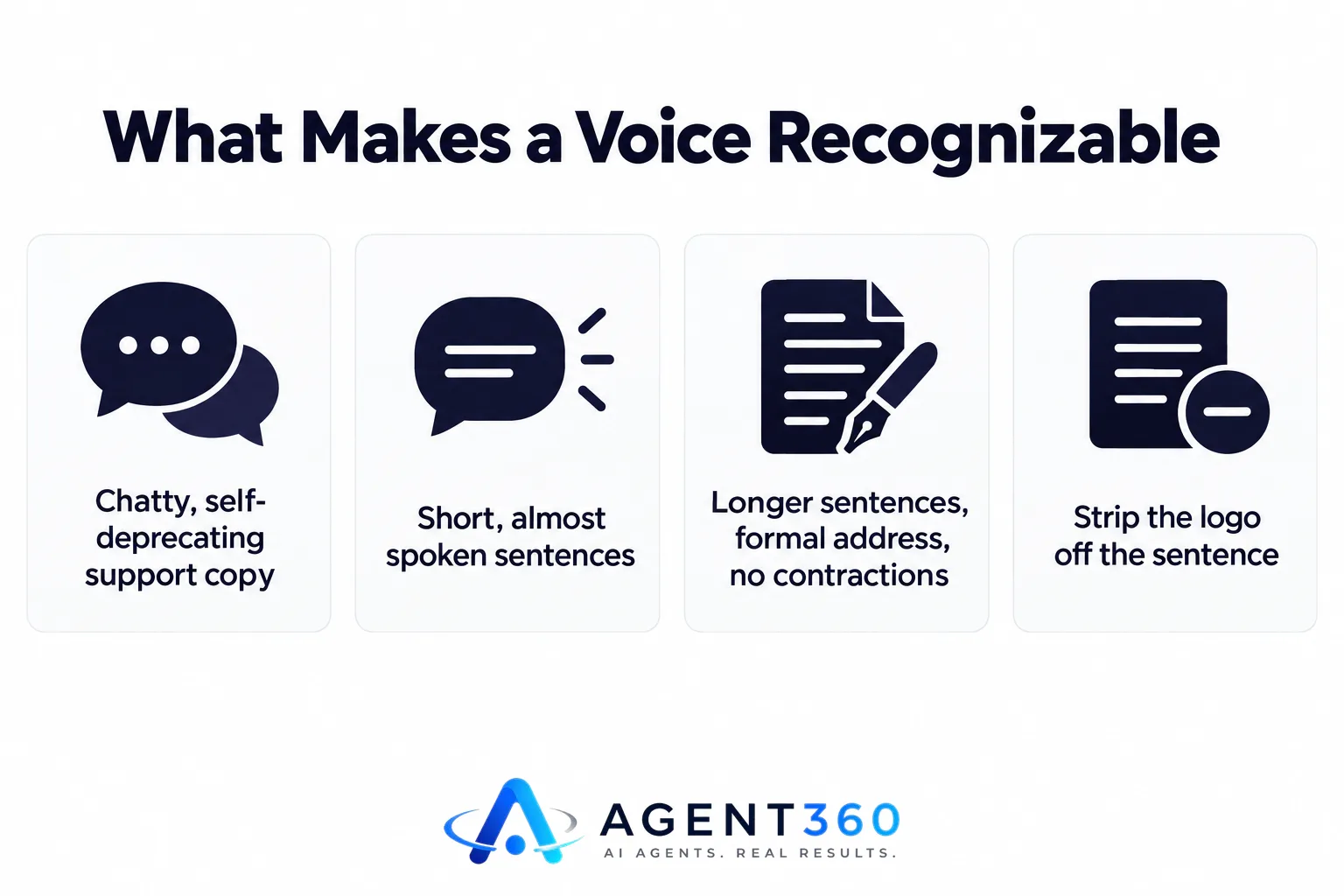
The test is simple: strip the logo off the sentence. If it could run on a competitor's page without anyone noticing, it isn't a brand voice example. It's just copy. Good brand voice AI gets judged the same way — against that test, not against whether the grammar checks out.
What is Apple's brand voice?
Short declarative sentences. Almost no adjectives. A refusal to explain the obvious. Apple states a benefit and stops. It avoids comparison with competitors by name, keeps technical jargon out of consumer copy, and uses the product name instead of pronouns more often than most brands would. The confidence comes from omission — what Apple's copy doesn't say is as deliberate as what it does.
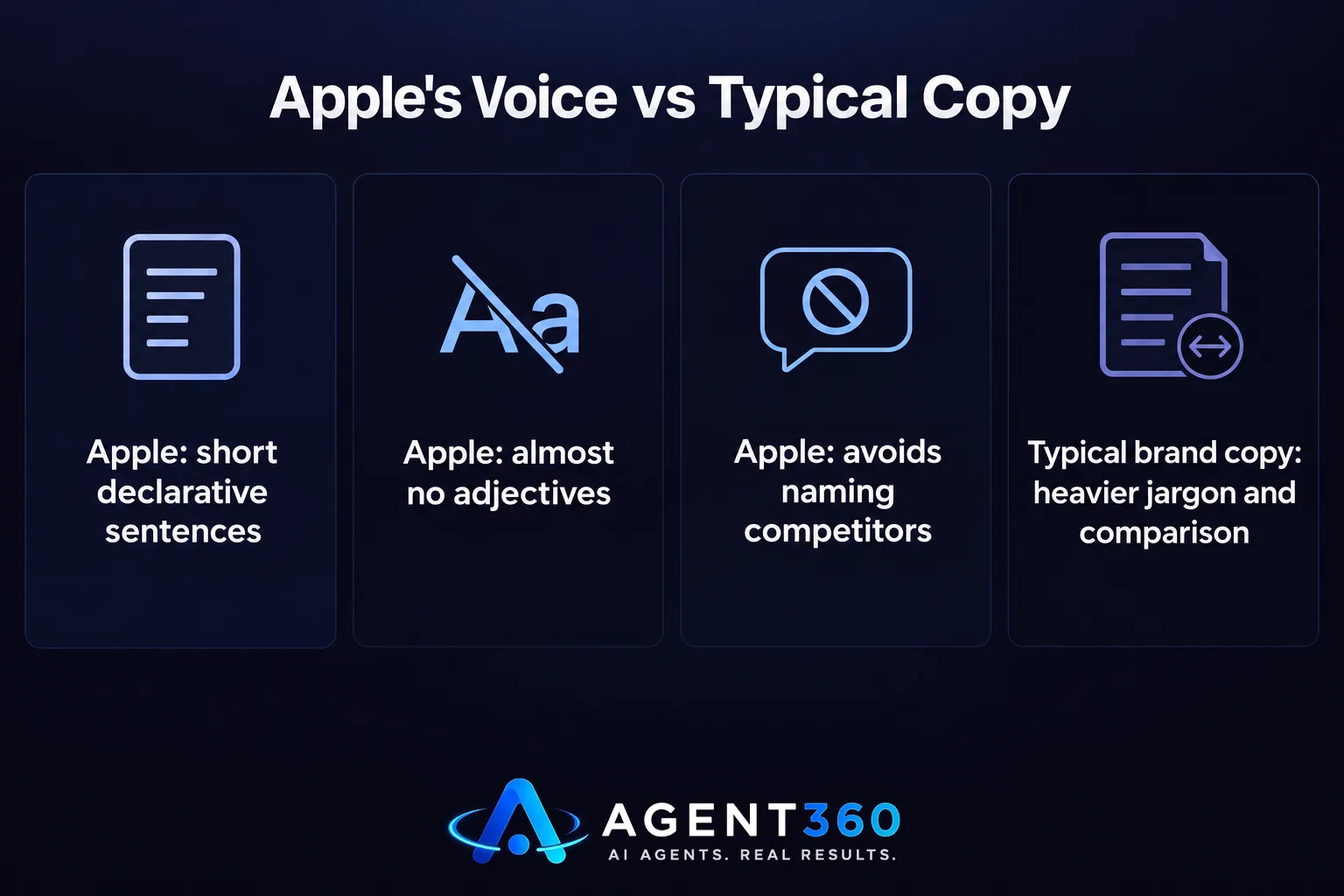
Apple gets cited as the benchmark because the pattern holds across two decades of product pages, keynote scripts and packaging — not because any single ad is clever. Consistency, not cleverness, is what brand voice AI is actually trying to reproduce: a pattern held across hundreds of posts, not one good line.
What is brandvoice?
"BrandVoice" with no space is Forbes's paid content program, where a company sponsors articles that run under Forbes's masthead with an advertising label. It has nothing to do with the style concept above — it's a media placement product, not a writing style. If a search brought you here looking for sponsored content on Forbes, that's a different animal from everything else in this article.
What is the most popular AI voice?
If the question means spoken AI voices — the kind used in audiobooks, ads or video narration — there's no single verified "most popular" one. The companies that make them (ElevenLabs, Amazon Polly, Google, and others) don't publish usage rankings, and preference swings hard by language and use case. What is true is the direction of travel: synthetic voices have closed the gap on human cadence so far that the deciding factor is now fit for the brand, not whether listeners can tell it's synthetic.
That's a separate question from brand voice AI in the writing sense, but the two meet in one place: a talking-head or presenter video still needs a voice, and that voice should match the same brand pattern as the written copy, or the video ends up feeling like it belongs to someone else.
A style guide only works if something enforces it on every draft
Most companies already have a brand voice written down somewhere — a one-pager with adjectives like "confident" and "approachable." The document was never the problem. The problem is that nobody checks the fortieth LinkedIn post against it the way they checked the first. Brand voice AI's real job is enforcement at volume: read the source material once, then apply the same constraints to post four hundred that it applied to post one, catching the generic sentence before it ships rather than after someone notices the brand has started sounding like everyone else's content.
Done well, this starts from source material the company already has — a website, a handful of existing posts, a style guide if one exists — rather than from a prompt someone writes from memory. A prompt drifts every time it gets rewritten. A kit built from the actual site doesn't.
Where BrandAgent fits
BrandAgent's Brand Kit reads a company's website once and learns its voice, tone, colours and logo, and every post, picture and video after that starts from that kit instead of a prompt typed fresh each time — the difference covered in more detail when comparing it to generic AI chat tools that have no memory of the brand between sessions. Plans start at $97 a month on the pricing page, and getting the mix of useful and promotional posts right from that kit is covered in the value vs pitch guide.

Common questions
Is brand voice AI the same as an AI voice generator?
No. Brand voice AI refers to written style — matching sentence structure and word choice to a brand. An AI voice generator produces spoken audio. They only overlap in presenter or narrated video, where the spoken voice needs to match the same brand pattern as the written copy.
Can brand voice AI work from just a style guide, with no website?
It can, but a style guide alone tends to produce generic output, because adjectives like "friendly" or "bold" don't specify sentence length or word choice. Actual published copy — a website, past posts — gives the system real patterns to match, which is why tools that read a live site tend to sound less generic than ones built from a prompt alone.
How do I know if AI-written content still sounds like my brand?
Run the same test used for a human-written example: remove the logo and name, and ask whether a competitor's content could pass for the same sentence. If yes, the voice hasn't been matched closely enough yet — no matter how clean the grammar is.
More articles
- How Often to Post on LinkedIn: The Rules That Actually Matter
- Social Media Content for Small Business: The Rules That Work
- What an AI Short Video Maker Needs to Actually Work
- The Honest Guide to AI Video Generators for Social Media
- LinkedIn Ghostwriting: What It Really Costs and How It Works
- An AI Content Calendar Only Works With Rules Behind It
- Social Media Scheduling Tools Won't Fix Your Empty Calendar
- The AI LinkedIn Post Generator That Doesn't Sound Like AI
