The AI LinkedIn Post Generator That Doesn't Sound Like AI

An AI LinkedIn post generator takes a topic, a few notes, or a link and turns it into a finished post — a hook, a body, a line that invites comments. Whether it actually works comes down to one thing: what the tool knows about you before it starts typing. Give it only a topic and it writes a post that could belong to anyone. Give it your website, your past posts, or an outline in your own words, and it writes something closer to you. That gap — not the model underneath — is why some AI posts sound robotic and others don't.
Yes, you can use AI to generate a LinkedIn post — plenty of people already do, and LinkedIn has no rule against it. The platform tracks engagement, not authorship. What it punishes indirectly is the thing AI makes easy to churn out in bulk: flat, interchangeable posts people scroll past without a pause. Do that long enough and your reach quietly tanks, no matter who or what wrote the words.
Generic prompts produce generic posts
Type “write a LinkedIn post about leadership” into any chat tool and you'll get three paragraphs that read like they were written for a stock photo. The failure isn't the model. It's the input. A prompt with no voice, no specifics, and no point of view gives the AI nothing to differentiate with, so it defaults to the safest, most average leadership post it has ever seen. That's the post everyone spots as AI-written on sight: the em-dashes, the “in today's world,” the three-part list that resolves into a platitude.
The fix isn't avoiding AI. It's feeding it something specific: your actual opinion, a number from your own work, a disagreement with the obvious take. A tool built around a brand kit pulled from your own website and prior writing starts every draft already loaded with your vocabulary and positioning, instead of guessing at a generic voice from a one-line prompt. That's the real gap between a chat tool that only drafts text and something built to write for one brand specifically.
What is the 3-2-1 rule on LinkedIn?
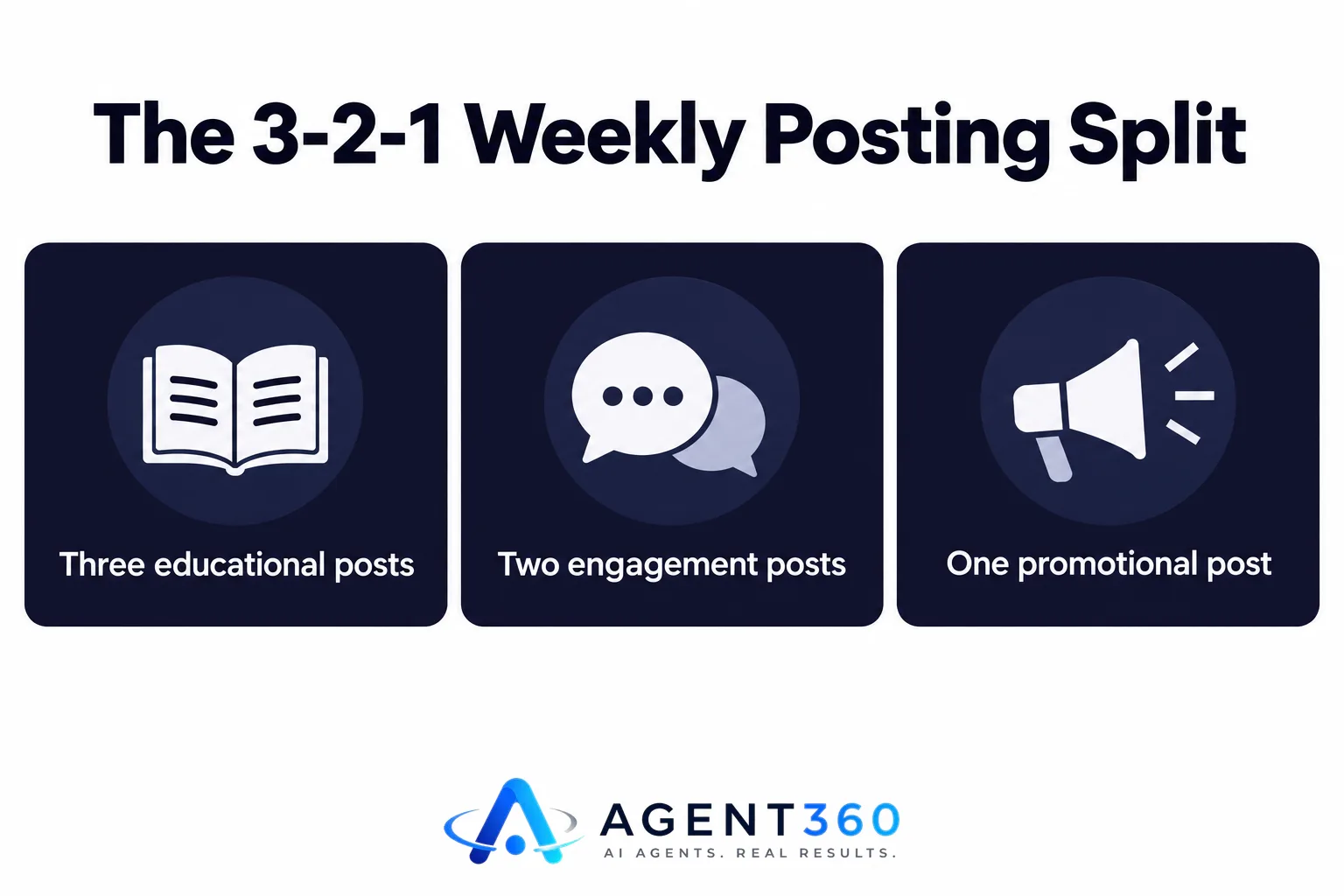
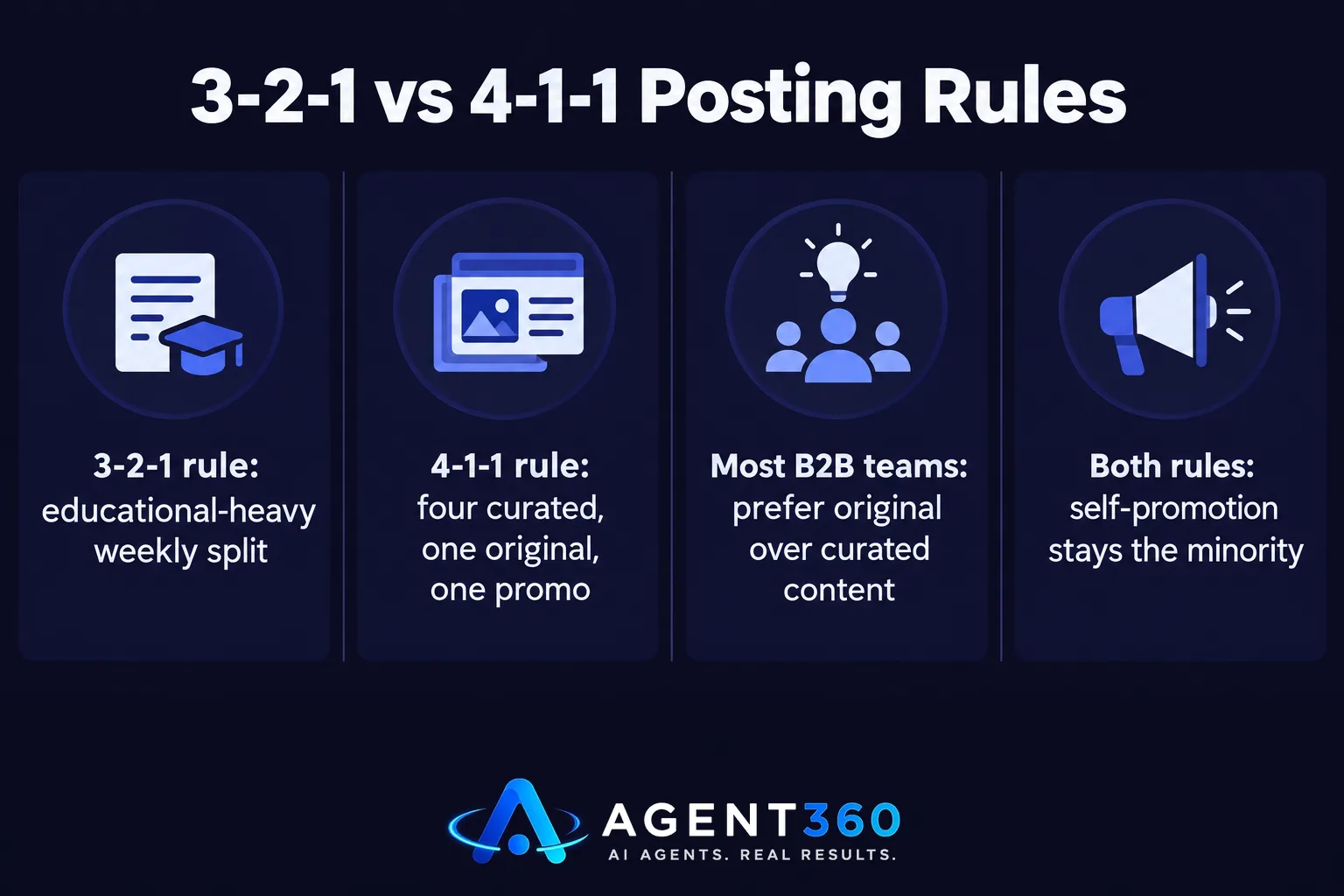
The 3-2-1 rule is a simple weekly split: three educational posts, two engagement posts (questions, polls, opinions), one promotional post. The logic: a feed of nothing but pitches trains people to scroll past you, and a feed of nothing but value gives them no reason to ever consider buying. Three-to-two-to-one keeps the weight on usefulness without disappearing as a vendor entirely. It's a weekly guideline, not a law — post daily, and you round to the nearest whole post instead of forcing fractions.
What is the 4-1-1 rule on LinkedIn?
The 4-1-1 rule, borrowed from Twitter-era content planning, says this: for every one self-promotional post, share four pieces of other people's or industry content and write one piece of your own original content. Few B2B teams follow it literally now — most would rather publish six original posts than curate four reposts — but the principle holds. Self-promotion should be the minority of what you publish, not the majority. Treat both rules as a ceiling on pitching rather than a formula to hit exactly. The gap between the rule and your actual calendar matters less than the direction it points you in.
Check what a generator actually knows before you trust its output
Before using any AI LinkedIn post generator, ask it three things: does it know my industry's actual vocabulary, has it read anything I've written before, and will it give me a different post for LinkedIn than for X. A tool that answers no to all three will hand you usable drafts that need heavy editing every time — which erases most of the time you were trying to save. A tool that answers yes to the first two still needs platform-specific formatting. A post written for LinkedIn's long-form, hook-first structure reads wrong pasted straight onto X or Instagram, where length, hashtags, and tone all work differently.
Worth checking, too: does the generator score or rewrite a weak draft on its own, or does every draft land in your lap regardless of quality? The second kind means you're doing the editing a tool should be doing.
Where BrandAgent fits
BrandAgent's Writer Agent drafts from a brand kit built from your own website — your voice, tone, and colours — and gives LinkedIn, Instagram, X and YouTube each their own version of a post, scoring and rewriting weak drafts before they ever reach you for approval. It also runs on ten proven post formulas instead of one generic prompt pattern, and nothing publishes without your sign-off. Plans start at $97 a month, month to month, no setup fee, no contract.

Questions
Which AI is best for creating LinkedIn posts?
There's no single best model. The quality gap comes almost entirely from what the tool knows before it writes, not which language model sits underneath. A tool that learns your voice, tone and positioning from your own site and writes a separate version per platform will beat a general chat assistant fed the same one-line prompt, every time.
Can I use AI to generate a LinkedIn post?
Yes. LinkedIn doesn't prohibit AI-assisted writing, and there's no detection penalty for using it. The risk isn't the tool — it's publishing flat, generic drafts at volume. That's what quietly cuts your reach, regardless of who or what wrote the post.
What's the fastest way to tell if an AI draft sounds like you?
Read it out loud and listen for a claim or opinion you'd actually defend in a meeting. Generic AI drafts hedge everything into agreeable mush. A post built from your own specifics will have at least one line someone could push back on — and that's the one line worth keeping even if you cut everything else.
More articles
- How Often to Post on LinkedIn: The Rules That Actually Matter
- Social Media Content for Small Business: The Rules That Work
- Brand Voice AI: What It Means and What It Can’t Fake
- What an AI Short Video Maker Needs to Actually Work
- The Honest Guide to AI Video Generators for Social Media
- LinkedIn Ghostwriting: What It Really Costs and How It Works
- An AI Content Calendar Only Works With Rules Behind It
- Social Media Scheduling Tools Won't Fix Your Empty Calendar
